
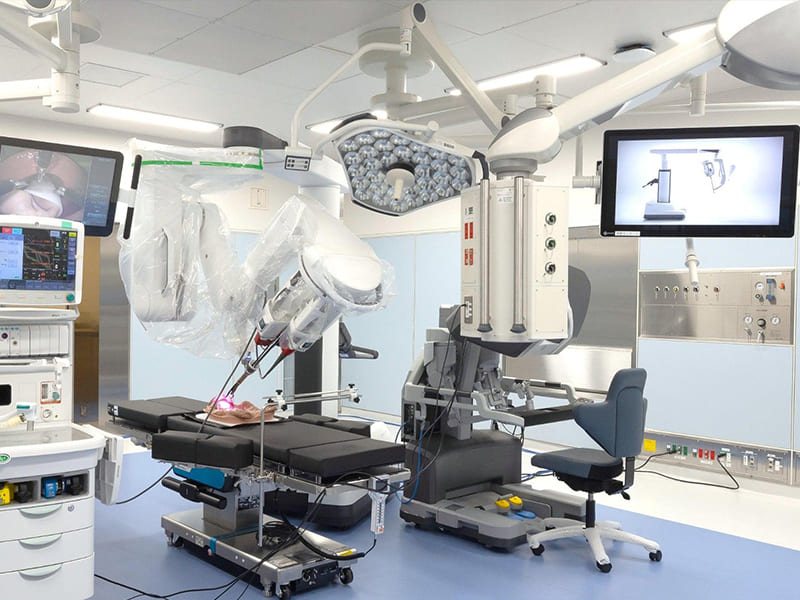
A surgical robot manufacturer discovers that bearing bores in joint housings are running 0.02 mm oversized across a production batch — within print tolerance but at the upper limit. The result: undersized bearing preload throughout the kinematic chain. Force feedback signal quality degrades measurably within 6 months as the reduced preload allows micro-motion at each joint. No single joint fails. The system passes all dimensional inspections. But surgeons report reduced “feel” during procedures — a clinical performance degradation that traces directly to a manufacturing dimension sitting at the wrong end of its tolerance band. We evaluate precision component requirements for medical robot programs regularly. In this engineering space, the connection between CNC machining quality and clinical performance is direct and measurable — a bore tolerance that’s technically conforming but functionally marginal produces a system that technically works but clinically underperforms.
Medical robots operate in direct proximity to patients during surgery, rehabilitation, and clinical care — making them fundamentally different from industrial robotics. This guide covers system types, the technologies that make them function, engineering challenges, regulatory requirements shaping hardware decisions, and what engineers and procurement teams need when sourcing precision components.
What Defines a Medical Robot?
Not an industrial robot with better surface finish. Three conditions simultaneously:
Clinical purpose — performs a medically intended function (surgical manipulation, rehabilitation, diagnostic positioning). Human-robot interaction — operates in continuous patient/clinician proximity requiring predictable motion and real-time feedback. Regulatory compliance — satisfies medical device regulations, risk management (ISO 14971), and manufacturing traceability (ISO 13485).
These constraints cascade into hardware decisions: what tolerances are achievable and maintainable through sterilization cycles, what materials survive autoclave without degradation, what surface finishes minimize wear particle generation near tissue.
Types of Medical Robots
Surgical Robots
The most technically demanding category. Multi-DOF kinematics replicating human dexterity in small surgical fields. Tool tip accuracy ±0.1–0.5 mm. Backlash-free transmissions. Structural stiffness preventing deflection under tissue resistance.
Manufacturing demands: Joint housings and transmission interfaces at IT5–IT7. Surface finish Ra 0.4–0.8 µm on bearing seats. Components surviving repeated 134°C autoclave without dimensional change or corrosion. This eliminates most aluminum alloys from sterile-field roles — pushing toward 316L stainless, titanium, and medical-grade polymers.
In 5-axis CNC operations for surgical components, compound-angle features and bore centerline relationships hold ±0.010–0.020 mm. Based on our production data, achieving this consistently requires in-process probing, thermal stabilization, and finish passes at 0.05–0.10 mm depth of cut.
Rehabilitation and Exoskeleton Robots
Extended physical contact during therapy sessions shifts priorities toward force control, ergonomic compliance, and session-to-session repeatability. An exoskeleton worn for 45-minute sessions must be light enough that its weight doesn’t limit therapy effectiveness.
Materials: Aluminum 6061-T6 or 7075-T6 for structural members where titanium’s cost premium isn’t justified. Smooth, burr-free patient-contact surfaces prevent skin irritation. Manufacturing challenge: maintaining tolerance consistency across multiple size variants for different patient anthropometrics — requires documented process capability, not one-off sampling.
Hospital Automation
Logistics robots, pharmacy systems, UV disinfection platforms. Generally lower positional precision but higher reliability and uptime demands. Modular serviceability (failed modules swappable in minutes). Contamination resistance. Quiet operation.
Pharmacy exception: High repeatability for dispensing accuracy with consequences approaching surgical risk levels. Consistent motion profiles and controlled bearing preload matter here.
Therapeutic and Telepresence
Patient interaction, remote consultation, behavioral therapy support. Emphasis on stable mobility, communication integration, and enclosure durability. Precision tolerances of surgical systems don’t apply, but consistent assembly quality and surface integrity matter for systems interacting with vulnerable populations.
How Medical Robots Work
Mechanical Structure
Multi-axis structures delivering accurate, repeatable motion. In serial 6-DOF arms, joint position error accumulates — 0.01 mm at joint 1 may produce 0.05–0.1 mm error at the end-effector. This amplification means bearing selection, housing bore tolerances, and assembly preload must be specified with the full kinematic chain in view.
Backlash-free transmission is standard in surgical systems. Harmonic drives require IT5–IT6 housing bores with Ra ≤ 0.4 µm — typically requiring grinding or honing after CNC turning. Cable-drive mechanisms eliminate gear hysteresis for the same reason.
Sensors and Control
Force/torque sensors, optical encoders, and vision systems feed closed-loop control that adjusts trajectories in real-time. A surgical robot’s force feedback — distinguishing tissue resistance levels — depends on sensor sensitivity and transmission stiffness. Bearing preload that degrades 15–20% over a year doesn’t immediately show as motion error, but it degrades force signal quality affecting the surgeon’s sensory information. One common pitfall we see: treating bearing preload as a static specification rather than a service-life parameter that needs monitoring.
Software and Autonomy
Most systems operate under supervised autonomy — the robot executes planned motions with continuous human oversight and clinician override authority. Full autonomy faces both regulatory and liability barriers. Motion planning algorithms must produce demonstrably predictable behavior, and fail-safe logic must be testable and documented for FDA or CE submission.
Engineering Challenges
| Challenge | Clinical Impact | Manufacturing Response |
|---|---|---|
| Precision + repeatability | Positioning error affects outcomes | Tight CNC tolerances, kinematic error mapping |
| Safety redundancy | Uncontrolled motion = patient risk | Dual-channel sensing, mechanical hard stops |
| Long-term stability | Performance drift compromises safety | Wear-resistant joints, controlled preload |
| Sterilization compatibility | Surface/dimensional degradation | 316L or Ti, electropolishing, autoclave qualification |
| Low-volume consistency | Batch variation = regulatory risk | Documented Cpk ≥1.33, full traceability |
Sterilization materials: Black oxide, zinc plating, and standard anodizing are typically unacceptable for sterile-field components. Electropolishing 316L to Ra ≤ 0.4 µm (often ≤0.2 µm for critical surfaces) provides corrosion resistance, cleanability, and surface integrity. Electropolishing removes 5–10 µm — critical dimensions must be machined to compensate.
Low-volume consistency is the most underestimated challenge. Surgical systems may ship 50–200 units/year. Maintaining tight capability at these volumes — without high-volume statistical averaging — requires genuine Cpk ≥1.33, not just inspection-based conformance.
Regulatory Framework
Design Constraints from Day One
FDA 510(k)/PMA, CE marking under EU MDR, and ISO 13485 aren’t certification milestones following development — they’re design constraints from the first architecture decision.
ISO 13485 requires documented design controls: manufacturing processes validated (not just parts), inspection methods demonstrated capable, and formal change control for any process modification. Informal iteration isn’t compatible with 13485 compliance.
FDA traceability: Design history file (DHF) and device history record (DHR) requirements mean every production unit needs documentation linking components to specifications, manufacturing records, and inspection data. Suppliers who can’t provide this consistently create regulatory exposure.
ISO 14971 risk management identifies unintended motion, joint failure, and wear particle contamination as significant hazards — driving redundant motion limits, conservative safety factors, and surface treatments minimizing particle generation.
Sourcing Precision Components
Why It’s a Technical Decision
Joint housings, transmission interfaces, bearing seats, and end-effector mounts are precision CNC parts where accuracy, surface quality, and traceability aren’t negotiable. A bore 0.025 mm oversized means a bearing running with clearance rather than preload — introducing positional noise and force feedback degradation over time.
Supplier Evaluation Criteria
Process capability over sample accuracy. A first-article with excellent results proves the part can be made once. Cpk ≥1.33 across production batches proves consistency — the only meaningful metric for medical robot procurement.
Surface finish matched to application. Bearing seats: Ra ≤ 0.4 µm (grinding or careful finish turning). Sterile-field components: Ra ≤ 0.2 µm after electropolishing — with pre-polish dimensions compensated for stock removal.
Full traceability. Heat number to certified MTR, process records per batch, inspection data available for audit. The minimum baseline for regulated medical device components.
Controlled process discipline. Suppliers working in AS9100 or ISO 13485 environments understand undocumented process changes aren’t acceptable. In our shop floor experience, shops without this background consistently struggle with the documentation discipline medical device customers require.
Small-batch capability. Programs producing 20–100 units/year across multiple component families. Suppliers maintaining documented capability at these volumes are harder to find than high-volume production shops.
Market Trends
Increasing autonomy within regulatory constraints. AI-driven motion planning must be explainable and testable, not just accurate. Validation burden for black-box algorithms in safety-critical systems is prohibitive under current frameworks.
Modular architecture. Standardized, swappable arm segments and end-effectors reuse validated components across variants — reducing regulatory submission effort and simplifying field service. From a manufacturing standpoint, modularity enables component standardization improving batch economics at low annual volumes.
Cost reduction and expanded deployment. Maturing processes and deeper supply chain experience drive costs down, enabling deployment to rehabilitation clinics and regional hospitals with different cost expectations. In projects we’ve delivered, scalability and supply chain robustness are becoming as strategically important as peak technical performance.
Conclusion
Medical robots are among the most demanding engineering systems built — not because any single technology is uniquely difficult, but because clinical performance, patient safety, regulatory compliance, and manufacturing consistency must all be achieved simultaneously at low volumes with zero tolerance for field failures.
The details that determine success aren’t the visible ones (kinematics, control architecture). They’re bore tolerances maintaining kinematic accuracy across batches, surface finishes surviving hundreds of sterilization cycles, and material traceability satisfying regulatory audit. For procurement teams, understanding these requirements separates a capable medical device supplier from a competent general machining shop. Need help sourcing precision CNC components for medical robot programs? [Contact our engineering team] for process capability evaluation, material guidance, and manufacturing support.
FAQ
Are medical robots fully autonomous?
No. Most operate under supervised autonomy — automated positioning and sequencing with human clinical decision-making. FDA and EU MDR requirements for predictable, transparent behavior make full patient-facing autonomy impractical with current validation methods.
How precise are surgical robots?
Positioning repeatability of ±0.1–0.5 mm at the tool tip — substantially better than the human hand for fine repetitive movements, without tremor. Robots extend a surgeon’s physical capability while the surgeon retains all procedural decisions.
What materials are used?
316L stainless steel for sterile-field structure (autoclave-compatible, electropolishable). Titanium Grade 5/23 where mass reduction is critical. Aluminum 6061-T6 for non-sterile structural members. Medical-grade polymers for patient-contact surfaces requiring biocompatibility.
How does CNC quality affect performance?
Directly. Bore accuracy determines bearing preload → affects positional repeatability and force feedback. Transmission tolerances affect backlash and kinematic error. Surface finish on bearing seats determines wear rate and particle generation. A batch of housings with bores 0.02 mm oversized degrades force feedback quality over time without any obvious failure event.
What certifications should component suppliers have?
ISO 13485 is baseline. AS9100 provides compatible precision process discipline. Beyond certification: documented Cpk data on critical dimensions, full material/process traceability, and experience operating under formal change control — because in medical device manufacturing, an undocumented process change is a regulatory event.


