
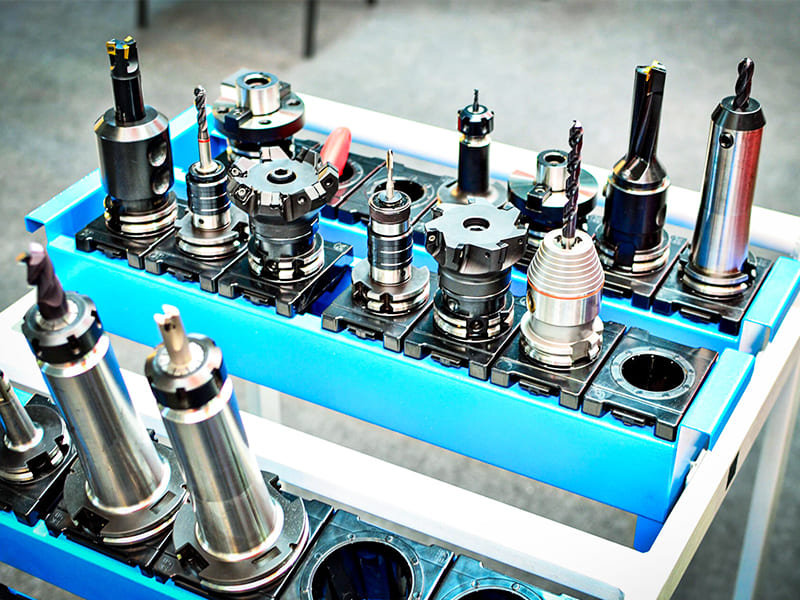
Quick Answer: Tooling in manufacturing refers to the molds, dies, fixtures, jigs, cutting tools, and inspection gauges used to shape, hold, cut, and verify parts so they can be produced consistently, accurately, and at scale. The core distinction is between machines (which provide force and motion) and tooling (which provides geometry and constraint — determining what shape the machine produces). Injection molds hold tolerances of ±0.020–0.050 mm across production runs of 100,000+ parts; a CNC fixture with a 0.050 mm positional error produces the same error on every part it holds. Tooling has high upfront cost but low per-part cost at scale: a $10,000 injection mold at 50,000 units adds $0.20/unit to cost, while CNC machining the same part at $6/unit costs $300,000 for the same volume. The tooling investment is justified when volume, design stability, and consistency requirements align — and it is the primary lever for reducing per-part cost in medium-to-high volume manufacturing.
What Tooling Actually Means in Manufacturing
A machine without tooling can move — but it cannot guarantee shape, dimension, or consistency. Tooling is the physical interface between the machine’s power and the part’s geometry.
Consider an injection molding machine: the machine provides the clamping force (typically 50–5,000 tons), heating, and injection pressure. But without a mold, it cannot produce any specific shape. The mold — the tooling — defines every feature of the part: wall thickness, surface texture, hole positions, thread geometries, and snap-fit profiles. The mold determines whether the part is an M4 connector housing or a automotive airbag bracket.
The same principle applies across manufacturing processes:
- A CNC machining center provides spindle rotation and axis movement; the fixture (tooling) holds the workpiece at the correct position and orientation so the tool engages the correct geometry
- A hydraulic press provides force; the stamping die (tooling) determines whether that force produces a flat washer, a complex bracket, or an automotive door panel
- A drilling machine provides rotation and feed; the drill jig (tooling) guides the drill bit to the exact hole location relative to the part’s datum features
The engineering definition: Tooling is any purpose-built device or tool that directly controls the geometry, position, or dimension of a manufactured part. This includes shaping tools (molds, dies), holding tools (fixtures, jigs), cutting tools (end mills, drill bits, turning inserts), and verification tools (go/no-go gauges, CMM fixtures, comparison gauges).
The Main Types of Manufacturing Tooling
| Tooling Type | Primary Function | Typical Tolerance Capability | Key Application |
|---|---|---|---|
| Injection molds | Form molten plastic into shape | ±0.020–0.050 mm | High-volume plastic parts |
| Die casting dies | Inject molten metal into shape | ±0.050–0.100 mm | Aluminum/zinc complex components |
| Stamping dies (progressive) | Cut and form sheet metal | ±0.050–0.100 mm | High-volume sheet metal parts |
| CNC fixtures | Hold workpiece at precise position | Position control ±0.010–0.050 mm | Precision machined components |
| Drill jigs | Guide drill bit to specified location | ±0.050–0.100 mm hole position | Volume drilling operations |
| Cutting tools (milling, turning) | Remove material to form geometry | Process-dependent (±0.005–0.050 mm) | All CNC machining operations |
| Go/No-Go gauges | Verify dimensional compliance | ±0.005–0.010 mm | Production quality control |
| CMM fixtures | Hold parts for coordinate measurement | Consistent datum reference | First article and SPC inspection |
Injection Molds
An injection mold is the tooling investment most commonly associated with manufacturing tooling decisions. The mold consists of a cavity block (negative of the part’s external geometry) and a core block (negative of internal geometry), with runner systems to distribute plastic, cooling channels to control part solidification, and ejector systems to remove the part after solidification.
Mold cost ranges widely: aluminum prototype molds for simple parts cost $2,000–$8,000 and have tool life of 1,000–50,000 shots; hardened steel production molds for complex parts cost $15,000–$150,000+ and have tool life of 500,000–1,000,000+ shots. The cost is driven by: mold steel grade and hardness, number of cavities (each cavity produces one part per cycle), part complexity (number of slides, lifters, and side-actions required for undercut geometry), and surface finish specification.
Stamping Dies
Progressive stamping dies perform multiple operations (blanking, forming, piercing, bending) in a single press stroke using a multi-station die. Sheet metal stock feeds progressively through the die, with each press stroke advancing the strip one step and performing the next operation. A progressive die producing a complex bracket might have 8–12 stations, with cycle times of 1–3 seconds per part.
Progressive die cost is typically $20,000–$100,000+ depending on complexity and number of stations. This investment is justified by the dramatic cycle time advantage: stamping at 20–60 parts per minute is approximately 100× faster than machining the same part, with per-part costs measured in cents rather than dollars.
Fixtures and Jigs
Fixtures hold the workpiece at a specific position and orientation relative to the machine’s cutting axis. The fixture defines the datum — the reference from which all the part’s dimensions are measured and produced. A well-designed fixture positions the part so that when the first cut is made, all subsequent cuts are in the correct relationship to each other without requiring re-measurement.
The tolerance stack-up impact of fixture quality: If a fixture positions a workpiece with a repeatable error of 0.050 mm, every part machined in that fixture carries that 0.050 mm positional error. This error is deterministic (the same error on every part) rather than random, but it affects the total tolerance budget available for the machining operation. For a part specification of ±0.025 mm, a fixture with 0.050 mm positioning error makes the specification unachievable regardless of machine accuracy.
Drill jigs specifically guide cutting tools to defined positions without requiring CMM-based setup for each part. A drill jig with hardened steel drill bushings guides the drill bit to the correct location and perpendicularity, enabling volume drilling operations without the setup time of fixture-and-indicate methods.
Prototype, Bridge, and Production Tooling: Matching Investment to Stage
Tooling should match the stage of a product’s development and production lifecycle. Using production-level tooling before design is stable wastes money; using prototype tooling beyond its appropriate volume wastes manufacturing cost.
| Factor | Prototype Tooling | Bridge Tooling | Production Tooling |
|---|---|---|---|
| Upfront cost | Low ($500–$5,000 for molds) | Medium ($3,000–$20,000) | High ($10,000–$150,000+) |
| Lead time | Fast (3–10 days) | Medium (2–6 weeks) | Long (6–16 weeks) |
| Tool life | Low (1–1,000 shots/cycles) | Medium (1,000–50,000) | High (100,000–1,000,000+) |
| Appropriate volume | Below 100–500 pcs | 500–10,000 pcs | Above 10,000 pcs |
| Design change cost | Low | Moderate | High ($2,000–$15,000+ per change) |
Prototype Tooling
Prototype tooling prioritizes speed and design flexibility over durability. Aluminum injection molds, soft steel dies, and 3D-printed tooling inserts fall in this category. The primary value is enabling real-material, production-process parts for design validation and functional testing — without committing to hardened production tooling before design issues are identified.
The cost of discovering a design flaw in a prototype mold is the cost of machining a new aluminum insert ($500–$2,000 and a few days). The same discovery in a production hardened steel mold costs $5,000–$20,000 and 2–6 weeks for the rework. Running through two or three design iterations in prototype tooling before transitioning to production tooling is almost always less expensive than discovering the same issues after locking into production tooling.
Bridge Tooling
Bridge tooling occupies the intermediate position: more durable than prototype tooling, but not the fully optimized multi-cavity high-volume tool of production. It serves the gap between design freeze and mass production tooling availability, typically supporting the first customer shipments, initial market validation, or the production ramp while production tooling is being built in parallel.
A common bridge tooling scenario: a product is ready for commercial launch, but the production mold at 4-cavity with full automation will take 16 weeks to build. A single-cavity bridge mold at lower production speed can support initial customer deliveries within 4–6 weeks, generating revenue and confirming market acceptance while the production tool is built.
Production Tooling
Production tooling is designed for the lowest cost per part at maximum volume, with minimum cycle time, maximum uptime, and the longest possible tool life. These tools typically use hardened tool steel (P20 at HRC 30–34, H13 at HRC 48–52, or S7 for impact-loaded tooling), advanced cooling channel layouts (conformal cooling via metal 3D printing for complex geometries), hot runner systems (eliminating runner material waste in injection molding), and automation integration.
The economics of production tooling: a 4-cavity injection mold producing 4 parts per 20-second cycle operates at 720 parts/hour. The same part produced on a CNC center might take 3 minutes per part — approximately 20 parts/hour per machine. Injection tooling at this production rate requires 36 fewer machine-hours per 1,000 parts, translating to direct cost savings of $1,800–$3,600 per 1,000 parts at typical machine rates.
Tooling vs CNC Machining: The Volume Break-Even Decision
The practical manufacturing decision between CNC machining (no tooling investment) and process tooling (mold, die, or dedicated fixture) is fundamentally an economic calculation based on production volume.
The break-even model for injection molding:
| Volume | CNC Machining ($8/part) | Injection Molding ($10,000 mold + $1/part) | Better Choice |
|---|---|---|---|
| 100 pcs | $800 total | $10,100 total | CNC machining |
| 1,000 pcs | $8,000 total | $11,000 total | CNC machining (marginal) |
| 5,000 pcs | $40,000 total | $15,000 total | Injection molding |
| 50,000 pcs | $400,000 total | $60,000 total | Injection molding |
The break-even in this example is approximately 1,400 parts. Below 1,400 parts, CNC machining is cheaper despite the higher per-part cost. Above 1,400 parts, the injection mold’s higher upfront cost is more than offset by the lower per-part cost.
The break-even point varies with part complexity, mold cost, per-part cost differential, and expected design change frequency. High mold cost (complex part, $30,000 mold) shifts the break-even toward higher volumes; large per-part cost differential (complex part where CNC takes 20 minutes) shifts the break-even toward lower volumes.
Key factors that shift the decision toward tooling earlier:
Tight tolerances that CNC alone cannot consistently maintain at production rates; assembly requirements that demand consistent inter-part variation well below ±0.050 mm; and production continuity requirements where supply chain stability matters (a mold and a known supplier provides more predictable supply than ad-hoc CNC machining).
Key factors that keep CNC machining appropriate even at higher volumes:
Very low annual production (below 500 parts/year where tooling amortization never reaches favorable unit economics); rapid product evolution (design changes every 6–12 months make tooling investment difficult to recover); and highly complex geometry where molds or dies cannot hold the required tolerance without cost-prohibitive tooling complexity.
How Tooling Quality Directly Affects Production Performance
Two manufacturers running the same injection molding machine with the same material and the same part specification can achieve dramatically different production performance based solely on mold quality. This is the most important practical consequence of tooling decisions.
Cycle time: A well-designed mold with optimized cooling channels (channel diameter, spacing, and proximity to part walls engineered for maximum heat extraction) cycles in 12–18 seconds for a typical 2 mm wall thickness part. A mold with poor cooling design or cooling channels too far from the cavity walls may cycle in 30–40 seconds for the same part. At 100,000 annual parts, the difference is 550–650 machine-hours per year — at $100/hour machine cost, $55,000–$65,000 in annual machine cost variance on cooling design alone.
Scrap rate: A mold with inadequate venting, unbalanced fill, or insufficient draft angles produces parts with flash, short shots, sink marks, or warpage. Scrap rates of 5–15% are common with poorly designed tooling; well-designed production tooling achieves scrap rates below 1–2%. At 100,000 parts per year with $2 material cost per part, the difference between 10% and 2% scrap is $16,000/year in material waste alone, before rework labor and machine time.
Dimensional consistency: A mold with correct shrinkage compensation, balanced fill, and adequate cooling produces parts with part-to-part variation well below the specification. A mold without these elements produces systematic dimensional variation that accumulates across the production run, driving periodic batch rejections, assembly non-conformances, and quality holds.
Common Tooling Mistakes That Increase Manufacturing Cost
Committing to production tooling before design freeze: Every engineering change to a hardened steel injection mold costs $2,000–$15,000 in steel machining and heat treatment time, and 2–6 weeks of lost production capability. A product that goes through three design iterations after production tooling is committed has effectively paid for two or three extra molds. The correct approach is to use prototype tooling to validate design, bridge tooling to support early production, and production tooling only when the design is frozen and validated.
Selecting tooling based on lowest initial quote: Low-cost molds and dies are typically built from softer steel, with less attention to cooling optimization, gate location, and parting surface quality. The consequences appear in production: shorter tool life (requiring earlier replacement), longer cycle times (from inadequate cooling), and higher scrap rates (from inconsistent fill or insufficient venting). Evaluating tooling cost on a total lifecycle basis — (tooling cost) + (cycle time × machine rate × volume) + (scrap rate × part cost × volume) — almost always favors higher initial tooling investment over lowest initial cost.
Ignoring DFM in tooling design: Features that are difficult for the tooling to reproduce — sharp internal corners (no draft), deep narrow recesses with limited steel support, wall thickness transitions that create differential shrinkage — directly increase tooling complexity and cost and reduce part quality consistency. Adding 1–2° of draft to molded walls, replacing sharp corners with minimum radius transitions (R0.5–1.0 mm), and designing wall thickness variations within ±20% of nominal directly simplify tooling while improving part quality.
Treating tooling maintenance as optional: Production tooling is a capital asset with wear rate and maintenance requirements. Injection mold parting surfaces, gate inserts, and ejector pins wear with each cycle. Stamping die clearances change with use. Ignoring maintenance intervals produces progressively worsening part quality — flash grows as parting surfaces wear, dimensions drift as clearances increase — until a preventable quality failure forces emergency tooling repair at maximum disruption cost. Defining maintenance intervals (every 50,000–100,000 shots for injection molds, depending on material and part complexity) and stocking critical spare components prevents this pattern.
Key Takeaways
- Tooling is the interface between machine capability and part geometry: machines provide force, motion, and power; tooling defines what shape is produced, at what tolerance, and with what consistency.
- The three tooling stages — prototype, bridge, production — serve different purposes and should be selected based on design stability and production volume: committing to production tooling before design freeze is the single most common source of avoidable tooling cost.
- The volume break-even between CNC machining and process tooling is the central manufacturing economics decision: for injection-moldable plastic parts, this typically occurs between 1,000 and 5,000 parts depending on mold cost and per-part cost differential.
- Tooling quality directly determines cycle time, scrap rate, and dimensional consistency: two manufacturers with identical machines and materials can achieve 2× cycle time difference and 5–10× scrap rate difference based solely on mold or die design quality.
- Total lifecycle cost — not initial tooling price — is the correct basis for tooling investment decisions: lower initial cost often means shorter tool life, longer cycle times, and higher scrap, which frequently cost more over the production run than the initial price difference.
- DFM input to tooling design reduces both tooling cost and production scrap: draft angles on molded walls (1–3°), minimum internal radii, and consistent wall thickness are the three most impactful DFM parameters for injection mold tooling cost and quality.
- For OEM procurement teams: tooling ownership, storage responsibility, and maintenance obligation should be explicitly documented in supplier agreements before production begins. Customer-owned tooling (buyer pays for tooling, supplier stores and uses it) provides supply chain leverage but requires clear documentation of tool condition, maintenance history, and relocation rights if the supply relationship changes.
Frequently Asked Questions
What is tooling in manufacturing?
Tooling in manufacturing is the collective term for molds, dies, fixtures, jigs, cutting tools, and gauges used to produce parts consistently and accurately. The distinction from machines is that machines provide the force and motion, while tooling provides the geometry and constraint — it defines what shape is produced. An injection mold defines every feature of a plastic part; a CNC fixture defines the datum from which all machining dimensions are measured; a go/no-go gauge defines the acceptance boundary for a tolerance specification. Without tooling, a machine can move but cannot guarantee that it produces the correct shape. With appropriate tooling, the machine produces consistent, accurately dimensioned parts across a production run.
What is the difference between prototype tooling, bridge tooling, and production tooling?
Prototype tooling is low-cost, fast-to-build tooling (typically aluminum molds or soft steel dies) for design validation and small quantities — typically 1–1,000 parts. It prioritizes speed and modifiability over durability. Bridge tooling has intermediate durability and cost, supporting early production of 1,000–50,000 parts while full production tooling is built. Production tooling is hardened steel tooling designed for 100,000–1,000,000+ cycle life, optimized for minimum cycle time, and designed for integration with automated production. The correct tooling stage matches the product’s development status: prototype tooling when design is evolving, bridge tooling during market launch and ramp, and production tooling when design is stable and volume justifies the investment.
When is tooling more cost-effective than CNC machining?
Tooling becomes more cost-effective than CNC machining when the cumulative tooling investment divided across the production volume is less than the per-part cost savings it enables. For a typical injection-moldable plastic part with CNC cost of $8/part and injection molding cost of $1/part after a $10,000 mold, the break-even is approximately 1,400 parts. Above this volume, injection molding is less expensive in total; below this volume, CNC machining is less expensive. The break-even shifts based on mold cost, per-part cost differential, and expected design change frequency. High-complexity parts with large per-part cost savings reach break-even at lower volumes; low-complexity parts with small per-part savings require higher volumes to justify tooling.
Why does tooling quality affect production output so significantly?
Tooling quality affects production through three mechanisms. First, cycle time: a well-cooled injection mold cycles in 12–18 seconds while a poorly cooled mold cycles in 30–40 seconds for the same part — a 2× throughput difference worth tens of thousands of dollars per year in machine cost at typical volumes. Second, scrap rate: properly designed tooling with correct venting, fill balance, and draft angles achieves less than 2% scrap; poorly designed tooling produces 5–15% scrap from flash, short shots, and warpage. Third, dimensional consistency: tooling that correctly compensates for material shrinkage, thermal expansion, and fill dynamics produces parts with consistent dimensions; tooling that does not produces systematic dimensional drift that drives periodic batch rejections.
Who owns the tooling after it’s built?
Tooling ownership depends on the agreement between the buyer and the supplier. In customer-owned tooling arrangements, the buyer pays for tooling as a separate line item, retains legal ownership, and has the right to move the tool to a different supplier or retrieve it. In supplier-owned tooling arrangements, the supplier builds and owns the tooling, recovering the cost through part pricing over the production run. Customer-owned tooling provides supply chain flexibility and leverage but requires explicit documentation of tool condition, maintenance responsibility, insurance, and relocation procedures. Before starting a tooling program, buyers should confirm: who pays for tooling, who owns it, who is responsible for maintenance and repair costs, how tool condition is documented, and what happens to the tool if the supply relationship ends.
Written by the CMS engineering team with 15+ years of precision CNC machining experience, including coordination of injection mold tooling, stamping die programs, CNC fixture engineering, and inspection gauging for automotive, aerospace, medical device, consumer electronics, and industrial OEM manufacturing programs. Technical references: Rosato D.V. — Injection Molding Handbook (Tooling and Mold Design), Kalpakjian S. and Schmid S.R. — Manufacturing Engineering and Technology (Tooling and Fixturing chapters), SME Fundamentals of Tool Design, ASM Handbook Vol. 14B (Metalworking: Sheet Forming — Progressive Dies).
Need Support with Tooling Strategy for Your Manufacturing Program?
At CMS, we provide tooling specification guidance at the quoting stage — including prototype vs production tooling recommendations, DFM review for moldability and fixture design, and coordination with tooling suppliers to align tool investment with production volume targets.
[Request a tooling strategy review and manufacturing quote →]


