
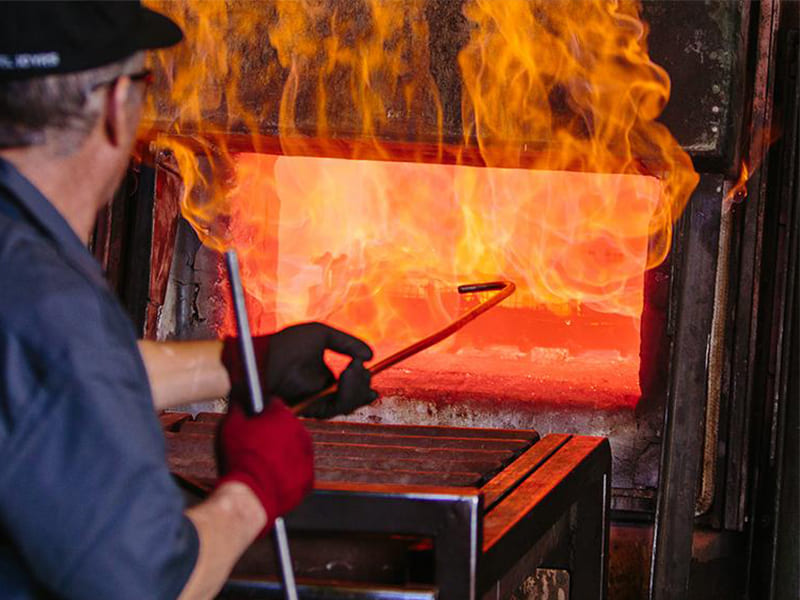
Every CNC shop has dealt with this scenario: a batch of cold-drawn steel bar stock arrives, machines erratically, burns through inserts, and produces parts that warp after roughing. The root cause isn’t bad tooling or wrong feeds — it’s residual stress and work hardening locked into the material from upstream processing. The fix is annealing.
So what is annealing, and why does it matter for manufacturing? Annealing is a controlled heat treatment that heats material to a specific temperature, holds it there, and cools it slowly to reset internal structure. It reduces residual stress, restores ductility, and stabilizes dimensions — making downstream machining, forming, and assembly far more predictable. This guide covers the metallurgical principles, the step-by-step process, common annealing types, material-specific effects, comparisons with other heat treatments, and practical applications in CNC and industrial manufacturing.
What Is Annealing in Materials Science?
Formal Definition
Annealing is a heat treatment process defined by three controlled stages: heating a material to a specified temperature range, holding (soaking) at that temperature, and then cooling — typically slowly. This “heat → hold → slow cool” sequence isn’t arbitrary. Each stage serves a metallurgical purpose.
Heating activates atomic mobility inside the crystal lattice. Holding allows internal changes — dislocation rearrangement, grain nucleation, compositional leveling — to progress uniformly through the cross-section. Slow cooling prevents the reintroduction of thermal stress. Together, these stages reduce residual stress, restore ductility, and stabilize the material for whatever comes next.
How Annealing Differs from Simple Heating
Plenty of manufacturing processes involve heat — welding, forming, even aggressive machining. However, random thermal exposure doesn’t qualify as annealing. The distinction is control.
In annealing, temperature targets are selected relative to the material’s recrystallization threshold or phase behavior. Soak time ensures uniform microstructural change throughout the part volume. Cooling rate determines whether the benefits hold. Faster cooling would lock in stress or create unwanted phases — pushing the outcome toward hardening rather than softening.
From a machining standpoint, this matters because annealing is a property-control process. Specifying “annealed condition” on a drawing means a defined microstructural state, not just “it got hot at some point.”
Why Does Annealing Change Material Properties?
Atomic Diffusion and Dislocations
Cold work, welding, and rapid solidification create high densities of dislocations — line defects in the crystal lattice that resist further deformation. As a result, these defects increase hardness and strength while reducing ductility. That’s why cold-drawn bar stock machines differently than annealed stock of the same alloy.
When you heat the material into the annealing range, atoms gain enough mobility to rearrange. Dislocations annihilate, reorganize into lower-energy configurations, or get absorbed at grain boundaries. As dislocation density drops, so does internal resistance to deformation. Consequently, hardness falls, ductility rises, and the material becomes easier to form and machine.
Thermodynamic Driving Forces
The underlying physics is straightforward: systems move toward lower energy states when given the opportunity. Cold work, rapid cooling, and welding all store energy as lattice strain and defects. Annealing supplies the thermal energy needed to release that stored energy through recovery, recrystallization, and — if taken too far — grain growth.
During the soak period, grain boundaries straighten, compositional gradients level out, and defect populations decline. Slow cooling preserves this stabilized structure. In practice, this explains why annealed materials machine more consistently, deform more predictably, and warp less after roughing cuts.
How Does the Annealing Process Work Step by Step?
Heating: Reaching the Target Temperature
The process starts by heating the material to a carefully selected annealing temperature — typically at or above the recrystallization point for metals. This threshold varies by alloy and prior deformation history. For instance, low-carbon steel (1018/1020) anneals at roughly 850–900°C, while 6061 aluminum requires only 340–415°C. Ti-6Al-4V sits around 700–785°C for stress relief annealing.
More importantly, precise temperature control matters. Too low, and microstructural changes stall before completion. Too high, and excessive grain growth or surface oxidation degrades the part. Based on our production data, a ±10°C deviation from target on thin cold-worked sheet stock can shift results from proper recrystallization into uncontrolled grain coarsening.
Holding: Time-Dependent Microstructural Changes
Once at temperature, the material soaks for a defined period. Time is as important as temperature here — recovery and recrystallization progress with duration, not just thermal energy. Adequate soak time ensures uniform changes through thick cross-sections.
However, over-holding introduces risk. Prolonged exposure at temperature drives excessive grain growth, which reduces strength and degrades fatigue performance. In our shop floor experience, we typically calculate soak time at roughly 1 hour per 25 mm of cross-section thickness for steels — then validate with hardness testing on sample pieces before committing full batches.
Cooling: Why Slow Cooling Matters
Cooling largely determines whether the annealing benefits stick. Slow cooling — often inside the furnace with the door closed — lets atoms settle into stable, low-energy arrangements. This minimizes thermal gradients, suppresses new residual stress, and preserves the softened grain structure.
Conversely, rapid cooling can undo the work. It reintroduces thermal stress, locks in non-equilibrium phases, and creates the very problems annealing was supposed to solve. For manufacturing workflows, controlled cooling ensures predictable behavior in subsequent machining or forming operations.
The Three Metallurgical Stages of Annealing
Annealing doesn’t change properties all at once. Instead, it progresses through three stages — recovery, recrystallization, and grain growth — each with distinct mechanisms and engineering consequences.
Recovery: Stress Relief Without Grain Change
Recovery occurs at the lower end of the annealing range. The overall grain structure stays intact, but dislocations rearrange and partially annihilate. Internal strain energy drops. Hardness may decrease slightly. Dimensional stability improves.
From an engineering standpoint, recovery alone is often sufficient when the goal is stress relief — for example, after welding or rough CNC machining — without significantly altering strength or grain size.
Recrystallization: New Grain Formation
As temperature climbs past the recrystallization threshold, new strain-free grains nucleate and replace the deformed grains from cold work. This stage produces the most dramatic property changes: dislocation density drops sharply, hardness and yield strength decrease, and ductility increases significantly.
For manufacturing, recrystallization is the stage that “resets” the material. It restores workability for further forming or machining. One common pitfall we see is customers requesting annealing without specifying which stage they need — recovery-level stress relief and full recrystallization produce very different material conditions at very different costs.
Grain Growth: When Annealing Goes Too Far
If annealing continues at high temperature or for excessive time, grains keep growing as boundaries migrate to reduce total boundary energy. While this lowers internal energy further, it introduces real engineering problems. Specifically, coarse grains reduce strength, toughness, and fatigue resistance. Surface finish quality during machining also suffers.
In most applications, grain growth is avoided rather than targeted. Effective annealing means stopping at the right stage.
Stage Comparison
| Annealing Stage | Microstructural Change | Property Impact | Typical Use |
|---|---|---|---|
| Recovery | Stress reduction, dislocation rearrangement | Slight softening | Stress relief |
| Recrystallization | New strain-free grains form | Major ductility gain | Process reset |
| Grain growth | Grain coarsening | Strength loss | Usually undesirable |
Main Types of Annealing Processes
Annealing isn’t one-size-fits-all. Different types target different outcomes, and selecting the wrong one wastes time and money — or worse, produces the wrong material condition.
Full (Complete) Annealing
Full annealing heats steel above its critical transformation temperature, holds for complete austenitization, and cools slowly inside the furnace. The result is a coarse, equilibrium ferrite-pearlite microstructure with low hardness and high ductility. This process is standard when castings or heavily worked steels need a complete reset before machining or forming.
Process Annealing (Recrystallization Annealing)
Process annealing is the workhorse intermediate heat treatment in sheet metal, wire, and strip production. Temperature targets sit below the full transformation range but above the recrystallization point. This restores ductility without fully softening the material — allowing additional forming steps while maintaining dimensional control. In practice, cold-rolled sheet that’s lost all formability after 40–50% reduction gets process-annealed to continue drawing or bending.
Stress Relief Annealing
Stress relief annealing operates at relatively low temperatures — below the recrystallization threshold. Microstructural changes are minimal. Strength and hardness stay largely unchanged. However, residual stresses drop significantly, improving dimensional stability and reducing the risk of distortion or cracking during service or subsequent machining.
In projects we’ve delivered, adding a stress relief cycle between rough and finish CNC machining on 4140 steel housings cut dimensional drift by roughly 60% on critical bore tolerances.
Other Specialized Types
Spheroidizing annealing converts lamellar carbides in high-carbon steels into spherical particles. This dramatically improves machinability and formability — essential for steels above ~0.6% C that would otherwise be too hard to cut efficiently.
Isothermal annealing holds material at a constant transformation temperature for a more uniform microstructure and predictable properties. It’s often used to shorten cycle time compared with conventional full annealing.
Comparison Table
| Annealing Type | Primary Purpose | Temp Level | Typical Effect |
|---|---|---|---|
| Full annealing | Maximum softening | High | Lowest hardness, high ductility |
| Process annealing | Restore ductility mid-process | Medium | Recrystallization without full softening |
| Stress relief | Reduce residual stress | Low | Stress reduction, minimal property change |
| Spheroidizing | Improve machinability | Medium–high | Soft carbides, improved formability |
| Isothermal | Uniform properties | Controlled hold | Consistent microstructure |
How Annealing Affects Different Materials
Annealing doesn’t produce the same results across every material. Crystal structure, alloying elements, and prior processing history all shift the outcome.
Steel and Alloy Steels
In carbon steels, full annealing produces a soft ferrite-pearlite structure with significantly reduced hardness. For alloy steels (4140, 4340, 8620), controlled annealing homogenizes composition and relieves stresses from forging or casting. From a machining standpoint, annealed steels cut more predictably, generate less tool wear, and show reduced distortion during CNC operations. Based on our production data, switching from hot-rolled to annealed 4140 bar stock reduced insert consumption by roughly 25% on a recent housing program.
Aluminum, Copper, and Brass
In contrast, non-ferrous metals don’t undergo the same phase transformations as steel. In aluminum, annealing drives recovery and recrystallization — cold-worked 6061 softens rapidly once recrystallization begins at around 340°C, restoring ductility for further forming. Over-annealing causes grain growth that degrades strength and surface quality.
Copper responds similarly — annealing sharply increases ductility while reducing hardness. For electrical components, annealing also restores conductivity by reducing dislocation density. Brass benefits from annealing between forming steps, though zinc content makes it more sensitive to temperature and grain growth.
Glass and Plastics
Annealing isn’t limited to metals. Glass annealing relieves internal stresses from cooling, preventing cracking and improving optical uniformity. Plastic annealing reduces molded-in stresses, improving dimensional stability and stress-crack resistance — though structural changes are far less dramatic than in metals.
Annealing vs. Other Heat Treatments
All heat treatments involve controlled heating, but engineering intent and outcomes differ fundamentally. Confusing these processes leads to wrong material conditions on the shop floor.
Annealing vs. Normalizing
Both processes heat steel to elevated temperatures. The difference is cooling rate. Annealing uses slow furnace cooling to maximize softening and stress relief. Normalizing cools in still air, which refines grain size and produces higher strength with more uniform microstructure.
Choose annealing when machinability and formability are priorities. Choose normalizing when balanced strength and uniformity matter before service or further heat treatment.
Annealing vs. Tempering
Tempering is not a softening process. It follows hardening (quenching) to reduce brittleness while retaining strength. Annealing does the opposite — it intentionally lowers strength to restore ductility and remove work hardening. In practical terms, annealing “resets” the material. Tempering “fine-tunes” a hardened condition.
Annealing vs. Stress Relieving
Meanwhile, stress relieving operates at lower temperatures than full annealing and doesn’t trigger recrystallization. It narrows its focus to reducing residual stress without changing strength or grain structure. Annealing goes further — causing recovery, recrystallization, and substantial changes in hardness and ductility.
Use stress relieving to stabilize dimensions. Use annealing to change material behavior.
Heat Treatment Comparison
| Process | Primary Goal | Cooling Method | Recrystallization? | Outcome |
|---|---|---|---|---|
| Annealing | Maximum ductility, stress relief | Very slow (furnace) | Yes | Soft, stable structure |
| Normalizing | Uniform strength, grain refinement | Air cooling | Partial | Stronger than annealed |
| Tempering | Toughness after hardening | Controlled | No | Strength-toughness balance |
| Stress relieving | Reduce residual stress | Slow | No | Dimensional stability |
Where Annealing Fits in CNC and Industrial Manufacturing
Before CNC Machining
Annealing before machining softens cast, forged, or cold-worked stock to improve machinability. Lower hardness means lower cutting forces, more consistent chip formation, less tool wear, and better surface finish. For steels and work-hardened aluminum alloys, skipping pre-machining annealing often leads to chatter, poor surface quality, and dimensional drift during cutting.
Additionally, pre-machining annealing improves dimensional stability. Residual stress released unevenly during roughing causes parts to move — sometimes enough to push critical features out of tolerance. In our shop floor experience, annealing 17-4 PH stainless stock before rough machining reduced rejection rates on a recent aerospace bracket program from 12% to under 2%.
After Welding and Forming
Welding creates heat-affected zones with uneven stress distributions. Forming introduces work hardening. As a result, post-process annealing relieves residual stress, restores ductility, and reduces the likelihood of cracking or warping. For welded assemblies, it homogenizes mechanical properties across the joint. For bent or deep-drawn parts, it recovers ductility lost to work hardening.
In Production Workflows
Many production environments position annealing as a repeatable intermediate step: Forming → Annealing → Secondary Forming or Machining. This approach lets manufacturers push forming limits while maintaining material control. In batch production, standardized annealing schedules balance cycle time, energy cost, and property consistency across large part runs.
Practical Considerations and Limitations
Temperature Control and Process Accuracy
Annealing outcomes depend heavily on temperature accuracy and uniformity. Even a ±15°C deviation can shift thin, cold-worked parts from proper recrystallization into uncontrolled grain growth. Specifying annealing with temperature ranges — not just nominal values — is essential. For critical parts, thermocouple verification at multiple zones inside the furnace provides the documentation needed to satisfy AS9100 or NADCAP audit requirements.
Furnace Selection
Furnace choice directly affects surface quality, cost, and consistency. Box furnaces handle general-purpose batch annealing but offer limited atmosphere control. Controlled-atmosphere furnaces reduce oxidation and decarburization — important for steels and copper alloys. Vacuum furnaces deliver the highest surface cleanliness and dimensional stability but carry significantly higher operating costs. As a result, selecting the wrong furnace type leads to surface scaling, material loss, or added post-process finishing steps.
Cost and Cycle Time Realities
Annealing is time- and energy-intensive by nature. Slow heating and cooling increase cycle time and affect throughput — especially for large or thick components. Furnace capacity can constrain part size or force batch splitting in production. From a manufacturing perspective, annealing must be justified as a value-adding step. The benefits — better machinability, fewer rejects, tighter dimensional control — need to outweigh the cost of heat treatment, handling, and added lead time.
Key Engineering Takeaways
Annealing is a fundamental tool for controlling material microstructure and properties — not merely a heating step. By enabling recovery, recrystallization, and controlled stabilization, it resets material behavior after deformation, welding, casting, or prior processing. Its engineering value shows up as improved machinability, dimensional stability, and process reliability. Annealed materials cut more consistently, distort less during CNC operations, and deliver more predictable mechanical performance across production batches.
Equally important, annealing demands correct specification. Temperature range, hold time, cooling rate, and annealing type must match the material and the manufacturing goal. If your next project involves parts where material condition affects machining quality or dimensional stability, [contact our engineering team] to discuss heat treatment specification, alloy selection, and process sequencing for your application.
FAQ: Common Questions About Annealing
What is the main purpose of annealing?
Annealing controls and stabilizes material properties by modifying internal microstructure. In practice, it relieves residual stress, restores ductility after cold work, improves machinability, and ensures consistent behavior during further manufacturing or service. For CNC machining specifically, annealing before cutting often reduces tool wear by 20–30% and significantly improves dimensional stability on complex parts.
Does annealing always soften a material?
Not necessarily. Softening extent depends on the annealing type and temperature. Stress relief annealing mainly reduces residual stress with minimal hardness change. Significant softening occurs only when recrystallization takes place — which requires heating past the material’s recrystallization threshold. Specifying the right annealing type for the right goal avoids both over-softening and under-treating.
How do engineers determine annealing temperature?
Annealing temperature depends on material type, alloy composition, and prior processing. Engineers reference recrystallization temperature ranges, phase diagrams (for steels), and specifications like AMS 2750 (pyrometry) and AMS 2759 (heat treatment of steel parts). The target must be high enough to activate atomic diffusion but low enough to avoid melting, phase instability, or excessive grain growth.
Can annealing improve CNC machinability?
Yes — often dramatically. Annealing lowers cutting forces, reduces tool wear, and minimizes part distortion during machining. This is why cast, forged, or cold-worked materials are commonly annealed before precision CNC operations. In our experience, the machinability improvement on work-hardened alloy steels justifies the added heat treatment step on nearly every production program.
What happens if annealing is done incorrectly?
Incorrect annealing creates new problems. Insufficient temperature or time leaves residual stress and uneven properties intact. Excessive temperature or hold time causes grain growth, strength loss, and surface oxidation. Poor cooling control reintroduces thermal stress. The result is parts that machine unpredictably, fail inspection, or distort in service. Proper parameter selection and furnace process control are essential — not optional.


