
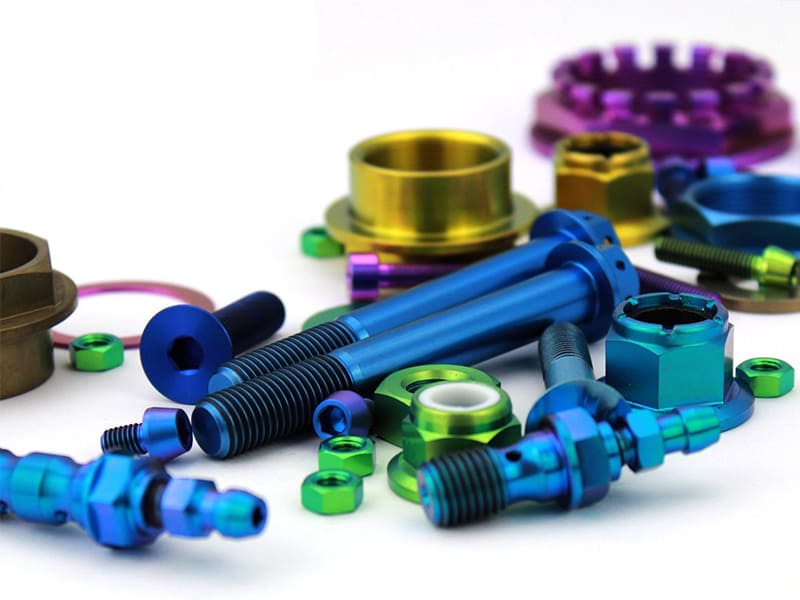
A medical device manufacturer color-codes surgical instrument sizes using anodized titanium — blue for small, purple for medium, gold for large. After 6 months of autoclave sterilization cycles, the colors remain vivid and stable. A competitor using painted stainless steel instruments sees color peeling within weeks of clinical use, requiring replacement. The difference: titanium’s anodized color is generated by the oxide layer itself (thin-film optical interference), not surface coating — it cannot peel, flake, or delaminate because there is no coating to separate from the substrate. We specify titanium anodizing for both functional identification and aesthetic finishing on medical and consumer product programs. Titanium is naturally silver-gray — a muted metallic tone slightly darker than stainless steel. Through anodizing, it transforms into virtually any color (blue, purple, gold, green) without paint or dye — the color is physics, not pigment, and it’s as durable as the oxide layer that creates it.
This guide covers titanium’s natural appearance, the physics behind color change, the anodized color chart by voltage, anodizing types (functional vs decorative), comparison with stainless steel, how surface finish affects color, applications of colored titanium, durability and wear behavior, and DFM tips for consistent results.
Natural Color of Titanium
Titanium’s natural color is silver-gray with a slightly darker, more muted tone than stainless steel or aluminum. The surface appears less reflective — more “soft” and refined rather than mirror-bright.
This appearance comes from titanium’s native oxide layer — a thin TiO₂ (titanium dioxide) film that forms instantly upon air exposure. This passive layer provides corrosion resistance while giving the surface its characteristic subtle gray hue.
| Material | Natural Color | Reflectivity |
|---|---|---|
| Titanium | Silver-gray (muted) | Lower, matte feel |
| Stainless Steel | Bright silver-white | Higher, mirror-capable |
| Aluminum | Light silvery-white | Medium, reflective |
Surface finish changes perception significantly. As-machined titanium shows tool marks with directional texture. Sandblasted creates a uniform matte gray. Polished produces a brighter, more reflective surface — but still less mirror-like than polished stainless steel. Based on our production data, approximately 60% of our titanium CNC parts ship in as-machined or bead-blasted finish — the natural matte gray provides a clean, professional appearance without additional processing cost.
Why Titanium Changes Color
Titanium’s color change through anodizing is a physical optics phenomenon — not a chemical coloring process.
The Mechanism
During anodizing, controlled voltage grows the TiO₂ oxide layer to a specific thickness (typically 20–150 nm). When white light hits this transparent oxide film, it reflects from both the top surface and the oxide-metal interface below. These two reflected waves interfere — constructively amplifying certain wavelengths (colors) while destructively canceling others. The result: the eye sees a specific color determined entirely by oxide thickness.
Key distinction: The color is structural (generated by physics of light interference), not pigment-based. There is no dye, paint, or coating material involved. This means the color cannot peel, flake, or delaminate — it’s literally part of the surface.
Color Control
Voltage directly controls oxide thickness → thickness determines color. Lower voltage → thinner oxide → bronze/gold tones. Higher voltage → thicker oxide → blue/purple/green tones. Surface finish affects color intensity: polished surfaces produce vivid, saturated colors while matte surfaces produce softer, diffused tones.
Anodized Color Chart
| Voltage Range | Approximate Color |
|---|---|
| 10–20V | Bronze / light brown |
| 20–40V | Purple / violet |
| 40–60V | Blue |
| 60–80V | Green / teal |
| 80–100V | Yellow / gold |
Reading the chart: Voltage = oxide thickness = color. The progression is predictable but not perfectly linear — small voltage changes (±2V) can produce noticeable color shifts. Surface condition strongly influences the final visual result at any given voltage.
Important limitations: Colors are angle-dependent (interference effect — viewing angle slightly shifts perceived hue). No true black or red through standard anodizing (these require PVD coating or thermal oxidation). Color consistency between batches requires tight voltage control (±1–2V) and uniform surface preparation. One common pitfall we see: assuming identical voltage produces identical color across different surface finishes — polished and bead-blasted parts anodized at the same voltage look noticeably different because light interacts differently with smooth versus rough surfaces.
Anodizing Types
| Type | Appearance | Purpose |
|---|---|---|
| Type II | Gray / dull metallic | Wear resistance, surface protection |
| Type III | Colorful (blue, purple, gold) | Aesthetics, identification, corrosion |
Type II (functional): Produces a thin, dense oxide optimized for wear resistance and surface durability. Appearance is gray or slightly darkened — no vivid color. Standard for aerospace components, medical implants, and industrial parts where function matters more than appearance.
Type III (decorative/color): Precisely controls oxide thickness using voltage to generate interference colors. Focus on visual differentiation, branding, or identification coding. Common in consumer products, surgical instrument color-coding, and premium industrial components.
Selection logic: Durability and wear → Type II. Color, aesthetics, or visual coding → Type III. Same base material, different process parameters → fundamentally different results.
Titanium vs Stainless Steel Color
| Attribute | Titanium | Stainless Steel |
|---|---|---|
| Base color | Darker silver-gray | Brighter silver-white |
| Reflectivity | Lower, matte | Higher, mirror-capable |
| Color capability | Anodized (structural color) | Requires PVD/paint coating |
| Color durability | Integral to oxide (no peeling) | Coating may delaminate |
The critical difference: titanium generates color through its native oxide layer — no external coating needed. Stainless steel cannot produce colors through anodizing — it requires applied coatings (PVD, paint, powder coat) that can wear, chip, or delaminate over time. For applications where colored metal surface must survive harsh environments (sterilization, chemicals, outdoor exposure), titanium’s integral color has a fundamental durability advantage.
How Surface Finish Affects Color
| Finish | Appearance | After Anodizing |
|---|---|---|
| Polished (mirror) | Bright, reflective | Vivid, saturated colors |
| Sandblasted (matte) | Soft, uniform gray | Muted, diffused colors |
| As-machined | Directional texture | Non-uniform, streaked color |
Polished surfaces reflect light in a controlled way — producing clear, vivid anodized colors. Sandblasted surfaces scatter light — creating softer, less intense but more uniform-looking colors. As-machined surfaces have directional tool marks that cause uneven light reflection — anodized color may appear streaked or patchy without post-machining surface preparation.
Practical rule: For consistent anodized color, standardize surface finish before anodizing. Mixing different surface preparations in the same anodizing batch produces visible color variation even at identical voltage. In our shop floor experience, pre-anodizing bead blast at consistent pressure produces the most repeatable color results for production batches — better than polishing (which is harder to standardize across operators) and far better than as-machined (which always produces inconsistent color).
Applications of Colored Titanium
Medical (Identification + Biocompatibility)
Color-coded surgical instruments — sizes, types, and functions identified by anodized color. Withstands autoclave sterilization. Biocompatible TiO₂ surface. Reduces human error in fast-paced clinical settings.
Aerospace (Marking + Durability)
Part identification, routing markers, and inspection status indicators. Lightweight material + durable color that won’t flake under vibration. No coating delamination risk in service environments.
Consumer Products (Aesthetics + Wear)
Watches, phone housings, eyewear frames, EDC tools. Distinctive premium appearance (blue, purple, gold). Color integrated into surface — better wear behavior than paint. Maintains corrosion resistance while enhancing design.
Industrial (Functional Coding)
Valves, fittings, heat exchangers. Visual differentiation of components or flow systems. Stable in many chemical environments.
Does Titanium Color Fade or Wear Off?
Fading: No. The color comes from oxide layer physics (light interference), not pigment. No dye to degrade under UV. No paint to discolor. Colors remain stable indefinitely in normal environments.
Wear: Yes, under abrasion. The oxide layer is nanometer-thin. Mechanical contact (scratching, friction, impact) can remove or damage it — exposing base metal and eliminating color locally. Edges, contact zones, and high-friction areas are vulnerable. Based on our production data, anodized titanium color survives indefinitely on non-contact surfaces but shows visible wear within 6–12 months on surfaces experiencing regular sliding friction — matching the application to the finish is critical.
Practical guideline: Use anodized color on visible, low-contact surfaces. Avoid relying on it for high-wear, high-friction areas. For abrasion-prone applications, consider PVD coating or accepting natural titanium finish.
DFM Tips for Consistent Color
Surface cleanliness: Remove all oils, coolant, and handling contamination before anodizing. Fingerprints create visible color defects after anodizing — handle with gloves only.
Consistent surface finish: Define finish specification (polished/brushed/blasted) and maintain it across batches. Different finishes at the same voltage produce different colors.
Tight voltage control: Specify voltage window (±1–2V). Small variations produce visible color shifts.
Process timing: Anodize promptly after surface preparation — oxide growth on freshly prepared surfaces is more uniform.
Fixturing: Ensure uniform electrical contact during anodizing. Poor contact creates color variation across parts.
Conclusion
Titanium is naturally silver-gray — darker and more matte than stainless steel, with a subtle premium aesthetic from its native TiO₂ oxide layer. Through anodizing, voltage-controlled oxide thickness generates structural colors (blue, purple, gold, green) via thin-film light interference — no dye or coating involved. The color is integral to the surface, cannot peel or delaminate, and remains stable indefinitely on non-contact surfaces.
Type II anodizing provides functional wear resistance (gray). Type III generates decorative colors for identification, branding, and aesthetics. Surface finish directly determines color intensity and consistency — standardized preparation before anodizing is essential for repeatable results. Need help specifying titanium surface finishing or anodized color for your components? [Contact our engineering team] for finishing selection, DFM review, and manufacturing support.
FAQ
What color is titanium naturally?
Silver-gray with a muted, matte metallic tone — slightly darker and less reflective than stainless steel. The native TiO₂ oxide layer provides corrosion resistance while giving the surface its characteristic soft appearance.
Why does anodized titanium have color?
Optical interference in the oxide layer. Controlled voltage grows the TiO₂ film to specific thickness — different thicknesses reflect different wavelengths of light. The color is structural (physics-based), not from pigment or coating.
Does titanium color fade?
No — the oxide-generated color doesn’t fade because there’s no pigment to degrade. However, it can wear off locally under mechanical abrasion (scratching, friction) since the oxide layer is nanometer-thin.
Can titanium be made black?
Not through standard anodizing. True black requires PVD coating or thermal oxidation processes. Standard anodizing produces bronze, purple, blue, green, and gold — but not deep black.
How does surface finish affect anodized color?
Polished surfaces produce vivid, saturated colors. Matte/blasted surfaces produce softer, diffused tones. As-machined surfaces may show uneven color due to directional tool marks. Consistent surface preparation before anodizing is essential for uniform color across production batches.


