
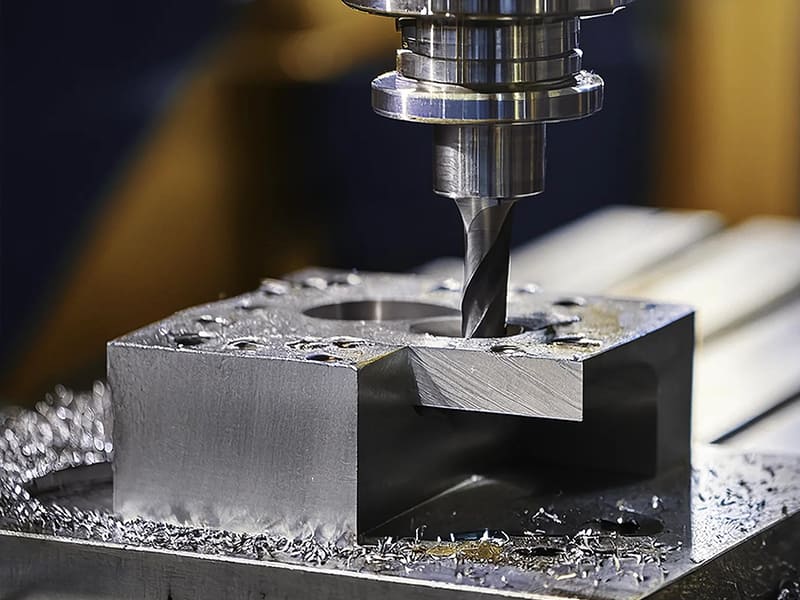
A medical device company machines Grade 23 titanium spinal implants using the same cutting parameters as their stainless steel 316L program — 120 m/min cutting speed with standard carbide inserts. Tool edges fail after 15 parts versus 200+ on stainless. Heat concentrated at the cutting zone causes premature crater wear, built-up edge, and surface micro-cracks on the implant. Reducing cutting speed to 45 m/min, switching to TiAlN-coated fine-grain carbide, applying through-spindle coolant at 70 bar, and shortening tool overhang by 30% extends tool life to 80+ parts with consistent surface quality. The machining approach that works for stainless steel doesn’t transfer to titanium — the material’s thermal, mechanical, and chemical behavior at the cutting interface demands a fundamentally different strategy. We optimize titanium CNC machining programs across aerospace and medical applications regularly. CNC machining titanium delivers exceptional strength-to-weight ratio, corrosion resistance, and biocompatibility — but at higher cost and complexity than aluminum or steel. Success depends on controlling heat, tool wear, and vibration through proper grade selection, conservative cutting parameters, rigid setups, and aggressive coolant strategy.
This guide covers why titanium is chosen, common grades (2, 5, 7, 23), why it’s difficult to machine, proven best practices, milling vs turning considerations, comparison with aluminum and stainless steel, applications, cost factors, surface finishes, and a practical decision framework.
Why Use Titanium?
| Property | Engineering Value | Compared To |
|---|---|---|
| Strength-to-weight | Strong as steel at ~60% weight | 2× aluminum strength |
| Corrosion resistance | Resists seawater, acids, chlorides | Superior to stainless in marine |
| Biocompatibility | Non-toxic, integrates with bone | Required for implants |
| Heat resistance | Maintains strength to ~400–600°C | Better than aluminum |
| Density | ~4.5 g/cm³ | 40% lighter than steel |
Titanium is not a general-purpose material — it’s a performance-driven choice for applications where conventional metals cannot simultaneously meet strength, weight, and environmental demands. Based on our production data, approximately 80% of our titanium CNC programs fall into three categories: aerospace structural components (weight-critical), medical implants (biocompatibility-critical), and marine/chemical parts (corrosion-critical). If none of these drivers apply, aluminum or stainless steel typically delivers adequate performance at significantly lower cost.
Common Grades
| Grade | Type | Strength | Best For | Machinability |
|---|---|---|---|---|
| Grade 2 | Commercially pure | Moderate | Marine, chemical, non-load medical | Easier (for titanium) |
| Grade 5 (Ti-6Al-4V) | Alpha-beta alloy | High | Aerospace, structural, high-load | Difficult (industry standard) |
| Grade 7 | CP + palladium | Moderate | Extreme acid/chloride environments | Similar to Grade 2 |
| Grade 23 (ELI) | Extra low interstitial | High | Medical implants, surgical | Similar to Grade 5, stricter QC |
Grade 5 (Ti-6Al-4V) accounts for approximately 50% of all titanium usage — the industry standard for high-strength applications. Higher machining cost than Grade 2 due to greater strength and heat generation. Grade 2 is the corrosion-first choice — lower strength but excellent formability and easier machining. Grade 23 (ELI) is the medical standard — cleaner composition (lower oxygen/iron) provides better fracture toughness and fatigue life for implants. One common pitfall we see: specifying Grade 5 when Grade 2 meets the mechanical requirement — the strength premium adds 20–30% machining cost without functional benefit on moderate-load corrosion applications.
Why Titanium Is Difficult to Machine
| Challenge | Cause | Impact |
|---|---|---|
| Heat concentration | Thermal conductivity ~1/6 of steel | Rapid tool edge failure |
| Work hardening | Surface hardens during cutting | Subsequent passes face harder material |
| Elastic deflection | Modulus ~50% of steel | Chatter, poor accuracy on thin features |
| Chemical reactivity | Reacts with tool material at high temp | Built-up edge, tool welding |
| High strength at temperature | Maintains strength when hot | Higher cutting forces required |
Heat is the core problem. Unlike aluminum (which conducts heat away rapidly), titanium traps heat at the cutting interface. Tool coatings break down. Flank and crater wear accelerate. Tool failure is often sudden rather than gradual — a tool cutting well can fail within 2–3 parts if parameters push into the thermal damage zone. In our shop floor experience, approximately 70% of titanium machining failures trace to heat-related tool damage — not mechanical overload. Controlling heat through coolant, speed, and engagement strategy is the single most important factor.
Geometry amplifies difficulty. Thin walls deflect under cutting forces (titanium’s lower modulus). Deep pockets trap heat and restrict chip evacuation. Long tool overhangs increase vibration. Parts designed without considering titanium’s machinability characteristics cost 2–3× more to produce than equivalent geometry optimized for the material.
Best Practices
Tooling
Use sharp fine-grain carbide tools with heat-resistant coatings (TiAlN, AlTiN). Maintain sharp cutting edges — titanium punishes dull tools with exponentially increasing wear. Replace based on part count, not visible wear — by the time wear is visible, surface integrity may already be compromised.
Cutting Parameters
Low cutting speed + adequate feed. Typical speeds: 30–60 m/min (versus 200–400 m/min for aluminum). Maintain consistent chip load — never let the tool rub. Rubbing causes work hardening, which makes subsequent passes harder and accelerates tool failure. Prefer climb milling for reduced heat generation and better surface finish.
Coolant (Critical)
High-pressure through-spindle coolant (40–70+ bar) directed at the cutting zone. Coolant serves three functions: heat removal, chip evacuation, and preventing chemical bonding between titanium and tool material. Without adequate coolant, tool life drops 50–70%. Based on our production data, switching from flood coolant to 70 bar through-spindle coolant on Grade 5 Ti-6Al-4V programs increases tool life by approximately 2.5× and improves surface finish consistency by 40%.
Setup Rigidity
Short tool overhang. Rigid toolholders (shrink-fit or hydraulic — not collet). Rigid fixturing with adequate support for thin features. Titanium’s lower stiffness means vibration starts at lower cutting forces than steel — everything in the setup must compensate.
Process Strategy
Avoid dwelling in the cut — continuous tool movement prevents localized heat buildup and work hardening. For precision parts: rough machine → stress relieve → finish machine to improve dimensional stability. Leave finishing allowance for final passes at optimized parameters.
Milling vs Turning vs 5-Axis
| Process | Best For | Key Challenge |
|---|---|---|
| CNC Milling | Brackets, housings, complex profiles | Intermittent cutting → heat spikes |
| CNC Turning | Shafts, pins, bushings | Built-up edge, continuous heat |
| 5-Axis | Aerospace, medical, complex geometry | Programming complexity, cost |
| EDM/Grinding | Hardened areas, thin features | Slower, higher cost |
Milling handles complex geometry but intermittent cutting creates thermal cycling. Turning provides more stable continuous cutting — better chip control and more consistent surface finish on rotational parts. 5-axis reduces setups on complex multi-face titanium components — the setup reduction often justifies the higher machine rate through improved accuracy and lower cumulative tolerance error.
Titanium vs Aluminum vs Stainless Steel
| Factor | Titanium | Aluminum | Stainless Steel |
|---|---|---|---|
| Machinability | Difficult | Easy | Moderate |
| Strength-to-weight | Excellent | Good | Moderate |
| Corrosion resistance | Excellent | Good | Good-Excellent |
| Material cost | High (3–10× Al) | Low | Medium |
| Machining cost | High (2–4× Al) | Low | Medium |
| Best for | Aerospace, medical, marine | Lightweight, prototypes | Food, medical, structural |
Decision logic: Choose titanium when weight + strength + corrosion must all be satisfied simultaneously. Choose aluminum when cost and machining speed matter and loads are moderate. Choose stainless when corrosion resistance + strength are needed without the titanium cost premium. In projects we’ve delivered, switching from titanium to aluminum 7075-T6 where corrosion isn’t a concern typically reduces total part cost by 60–70% — titanium’s premium is justified only when its unique property combination is functionally required.
Applications
| Industry | Typical Parts | Why Titanium |
|---|---|---|
| Aerospace | Brackets, fasteners, engine parts | Strength-to-weight + heat resistance |
| Medical | Implants, surgical instruments | Biocompatibility + corrosion resistance |
| Marine | Valves, fittings, pump parts | Seawater corrosion immunity |
| Chemical | Heat exchangers, reactor components | Acid and chloride resistance |
| Robotics | Arms, joints, structural parts | Weight reduction for motion efficiency |
Cost Factors
| Driver | Impact |
|---|---|
| Raw material | 3–10× aluminum price |
| Cutting speed | 20–40% of aluminum speed → longer cycles |
| Tool consumption | 3–5× faster wear than aluminum |
| Coolant requirements | Through-spindle high-pressure mandatory |
| Geometry complexity | Deep pockets/thin walls amplify cost |
| Inspection | Stricter for aerospace/medical compliance |
Cost Reduction Strategies
Simplify geometry — avoid deep pockets, thin walls, sharp internal corners. Use standard internal radii matching available tool sizes. Specify Grade 2 instead of Grade 5 when strength allows — easier machining, lower material cost. Apply tight tolerances only on functional features. Use 5-axis strategically to reduce setups. DFM review before production typically identifies 20–40% cost reduction on titanium programs.
Surface Finishes
| Finish | Purpose | Typical Ra |
|---|---|---|
| As-machined | Functional, lowest cost | 1.6–3.2 µm |
| Bead blasted | Uniform matte appearance | ~1.6–3.2 µm |
| Polished | Smooth, aesthetic | <0.8 µm |
| Passivated | Corrosion + cleanliness | N/A (chemical) |
| Anodized | Color coding, oxide layer | N/A (interference color) |
| Electropolished | Ultra-smooth (medical) | <0.4 µm |
Titanium anodizing produces interference colors (blue, purple, gold) without dye — used for medical instrument identification and consumer aesthetics. Passivation removes surface contaminants for medical and chemical applications.
Decision Guide
| Requirement | Recommendation |
|---|---|
| Lightweight + high strength | Titanium |
| Corrosion (marine/chemical) | Titanium |
| Medical biocompatibility | Grade 2 or Grade 23 |
| Cost-sensitive | Aluminum or stainless |
| Complex geometry, titanium required | Optimize DFM first |
| High volume | Validate process stability early |
Conclusion
CNC machining titanium delivers unmatched strength-to-weight ratio, corrosion resistance, and biocompatibility — but demands fundamentally different machining strategy than aluminum or steel. Heat control (through-spindle coolant), conservative cutting speeds (30–60 m/min), sharp coated carbide tooling, and rigid setups are non-negotiable. Grade selection (2 for corrosion, 5 for strength, 23 for medical) and DFM optimization (avoid deep pockets, thin walls, unnecessary tight tolerances) determine whether a titanium program delivers high-performance parts at manageable cost or becomes an expensive machining exercise. Choose titanium when its unique property combination is genuinely required — and invest in the machining strategy to execute it properly. Need help with titanium CNC machining? [Contact our engineering team] for grade selection, DFM review, and manufacturing support.
FAQ
Is titanium hard to machine?
Yes — heat concentrates at the cutting edge (~1/6 steel’s thermal conductivity), causing rapid tool wear. Lower stiffness creates vibration risk. Requires low cutting speeds (30–60 m/min), high-pressure coolant, sharp coated carbide tools, and rigid setups.
What titanium grade is best for CNC?
Grade 5 (Ti-6Al-4V) for high-strength aerospace/structural parts. Use Grade 2 for corrosion applications with moderate load, or Grade 23 for medical implants. Avoid over-specifying Grade 5 when Grade 2 meets requirements — saves 20–30% machining cost.
Why is titanium expensive to machine?
Material costs 3–10× aluminum. Cutting speeds run 20–40% of aluminum. Tools wear 3–5× faster. Requires through-spindle high-pressure coolant. Complex geometry amplifies all these factors.
Titanium vs aluminum — when to choose which?
Titanium when weight + strength + corrosion must all be satisfied. Aluminum when cost and machining speed matter and loads are moderate. Switching to 7075 aluminum where corrosion isn’t critical typically saves 60–70% total part cost.
How to reduce titanium machining cost?
Simplify geometry (no deep pockets/thin walls). Use standard radii. Specify Grade 2 when possible. Apply tight tolerance only where needed. Use 5-axis to reduce setups. DFM review typically identifies 20–40% savings.


