
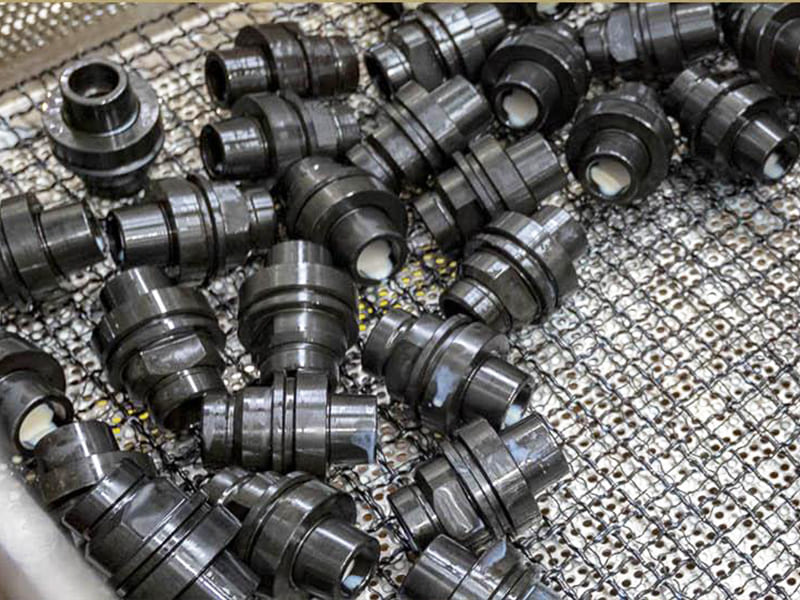
Quick Answer: Black oxide on steel is a chemical conversion coating — not a paint, plating, or applied layer — that transforms the steel surface itself into magnetite (Fe₃O₄) at approximately 0.5–1.5 µm thickness. This near-zero thickness is the defining engineering advantage: it adds no measurable dimension to shafts, threaded holes, precision bores, or fitted surfaces, making it the only practical black surface treatment for parts with tolerances of ±0.01–0.02 mm. The conversion layer alone provides minimal corrosion resistance — protection depends almost entirely on the post-treatment sealing step (oil, wax, or polymer). Black oxide is the correct choice for indoor industrial precision components, fasteners, gears, and cutting tools. It is not suitable for marine, saltwater, heavy outdoor, or high-abrasion environments.
What Is Black Oxide?
Black oxide is a controlled electrochemical oxidation process that converts the iron at the steel surface into magnetite (Fe₃O₄) — a stable black iron oxide — by immersion in a hot alkaline solution at approximately 135–150°C. The chemical reaction:
3 Fe + 4 H₂O → Fe₃O₄ + 4 H₂ (simplified)
The magnetite layer formed is approximately 0.5–1.5 µm thick. This is the fundamental property that distinguishes black oxide from all other black finishing processes. The layer does not sit on top of the steel — it is the converted steel surface. When the process is complete, the part has the same outer dimensions as when it entered the process bath. Any dimensional change is below the measurement capability of common inspection equipment.
This characteristic is why the process is called a “conversion coating” — the surface is converted, not coated.
Black Oxide vs Other Black Finishing Methods
| Finish | Process Type | Typical Thickness | Effect on Dimensions | Suitable for ±0.02 mm Tolerance? |
|---|---|---|---|---|
| Black oxide | Conversion coating | ~0.5–1.5 µm | None measurable | Yes |
| Black zinc plating | Electrodeposition | 5–15 µm | Changes dimensions | Limited |
| Powder coating (black) | Applied coating | 60–120 µm | Significant | No |
| PVD (TiN, TiAlN, DLC) | Physical vapor deposition | 1–5 µm | Negligible | Yes |
| Black paint | Applied coating | 20–80 µm | Significant | No |
| Manganese phosphate | Conversion coating | 5–25 µm | Moderate | Limited |
The practical consequence: when a part has threaded holes, precision shafts, bearing seats, or tight-clearance fits, black oxide is the only low-cost black treatment that does not require subsequent machining or tolerance compensation.
Why Engineers Choose Black Oxide for Precision Steel Parts
Dimensional Neutrality
The primary engineering reason for specifying black oxide is not its corrosion resistance or appearance — it is that the process does not change part dimensions. Compare the tolerance impact:
An M8×1.25 threaded hole on a precision assembly: the pitch diameter tolerance for a 6H thread fit is approximately +0.000/+0.250 mm. Black zinc plating at 10 µm per surface reduces the effective hole pitch diameter by approximately 0.020 mm — potentially shifting the thread fit from 6H to 5H and causing assembly interference. Black oxide at 1 µm: the change is below the measurement resolution of most production inspection.
For a precision shaft with a diameter tolerance of ±0.010 mm: black zinc plating at 10 µm increases the diameter by 0.020 mm, consuming the entire tolerance band. Black oxide at 1 µm is below the threshold of concern.
This dimensional neutrality eliminates:
- The need to machine a pre-plating undersize and hold closer tolerances pre-process
- Post-process thread chasing or re-tapping operations
- Tolerance stack-up analysis for the coating contribution
- Masking of precision surfaces before coating
Thread and Gear Tooth Preservation
Threads are the most sensitive geometry for coating buildup because the tolerance bands are narrow and the mating part tolerance is already consumed by the thread class. Black oxide is the standard surface treatment for precision threaded fasteners — including aerospace, medical, and instrumentation bolts — for this reason.
Gear tooth geometry is similarly sensitive. Even 5–10 µm of plating thickness on a gear tooth face changes the effective tooth thickness, increases backlash on one side of mesh, and shifts the operating pitch circle. Black oxide does not affect gear tooth geometry.
Electrical Conductivity Preservation
Unlike most coatings, black oxide preserves the electrical conductivity of the steel surface. The magnetite layer (Fe₃O₄) has moderate electrical conductivity — far higher than paint, powder coating, or polymer films. This matters for:
- Grounding components that require metallic contact resistance
- EMC/EMI shielding surfaces where continuity is required
- Electrical assembly components where conductivity at the surface interface is specified
Paint and powder coating produce insulating surfaces; electroplating changes conductivity depending on the deposited metal. Black oxide maintains the conductivity character of the steel.
Applications Where Black Oxide Is the Standard Specification
| Application | Why Black Oxide Is Standard |
|---|---|
| Precision fasteners (bolts, screws, nuts) | No thread interference, consistent torque values |
| Precision gears and gear shafts | Preserves tooth geometry and backlash specification |
| Dowel pins and alignment pins | Maintains H7/h6 or tighter diameter fits |
| Cutting tools (taps, drills, end mills) | Maintains edge geometry, holds cutting oil |
| Firearm components | Low-glare matte finish, dimensional stability |
| Precision instrument components | Non-reflective surface, no tolerance impact |
| Surgical and medical steel instruments | Clean finish, precision surface dimensions |
| CNC machined housings with multiple threaded holes | No re-tapping needed, faster assembly |
Corrosion Resistance: The Critical Limitation
The most consequential misunderstanding about black oxide is the assumption that it provides substantial corrosion protection. It does not, by itself.
Why the Oxide Layer Alone Provides Minimal Protection
The magnetite layer formed by black oxide is porous at the microscopic level. The pores allow moisture and oxygen to reach the underlying steel, which means that unsealed black oxide parts will begin rusting within hours to days in humid ambient air — faster than bare steel in some conditions because the process removes surface oils from the degreasing step.
The oxide layer’s contribution to corrosion resistance is providing a surface with high porosity for oil retention — it acts as a sponge for the sealing treatment applied after oxidation, not as a barrier itself.
Post-Treatment Sealing Options
| Sealing Treatment | Corrosion Performance | Durability | Typical Salt Spray Resistance |
|---|---|---|---|
| No sealing | Essentially none | N/A | < 1 hour |
| Light mineral oil | Low to moderate | Days to weeks | 10–30 hours |
| Heavy oil / preservative oil | Moderate | Weeks to months | 30–100 hours |
| Wax (microcrystalline) | Moderate | Months | 50–150 hours |
| Oil with penetrating rust inhibitor | Moderate to good | Months | 100–300 hours |
| Polymer-based sealant | Good | Extended | 200–500 hours |
The sealing step is not optional — it is the actual corrosion protection mechanism for black oxide parts. A correctly specified black oxide process should always include the sealing specification as part of the surface treatment callout.
Environmental Suitability
| Environment | Black Oxide Suitability | Minimum Sealing Required |
|---|---|---|
| Clean dry indoor | Excellent | Light oil acceptable |
| Controlled indoor with humidity | Good | Oil or wax required |
| Outdoor with light exposure | Marginal | Heavy oil or polymer sealant, periodic maintenance |
| Continuous outdoor exposure | Not recommended | — |
| Marine or saltwater environment | Not suitable | — |
| Chemical or acid exposure | Not suitable | — |
For parts requiring corrosion resistance beyond what black oxide with sealing provides, alternative processes should be specified: black zinc plating for moderate corrosion resistance at acceptable dimensional impact, PVD coatings for premium corrosion and wear resistance with minimal dimensional change, or powder coating for maximum barrier protection where dimensional impact is acceptable.
CNC Machining Quality and Black Oxide Finish
Black oxide converts the surface as it is. It does not fill surface irregularities, hide machining marks, or average out surface roughness. The finish quality is entirely determined by the machined surface condition entering the process.
Surface Roughness Effect on Appearance
| Machined Ra Value | Black Oxide Appearance |
|---|---|
| Ra ≤ 0.8 µm (ground or fine-turned) | Deep, uniform, consistent black |
| Ra 0.8–1.6 µm (standard CNC turning/milling) | Good uniformity, slight texture visible |
| Ra 1.6–3.2 µm | Texture variation visible; acceptable for industrial parts |
| Ra > 3.2 µm | Visibly uneven; matte with texture contrast |
The mechanism: the black oxide layer follows the micro-topography of the surface. Areas with different roughness react at slightly different rates and produce marginally different color depth. On a precision-ground surface (Ra ≤ 0.4 µm), the finish appears deep and uniform. On a rougher surface, micro-peaks and valleys create visible texture in the converted layer.
Machining Preparation Requirements
Oil and coolant removal: Cutting oil and coolant residues on the surface prevent the oxidation reaction from occurring uniformly. The alkaline process solution cannot fully penetrate oil-contaminated surfaces, resulting in patchy areas where the reaction was incomplete. Comprehensive degreasing — typically ultrasonic cleaning in alkaline cleaner followed by water rinse — is essential before the oxidation step.
Burr removal: Burrs react differently from parent metal during oxidation because their geometry, grain orientation, and surface condition differ from the primary machined surface. Burrs on black-oxidized parts appear as irregular lighter or darker spots at edges. All edges should be deburred and ideally chamfered (0.2–0.5 mm × 45°) for consistent appearance.
Surface uniformity: If a part has areas with significantly different surface finishes — for example, a milled face at Ra 1.6 µm adjacent to a ground bore at Ra 0.4 µm — the difference will be visible after black oxide as a contrast between areas. Parts with demanding cosmetic requirements should have consistent surface finish specifications across all visible surfaces.
Pre-Process Inspection Checklist
| Pre-Process Condition | Impact on Black Oxide | Required Action |
|---|---|---|
| Machining oil present | Patchy reaction, light areas | Full degreasing (alkaline clean + rinse) |
| Coolant residue | Uneven color | Ultrasonic cleaning |
| Burrs at edges | Color variation at edges | Deburring before process |
| Mixed surface finishes | Visible contrast between zones | Unify Ra or accept appearance variation |
| Heat treat scale or discoloration | Poor reaction, poor adhesion | Acid pickling before oxidation |
Black Oxide on Stainless Steel
Black oxide on stainless steel is a different and more complex process than on carbon steel.
Why Stainless Steel Is Harder to Blacken
Stainless steel contains chromium (10.5%+ by mass), which forms a dense, self-healing chromium oxide passive layer (Cr₂O₃) at the surface. This passive layer provides stainless steel’s corrosion resistance, but it also prevents the iron oxidation reaction that produces black oxide on carbon steel from occurring readily.
To black oxide stainless steel, the passive layer must first be broken down through an aggressive acid activation step, after which the part can be processed in a specialized oxidation bath formulated for stainless alloys. The reaction chemistry, bath composition, and temperature differ significantly from carbon steel black oxide.
Appearance Differences
The black oxide layer produced on stainless steel differs from carbon steel results:
- Color depth: Stainless black oxide typically produces a dark gray to gray-black appearance rather than the deep uniform black achievable on carbon steel. The difference is metallurgical — the layer formed on stainless is a different oxide composition and structure.
- Batch variation: Color consistency across batches is more difficult to achieve on stainless because the passive layer condition varies with heat treatment history, surface finish, and alloy lot.
- Alloy effect: 304 stainless typically produces a darker result than 316 stainless because 316’s higher molybdenum content changes the passive layer chemistry and resistance to activation.
Process Control Requirements for Stainless
| Process Parameter | Carbon Steel | Stainless Steel |
|---|---|---|
| Surface activation step | Standard alkaline clean | Aggressive acid activation required |
| Bath chemistry | Standard alkaline oxidation | Specialized stainless formula |
| Process control tolerance | Moderate | Tight (temperature, time, concentration) |
| Achievable color | Deep black, consistent | Dark gray to gray-black, variable |
| Color consistency batch-to-batch | High | Moderate |
For applications requiring deep, uniform black on stainless steel with better color consistency, PVD coating (DLC, TiN, or CrN-based) is a more reliable option — at higher cost but with better appearance control and superior wear resistance.
Common Black Oxide Defects and Root Causes
| Defect | Visual Symptom | Root Cause | Corrective Action |
|---|---|---|---|
| Patchy coloration | Light/dark areas on same part | Insufficient degreasing; oil residue | Full alkaline clean + ultrasonic rinse |
| Surface rubbing off | Black layer wipes away on cloth | Process contamination; incomplete reaction | Improve pre-clean; verify bath chemistry |
| Rust spots (rapid) | Corrosion within days | No sealing or insufficient sealing | Apply oil or wax immediately after oxidation |
| Gray rather than black | Overall gray tone | Bath temperature too low; weak chemistry | Increase bath temperature; refresh chemistry |
| Inconsistent batch color | Color variation between parts | Mixed alloys in same batch; Ra variation | Segregate alloys; control surface finish |
| Streaks or flow marks | Linear marks on surface | Improper rinsing; contaminated baths | Improve rinse steps; clean baths |
| Blistering/peeling | Film separates in sheets | Not possible with true black oxide | If this occurs: deposit is a different material (paint, scale) — not true black oxide |
Note on the last row: True black oxide cannot peel or blister because it is not a separate layer — it is the converted steel surface. If a “black oxide” finish peels, the deposit was not properly formed magnetite but rather a surface scale, contamination layer, or residue from an improperly controlled bath. This is always a process failure, not a material failure.
When Not to Use Black Oxide
Black oxide is not appropriate for every application. The following conditions indicate where alternative surface treatments should be specified:
Marine or saltwater exposure: The sealing treatment cannot maintain adequate protection in continuous salt spray or seawater immersion. Salt spray testing per ASTM B117 for properly sealed black oxide typically achieves 30–100 hours — far below the 500–2000+ hours required for marine-grade protection. Specify zinc plating (5–15 µm) or PVD coating for these environments.
Continuous outdoor exposure: Rain, UV, and weathering degrade the sealing treatment over time. Without periodic re-oiling, outdoor black oxide parts will develop rust within weeks to months. For permanent outdoor installations, specify galvanizing, zinc plating, or powder coating.
Heavy abrasion or sliding wear: At 0.5–1.5 µm, black oxide is abraded away almost immediately under sliding contact against hard surfaces. It provides no wear resistance in any conventional sense. For wear-resistant black finishes, specify nitriding (which forms a hard compound layer of 0.1–0.5 mm depth), TiN or TiAlN PVD coatings, or hard chrome.
Chemical environments: Black oxide and its sealing treatments have no meaningful resistance to acids, strong alkalis, or industrial solvents. The oxide layer dissolves in even dilute acid exposure.
Premium decorative requirements: The matte black of black oxide is functional and appropriate for industrial applications, but it does not provide the color depth, luster, or durability of PVD coatings for consumer or architectural applications.
Drawing Specification for Black Oxide
A complete black oxide specification on an engineering drawing should include:
Minimum required elements:
| Element | Typical Specification | Engineering Purpose |
|---|---|---|
| Process standard | MIL-DTL-13924 Class 1 (hot alkaline) | Defines process type and quality requirements |
| Applicable material | Steel (specify grade if stainless) | Avoids incorrect process application |
| Sealing requirement | Oil seal / wax seal / polymer sealant | Ensures corrosion protection is specified |
| Color acceptance range | Black to dark black (define if critical) | Controls cosmetic variation |
| Ra requirement (if cosmetic) | Ra ≤ 1.6 µm prior to processing | Controls surface finish entering process |
Example drawing callout:
BLACK OXIDE PER MIL-DTL-13924 CLASS 1, OIL SEAL AFTER PROCESSING. PRE-PROCESS SURFACE FINISH: Ra ≤ 1.6 µm. ALL SURFACES UNLESS NOTED.
The sealing specification must appear explicitly. A callout of just “BLACK OXIDE” without a sealing requirement will produce parts that rust rapidly in ambient humidity.
Key Takeaways
- Black oxide is a conversion coating, not an applied layer — it converts the steel surface to magnetite (Fe₃O₄) at 0.5–1.5 µm, with no measurable dimensional change. This makes it the only practical low-cost black surface treatment for parts with ±0.01–0.02 mm tolerances.
- The oxide layer itself provides no useful corrosion resistance — protection depends entirely on the post-treatment sealing step. Unsealed black oxide parts will rust within hours in ambient humidity. Always specify oil, wax, or polymer sealing as part of the surface treatment requirement.
- Black oxide is appropriate for clean indoor industrial environments — properly sealed, it provides adequate corrosion resistance for machinery, instruments, and assemblies protected from direct moisture exposure. It is not suitable for outdoor, marine, or chemical environments.
- Surface quality entering the process determines finish quality — black oxide does not hide machining marks or surface irregularities. Parts with Ra > 1.6 µm or inadequate degreasing will have visibly inconsistent finish quality.
- Black oxide on stainless steel is a different, more complex process that produces dark gray rather than deep black, with lower batch-to-batch consistency than on carbon steel.
- The principal competitive advantage of black oxide is cost and dimensional neutrality: it is faster and cheaper than plating, and unlike all other black treatments, it requires no tolerance compensation, no masking of precision surfaces, and no post-process rework on threads or fits.
- For OEM procurement teams: black oxide specifications should include MIL-DTL-13924 Class 1 (the standard for hot alkaline process on steel), the sealing treatment type and application method, the required surface finish before processing, and whether stainless steel requires a separate process approval and color range acceptance.
Frequently Asked Questions
Does black oxide prevent rust on steel?
By itself, unsealed black oxide provides essentially no rust prevention — parts will rust within hours to days in humid air. The corrosion resistance of black oxide comes entirely from the sealing treatment applied immediately after the oxidation step: light mineral oil provides 10–30 hours of salt spray resistance; heavy oil or wax provides 50–150 hours; polymer-based sealants can achieve 200–500 hours. For indoor industrial applications with controlled humidity, properly sealed black oxide is adequate. For outdoor, marine, or high-humidity environments, alternative surface treatments (zinc plating, PVD, powder coating) provide substantially better corrosion protection.
Is black oxide better than zinc plating for precision steel parts?
For precision parts where dimensional accuracy is the overriding requirement, black oxide is significantly better than zinc plating. Black oxide adds approximately 0.5–1.5 µm with no measurable effect on threads, shafts, or precision fits. Zinc plating adds 5–15 µm per surface, which can close clearances on precision fits, make threaded holes tight, and require post-process thread chasing. For corrosion resistance alone, zinc plating is better — it provides superior barrier protection and sacrificial protection even when scratched. The correct choice depends on whether dimensional accuracy or corrosion protection governs the application.
What thickness does black oxide add to steel?
Black oxide adds approximately 0.5–1.5 µm per surface — a conversion layer, not a deposited layer, meaning the material does not build up on the surface. For practical engineering purposes, this thickness is negligible: it is below the measurement resolution of standard micrometers and is less than 10% of the tolerance band on a ±0.010 mm precision fit. This near-zero thickness is the property that makes black oxide the standard surface treatment for precision threaded fasteners, precision gears, and tight-tolerance machined components where any coating buildup would require dimensional compensation or post-process rework.
Can black oxide be applied to stainless steel?
Yes, but the process is more complex and the result differs from carbon steel. Stainless steel’s chromium oxide passive layer resists the oxidation reaction, requiring acid activation before the oxidation bath. The resulting finish is typically dark gray to gray-black rather than the deep black achievable on carbon steel, and color consistency between batches is lower. Alloy grade affects the result — 304 stainless typically produces a darker result than 316. For applications requiring consistent deep black on stainless steel, PVD coatings provide better appearance control, though at higher cost.
How is black oxide specified on an engineering drawing?
The recommended specification is: “BLACK OXIDE PER MIL-DTL-13924 CLASS 1, OIL SEAL AFTER PROCESSING.” The sealing requirement must be explicitly specified — a callout of just “BLACK OXIDE” will produce parts that rust rapidly because most processors will not apply sealing unless specified. For cosmetic-critical applications, add a surface finish requirement before processing (e.g., “PRE-PROCESS SURFACE FINISH Ra ≤ 1.6 µm”) and a color acceptance range (e.g., “BLACK TO DARK BLACK — NO GRAY OR UNEVEN PATCHES ACCEPTABLE”). For stainless steel parts, note the alloy grade and confirm with the processor that a stainless-appropriate black oxide process will be used.
Written by the CMS engineering team with 15+ years of precision CNC machining experience producing black oxide steel components for precision instruments, medical devices, firearms, cutting tools, industrial fasteners, and automotive assemblies. Technical references: MIL-DTL-13924 (Black Oxide Coating for Ferrous Metals), ASTM B117 (Salt Spray Testing of Black Oxide), SAE AMS 2485 (Black Oxide Treatment of Ferrous Materials), ISO 11408 (Chemical Conversion Coatings — Black Oxide Coating).
Sourcing CNC Machined Steel Components With Black Oxide Finishing?
At CMS, we machine precision steel components in 1018, 4140, 4340, and stainless grades, coordinating black oxide finishing with oil or polymer sealing. Every black oxide order includes pre-process surface finish verification, deburring confirmation, and post-process dimensional check on precision features to ensure fit and finish meet drawing requirements.
[Request a black oxide specification review and CNC machining quote →]


