
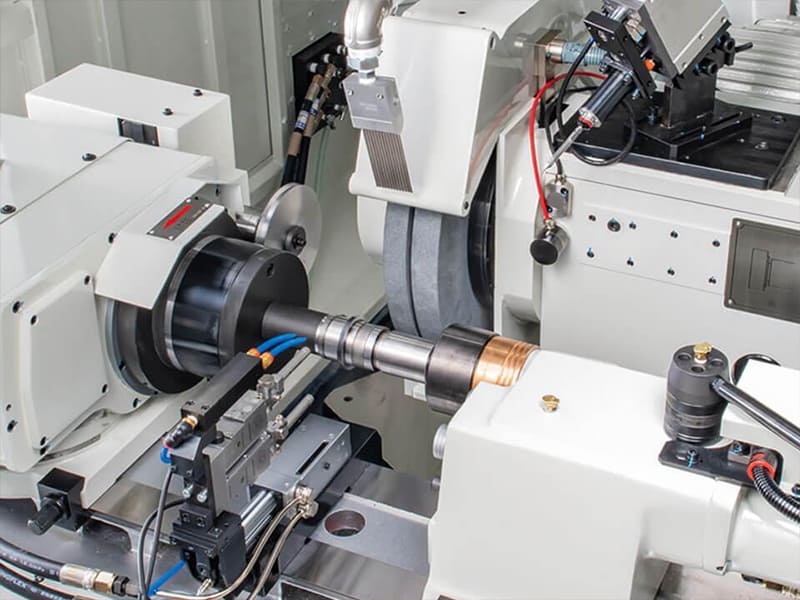
A bearing journal that’s 3 microns out of round. Hardened shafts that drifted 8 microns during heat treatment. Sealing surfaces at Ra 0.6 μm when the spec calls for 0.3 μm. These are problems that milling and turning can’t fix — the parts are already hardened to 58 HRC, the features are already shaped, and the tolerance window left is measured in single-digit microns. This is where CNC grinding takes over. It’s not a roughing process, not a shaping process, and not interchangeable with milling. CNC grinding is the final-authority finishing operation that locks in critical dimensions, surface integrity, and geometric control on parts where other processes reach their limits.
This article covers CNC grinding from a manufacturing engineering perspective: how the process works, the main machine types, which materials benefit most, grinding wheel selection, process parameters that control accuracy, how tight tolerances and surface integrity are achieved, industry applications, and when to choose grinding over milling or turning. Whether you’re a designer specifying post-heat-treatment tolerances, an engineer planning a process chain, or a buyer evaluating precision grinding capability, the goal is to explain where CNC grinding fits — and why it’s often non-negotiable.
How Does CNC Grinding Work?
CNC grinding removes material using a rotating wheel composed of bonded abrasive grains. Unlike milling or turning, which use defined cutting edges, each abrasive grain acts as a microscopic cutting point — removing material in extremely small increments. This micro-removal mechanism enables very high accuracy on hardened materials where conventional cutting tools wear rapidly or generate excessive heat.
The basic sequence: the workpiece is fixed or rotated (depending on grinding type), a grinding wheel rotates at high speed and engages with controlled infeed, and material is removed through micro-scale abrasion. Because removal per pass is minimal, CNC grinding excels at final-size control after heat treatment.
CNC control transforms grinding from an operator-dependent craft into a repeatable precision operation. Modern controllers manage multi-axis motion, infeed resolution, spark-out cycles, and automatic wheel wear compensation — ensuring consistent results across batches with micron-level repeatability.
CNC Grinding Machine Types
Surface Grinders
Produce highly accurate planar surfaces — flatness, parallelism, and controlled surface finish. Used for mold bases, inserts, fixtures, gauges, and tooling plates. Surface grinding is often the last operation to lock in geometry before assembly or inspection.
Cylindrical Grinders
Rotate the workpiece while grinding the outer diameter. Deliver tight control of diameter, roundness, and concentricity. Used for shafts, pins, rollers, bearing journals, and sealing surfaces — any feature where runout and roundness directly affect noise, wear, or fatigue life.
Centerless Grinders
Support the workpiece between a grinding wheel and regulating wheel — no chucking or centers needed. Extremely high throughput with consistent diameter control across large batches. Ideal for pins, dowels, and high-volume automotive components. In our production experience, centerless grinding achieves 2-3× the throughput of conventional cylindrical grinding on suitable parts.
Internal and Special-Purpose Grinders
Internal grinders machine bores and IDs to tight tolerances. Special-purpose variants include gear grinders, thread grinders, and tool-and-cutter grinders. These address geometries and accuracy levels that milling and turning simply can’t reach.
What Materials Benefit Most from CNC Grinding?
Hardened Steels
The most common grinding candidates. Once quenched and tempered above 45-60 HRC, conventional cutting tools suffer rapid wear, edge chipping, and dimensional drift. CNC grinding removes material via micro-abrasion rather than shearing — maintaining roundness, flatness, and size after hardening. Typical applications: bearing seats, shafts, dies, and transmission components.
Stainless Steels
Austenitic and martensitic grades prone to work hardening and heat buildup during cutting. Grinding offers lower chip thickness per grain, improved surface finish without tearing, and better dimensional stability on thin or distortion-sensitive parts. Common uses: precision valves, medical components, and sealing surfaces.
Titanium Alloys
Low thermal conductivity and chemical reactivity make titanium challenging for milling. CNC grinding distributes heat across many abrasive contacts, enables fine material removal control, and achieves tight tolerances on aerospace and medical parts.
Carbides and Ceramics
Tungsten carbide and advanced ceramics are often impractical to machine with defined cutting edges. CNC grinding — typically with CBN or diamond superabrasives — is essential for tooling components, wear parts, and precision inserts.
Grinding Wheels and Abrasive Selection
The grinding wheel is the cutting tool. Many problems blamed on “machine accuracy” are actually wheel selection issues.
Abrasive Types
Aluminum oxide (Al₂O₃): Most widely used for steels and general-purpose grinding. Good toughness, cost-efficient. CBN (Cubic Boron Nitride): Optimized for hardened ferrous materials above 50 HRC. Excellent thermal stability, long wheel life, micron-level repeatability. Based on our production data, CBN wheels typically deliver 5-10× longer life than aluminum oxide on hardened steel — with more consistent size control. Diamond: For non-ferrous hard materials — carbide, ceramics, composites. Unsuitable for ferrous materials due to chemical interaction at temperature.
Key Selection Parameters
Grit size: Coarser grits remove faster but leave rougher surfaces. Fine grits achieve low Ra and tight form control. Bond system: Vitrified bonds offer rigidity for high-accuracy work. Resin bonds provide shock absorption for high-speed grinding. Metal bonds deliver extreme wheel life with diamond abrasives. Structure and porosity: Open structures improve coolant access and chip evacuation — critical for preventing thermal damage on hardened materials.
| Wheel Parameter | Primary Effect |
|---|---|
| Abrasive type | Material compatibility, wheel life |
| Grit size | Surface finish vs. removal rate |
| Bond system | Accuracy, thermal behavior |
| Structure | Heat control, process stability |
Process Parameters That Control Accuracy
Wheel Speed
Higher surface speed generally improves finish and size control by reducing chip thickness per grain. However, excessive speed increases heat and risks grinding burn — especially on hardened steels. Engineering practice targets a speed window balancing cutting efficiency and thermal safety.
Feed Rate
Higher feeds boost productivity but raise normal forces, risking vibration and waviness. Lower feeds improve finish and roundness but can cause rubbing and glazing if too slow. For finishing passes, reduced feed combined with a spark-out period stabilizes size and improves form.
Depth of Cut
Large depths accelerate stock removal during roughing but amplify heat and deflection. Shallow depths enable fine size control during finishing. Standard practice: rough grind to near size, then multiple light finishing passes.
Thermal Control
Heat is the dominant error source. Inadequate cooling causes grinding burn (surface discoloration and microstructural damage), tensile residual stress reducing fatigue life, and dimensional drift from thermal expansion. Effective control combines directed coolant delivery, appropriate wheel porosity, and parameter limits that prevent excessive heat flux.
How CNC Grinding Achieves Tight Tolerances
CNC grinding routinely holds single-digit micron tolerances on diameters, flatness, and roundness. This is possible because grinding removes material in very small, repeatable increments with low cutting forces. CNC control supports precise infeed resolution, spark-out cycles, and automatic compensation for wheel wear.
Surface roughness below Ra 0.4 μm is routine with fine-grit wheels and light finishing passes. More importantly, grinding produces uniform surface texture — critical for bearing interfaces, sealing surfaces, and noise/vibration control.
Machine rigidity and thermal management complete the picture. High-rigidity spindles and thermally managed structures minimize deflection. CNC systems apply thermal growth compensation, axis error mapping, and wear offsets. In projects we’ve delivered, combining proper wheel selection with thermal compensation reduced batch-to-batch diameter variation from ±4 μm to ±1.5 μm on hardened 52100 bearing journals.
Industry Applications
Automotive: Transmission shafts, gears, bearing races — where roundness and surface finish directly affect noise, wear, and fatigue life across high-volume production.
Aerospace: Engine shafts, seal surfaces, and precision bores in turbine components made from heat-resistant alloys requiring surface integrity under extreme loads.
Medical devices: Implant components, surgical instruments, and guide components with strict dimensional and surface requirements.
Tooling and molds: Mold bases, inserts, fixtures, gauges, cutting tools, and wear parts — where flatness, parallelism, and dimensional repeatability exceed what milling alone can deliver.
When to Choose CNC Grinding Over Milling or Turning
Tolerances in the micron range. When size, roundness, flatness, or concentricity requirements enter single-digit microns, grinding provides more stable control than milling or turning.
Surface integrity matters. When the application demands Ra ≤ 0.4 μm, uniform texture, or controlled residual stress (bearings, seals, fatigue-loaded parts), grinding delivers superior results.
Material is hardened. Above 45-50 HRC, milling and turning become inefficient or unstable. CNC grinding handles hardened steels, carbides, and ceramics with lower forces and controlled heat.
Final sizing after heat treatment. Grinding is often the last operation, correcting dimensional changes from hardening and locking in function-critical geometry.
| Factor | Milling / Turning | CNC Grinding |
|---|---|---|
| Typical tolerance | ±0.01 mm | Micron-level |
| Surface roughness | Moderate–good | Excellent, uniform |
| Hardened materials | Limited | Ideal |
| Best role | Shape generation | Final sizing and finishing |
Conclusion
CNC grinding is the final authority on precision in manufacturing. It’s not a high-removal process and not a substitute for milling or turning — it’s the finishing operation that locks in function-critical dimensions, surface integrity, and geometric control. Its value comes from system-level control: machine rigidity, correct wheel selection, tightly managed parameters, and effective thermal management working together in a narrow, repeatable process window.
For precision components made from hardened steels, difficult alloys, carbides, or ceramics, CNC grinding is often non-negotiable. It enables micron-level tolerances, controlled surface conditions, and residual stress states that support fatigue life, sealing performance, and long-term reliability. Need CNC grinding capability for your precision parts? [Contact our engineering team] for process guidance and manufacturing support.
FAQ
What tolerance can CNC grinding achieve?
In production, CNC grinding routinely holds ±1–5 μm on size, roundness, flatness, and concentricity. Actual capability depends on machine rigidity, wheel selection, and thermal control. More important than the absolute number is repeatability — CNC grinding delivers stable results across batches, which is why it’s used for final sizing.
Is CNC grinding better than hard turning?
They serve different roles. Hard turning is efficient for near-net shaping of hardened parts with good accuracy. CNC grinding is preferred when tighter tolerances, lower surface roughness, better roundness control, or minimal residual tensile stress are required. Many production routes use hard turning first, then grinding for final precision.
What materials can’t be ground?
Most engineering materials can be ground with the correct abrasive and parameters. Challenges arise with extremely soft, gummy materials that smear, certain composites that degrade under heat, and ferrous steels with diamond wheels (chemical incompatibility). These limitations are addressed through wheel selection and parameter optimization rather than excluding grinding.
How does grinding affect surface integrity?
Properly controlled CNC grinding produces uniform texture, low roughness, and favorable residual stress states. Poor control causes grinding burn, microstructural damage, or tensile stress. Modern CNC systems mitigate these risks through controlled infeed, effective cooling, and wheel wear compensation.
Is CNC grinding suitable for small batches?
Yes. While common in high-volume production, CNC grinding suits small batches and custom parts where precision is critical. Digital control reduces setup variability, and once proven, the process repeats reliably — even for low quantities. Based on our production data, setup time for a new cylindrical grinding job typically runs 30–60 minutes, making small batches economically viable for tolerance-critical work.


