
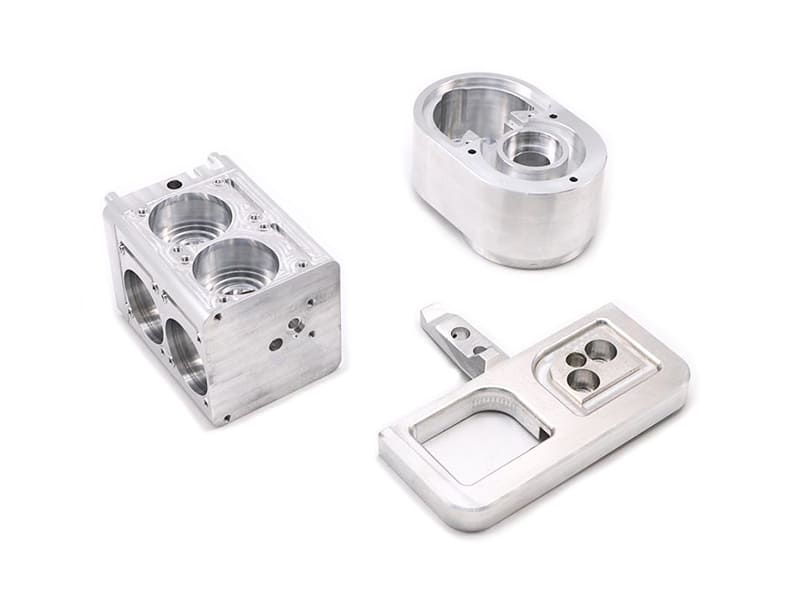
A product team designs an aluminum equipment enclosure with CNC-machined mounting features and an anodized exterior appearance. Initial specification calls for 6063-T6 across the entire part — leveraging its superior anodizing quality. During CNC machining, the softer 6063 smears instead of cutting cleanly. Tool marks drag across surfaces. Burrs require extensive secondary deburring. Dimensional tolerance on precision bore features drifts to ±0.03 mm versus the required ±0.01 mm. Switching the CNC-machined structural body to 6061-T6 while keeping 6063 for the extruded decorative trim eliminates all machining issues — 6061’s higher hardness produces clean chip formation, stable dimensions, and consistent surface finish directly from the machine. We optimize 6061 versus 6063 selection on CNC and extrusion programs regularly. Both are 6xxx series Al-Mg-Si alloys sharing good corrosion resistance and heat treatability — but 6061 is engineered for structural strength and machining performance, while 6063 is optimized for extrusion flow and anodized appearance. Choosing one where the other belongs creates predictable manufacturing problems.
This guide covers composition differences, mechanical properties, machinability and CNC performance, anodizing and surface finish, corrosion resistance, applications, cost analysis, and a practical decision framework.
Composition
| Element | 6061 | 6063 | Impact |
|---|---|---|---|
| Magnesium (Mg) | 0.8–1.2% | 0.45–0.9% | More Mg → stronger precipitation hardening |
| Silicon (Si) | 0.4–0.8% | 0.2–0.6% | Higher Si supports strength |
| Copper (Cu) | 0.15–0.4% | ≤0.1% | Cu boosts strength, slightly reduces corrosion |
| Chromium (Cr) | 0.04–0.35% | Very low | Improves grain control and toughness |
Both alloys strengthen through Mg₂Si precipitates during heat treatment (T5/T6 temper). 6061’s higher Mg + Si + Cu content produces more precipitates → higher strength and hardness. 6063’s lower alloying keeps the material softer and more formable → better extrusion flow and cleaner anodized appearance.
Key composition effect: 6061’s copper content (~0.15–0.4%) boosts strength but can produce slightly less uniform anodized color versus 6063’s very low copper (<0.1%). This single element difference explains why architectural extrusions default to 6063 — the cleaner chemistry produces more consistent anodized appearance across production batches.
Mechanical Properties
| Property | 6061-T6 | 6063-T5/T6 | Meaning |
|---|---|---|---|
| Tensile strength | ~290 MPa | ~145–240 MPa | 6061 handles higher loads |
| Yield strength | ~240 MPa | ~110–200 MPa | 6061 has larger safety margin |
| Hardness | ~95 HB | ~60–80 HB | 6061 resists wear better |
| Elongation | ~8–12% | ~10–18% | 6063 forms/extrudes more easily |
| Fatigue resistance | Better | Moderate | 6061 for cyclic loading |
6061-T6 provides roughly 20–50% higher strength than 6063-T6 across all metrics. This makes 6061 the default for load-bearing frames, brackets, fixtures, and any component where structural safety margin matters. 6063’s higher elongation and lower flow stress make it ideal for pushing through extrusion dies — enabling thin-wall, complex cross-section profiles that 6061 cannot achieve as efficiently. Based on our production data, 6061-T6 accounts for approximately 70% of our structural aluminum CNC programs, while 6063 dominates our extruded profile orders at roughly 80% share — each alloy clearly owns its manufacturing domain.
Machinability and CNC Performance
| Factor | 6061 | 6063 | Impact |
|---|---|---|---|
| Machinability rating | High | Moderate | 6061 machines faster |
| Chip formation | Short, controlled | Soft, can smear | 6061 gives cleaner cuts |
| Surface quality | Stable, consistent | Prone to drag marks | 6063 needs finishing |
| Dimensional stability | Excellent | Moderate | 6061 holds tighter tolerance |
| Tool behavior | Predictable wear | Built-up edge risk | 6063 requires sharper tools |
Why 6061 Is CNC-Optimized
Higher hardness means the cutting tool shears material cleanly rather than deforming it. Chips break short and evacuate well. Dimensional stability allows achieving ±0.01 mm or tighter on precision features. Tool wear is predictable and gradual. One common pitfall we see: specifying 6063 for CNC-intensive parts based on lower raw material cost — the machining cost increase (slower parameters, more deburring, higher scrap from dimensional drift) typically exceeds the material savings by 15–30%.
Machining 6063
Softer material → tool pushes instead of cutting cleanly. Built-up edge forms more readily. Burrs on edges require secondary deburring. Acceptable for light machining on extruded profiles (drilling, tapping, simple cuts) but not ideal for precision multi-axis CNC work.
Practical rule: If the part is primarily CNC-machined → 6061. If the part is primarily extruded with minimal secondary machining → 6063.
Anodizing and Surface Finish
| Aspect | 6061 | 6063 | Selection |
|---|---|---|---|
| Anodizing quality | Good | Excellent | 6063 for visual parts |
| Color consistency | Moderate | High | 6063 for batch uniformity |
| Surface defect visibility | More visible | Less visible | 6063 hides imperfections |
| Decorative finishes | Acceptable | Superior | 6063 for architecture |
6063’s lower copper content produces a cleaner oxide layer during anodizing — resulting in more uniform color, smoother texture, and fewer visible surface defects. This is why 6063 is the global standard for architectural aluminum (windows, curtain walls, facades, decorative trim).
6061 anodizes well for functional purposes (corrosion protection, wear resistance) but may show slight color variation and more visible machining marks through the anodized layer. In our shop floor experience, rejection rates on appearance-critical anodized parts run approximately 3× higher with 6061 versus 6063 — driven primarily by color inconsistency across batches rather than functional coating failure.
Corrosion Resistance
| Environment | 6061 | 6063 |
|---|---|---|
| Indoor / dry | Excellent | Excellent |
| Outdoor (rain) | Good | Very good |
| Anodized exterior | Good | Excellent |
| Coastal / salt spray | Good (with protection) | Better (with anodizing) |
Both alloys form a natural aluminum oxide (Al₂O₃) film providing inherent corrosion protection. 6063’s lower copper content produces a cleaner, more uniform oxide — performing slightly better in outdoor and coastal exposure, especially when anodized. For structural outdoor parts where appearance is secondary, 6061 with appropriate anodizing (10–25 µm) performs well. For visible outdoor parts where consistent appearance matters, 6063 with anodizing is the safer specification.
Applications
| Application | Better Choice | Reason |
|---|---|---|
| CNC machined brackets | 6061 | Strength + machinability |
| Structural frames | 6061 | Load-bearing capacity |
| Window/door profiles | 6063 | Extrusion quality + anodizing |
| T-slot profiles | 6063 | Complex cross-sections |
| Heat sinks | 6063 | Fine fin extrusion + surface |
| Aerospace structural | 6061 | Strength-to-weight + fatigue |
| Decorative trim | 6063 | Surface finish + color consistency |
6061 domain: Structural brackets, machine frames, mounting plates, automotive/aerospace components, CNC-machined precision parts, jigs and fixtures. Chosen when mechanical performance and dimensional accuracy drive the design.
6063 domain: Architectural profiles (windows, doors, curtain walls), heat sink fins, modular framing (T-slot), decorative trim and housings. Chosen when extrusion complexity and anodized appearance drive the design.
Hybrid approach: Many products use both — 6063 extruded profiles for the visible frame structure with 6061 CNC-machined components at structural connection points. This captures each alloy’s strength in its optimal manufacturing process.
Cost
| Factor | 6061 | 6063 |
|---|---|---|
| Raw material | Similar | Similar |
| CNC machining cost | Lower (cleaner, faster) | Higher (smearing, deburring) |
| Extrusion cost | Moderate | Lower (better flow) |
| Anodizing rework | Moderate risk | Lower risk |
| Structural efficiency | Thinner sections possible | May need thicker walls |
Total cost depends on manufacturing method. CNC-heavy programs → 6061 typically costs less overall (faster machining, less scrap, less finishing). Extrusion-heavy programs → 6063 costs less (better die flow, higher extrusion speed, lower rejection). Based on our production data, switching from 6063 to 6061 on CNC-intensive programs reduces total per-part cost by approximately 10–20% — the machining efficiency gain more than offsets any material price difference.
Decision Guide
| Priority | Choose |
|---|---|
| High strength / structural | 6061-T6 |
| Precision CNC machining | 6061 |
| Complex extrusion profiles | 6063-T5/T6 |
| Anodized appearance | 6063 |
| Architectural / decorative | 6063 |
| Outdoor structural (non-visual) | 6061 + anodizing |
| Mixed structure + appearance | Hybrid (both alloys) |
Decision logic: Start with manufacturing method → CNC-driven = 6061, extrusion-driven = 6063. Then verify: does the strength requirement match? Does the appearance requirement match? Adjust if either criterion overrides the default.
Conclusion
6061 and 6063 are both Al-Mg-Si alloys sharing good corrosion resistance and heat treatability — but they serve fundamentally different manufacturing and performance roles. 6061’s higher alloying (Mg, Si, Cu, Cr) delivers ~20–50% more strength, cleaner CNC machining, and better dimensional stability — making it the structural and precision machining alloy. 6063’s lower alloying produces superior extrusion flow, smoother anodized appearance, and more consistent batch-to-batch color — making it the architectural and decorative alloy.
Choosing correctly by manufacturing method (CNC → 6061, extrusion → 6063) prevents the most common and most expensive specification errors. For products requiring both structural performance and visual quality, a hybrid approach using each alloy where it excels delivers the best total result. Need help selecting between 6061 and 6063 for your aluminum program? [Contact our engineering team] for alloy selection, DFM review, and manufacturing support.
FAQ
What’s the difference between 6061 and 6063?
6061 is stronger (tensile ~290 MPa vs ~145–240 MPa) and better for CNC machining and structural parts. 6063 is optimized for extrusion and anodized appearance. Both are 6xxx Al-Mg-Si alloys — the difference is alloying level, which shifts the balance between strength and formability.
Is 6061 stronger?
Yes — approximately 20–50% higher tensile and yield strength in equivalent temper (T6). 6061 is the default for load-bearing, fatigue-critical, and structurally demanding applications.
Which is better for CNC machining?
6061 — higher hardness produces clean chip formation, stable dimensions (±0.01 mm achievable), and predictable tool wear. 6063 is softer and tends to smear, requiring more deburring and producing less consistent results.
Which is better for anodizing?
6063 — lower copper content creates more uniform color, smoother oxide layer, and fewer visible surface defects. Standard for architectural aluminum where appearance consistency matters.
Which costs less?
Raw material price is similar. Total cost depends on process: CNC-heavy → 6061 is cheaper overall (10–20% less). Extrusion-heavy → 6063 is cheaper (better flow, lower rejection). Choose by manufacturing method, not material price alone.


