
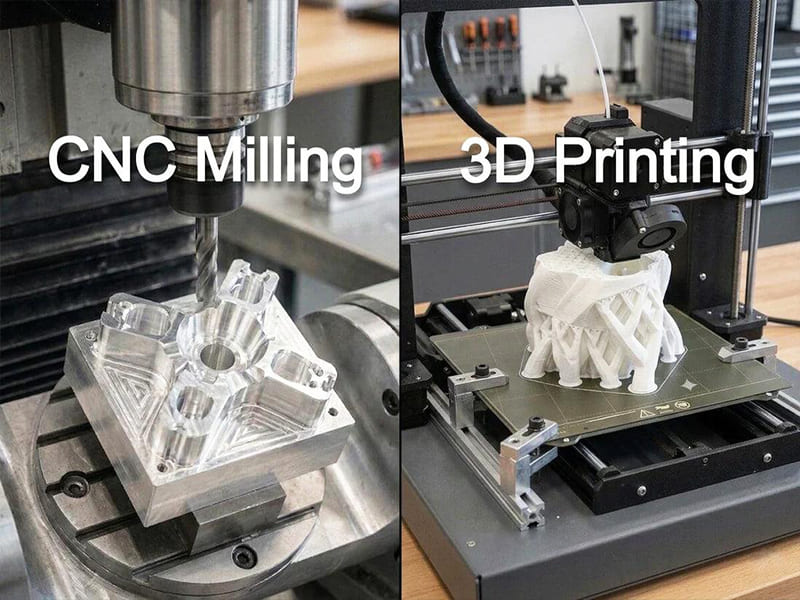
Quick Answer: Additive manufacturing (3D printing) and subtractive manufacturing (CNC machining) serve fundamentally different engineering requirements and are not interchangeable. Additive manufacturing builds parts layer by layer from powder, filament, or resin — enabling complex internal geometries, topology-optimized structures, and low-volume customization without tooling cost. Subtractive manufacturing removes material from solid stock with cutting tools — achieving tolerances of ±0.010 mm or better, surface finish Ra 0.8–1.6 µm, and full-density material properties from a complete range of industrial alloys. The correct process is determined by whether geometry complexity or dimensional precision governs the design. When both matter, hybrid manufacturing — additive for near-net shape plus CNC machining for critical features — is often the optimal solution.
The Fundamental Difference
The core distinction between additive and subtractive manufacturing is how material is shaped:
Additive manufacturing starts from nothing and builds geometry by depositing, fusing, or curing material in successive layers. The part geometry is limited primarily by what can be built layer by layer — complex internal channels, lattice structures, and organic shapes that are physically inaccessible to cutting tools are achievable. The limitation is in dimensional accuracy, material properties, and surface quality.
Subtractive manufacturing starts from solid stock and removes material with cutting tools to reveal the desired geometry. The capability is limited by tool access — features that cutting tools cannot physically reach cannot be machined — but what can be machined is held to very high dimensional accuracy with excellent surface quality and full material density.
This “add vs remove” distinction directly determines every downstream trade-off: geometry freedom, tolerance, material performance, cost structure, and production scalability.
Core Capability Comparison
| Factor | Additive Manufacturing | Subtractive Manufacturing (CNC) |
|---|---|---|
| Dimensional tolerance | ±0.05–0.1 mm typical (process-dependent) | ±0.010 mm or better consistently achievable |
| Surface roughness (Ra) | 3.2–12.5 µm (before secondary finishing) | 0.8–1.6 µm standard; finer achievable |
| Internal geometry | Feasible (unrestricted) | Limited by tool access |
| Material density | May have porosity (especially metals) | Full density from solid stock |
| Material strength | Potentially anisotropic (layer-dependent) | Isotropic — same as stock material specification |
| Available materials | Limited to process-compatible forms | Full industrial range (all machinable metals and plastics) |
| Setup cost | Very low (no tooling) | Moderate (CAM programming, fixturing) |
| Cost per part (low volume) | Lower | Higher |
| Cost per part (high volume) | Remains relatively flat | Decreases significantly with volume |
| Production repeatability | Moderate | High — identical tool paths per part |
| Post-processing required | Often (support removal, finishing, machining) | Minimal to none for most features |
When Additive Manufacturing Is the Correct Choice
Internal Geometry Inaccessible to Cutting Tools
The decisive advantage of additive manufacturing is the ability to build internal features that no cutting tool can reach. Internal cooling channels in injection molds and die casting tooling (conformal cooling) is the canonical industrial application: cooling channels that follow the contour of the part cavity, impossible to drill conventionally, dramatically reduce cooling cycle time and improve part quality when produced additively. Other applications include:
- Hollow lightweight structures where material is present only along load paths
- Internal flow passages in hydraulic manifolds and heat exchangers
- Lattice cores within structural components for weight reduction
- Topology-optimized aerospace brackets where material is removed from regions with no structural contribution
For these applications, the question is not additive versus CNC — CNC physically cannot produce the required geometry. Additive manufacturing is not a preference; it is the enabling technology.
Rapid Prototyping and Iterative Design
When the primary objective is a physical model for fit, form, or functional testing — not a production part — additive manufacturing’s elimination of tooling cost and lead time makes it substantially faster and less expensive than CNC machining.
A product team can iterate through 5 design revisions in a week using FDM or SLA printing, where the same iterations in CNC would require 5 separate setup operations with individual fixturing and programming. In early-stage product development where design requirements are not yet frozen, this iteration speed compresses development timelines.
The critical caveat: prototype performance in an additively manufactured part does not always predict production performance in a machined part, because material properties, dimensional accuracy, and surface condition differ. Prototype validation should include performance tests that are relevant to the final part material and process.
Low-Volume Custom Parts
For production quantities of 1–50 units where each part may differ (or where production volume is insufficient to amortize tooling), additive manufacturing’s zero tooling cost structure is economically superior. Medical implants customized to patient anatomy — hip stems with patient-specific geometry, cranial plates matching CT-scan profiles — are produced additively because no two parts are identical and tooling cost per part would be prohibitive.
Industrial applications include: replacement parts for legacy machinery where patterns no longer exist; custom fixtures for production environments; specialized components for one-off systems.
Lightweight Topology-Optimized Structures
Generative design and topology optimization algorithms remove material from low-stress regions of a structural component, leaving material only along load paths. The resulting geometry — organic, branching, with varying cross-sections that no conventional manufacturing process can produce — can achieve 30–50% weight reduction from an equivalent solid machined part while maintaining structural performance.
Aerospace primary structure, automotive performance components, and robotics end-effectors are examples where this capability provides system-level performance benefits that justify additive manufacturing’s higher per-part cost and post-processing requirements.
When Subtractive Manufacturing (CNC Machining) Is the Correct Choice
Tight Dimensional Tolerances
For any application requiring dimensional tolerances tighter than approximately ±0.05 mm in the as-produced condition, CNC machining is the correct process. Additive manufacturing is subject to thermal distortion during layer deposition or powder bed sintering, layer-to-layer shrinkage variation, and orientation-dependent dimensional behavior. Achieving ±0.010 mm on a precision shaft diameter or bearing seat from any additive process in production requires post-machining — which means the final accuracy comes from machining, not from printing.
CNC machining routinely achieves ±0.010 mm in production, tighter with care and temperature control. This is the standard for:
- Precision shafts, bearing journals, and journals in rotating machinery
- Sealing surfaces (O-ring seats, face seals, pipe thread forms)
- Threaded features (tolerance class 6H/6g and tighter)
- Precision bores for bearings, bushings, and shrink-fit assemblies
- Mating surfaces in assemblies with defined clearance or interference
Surface Quality
CNC machining produces surface roughness of Ra 0.8–1.6 µm as standard from turning and milling operations, without secondary finishing. Fine turning, grinding, and honing extend this to Ra 0.4, 0.2, and 0.1 µm respectively.
Additive processes produce Ra 3.2–12.5 µm as-built (FDM and DMLS, respectively) — too rough for sealing surfaces, precision bearing interfaces, fluid passage walls that must minimize flow resistance, and any surface where friction behavior matters. Finishing additive surfaces to Ra 1.6 µm or better typically requires machining or grinding, meaning the final surface is a machined surface anyway.
For components where surface quality directly affects function — hydraulic seals, pneumatic piston surfaces, cam followers, precision optical mounts — CNC machining is both the enabling and the terminal process.
Full-Density Material with Predictable Mechanical Properties
CNC parts are machined from solid stock — forged, rolled, or drawn — with consistent, isotropic mechanical properties documented by the material supplier and verified by incoming material certification. The fatigue strength, yield strength, and fracture toughness are those specified in the material datasheet without qualification.
Metal additive parts (DMLS, SLM, EBM) may contain:
- Residual porosity from incomplete powder fusion (typically 0.1–2%, depending on process optimization)
- Anisotropic mechanical properties where fatigue strength along the build direction differs by 10–30% from transverse properties
- Residual stresses from rapid thermal cycling during layer deposition, requiring post-process stress relief heat treatment
These effects are manageable for aerospace applications with full material qualification programs, but they represent engineering uncertainty for production components where material properties are assumed from standard specifications rather than part-specific testing.
For high-cycle fatigue applications, load-bearing shafts, structural fasteners, and components where material failure is a safety consequence, CNC machining from certified stock eliminates this uncertainty.
Material Selection Breadth
Subtractive manufacturing works with any machinable material in solid form — the full industrial range: aluminum alloys from 1100 to 7075, stainless steel grades 303 through 17-4PH, tool steels, titanium alloys, high-temperature alloys (Inconel, Hastelloy), engineering plastics (Delrin, PEEK, PTFE, UHMWPE), and copper alloys. Material selection is limited only by machinability.
Additive manufacturing is limited to materials available in appropriate process-compatible form: metal powders for DMLS/SLM (a limited subset of alloys), photopolymers for SLA (a different subset of polymers), filaments for FDM (the widest material range but with strength limitations from layer bonding). The specific grades available for additive processes may not match the grade specified for the application — for example, 303 free-machining stainless steel for precision CNC work has no equivalent additive process.
Medium to High Production Volume
At production quantities above approximately 50–200 parts (the exact crossover depends on part complexity and size), CNC machining’s economics become superior to additive:
- Cycle time per part decreases because setup cost is amortized
- Machine time per part is faster for most geometries (cutting speeds are higher than deposition rates)
- Post-processing requirements are lower (no support removal, less secondary finishing)
- Process repeatability improves at scale through established process controls
Cost Economics: Where the Crossover Occurs
The cost comparison is not a constant — it is a function of production volume, part complexity, and finishing requirements.
| Cost Element | Additive Manufacturing | CNC Machining |
|---|---|---|
| Tooling cost | None | Cutting tools, fixtures, custom toolholders |
| Setup per job | Minimal (file preparation) | Programming, setup, first article inspection |
| Material cost per kg | Higher (powder/resin vs billet) | Lower (standard stock) |
| Cycle time per part | Slower (layer deposition rate) | Faster at volume |
| Support removal and cleaning | Required for most builds | N/A |
| Post-machining of critical features | Often required | Minimal or none |
| Cost per part trend with quantity | Relatively flat | Decreases with volume |
Practical crossover estimate: For a moderately complex aluminum housing with several precision features:
- 1–5 parts: additive manufacturing typically lower total cost
- 10–50 parts: comparable, depending on part complexity and tolerance requirements
- 100+ parts: CNC machining typically lower total cost per part
This crossover shifts earlier (favoring CNC at lower quantities) when the additive part requires significant post-machining of precision features — because that post-machining cost must be added to the print cost for a valid comparison.
The most common cost estimation error is comparing “printing cost” to “machining cost” without including the full finishing cost for the additive part. If an additive part requires 45 minutes of CNC machining to achieve functional tolerances, that machining cost must be included in the additive manufacturing total cost.
Hybrid Manufacturing: When Both Processes Are Used Together
In practice, the most engineering-efficient solution for many complex precision parts is hybrid manufacturing — using additive manufacturing for the geometry that cannot be machined, and CNC machining for the features that require precision.
Standard hybrid workflow:
- Additive manufacturing produces the near-net shape with all internal features and complex geometry
- Heat treatment (stress relief or HIP — hot isostatic pressing — for metal parts) if required
- CNC machining of all precision features: holes to H7 tolerance, threaded interfaces, sealing faces, bearing seats, mounting surfaces
Example: Cooling manifold for injection mold tooling
- Additive produces the manifold body with conformal cooling channels (geometry impossible by conventional drilling)
- CNC machines all pipe thread ports, mounting hole patterns, sealing face flatness, and inlet/outlet surface finish
- Result: internal geometry from additive, functional interfaces from CNC — achievable by neither process alone
Example: Aerospace structural bracket
- Topology-optimized geometry from additive (40% lighter than solid machined equivalent)
- CNC machines all bearing interfaces, fastener hole bores to H7, and mounting surface flatness
- Final part meets both the weight objective from additive design and the dimensional requirements from CNC finishing
The hybrid approach is standard practice in medical implant manufacturing (titanium cages and stems), aerospace secondary structure, and advanced tooling. It is not a compromise — it is the explicit application of each process to the work it does best.
Common Decision Mistakes
Selecting Additive Because the Geometry “Looks Complex”
Complexity of geometry is not sufficient justification for additive manufacturing if CNC can produce the same geometry. Five-axis CNC machining reaches features that three-axis cannot — undercuts, complex contours, deep pockets from multiple approach angles. The correct question is not “is this geometry complex?” but “is this geometry physically unreachable by cutting tools?” If the answer is no, CNC should be evaluated first on the basis of its superior tolerance and surface quality.
Not Including Post-Processing Cost in Additive Economics
Additive metal parts typically require support structure removal (manual grinding and polishing), thermal stress relief heat treatment, and CNC machining of precision features. For a comparison to be valid, the full cost chain — printing, support removal, heat treatment, CNC finishing, inspection — must be summed against the CNC-only alternative. Projects that commit to additive based on print cost alone frequently discover the total cost exceeds the CNC alternative after finishing costs are included.
Assuming Additive Metal Properties Equal Wrought Metal Properties
The same alloy designation does not guarantee equivalent mechanical properties between additive and wrought forms. Ti-6Al-4V produced by DMLS has directional fatigue properties and residual stresses that require heat treatment to normalize. AlSi10Mg (the most widely available additive aluminum alloy) has lower ductility than 6061-T6 from billet. For safety-critical or fatigue-loaded components, material properties from additive processes should be validated by test, not assumed from standard datasheet values.
Choosing CNC for Geometries That Drive Excessive Machining Time
The converse error is attempting to CNC-machine designs with deep internal pockets, very thin walls, or extreme aspect-ratio features that require long cycle times and expensive custom tooling. For parts where internal features dominate the geometry and tight tolerances are limited to a few external interfaces, the hybrid approach often produces lower total cost and better performance than CNC-only.
Key Takeaways
- The fundamental selection criterion is whether geometry or precision governs the design: if internal geometry, weight optimization, or design freedom drives the part, additive manufacturing is the enabling technology; if dimensional tolerance, surface quality, or material performance governs, CNC machining is required.
- Additive manufacturing tolerances (±0.05–0.1 mm typical) require CNC post-machining for any feature requiring ±0.025 mm or better — threads, bearing seats, sealing surfaces, and precision fits always need machining.
- Material properties from additive metal processes are not equivalent to wrought material specifications: porosity, anisotropy, and residual stress require qualification testing for safety-critical or fatigue-loaded applications.
- Cost economics favor additive at low volume and complex geometry; CNC at medium-to-high volume — the crossover varies but typically occurs between 50–200 parts for moderately complex components.
- Hybrid manufacturing — additive for near-net shape, CNC for precision features — is often the optimal strategy for complex parts with precision interfaces, and represents established practice in aerospace, medical, and tooling industries.
- The most common cost estimation error is comparing print cost to machining cost without including post-processing — support removal, heat treatment, and CNC finishing of critical features must be included in the additive total cost for a valid comparison.
- For OEM procurement teams: manufacturing process selection should be part of DFM review, not assumed from the designer’s process preference. Parts designed for additive that include precision interfaces almost always require CNC finishing — if this is not planned in the production schedule, it becomes a late-stage cost and schedule surprise.
Frequently Asked Questions
Is additive manufacturing replacing CNC machining?
No. Additive manufacturing is expanding the range of manufacturable geometries and enabling new design possibilities, but it is not replacing CNC machining for precision functional parts. CNC machining’s advantages in dimensional tolerance (±0.010 mm), surface finish (Ra 0.8–1.6 µm), material reliability, and production repeatability are not matched by any current additive process without post-machining. The dominant trend is hybrid manufacturing — additive for complex geometry and near-net shape, CNC for precision features — not replacement of one by the other. The majority of production industrial components still require CNC machining as either the primary or post-processing operation.
Which is cheaper: additive or CNC machining?
Cost depends primarily on production volume and finishing requirements. For 1–5 custom or complex parts without precision requirements, additive manufacturing typically costs less because there is no tooling or setup cost. For 100+ production parts with standard geometry, CNC machining costs less because setup is amortized and cycle times are shorter. The comparison must include all costs: for additive metal parts, support removal, heat treatment, and CNC machining of precision features must be added to print cost. When a printed part requires significant machining, the total additive + machining cost frequently exceeds the machining-only cost.
Which process is more accurate?
CNC machining is significantly more accurate. Production CNC achieves ±0.010 mm or better on precision features, with surface roughness Ra 0.8–1.6 µm standard, consistently across production batches. Additive manufacturing typically achieves ±0.05–0.1 mm tolerance as-built, with surface roughness Ra 3.2–12.5 µm. The accuracy of additive processes varies with build orientation, layer thickness, and thermal conditions during printing. For precision fits, threads, sealing surfaces, and bearing interfaces, CNC machining is not an alternative to additive — it is the required post-processing step if additive is used.
Can additive manufacturing produce precision metal parts?
Additive metal manufacturing processes (DMLS/SLM, EBM, binder jetting) can produce metal parts in limited alloy options (316L stainless, Ti-6Al-4V, AlSi10Mg, Inconel 625/718, and others). The as-built parts have limitations: tolerance of ±0.05–0.15 mm, surface roughness Ra 6–15 µm, possible residual porosity, and directional mechanical properties. For precision metal components, this means that all tolerance-critical features (threads, bores, sealing surfaces, bearing seats) must be post-machined. The printed part provides the geometry; the machined features provide the functional precision. This hybrid approach is standard practice in aerospace, medical, and tooling applications.
What is hybrid manufacturing and when is it used?
Hybrid manufacturing combines additive and subtractive processes to produce parts that neither process can deliver alone. The standard workflow is: additive printing produces the near-net shape with all complex internal features (channels, lattices, internal structures) that cutting tools cannot reach; CNC machining then finishes all precision external features (precision bores, threads, sealing faces, mounting surfaces, smooth finish surfaces). Hybrid is most valuable for: injection mold tooling with conformal cooling (internal channels from additive, precision cavity surfaces from CNC), aerospace brackets with topology-optimized structure (weight-optimized shape from additive, precision bolt interfaces from CNC), and medical implants with complex bone-interface geometry (porous structure from additive, smooth articulating surfaces from CNC). The approach achieves complex geometry and functional precision simultaneously.
Written by the CMS engineering team with 15+ years of precision CNC machining experience producing components in aluminum, steel, stainless steel, titanium, and engineering plastics for aerospace, medical, automotive, electronics, and industrial OEM manufacturing applications, with extensive DFM review experience for parts transitioning between additive prototypes and CNC production. Technical references: ASTM F2792 (Additive Manufacturing Terminology), ISO 52900 (Additive Manufacturing — General Principles), ASME Y14.5-2018 (GD&T for Machined and Additive Features), SME Fundamentals of Manufacturing (Additive and Subtractive Process Comparison).
Evaluating CNC Machining for Production Components Currently Manufactured Additively?
At CMS, we provide DFM review for parts transitioning from additive prototypes to CNC production, and for hybrid components requiring additive-near-net-shape plus CNC finishing. We identify which features require machining for tolerance compliance, which can remain from additive, and produce a manufacturing plan that delivers both geometry and precision.
[Request a DFM review and CNC machining production quote →]


