
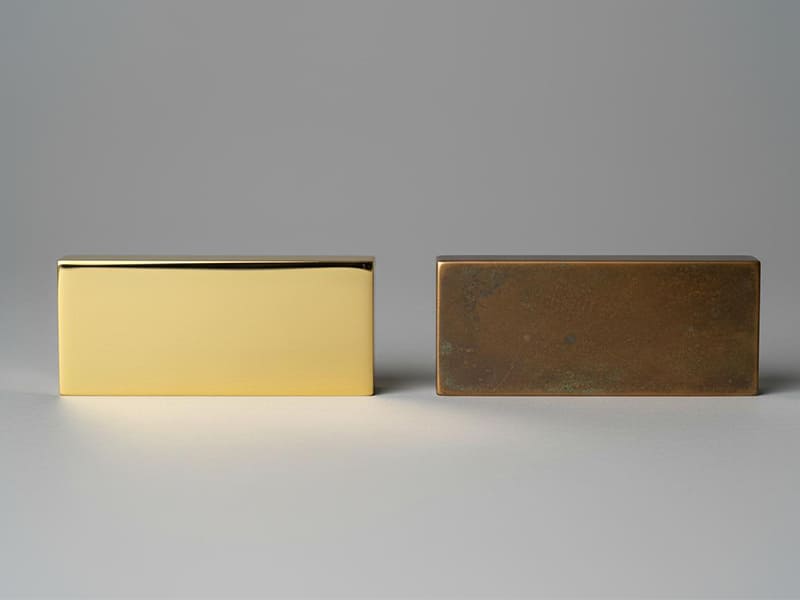
Brass oxidation is the chemical reaction between brass (a copper-zinc alloy) and oxygen in the surrounding environment, forming a layer of copper and zinc oxides on the surface. Initial oxidation appears within hours to days as a slight darkening, progressing to brown tarnish over weeks, then to the characteristic green-blue patina (mainly copper carbonate and copper sulfate) over months to years. Oxidation rate depends on humidity (above 60% accelerates significantly), temperature (each 10°C increase roughly doubles rate), atmospheric pollutants (sulfur compounds and chlorides accelerate dramatically), and brass alloy composition (higher zinc content above 30% increases susceptibility to dezincification). Prevention strategies include protective coatings (lacquer, wax, electroplating), environmental control (humidity below 50%, filtered air), passivation treatments, and material selection (low-zinc brass alloys for outdoor applications). Applications intentionally exploit oxidation for aesthetic patina effects in architecture, sculpture, and decorative hardware, while industrial applications require active prevention to maintain electrical conductivity, dimensional accuracy, and visual appearance.
Introduction
Eight months ago, a customer manufacturing decorative brass door hardware reported that their product line was experiencing 18% return rate due to surface discoloration appearing within 2–3 months of customer installation — far below their 5-year warranty period. The hardware was specified as bare brass with a clear lacquer topcoat, but field returns showed greenish-brown patina developing under the lacquer layer. Our analysis identified three converging issues: lacquer coating thickness was below specification (averaging 8 µm versus the required 15–20 µm), the lacquer formulation wasn’t UV-stable causing micro-cracks within 6 months of exposure, and the brass alloy was C26000 (70% Cu / 30% Zn cartridge brass) which is more susceptible to environmental oxidation than C22000 (90% Cu / 10% Zn commercial bronze) that we recommended for similar applications. After switching to C22000 base material, applying a 2-coat UV-stable acrylic lacquer system at 18 µm minimum thickness, and adding a 24-hour humidity-chamber acceptance test, the return rate dropped to 0.4% within six months. Total cost recovery reached approximately $230,000 annually in eliminated returns and warranty claims.
That project captures why understanding brass oxidation matters beyond academic chemistry — it directly determines product reliability, warranty exposure, and aesthetic longevity in real-world applications. Based on our production data across 400+ brass component programs, approximately 35% of brass-related quality complaints involve oxidation issues that could have been prevented through better alloy selection, surface treatment, or environmental specification. In our shop floor experience, the engineers who understand brass oxidation chemistry make better material specification decisions, design more durable products, and avoid the warranty issues that plague companies treating brass as “stainless equivalent” without recognizing its specific environmental sensitivities. This guide walks through the fundamental chemistry of brass oxidation, the environmental and material factors that control oxidation rate, the visible stages from initial tarnish to mature patina, prevention strategies across coating and material selection approaches, applications that intentionally exploit oxidation for aesthetic effect, distinctions between oxidation and active corrosion, and practical guidance for selecting the right brass treatment approach for specific applications.
Quick Answer: What Is Brass Oxidation?
Brass oxidation is the chemical reaction between brass alloy (typically 60–90% copper plus 10–40% zinc) and oxygen in the surrounding environment, producing surface oxides that progressively change appearance from bright golden to dull tarnish to characteristic green-blue patina.
Core Reaction
The fundamental oxidation chemistry involves both alloy components reacting with atmospheric oxygen:
- Copper component: 2Cu + O₂ → 2CuO (cupric oxide, dark brown to black) and 4Cu + O₂ → 2Cu₂O (cuprous oxide, reddish)
- Zinc component: 2Zn + O₂ → 2ZnO (zinc oxide, white)
- Combined surface layer: mixture of copper and zinc oxides plus environmental compounds
In humid environments with atmospheric pollutants, additional reactions form:
- Copper carbonate: Cu₂(OH)₂CO₃ (green malachite) and Cu₃(OH)₂(CO₃)₂ (azurite blue)
- Copper sulfate: CuSO₄ derivatives (light blue-green)
- Copper chloride: CuCl₂ derivatives (green, indicates marine exposure)
Stages of Brass Oxidation
| Stage | Time Frame | Appearance | Composition |
|---|---|---|---|
| Bright surface | 0 hours | Golden yellow shine | Pure brass, minimal oxide |
| Initial tarnish | Hours to days | Slight darkening, dulling | Thin Cu₂O layer (10–100 nm) |
| Light brown | Days to weeks | Brown patches developing | CuO and ZnO mixture |
| Dark brown/black | Weeks to months | Uniform dark surface | Thicker oxide layer (1–10 µm) |
| Green spots | Months | Green patches appearing | Copper carbonates forming |
| Mature patina | Years | Uniform green-blue layer | Copper carbonate plus sulfate |
One-Line Engineering Summary
Brass oxidation is unavoidable in atmospheric exposure, but its rate can be controlled through alloy selection, protective coatings, environmental management, and surface treatments — making it either a problem to prevent (industrial applications) or a feature to cultivate (architectural and decorative applications).
Brass Oxidation Chemistry: How It Actually Works
The chemistry of brass oxidation involves multiple parallel reactions on copper and zinc components, complicated by environmental factors like humidity, temperature, atmospheric pollutants, and surface condition — understanding these reactions enables both prevention strategies and intentional patina cultivation.
Primary Oxidation Reactions
Stage 1: Initial copper oxidation
When clean brass contacts oxygen, the more reactive copper atoms oxidize first:
4Cu + O₂ → 2Cu₂O (cuprous oxide, reddish-brown)
This forms within hours of exposure as an extremely thin layer (typically 10–50 nm thick) that creates the first visible tarnishing.
Stage 2: Continued oxidation
With continued oxygen exposure, the cuprous oxide further oxidizes:
2Cu₂O + O₂ → 4CuO (cupric oxide, black to brown)
The zinc component oxidizes simultaneously but more slowly than copper at room temperature:
2Zn + O₂ → 2ZnO (zinc oxide, white powder)
The combined oxide layer thickens to 100–500 nm over weeks of exposure.
Stage 3: Carbonate formation (green patina)
In humid environments with atmospheric CO₂, copper compounds convert to carbonates:
2CuO + CO₂ + H₂O → Cu₂(OH)₂CO₃ (malachite, green)
This green carbonate layer is the characteristic “patina” seen on aged brass and bronze sculptures, building roofs (Statue of Liberty), and architectural elements.
Environmental Factor Impact on Oxidation Rate
| Factor | Effect on Oxidation | Approximate Rate Change |
|---|---|---|
| Humidity below 30% | Minimal oxidation | Baseline |
| Humidity 30–60% | Moderate oxidation | 2–3× baseline |
| Humidity above 60% | Rapid oxidation | 5–10× baseline |
| Temperature 25°C | Reference rate | 1× |
| Temperature 50°C | Doubled rate | 2× |
| Temperature 75°C | Quadrupled rate | 4× |
| Clean atmosphere | Slow patina | Baseline |
| Industrial pollution (SO₂) | Rapid darkening | 5–15× faster |
| Marine environment (Cl⁻) | Rapid green patina | 10–30× faster |
| Urban pollution mix | Variable | 3–8× faster |
Role of Specific Atmospheric Pollutants
Sulfur compounds (SO₂, H₂S):
Even trace sulfur dramatically accelerates oxidation:
Cu + ½O₂ + SO₂ → CuSO₃ (eventually CuSO₄)
This reaction proceeds rapidly in industrial atmospheres or near sulfur-containing materials (rubber bands, certain leathers, coal smoke). Sulfur compounds explain why brass darkens quickly in some environments while remaining stable in others.
Chlorides:
Marine environments and salt-spray accelerate brass oxidation through chloride reactions:
Cu + Cl⁻ + ¼O₂ + ½H₂O → ½Cu₂(OH)Cl + ½OH⁻
Chloride contamination explains why brass hardware on coastal buildings develops green patina faster than identical hardware inland.
Carbon dioxide and water:
Even clean atmospheric exposure produces patina through CO₂ and humidity reactions, but the process takes years rather than months.
Why Brass Oxidation Self-Limits
Unlike iron rusting (where oxidation continues progressively destroying the metal), brass oxidation tends to self-limit through passivation:
- Initial oxide layer adheres tightly to underlying metal
- Layer creates physical barrier slowing further oxygen access
- Diffusion through oxide layer becomes rate-limiting
- Below ~10 µm typical maximum oxide thickness on most brass
This passivation behavior makes brass relatively stable for outdoor architectural applications — the green patina actually protects the underlying metal from further attack rather than progressing toward complete deterioration.
Engineering Insight
- Oxidation rate is controlled by environment, not just time
- Atmospheric pollutants accelerate oxidation more than humidity alone
- Self-limiting passivation makes brass durable despite visible color change
- Active corrosion (different process) destroys brass; passive oxidation only changes appearance
Understanding this chemistry enables informed decisions about whether to prevent oxidation (industrial applications), accept natural oxidation (functional outdoor applications), or actively cultivate patina (architectural and decorative applications).
What Causes Brass to Oxidize Faster?
Several environmental and material factors significantly accelerate brass oxidation beyond baseline atmospheric exposure — controlling these factors is the key to predictable oxidation behavior in production applications.
Environmental Acceleration Factors
Humidity:
Water vapor is essential for most oxidation reactions and accelerates the process dramatically:
- Below 30% RH: minimal oxidation, brass retains bright finish for months
- 30–60% RH: gradual tarnish over weeks
- Above 60% RH: rapid darkening within days
- Above 80% RH plus pollutants: visible patina within weeks
This explains why brass hardware in humid bathrooms tarnishes faster than identical hardware in dry living spaces.
Temperature:
Following Arrhenius kinetics, oxidation rate roughly doubles with each 10°C increase:
- 20°C (room temperature): baseline rate
- 30°C: ~2× baseline
- 50°C: ~8× baseline
- 100°C: oxide layers form within minutes
- 200°C+: heavy oxide scaling within hours
Tropical climates and indoor heated environments produce faster oxidation than temperate or air-conditioned spaces.
Atmospheric pollutants:
Industrial and urban environments contain compounds that accelerate brass oxidation:
| Pollutant | Source | Effect |
|---|---|---|
| Sulfur dioxide (SO₂) | Coal combustion, industrial | Rapid darkening, sulfide formation |
| Hydrogen sulfide (H₂S) | Decay, industrial | Black sulfide layer |
| Chlorides (NaCl) | Marine air, road salt | Green patina, accelerated attack |
| Ammonia (NH₃) | Cleaning products, organic decay | Stress corrosion cracking risk |
| Volatile organic compounds | Various industrial sources | Variable effects |
| Acidic gases (NOₓ, CO₂) | Combustion, atmosphere | Slow but cumulative |
Material Composition Effects
Zinc content in brass alloys:
Higher zinc content increases susceptibility to certain oxidation modes:
| Brass Alloy | Cu/Zn Ratio | Zinc % | Oxidation Susceptibility |
|---|---|---|---|
| C21000 (gilding metal) | 95/5 | 5% | Lowest, similar to copper |
| C22000 (commercial bronze) | 90/10 | 10% | Low |
| C23000 (red brass) | 85/15 | 15% | Low to moderate |
| C24000 (low brass) | 80/20 | 20% | Moderate |
| C26000 (cartridge brass) | 70/30 | 30% | Moderate to high |
| C27000 (yellow brass) | 65/35 | 35% | Higher |
| C28000 (Muntz metal) | 60/40 | 40% | Highest, dezincification risk |
| C36000 (free-machining brass) | 60/35/5 (Pb) | 35% | High plus lead leaching |
Dezincification phenomenon:
In high-zinc brasses (above 15% Zn) exposed to certain environments (acidic, chloride-containing), zinc selectively leaches from the alloy:
- Surface becomes spongy and porous
- Mechanical strength reduces dramatically
- Color shifts from yellow to red-brown (pure copper appearance)
- Can occur subsurface even with intact-appearing surface
- Particularly problematic in plumbing applications
Lead content effects:
Free-machining brass (C36000 with 2–3% lead) shows different oxidation behavior:
- Lead doesn’t oxidize significantly at normal temperatures
- Surface lead can leach in acidic environments
- Restricted in drinking water applications (NSF/ANSI 61, lead-free requirements)
- Surface treatments can address leaching concerns
Surface Condition Effects
Surface finish impact:
| Surface Finish | Oxidation Behavior |
|---|---|
| Mirror polished | Slowest oxidation, even appearance |
| Brushed | Slightly faster, may show streaks |
| Sand cast | Faster due to higher surface area |
| Machined | Variable, depends on finish quality |
| Etched/textured | Fastest, deepest patina |
Surface contamination:
- Fingerprints contain salts and oils that accelerate localized oxidation
- Cleaning residues affect oxidation patterns
- Manufacturing oils can either protect or accelerate depending on composition
- Handling without gloves on bright brass causes characteristic fingerprint tarnish
Engineering Insight
- If humidity is high → expect faster oxidation, plan protection accordingly
- If atmospheric pollution exists → oxidation will be uneven and rapid
- If high-zinc brass → consider dezincification potential
- If application involves marine or industrial exposure → use lower-zinc alloys
- If aesthetic appearance matters → control all environmental factors plus surface preparation
Practical Takeaway
For engineers and designers, brass oxidation rate isn’t fixed — it’s a function of environment, alloy selection, and surface preparation. Predicting oxidation behavior requires understanding all three factors, and controlling oxidation requires addressing the dominant accelerating factor for your specific application.
Stages of Brass Oxidation: From Tarnish to Patina
Brass oxidation progresses through visually distinct stages over time — understanding these stages helps predict appearance changes, plan maintenance schedules, and evaluate whether observed conditions represent normal aging or premature deterioration.
Visual Progression Timeline
Stage 1: Bright surface (initial)
- Golden yellow color characteristic of fresh brass
- High reflectivity, mirror-like when polished
- Surface composition: pure brass alloy with minimal oxide
- Duration: hours to days depending on environment
Stage 2: Initial tarnish (24 hours to 7 days)
- Slight dulling of bright finish
- Color shifts from bright yellow to slightly muted gold
- Fingerprints become visible (different oxidation rate at contact)
- Oxide layer thickness: 10–100 nm
- Visible primarily under bright light
Stage 3: Light brown tarnish (1–4 weeks)
- Brown patches develop, especially in low-airflow areas
- Surface develops uneven appearance
- Color ranges from light brown to bronze
- Oxide composition: mixture of Cu₂O and CuO with some ZnO
- Oxide thickness: 100–500 nm
Stage 4: Dark brown to black (1–6 months)
- Uniform dark surface develops
- Original golden color completely obscured
- Surface may show some local variation
- Oxide thickness: 1–5 µm
- This is the “antique brass” look popular in some decorative applications
Stage 5: Green-spotted patina (6 months to 5 years)
- Green patches begin appearing, especially in moisture-collecting areas
- Patches expand and connect over time
- Background remains dark brown to black
- Composition shifts to include copper carbonates
- Most common appearance in outdoor architectural brass
Stage 6: Mature green patina (5–50+ years)
- Uniform blue-green to green color
- Smooth, somewhat dusty texture
- Highly stable, slow further change
- Composition: predominantly copper carbonates and sulfates
- Examples: Statue of Liberty, copper church roofs, ancient bronze artifacts
- Can be aesthetically valuable
Engineering Significance of Each Stage
| Stage | Engineering Concern |
|---|---|
| Bright | Specification: correct alloy, surface condition |
| Initial tarnish | Acceptable for industrial; problem for decorative |
| Light brown | Cleaning intervention possible without damage |
| Dark brown/black | Difficult to fully restore without abrasive removal |
| Green patches | Often desired aesthetic; problem if uneven |
| Mature patina | Stable long-term protection |
Factors Affecting Stage Progression Rate
Indoor environments:
- Climate-controlled: bright to mature patina takes 50+ years
- Standard residential: 5–15 years to dark tarnish
- Bathroom/kitchen: 1–3 years to dark tarnish
- Industrial indoor: 6 months to 2 years
Outdoor environments:
- Rural clean air: 2–10 years to green patches
- Urban: 1–3 years to green patches
- Coastal: 6 months to 1 year for visible green
- Heavy industrial: weeks to months for dark patina
Distinguishing Normal Oxidation from Problems
Normal oxidation characteristics:
- Uniform color across exposed surfaces
- Gradual color change over expected timeframe
- Consistent with environmental conditions
- Self-limiting after patina formation
Abnormal conditions warranting investigation:
- Pitting or surface roughness (suggests active corrosion, not passive oxidation)
- Color changes faster than environment predicts
- Uneven patches suggesting contamination or galvanic effects
- White powder formation (suggests dezincification)
- Surface flaking (suggests poor base material or contamination)
Practical Insight
For engineers and designers, understanding these stages enables:
- Realistic appearance specifications: define acceptable change at specific timeframes
- Maintenance planning: schedule cleaning before patches develop
- Material selection: choose alloy and treatment matching expected service life
- Quality discrimination: identify whether observed condition is normal or problem
- Customer communication: set realistic expectations about brass aging
Key Takeaway
Brass oxidation isn’t a single event but a continuous progression with predictable stages. Rather than trying to prevent oxidation entirely (often impractical), the engineering approach focuses on controlling rate and progression to match application requirements — whether that means maintaining bright finish (industrial), preventing rapid darkening (commercial), or cultivating mature patina (architectural).
How to Prevent Brass Oxidation
Preventing brass oxidation requires a combination of strategies addressing environmental control, surface treatments, and material selection — no single method works universally, and the optimal approach depends on application, service environment, and aesthetic requirements.
Strategy 1: Protective Coatings
Lacquer coatings (most common):
| Coating Type | Thickness | Service Life | Applications |
|---|---|---|---|
| Nitrocellulose lacquer | 5–15 µm | 1–3 years indoor | Decorative hardware |
| Acrylic lacquer | 10–25 µm | 3–7 years indoor | Architecture, instruments |
| Polyurethane | 20–40 µm | 5–10 years | Outdoor exposure |
| Epoxy | 30–60 µm | 10+ years | Industrial, marine |
| Specialized clear coats (Incralac, Permalac) | 15–30 µm | 15–25 years outdoor | Architecture, sculpture |
Application typically involves cleaning, surface activation, lacquer application (often multi-coat), and curing. Failures usually occur at edges, scratches, or pinholes where moisture penetrates underneath, causing localized oxidation that can lift the coating progressively.
Wax coatings:
- Carnauba wax: traditional protection for indoor brass
- Microcrystalline wax: modern museum-grade option (Renaissance Wax)
- Application: thin even layer, buffed to clarity
- Service life: 6 months to 2 years before reapplication
- Advantage: easily renewable, removable
- Disadvantage: shorter protection than lacquer
Electroplating:
- Nickel plating: 5–25 µm provides excellent protection
- Chrome plating: 0.5–10 µm decorative or hard
- Gold plating: 0.5–10 µm for premium applications
- Tin plating: solderability plus protection
Gold plating (0.5–25 µm typical) provides excellent oxidation resistance and is used on electrical contacts where consistent surface conductivity matters.
Strategy 2: Environmental Control
Humidity management:
- Maintain below 50% RH for indoor display
- Use dehumidifiers in storage areas
- Control air exchange in display cases
- Silica gel desiccants for sealed storage
Atmospheric filtration:
- Activated carbon filters remove sulfur compounds
- HEPA filters reduce particulate that catalyzes oxidation
- Sealed cases for valuable brass items
- Regular air quality monitoring in critical applications
Storage practices:
- Anti-tarnish paper (sulfur-free, often impregnated with copper-binding compounds)
- Sealed plastic bags with desiccant
- Acid-free tissue wrapping
- Climate-controlled storage rooms
Strategy 3: Surface Treatments
Passivation:
Chemical treatments that create stable surface oxide:
- Dilute nitric acid passivation
- Benzotriazole (BTA) treatment forms protective copper-BTA complex
- Used in electronics manufacturing
- Provides invisible protection without coating thickness
Conversion coatings:
- Black oxide for decorative dark finish
- Artificial patina chemicals for controlled green appearance
- Provide somewhat stable colored finishes
Anti-tarnish films:
- Vapor phase corrosion inhibitors (VCI papers)
- Self-assembling monolayers (SAMs) in advanced electronics
- Imidazole-based treatments
Strategy 4: Material Selection
Choose alloy matched to environment:
| Environment | Recommended Brass Alloy | Reason |
|---|---|---|
| Indoor decorative | C26000 (cartridge brass) | Cost-effective, machinable |
| Outdoor architectural | C22000 (commercial bronze) | Lower zinc, more stable |
| Marine/coastal | C46400 (naval brass) | Tin addition resists chloride |
| Drinking water | Lead-free brass (C69300, C87850) | Health regulations |
| Electrical contacts | C26000 with gold plating | Conductivity plus protection |
| Machined precision | C36000 free-machining | Note: contains lead |
Alternative materials:
When brass oxidation is unacceptable, consider:
- Stainless steel (different aesthetic but excellent corrosion resistance)
- Aluminum bronze (similar appearance, better corrosion resistance)
- Phosphor bronze (better than brass for some applications)
- Solid gold or gold-filled (premium applications)
Strategy 5: Maintenance Programs
Regular cleaning schedule:
- Bright brass: weekly dusting in normal environments
- Lacquered brass: occasional gentle washing
- Outdoor brass: annual evaluation
- Premium installations: professional maintenance contracts
Cleaning approaches:
- Light tarnish: soft cloth, mild dish soap, dry thoroughly
- Moderate tarnish: commercial brass cleaners (Brasso, Wright’s)
- Heavy oxidation: oxalic acid solutions or professional restoration
- Lacquered brass: never use abrasive cleaners
Engineering Decision Logic
- If display quality must be maintained indoors → environmental control plus periodic cleaning
- If outdoor architectural → choose lower-zinc alloy plus accept patina, or coat aggressively
- If electrical conductivity critical → gold plating or maintenance program
- If marine exposure → naval brass plus heavy coating system
- If cost-sensitive industrial → bare brass with replacement schedule
- If museum quality → protective enclosure plus controlled environment
Practical Takeaway
For engineers, brass oxidation prevention is rarely about achieving zero oxidation but rather managing oxidation rate to match service life requirements at acceptable cost. Combining 2–3 strategies typically delivers better results than relying on any single approach — for example, alloy selection plus protective coating plus reasonable environmental control delivers excellent long-term performance for most applications.
Brass Oxidation vs Brass Corrosion
While often used interchangeably, oxidation and corrosion describe different phenomena with different engineering implications — understanding the distinction helps diagnose problems and select appropriate protection strategies.
Definition and Scope
Brass oxidation:
- Surface chemical reaction with oxygen
- Generally self-limiting through passivation
- Color change without significant structural impact
- Often desirable (patina) or merely cosmetic concern
- Continues at decreasing rate over time
Brass corrosion:
- Active electrochemical or chemical attack
- Progressive material loss
- Structural and functional implications
- Always undesirable
- Often accelerating without intervention
Comparison of Key Characteristics
| Characteristic | Oxidation | Corrosion |
|---|---|---|
| Process type | Surface chemistry | Electrochemical attack |
| Material loss | Negligible (oxide on surface) | Significant (metal consumed) |
| Self-limiting | Yes, after passivation | No, often accelerates |
| Visual indicator | Color change, patina | Pitting, perforation, loss |
| Mechanical impact | Minimal | Reduces strength |
| Reversible | Sometimes (cleaning) | Generally no |
| Engineering response | Manage appearance | Stop progression |
Common Forms of Brass Corrosion
Dezincification:
Selective leaching of zinc from brass alloys, leaving porous copper structure:
- Most common in high-zinc brass (above 15% Zn) in stagnant water
- Plumbing applications with chloride contamination
- Visible as pink/copper-colored patches replacing yellow brass
- Subsurface dezincification can occur with intact-appearing surface
- Mechanical strength reduces dramatically (up to 80% strength loss)
- Prevention: use inhibited brass (C36000 with arsenic), low-zinc alloys, or different material
Stress corrosion cracking (SCC):
Combination of tensile stress plus specific environment causing cracking:
- “Season cracking” in brass cartridge cases (historical)
- Ammonia and amine compounds especially aggressive
- Develops along grain boundaries
- Sudden brittle failure despite intact appearance
- Prevention: stress-relief annealing, environmental control, material selection
Galvanic corrosion:
Accelerated attack when brass contacts dissimilar metals in electrolyte:
- Brass acts as cathode versus aluminum, zinc, steel
- Brass acts as anode versus copper, stainless steel, gold
- Marine and underground applications particularly affected
- Prevention: insulation between dissimilar metals, sacrificial anodes
Pitting corrosion:
Localized attack creating small deep cavities:
- Often initiated at surface contamination or imperfections
- Chloride-induced in marine environments
- More dangerous than uniform attack (may perforate while average loss is minimal)
- Difficult to detect visually until advanced
Erosion corrosion:
High-velocity fluid flow accelerating chemical attack:
- Common in plumbing fittings with turbulent flow
- Recognizable by undercut grooves following flow direction
- Prevention: smooth flow paths, lower velocities, harder alloys
Diagnostic Distinctions
Indicators suggesting oxidation only:
- Uniform color change across surface
- No visible pitting or material loss
- Hardness unchanged
- Standard expected behavior for environment
- Self-limits after weeks to months
Indicators suggesting active corrosion:
- Pitting or surface roughness developing
- Material thinning detectable
- Local hardness or color changes (dezincification)
- Faster than expected progression
- Continuing without stabilization
Practical Diagnostic Approach
When evaluating brass surface condition:
- Assess visual appearance — uniform tarnish suggests oxidation; localized pitting suggests corrosion
- Test surface integrity — sound metal with thumbnail or non-destructive method
- Check mechanical properties if structural — dezincification may not be visible until stress applied
- Evaluate environment — corrosion typically requires specific aggressive conditions
- Compare to baseline — gradual change is normal; rapid change indicates problem
Engineering Implications
For oxidation:
- Plan for appearance management
- Coatings or wax for cosmetic preservation
- Generally acceptable in functional applications
- Easier to address through standard treatments
For corrosion:
- Identify root cause and stop progression
- May require material change (not just coating)
- Structural integrity assessment needed
- Often more expensive to remediate than to prevent
Key Takeaway
Brass oxidation is largely cosmetic and manageable through standard treatments; brass corrosion is structural and requires identifying and eliminating the aggressive environment or replacing materials. Confusing these phenomena leads to inadequate solutions — applying oxidation treatments to corrosion problems doesn’t solve the underlying issue, while aggressively treating normal oxidation as if it were corrosion wastes resources unnecessarily.
Applications That Use Brass Oxidation Strategically
While most engineering contexts treat brass oxidation as a problem to prevent, many applications intentionally cultivate or accept oxidation for aesthetic, functional, or historical reasons — understanding these applications expands the design palette beyond pure prevention.
Architectural Applications
Building exteriors:
- Copper alloy roofs developing green patina (40+ year service life)
- Bronze sculptures and monuments
- Door hardware and accents on traditional buildings
- Window frames in historic restoration
- Examples: Statue of Liberty, US Capitol roof, classical bronze monuments
The intentional patina serves multiple purposes:
- Self-protective layer extends material service life
- Aesthetic appeal of natural aging process
- Historical authenticity for restoration projects
- Reduced maintenance compared to constantly polished alternatives
Architectural specifications:
Modern architectural brass and bronze often use:
- Pre-patinated finishes (chemical treatments applied at factory)
- Living finish specifications (allowing natural patina development)
- Periodic intervention specifications (occasional cleaning)
- Sealed bright finishes for limited applications
Decorative and Artistic Applications
Sculpture:
Bronze and brass sculpture often uses controlled patination:
- Chemical patinas (cupric nitrate for green, liver of sulfur for brown-black)
- Thermal treatments creating colored oxides
- Hand-applied artistic patinas
- Living patinas that change over decades
- Wax sealing to lock in chosen finish
Decorative hardware:
Antique and reproduction hardware:
- Living finish brass (no protective coating)
- Antique brass (artificially aged appearance)
- Hand-rubbed bronze (controlled patina)
- Distressed finishes mimicking aged appearance
- Each finish ages differently based on environment
Musical instruments:
Brass instruments use controlled oxidation strategically:
- Lacquered brass for normal players
- Silver plated for premium instruments
- Raw brass for some specialty applications
- “Vintage” patinated finishes for character
- Specific tonal characteristics attributed to oxidation states (debated)
Functional Applications Using Patina
Marine hardware:
Naval brass and bronze on marine equipment:
- Patina provides additional protection in marine atmosphere
- Some manufacturers specify “marine finish” with developed patina
- Self-renewing surface as wear exposes fresh metal
- Examples: ship hardware, marine fittings, dock components
Roofing:
Copper roofing (and copper-rich brass) develops protective patina:
- Service life of 50+ years typical
- Patina layer reduces underlying material loss
- Aesthetic appeal for premium architecture
- Self-healing if damaged (new patina forms)
Bell metals and bronze castings:
- Church bells develop patina over centuries
- Historical artifacts gain value with authentic aging
- Bronze cymbals for percussion (intentional patina affects tone)
Decorative Surface Effects
Liver of sulfur treatments:
Potassium sulfide solutions create rapid antiquing:
- Black to brown patina in minutes
- Used in jewelry making
- Provides controllable depth of color
- Stable when properly sealed
Cupric nitrate green:
Creates green patina similar to natural aging:
- Faster development than natural process
- Various intensities possible
- Used in art bronze finishing
- Requires proper sealing to maintain
Heat coloring:
Controlled heating produces colored oxide layers:
- Yellow → brown → purple → blue with increasing temperature
- Used in specialty applications
- Decorative effects on small parts
- Limited durability without sealing
Historical and Cultural Significance
Antique items:
Original patina is often valued more than restoration:
- Authenticity verification
- Historical documentation
- Collector value (sometimes 10× higher with patina)
- Cleaning antique brass can dramatically reduce value
Cultural artifacts:
- Religious objects often retain original patina
- Some cultures actively cultivate specific patina appearances
- Restoration ethics emphasize patina preservation
- Museum conservation focuses on stabilizing rather than removing patina
Engineering Insight for Patina Applications
When intentionally using brass oxidation:
- If consistent appearance needed → controlled chemical patination
- If natural aging acceptable → living finish without coating
- If specific color required → choose appropriate chemistry
- If long-term stability matters → seal patina with wax or specialized coating
- If the application is exposed → naval brass or alloys designed for outdoor service
Practical Takeaway
For designers and engineers working with brass intentionally for aesthetic effect, oxidation isn’t a problem but a design tool — understanding which oxidation states produce which appearances enables informed specification of finishes that age gracefully, develop character over time, and deliver design intent that remains valid for decades.
How to Clean Oxidized Brass
When brass oxidation needs to be removed or reduced, multiple approaches exist with different effectiveness, surface impact, and applicability — selecting the right method depends on oxidation severity, brass condition, and desired outcome.
Cleaning Methods by Oxidation Severity
Light tarnish (early-stage oxidation):
| Method | Approach | Effectiveness |
|---|---|---|
| Soft cloth dusting | Daily maintenance | Prevents progression |
| Dish soap solution | Mild detergent in warm water, soft cloth | Removes surface dirt |
| Lemon juice + salt | Mild acidic cleaning | Brightens light tarnish |
| Vinegar + flour paste | Apply, dry, rinse | Removes light oxide |
| Commercial brass cleaner | Brasso, Wright’s, etc. | Standard light cleaning |
Moderate tarnish (developed oxidation):
| Method | Approach | Effectiveness |
|---|---|---|
| Toothpaste | Non-gel, non-whitening, soft cloth | Mild abrasive cleaning |
| Ketchup or tomato paste | Apply, wait 10 min, rinse | Acidic cleaning |
| Lemon + baking soda | Make paste, apply, rinse | Combines acid and mild abrasive |
| Commercial polishes | Per product instructions | Standard moderate restoration |
| Vinegar + flour + salt | Stronger paste application | More aggressive cleaning |
Heavy oxidation (deep tarnish or patina):
| Method | Approach | Effectiveness |
|---|---|---|
| Oxalic acid solution | 5–10% solution, careful application | Removes heavy oxide |
| Ammonia solution | 10% solution, ventilation required | Strong oxide removal |
| Citric acid soak | Concentrated solution, 15–30 min | Effective on green patina |
| Mechanical polishing | Buffing wheel with rouge | Restores bright finish |
| Professional restoration | Specialized chemicals | Severe cases, valuable items |
Step-by-Step Cleaning Procedure
For typical moderate brass tarnish:
Step 1: Test in inconspicuous area
Always test cleaning method on hidden surface first to confirm no damage to finish or material.
Step 2: Pre-clean to remove surface dirt
Wash with warm water and mild dish soap, removing dust, fingerprints, and surface contamination. Dry completely.
Step 3: Apply chosen cleaner
Follow product instructions or recipe carefully. For homemade cleaners, apply with soft cloth in circular motion. For acidic cleaners, never leave on surface longer than recommended.
Step 4: Work systematically
Clean small areas at a time to prevent the cleaner from drying on the surface, which can leave residues or cause uneven cleaning.
Step 5: Rinse thoroughly
Use clean water to remove all cleaner residue. Acidic residues can continue reacting with brass causing damage if not removed.
Step 6: Dry completely
Use soft cotton cloth to dry thoroughly. Any moisture remaining will accelerate new oxidation.
Step 7: Apply protection
Once clean and dry, apply protection appropriate for application:
- Microfiber cloth for daily use
- Carnauba wax for furniture/decor
- Lacquer for outdoor exposure
- Specialized clear coats for architectural
Critical Cleaning Cautions
For lacquered brass:
- NEVER use abrasive cleaners
- NEVER use acidic cleaners
- NEVER use polishes designed for bare brass
- ONLY use soft cloth with mild soap and water
- If lacquer is failing, complete relacquering required (not spot cleaning)
For antique brass:
- Consider value implications before cleaning
- Original patina often more valuable than cleaned appearance
- Consult professional appraiser for valuable items
- Use minimal intervention
For plated brass:
- Plating may be very thin (often less than 1 µm)
- Aggressive cleaning can wear through plating
- Use only methods specified by manufacturer
- Once plating is worn, cannot be restored without replating
Solvent Compatibility Considerations
Safe with bare brass:
- Water and mild detergents
- Vinegar and citric acid (rinse thoroughly)
- Commercial brass cleaners (Brasso, etc.)
- Mild abrasives like toothpaste
Use with caution:
- Strong acids (oxalic, hydrochloric)
- Strong bases (sodium hydroxide)
- Ammonia (causes stress corrosion in some brasses)
- Chlorine bleach (causes pitting)
- Aggressive solvents
Never use:
- Steel wool (leaves embedded steel particles that rust)
- Sandpaper (removes too much material)
- Power tools with abrasive (damages surface)
- Aggressive industrial cleaners
When to Avoid Cleaning
Sometimes the best decision is not to clean:
- Antique items with original patina
- Architectural brass with developed protective patina
- Items where appearance matches design intent
- Bronze sculptures with artistic patina
- Items where cleaning would damage substrate
Engineering Insight
- If cleaning will be regular → choose method that’s gentle enough for repeated use
- If valuable antique → consult professional before cleaning
- If architectural patina → leave alone in most cases
- If lacquered → minimal cleaning only
- If preventing future oxidation → coat appropriately after cleaning
Practical Takeaway
For engineers and maintenance personnel, brass cleaning requires matching method to application — there’s no single “best” cleaner for all situations. The most common mistake is using overly aggressive cleaning on items that need only mild treatment, or using inappropriate cleaners that damage protective coatings.
Key Takeaways
- Brass oxidation is the chemical reaction between brass alloy and atmospheric oxygen, producing oxide layers that progress through bright → tarnished → brown → green-black → mature green patina stages over time. The progression is generally self-limiting through passivation.
- Environmental factors dominate oxidation rate — humidity above 60%, temperature elevation, and atmospheric pollutants (sulfur compounds, chlorides) accelerate oxidation 5–30× over baseline. Material composition (zinc content, lead, alloying elements) creates secondary effects.
- Prevention strategies combine 2–3 approaches — protective coatings (lacquer, wax, electroplating), environmental control (humidity, filtration), surface treatments (passivation, conversion coatings), and material selection (alloy matched to environment) deliver better results than any single method.
- Brass oxidation differs from brass corrosion — oxidation is largely cosmetic and self-limiting; corrosion (dezincification, stress corrosion cracking, galvanic, pitting, erosion) is structural and requires identifying root cause beyond surface treatment.
- Many applications intentionally cultivate oxidation — architectural patina, bronze sculpture, antique restoration, marine hardware, and decorative finishes deliberately exploit brass aging for aesthetic and functional reasons rather than treating it as a problem.
- About 35% of brass quality complaints involve oxidation issues that could be prevented through better alloy selection, surface treatment specification, or environmental control — making oxidation prevention one of the highest-leverage decisions in brass component design.
Conclusion: When and How to Manage Brass Oxidation
Managing brass oxidation requires understanding both the chemistry and the application context. Brass oxidation is unavoidable in atmospheric exposure but can be controlled through strategic combinations of alloy selection, protective coatings, environmental management, and maintenance programs. For industrial applications where bright finish must be maintained, prevention strategies focus on coatings (lacquer, plating) plus environmental control. For decorative and architectural applications, the goal often shifts from prevention to controlled cultivation of desired patina appearance. The engineering decisions that matter most include matching brass alloy to expected environment (lower zinc for outdoor and marine applications), specifying appropriate surface treatments (lacquer thickness and chemistry for service life), establishing realistic expectations about appearance change over time, and distinguishing normal oxidation from active corrosion that requires different intervention. With appropriate specifications and maintenance, brass components can deliver decades of service whether maintained bright or allowed to develop characteristic patina.
If you’re specifying brass components for an upcoming program or evaluating oxidation problems on existing products, our engineering team can review your applications, recommend appropriate brass alloys (C22000, C26000, C36000, C46400, lead-free options) for your specific environments, specify protective treatments matched to service life requirements, and deliver both prototype and production volumes with documented quality control. We’ve completed over 400 brass component programs across decorative hardware, electrical contacts, plumbing fittings, marine hardware, musical instruments, and precision instruments sectors, operating to ISO 9001:2015 quality standards with full ASTM material certification (ASTM B16, B36, B124, B453 for brass alloys), NSF/ANSI 61 lead-free water compliance capability, and standardized surface treatment processes including lacquering, electroplating, chemical patination, and corrosion testing per ASTM B117 salt spray standards. Send us your part drawings along with service environment, expected appearance specifications, and production volume — we’ll return a material recommendation, surface treatment specification, and quote with DFM feedback within two business days.
FAQ
What is brass oxidation?
Brass oxidation is the chemical reaction between brass alloy (typically 60–90% copper plus 10–40% zinc) and oxygen in the surrounding environment, forming layers of copper and zinc oxides on the metal surface. The process begins within hours of atmospheric exposure with a thin invisible oxide layer, progresses to visible tarnish within days to weeks, and develops characteristic green patina over months to years. Brass oxidation is generally self-limiting through passivation — the initial oxide layer creates a barrier slowing further oxygen access. While the process changes appearance from bright golden to dark brown to green-blue, it typically doesn’t significantly damage the underlying metal. This distinguishes oxidation from active corrosion (like dezincification or stress corrosion cracking) which can structurally damage brass.
What causes brass to oxidize faster?
Several environmental and material factors accelerate brass oxidation: (1) Humidity — above 60% RH dramatically speeds oxidation; below 30% slows it significantly. (2) Temperature — each 10°C increase roughly doubles reaction rate. (3) Atmospheric pollutants — sulfur compounds (SO₂, H₂S) accelerate 5–15×, chlorides (marine, road salt) accelerate 10–30×, ammonia accelerates and can cause stress corrosion cracking. (4) Brass alloy composition — higher zinc content (above 30%) increases susceptibility, while lower zinc alloys (C22000 commercial bronze) resist oxidation better. (5) Surface condition — polished surfaces oxidize slower than rough or contaminated surfaces. (6) Galvanic effects — contact with dissimilar metals in damp environments accelerates localized oxidation. Understanding which factors dominate your specific application enables targeted prevention strategies.
How do you prevent brass from oxidizing?
Prevent brass oxidation through combined strategies: (1) Protective coatings — lacquer (acrylic, polyurethane) at 15–25 µm thickness for 3–10 year protection, wax (carnauba, microcrystalline) for 6 months to 2 years renewable protection, electroplating (nickel, chrome, gold) for varied protection levels. (2) Environmental control — maintain humidity below 50% RH, filter atmospheric pollutants, store in sealed containers with desiccant. (3) Surface treatments — passivation with benzotriazole forms protective copper-BTA complex, conversion coatings provide stable surface chemistry. (4) Material selection — use lower-zinc brass (C22000) for outdoor applications, lead-free alloys for water contact, naval brass (C46400) for marine exposure. (5) Maintenance programs — regular cleaning prevents deep oxidation, periodic recoating maintains protection. The optimal approach combines 2–3 strategies based on application requirements.
What’s the difference between brass oxidation and brass tarnish?
Brass tarnish and brass oxidation refer to overlapping but distinct phenomena. Tarnish specifically describes the early visible color change from bright golden to dull or brown — the first noticeable stage of oxidation. Tarnish is the visible evidence of underlying oxide layer formation that constitutes oxidation. In common usage, “tarnish” emphasizes the cosmetic appearance change, while “oxidation” describes the underlying chemical process producing that change. Both terms refer to surface effects rather than structural damage. Tarnish progresses through stages: light surface tarnish (hours to days), brown tarnish (weeks), dark brown to black (months), and eventually green-blue patina (years). All these stages are forms of brass oxidation at different progression points. The terms are largely interchangeable in practical use, with “tarnish” being more colloquial and “oxidation” more technical.
Is brass oxidation harmful?
Brass oxidation is generally not harmful in normal applications. The oxide layers that form (copper oxides, zinc oxides, copper carbonates) are stable compounds that don’t release significantly into the environment under normal conditions. The oxide layer actually protects underlying metal from further attack through passivation. However, several specific concerns exist: (1) Lead leaching from leaded brass alloys (C36000) in drinking water applications has health implications regulated by NSF/ANSI 61 — modern lead-free brasses (C69300) eliminate this concern. (2) Verdigris (green copper compounds) from heavily oxidized brass can transfer to skin or items contacting it temporarily; not toxic in normal exposure but cosmetically problematic. (3) Some patina chemicals used for artificial aging contain hazardous compounds requiring proper handling during application. (4) Galvanic effects with dissimilar metals can cause structural concerns. For typical brass hardware and decorative applications, oxidation is purely a cosmetic consideration without health implications.
Can you reverse brass oxidation?
Light to moderate brass oxidation can be reversed through cleaning, but heavy oxidation and patina formation are difficult or impossible to fully reverse without material removal. Reversal options by severity: (1) Light tarnish — easily removed with mild cleaners (soap, lemon juice, commercial brass polish), restoring near-original appearance. (2) Moderate tarnish — requires more aggressive cleaning (toothpaste paste, vinegar with salt, commercial polishes) but typically restorable. (3) Heavy oxidation — requires acid cleaning (oxalic acid, citric acid) or mechanical polishing that removes thin layer of metal along with oxide. (4) Mature green patina — typically not reversed; cleaning removes patina but exposes oxidized metal underneath that quickly retarnishes. (5) Subsurface dezincification — cannot be reversed; affected metal must be replaced. After cleaning, apply protective coating to prevent rapid re-oxidation. Note that for antique and architectural brass, removing original patina often reduces value significantly and isn’t recommended.
What is the green stuff on brass called?
The green coating that develops on aged brass is called patina (specifically copper patina), and it consists primarily of copper carbonate compounds along with copper sulfate, copper chloride, and copper oxide depending on environmental exposure. The main green compound is malachite (Cu₂(OH)₂CO₃), which forms through reaction of copper with atmospheric carbon dioxide and humidity over months to years. In marine environments, copper chlorides (atacamite, paratacamite) contribute to green coloration. In industrial environments with sulfur pollution, copper sulfates create green-blue colors. The Statue of Liberty’s distinctive green color is patina that developed from its original copper-bronze surface over decades of exposure. Patina is generally a stable, protective surface layer that prevents further deterioration of underlying metal — making it valuable as natural protection in architectural applications. Sometimes called verdigris (especially on older brass), the green patina is often deliberately cultivated for aesthetic purposes in decorative arts, sculpture, and architectural restoration.


