
A designer specifies 3 mm solid aluminum for a 1200 × 800 mm equipment enclosure panel. The panel looks fine on paper — but once fabricated, it oil-cans visibly under finger pressure and warps by 2 mm across its span after a few thermal cycles. The fix? Switching to a 4 mm ACM panel at roughly half the weight, double the bending stiffness, and lower fabrication cost. This scenario plays out constantly in panel-driven applications, and it’s why understanding what aluminum composite material actually is — and isn’t — matters for engineering and procurement decisions.
This article explains aluminum composite material (ACM) from an engineering and manufacturing perspective. We cover its sandwich structure, why it achieves high stiffness at low weight, key mechanical and environmental properties, manufacturing process, practical applications, comparison with alternative panel materials, and selection guidelines. The goal is to help designers, engineers, and buyers evaluate ACM based on real performance — not just appearance or price.
What Is Aluminum Composite Material (ACM)?
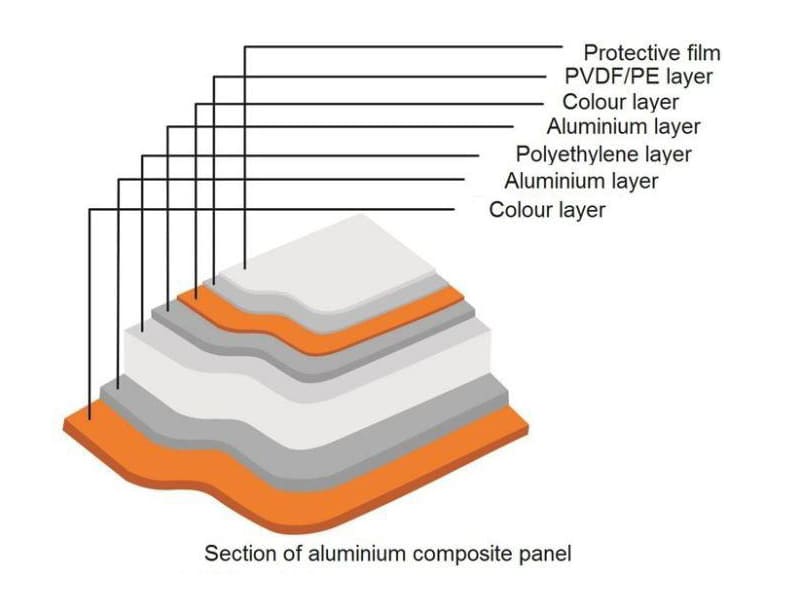
Aluminum composite material is an engineered sandwich panel consisting of two thin aluminum sheets permanently bonded to a non-aluminum core — typically polyethylene (PE) or mineral-filled polymer. This three-layer configuration delivers high bending stiffness and dimensional stability at a fraction of the weight of solid metal panels.
The aluminum skins primarily carry tensile and compressive stresses during bending. The core maintains skin separation and resists shear. This division of structural roles allows ACM to outperform monolithic sheets on a stiffness-per-weight basis — often by a factor of 3–5× at equivalent mass.
ACM vs. Solid Aluminum Sheet
Although ACM uses aluminum on its surfaces, it behaves fundamentally differently from solid aluminum sheet. Solid aluminum relies entirely on material thickness for stiffness. ACM achieves stiffness through geometry and layer separation. At equivalent weight, ACM panels are significantly stiffer in bending. However, solid aluminum offers higher edge strength and localized load resistance.
| Aspect | ACM Panel | Solid Aluminum Sheet |
|---|---|---|
| Structure | Layered sandwich | Monolithic |
| Stiffness-to-weight | High | Moderate |
| Formability | Good (routing, folding) | Good (bending, machining) |
| Edge load capacity | Limited | High |
| Typical use | Panels, enclosures, covers | Structural parts, brackets |
Key distinction: ACM is not a replacement for solid aluminum. It’s a structural efficiency solution optimized for panel applications where flatness, light weight, and large area matter most.
Structure of Aluminum Composite Material
ACM performance comes from its three-layer architecture. Each layer serves a distinct mechanical function.
Outer Aluminum Layers
The skins are typically 0.2–0.5 mm thick aluminum sheets, commonly 3xxx or 5xxx series alloys selected for formability, corrosion resistance, and surface quality. Chemical pretreatment (chromate-free processes per current environmental standards) enhances coating adhesion and long-term durability. These layers provide the visible finish, protect the core, and carry most of the panel’s bending strength.
Core Materials
The core separates the skins and resists shear — both critical to panel stiffness.
PE (polyethylene) core: Low density, good impact resistance. Common in signage, enclosures, and non-structural panels. Not fire resistant.
FR (fire-resistant) core: Mineral-filled or modified polymer. Reduced combustibility for regulated environments — building codes, transportation, public spaces.
Specialty cores: Higher inorganic content for improved stiffness, thermal stability, or sustainability-driven applications.
Core selection is a primary engineering decision. It directly drives fire behavior, shear rigidity, and panel weight.
Bonding
ACM layers join through thermal lamination or hot-press bonding. Heat and pressure activate adhesive layers, creating a permanent composite. Peel strength and shear adhesion determine resistance to delamination. In our fabrication experience, bond quality is the single most important variable separating panels that look identical but perform very differently in service.
Why Is ACM Lightweight Yet Rigid?
Composite Sandwich Action
The key mechanism: bending stiffness in a sandwich panel scales strongly with the distance between load-carrying skins — not just with material strength. Aluminum skins handle tension and compression. Meanwhile, the core keeps them separated and resists shear. Increasing skin separation dramatically raises the panel’s second moment of area, which governs bending resistance.
Practically, a 4 mm ACM panel with thin aluminum skins can be several times stiffer than a solid aluminum sheet of similar weight, even though the total aluminum content is much lower.
Dimensional Stability
ACM’s symmetric laminate structure balances internal stresses, reducing warpage. The core dampens vibration and limits stress concentration. Although aluminum skins expand with temperature, the composite structure controls thermal distortion across large panel areas better than thin metal sheets alone.
For designers, this translates into flatter panels, more consistent gaps, and improved visual quality across temperature changes — a significant advantage for enclosures and façade panels.
Key Properties of Aluminum Composite Material
Mechanical Properties
ACM optimizes for panel performance. High bending stiffness per unit weight makes it effective for large, flat panels where deflection control is critical. The polymer core absorbs energy, giving ACM better impact tolerance than thin aluminum sheets against dents and handling damage. However, ACM is not intended for high point loads or threaded fastening without reinforcement.
Environmental Durability
Coated aluminum skins (typically PVDF or polyester systems) resist rain, humidity, temperature cycling, and UV degradation. PVDF coatings offer superior long-term weather resistance for outdoor use. Polyester coatings are more economical for indoor or short-life applications. Durability depends heavily on coating system and core type — not just the aluminum itself.
Fabrication and Machinability
One of ACM’s strongest advantages. Panels cut, CNC-route, and V-groove easily using standard tools with low cutting forces. Routed grooves enable precise folding without cracking the aluminum skins — creating clean box structures and formed shapes. Based on our production data, ACM fabrication typically runs 40–60% faster than equivalent work in solid aluminum sheet, with significantly less fixturing required.
How Is ACM Manufactured?
Raw Material Preparation
Production starts with aluminum coils (0.2–0.5 mm thick) — cleaned, pretreated, and prepared for bonding. Core materials arrive as continuous sheets or extrudates. Consistency in aluminum thickness tolerance and core density is critical for uniform panel behavior.
Lamination and Coating
The lamination step permanently bonds layers under controlled heat and pressure, creating a void-free composite. After lamination, surfaces receive PVDF or polyester coatings. Coating thickness, curing temperature, and line speed all affect surface durability and color consistency.
Quality Control
High-quality ACM requires manufacturing discipline, not just good materials. Key checks include flatness and residual stress control (prevents warping during installation), peel bond strength testing (ensures long-term adhesion), and surface uniformity verification (consistent color, gloss, and coating thickness). Inconsistent lamination or coating leads to delamination, oil-canning, or premature surface degradation in service.
Common Applications of Aluminum Composite Material
Architectural and Construction
Curtain walls, exterior cladding, and interior decoration panels. ACM delivers flat, modern surfaces with low dead load, reducing structural demand on buildings. Coated skins offer corrosion and UV resistance for long-term outdoor exposure.
Signage, Displays, and Enclosures
Flatness and print compatibility make ACM ideal for signage systems and exhibition panels. Equipment enclosures benefit from the combination of rigidity, appearance, and low weight. For designers and procurement teams, ACM offers a predictable balance between cost, appearance, and manufacturability in custom or short-run projects.
Industrial and Engineering Uses
Machine covers, access panels, protective housings, lightweight partitions, and machine guards. These applications leverage ACM’s stiffness-to-weight ratio, impact tolerance, and CNC-friendly fabrication — especially valuable in low-volume or custom equipment manufacturing.
ACM vs. Other Panel Materials
ACM vs. Solid Aluminum
ACM is significantly stiffer per unit weight for panel applications. Solid aluminum requires greater thickness (and cost) to match stiffness. However, solid aluminum performs better under point loads, threaded fastening, and structural machining.
ACM vs. Steel Panels
Steel is heavier, requires corrosion protection, and increases handling and support structure costs. ACM wins on weight and maintenance, while steel excels in impact resistance and raw strength.
ACM vs. Other Composites
ACM benefits from standardized production, global availability, and lower cost than aerospace-grade composites. Compared to plastic panels, ACM shows better UV resistance, flatness retention, and surface stability over time.
| Material | Weight | Stiffness (per weight) | Cost | Maintenance | Best For |
|---|---|---|---|---|---|
| ACM | Low | High | Medium | Low | Panels, enclosures |
| Solid aluminum | Medium | Medium | High | Moderate | Structural parts |
| Steel | High | High | Low–medium | High | Heavy-duty panels |
| Other composites | Low | Variable | Medium–high | Varies | Specialty panels |
How to Choose the Right ACM
Key Selection Factors
Panel thickness (3–6 mm): Thinner panels suit signage and lightweight enclosures. Thicker panels improve flatness and deflection control for large spans.
Core type: PE core for indoor or low-risk environments. FR core where fire performance is regulated. Specialty cores for higher stiffness or environmental requirements.
Surface coating: PVDF for long-term outdoor use. Polyester for indoor or short-life applications.
Fire rating: Non-negotiable in construction, transportation, and public environments. Always verify compliance before finalizing.
Common Mistakes
Ignoring fire classification — using PE-core panels in regulated environments causes compliance failure. Over-prioritizing low cost — cheaper panels may sacrifice bond strength, flatness, or coating durability. Assuming all ACM panels are equivalent — manufacturing quality varies significantly between suppliers.
When Custom Solutions Are Needed
Standard panels don’t fit every use case. Custom solutions make sense for non-standard dimensions, special surfaces (custom colors, conductive layers), and structural integration requiring routed features or inserts. In projects we’ve delivered, combining ACM panels with CNC routing and secondary bonding often produces better functional integration than off-the-shelf alternatives.
Conclusion
Aluminum composite material is a structural optimization solution — not a simple substitute for solid metal panels. Its sandwich structure delivers high bending stiffness, flatness, and dimensional stability at low weight. ACM excels in large-area panels, enclosures, façades, and functional covers. Core type, panel thickness, surface coating, and fire rating determine safety and service life. Treating all ACM panels as equivalent — or selecting purely on price — introduces unnecessary risk.
Most importantly, ACM performance is built in during manufacturing. Lamination quality and coating systems are the primary differentiators between panels that look similar but perform very differently in real applications. Need help selecting the right ACM or evaluating panel options for your project? [Contact our engineering team] for material guidance and fabrication support.
FAQ
Is aluminum composite material stronger than solid aluminum?
Not in absolute terms. ACM doesn’t match solid aluminum in tension, compression, or point loading. Its advantage is bending stiffness per unit weight — thanks to the sandwich structure, ACM panels resist deflection far more efficiently than thin aluminum sheets of similar mass. For load-bearing parts or concentrated forces, solid aluminum remains the better choice.
Is ACM fire resistant?
It depends on the core. PE-core ACM is not fire resistant. FR-core ACM uses mineral-filled cores with significantly improved fire performance, required in regulated environments like buildings and public transportation. Fire resistance depends on standards compliance and core composition — not on the aluminum skins alone.
Can ACM be CNC machined?
Yes — within its design limits. ACM routes, V-grooves, cuts, and drills easily using standard CNC router tooling with low cutting forces. It’s well suited for precision routing and folding operations. However, ACM cannot handle heavy milling, tapping, or deep pocket machining without reinforcement due to its thin skin and polymer core structure.
What thickness of ACM should I choose?
Common thicknesses range from 3 mm to 6 mm. Choose 3 mm for signage and lightweight panels with short spans. Use 4 mm for general enclosures and interior panels. Specify 6 mm for large-area panels requiring higher flatness and stiffness. Base the decision on deflection requirements, not thickness alone.
How long does ACM last outdoors?
High-quality ACM with PVDF-coated skins can last 15–25+ years outdoors, depending on climate and exposure conditions. Durability depends primarily on coating quality, lamination integrity, and installation method. Lower-cost polyester coatings may fade or degrade significantly sooner — especially in high-UV environments.


