
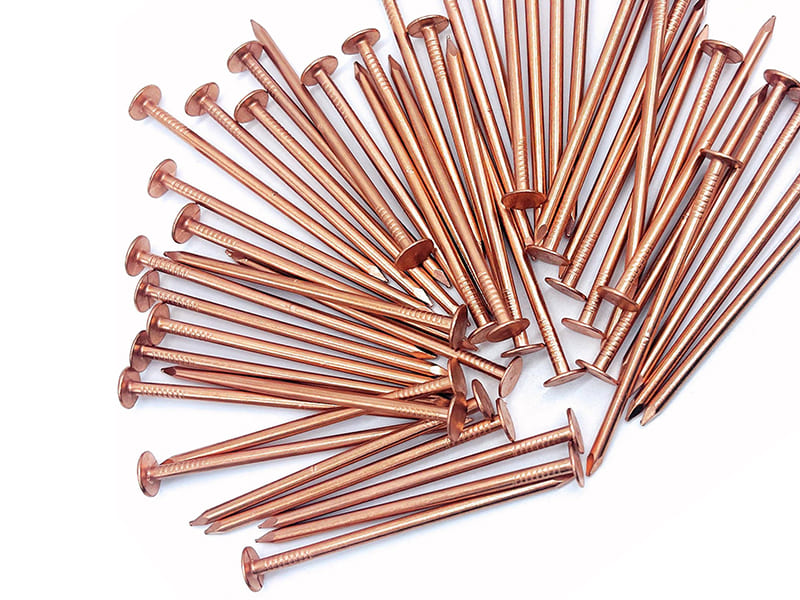
Copper nails remain a deliberate engineering specification — not a throwback to traditional construction. In outdoor, marine, and chemically active environments, they solve problems that galvanized or carbon steel fasteners simply can’t handle reliably over a 30–50 year service horizon. The core reason is straightforward: copper doesn’t rust, and in most atmospheric environments it develops stable surface films that slow further corrosion rather than accelerating it.
Beyond corrosion resistance, material compatibility drives a significant share of copper nail specifications. Copper roofing, lead flashing, treated timber, and non-ferrous assemblies all create environments where steel or zinc-coated fasteners become the weakest point in the system. Copper nails eliminate that failure mode — at higher upfront cost, but with meaningfully lower lifecycle risk and reduced maintenance burden.
Material Properties That Make Copper Nails Different
Most copper nails are manufactured from C110 electrolytic tough pitch (ETP) copper or equivalent high-purity copper alloys — typically 99.9% Cu minimum. The absence of iron is what matters most. No iron means no iron oxide formation, no expansive rust products cracking surrounding timber or coating systems, and no progressive section loss in humid or salt-laden service environments.
Several copper properties translate directly into fastener performance:
Corrosion behavior: Copper forms stable cuprous oxide (Cu₂O) and, over time, basic carbonate patina layers. Both are adherent and self-limiting. Unlike zinc coatings on galvanized nails, this protection doesn’t deplete over time — it stabilizes. In coastal or industrial atmospheres where galvanized zinc layers are consumed in 5–15 years, copper nails routinely outlast the assemblies they secure.
Ductility and cold-forming behavior: Copper’s elongation at break exceeds 40% in annealed condition. When a copper nail is driven, the shank deforms slightly to conform to wood fibers rather than cracking them. More importantly, the nail tail can be peened or mushroomed after installation to create a mechanical lock — the basis of the rivet-and-rove systems used in boatbuilding and heavy timber construction.
Electrochemical compatibility: Copper’s standard electrode potential (+0.34 V) makes it compatible with lead (+0.13 V) and other copper-based materials. Using steel fasteners with copper sheet or lead flashing creates a galvanic cell that aggressively corrodes the steel. Copper nails eliminate that galvanic mismatch entirely.
Types of Copper Nails: Structural Characteristics and Selection
Copper nails aren’t interchangeable commodities. Shank geometry and head design determine the load path, the holding mechanism, and how the joint performs under sustained exposure. Choosing the wrong type typically means undershooting pull-out resistance or overestimating capacity for the application.
Solid Copper Nails (Smooth Shank)
The baseline fastener — drawn from copper wire or rod with a smooth shank and flat or brad head. Holding mechanism is primarily friction between shank and wood fibers. Best suited for light to moderate loads in applications where corrosion resistance is the primary driver: copper flashing, roofing underlays, and softwood exterior trim.
Smooth shank pull-out values are lower than ring shank alternatives. For a 3.35 mm diameter copper clout nail in typical softwood (specific gravity ~0.45), smooth shank pull-out resistance runs approximately 300–450 N per nail depending on embedment length. Adequate for roofing tile and slate in normal wind zones; potentially undersized in high-wind-uplift applications without increased fixing density.
Clout Nails
Clout nails feature a large flat head (typically 8–12 mm diameter) on a relatively short shank. The oversize head increases bearing area against thin roofing materials, reducing pull-through without requiring a washer. Standard specification for slate and tile roofing, roofing felt, and sheet materials where the material being fixed has limited tensile strength perpendicular to its face.
From a design standpoint, clout nails address pull-through rather than withdrawal. They’re not intended for applications where shear or withdrawal loads dominate.
Annular Ring Shank Nails
Ring shank copper nails carry circumferential ridges along the shank at regular intervals — typically 1–2 mm pitch, 0.3–0.5 mm ring height. As the nail is driven, wood fibers deform around the rings and spring back, creating mechanical interlock rather than friction-only engagement.
Pull-out resistance improvement over smooth shank is significant: ring shank values typically run 2–3× higher than smooth shank in equivalent timber. For wind-loaded roofing in BS 5534 applications, ring shank copper nails are often the required specification rather than an upgrade. In practice, a 3.35 × 50 mm ring shank copper clout nail in C16 softwood achieves withdrawal resistance exceeding 900 N — adequate for most domestic roofing wind uplift requirements without increasing fixing count.
Square Shank Nails
Square shank copper nails cut into wood fibers on all four corners as they’re driven, creating a tighter, more secure interface than round shanks in dense or hardwood substrates. The square geometry resists rotation under cyclic loading — relevant in applications subject to vibration or repeated thermal movement.
Splitting risk is higher with square shanks than round or ring shank types. Pre-drilling to 80–90% of the diagonal shank dimension is recommended for hardwoods and near board edges. Without pre-drilling, driving a square shank nail within 25 mm of a slate edge or board end reliably produces splits.
Copper Rivet and Rove Systems
The rivet-and-rove connection is the high-performance end of copper fastening. A copper rivet is driven through both workpieces; a copper rove (washer, typically 12–20 mm diameter) is placed over the protruding tail; the tail is then cut to leave ~4 mm of excess and peened over the rove with a ball-peen hammer.
The resulting joint carries load in shear rather than withdrawal, distributes load through the rove bearing area, and creates a permanent mechanical clamp that tightens slightly under compression from moisture cycling rather than loosening. In wooden boat construction, this system has been standard practice for over a century — specifically because it maintains joint integrity through the continuous wet-dry cycling that destroys withdrawal-loaded connections over time.
Rivet diameter selection follows substrate thickness: a rule of thumb is rivet diameter ≥ 1/6 of the combined material thickness being joined. For 25 mm total timber thickness, 4–5 mm diameter copper rivets are typical.
| Type | Holding Mechanism | Relative Pull-Out | Primary Application |
|---|---|---|---|
| Smooth shank (clout) | Friction | Baseline | Roofing, flashing, softwood trim |
| Large-head clout | Pull-through resistance | Baseline | Slate, tile, sheet material |
| Annular ring shank | Mechanical interlock | 2–3× smooth shank | Wind-loaded roofing, exterior cladding |
| Square shank | Fiber bite + anti-rotation | 1.5–2× smooth shank | Hardwood, timber framing |
| Rivet + rove | Shear clamping | Very high (shear-governed) | Marine, heavy timber, heritage |
Why Copper Nails Outperform Steel and Galvanized Fasteners in Critical Environments
The performance advantage of copper nails over steel alternatives is environment-dependent — and in the environments where it matters, the gap is substantial.
Corrosion Resistance: The Primary Driver
Carbon steel nails in a coastal roofing application can show surface rust within 2–5 years. Once the shank corrodes, it expands, staining the roofing material and eventually losing cross-section. A 3.35 mm nail reduced to 2.5 mm effective diameter by corrosion has lost approximately 44% of its shear area — far beyond any acceptable structural margin.
Galvanized nails improve on bare steel, but protection depends entirely on zinc coating integrity and thickness. Hot-dip galvanized nails carry 45–85 µm of zinc; electro-galvanized nails 5–25 µm. In salt spray conditions representative of coastal environments, a G90 electro-galvanized nail may exhaust its zinc layer in 3–8 years. Once zinc is gone, the underlying steel corrodes aggressively.
Copper nails sidestep this depletion model entirely. There’s no finite protective coating to consume. The copper itself forms a stable surface condition — and unless the service environment includes strong acids, concentrated ammonia, or continuous seawater immersion, that stability continues for decades.
Material Compatibility: System-Level Thinking
Galvanic compatibility is frequently underweighted in fastener selection until failures start appearing. Steel or galvanized nails used to fix copper flashing create a galvanic cell (copper–steel potential difference ~0.5 V in electrolyte) that corrodes the steel fastener preferentially. The copper sheet is fine; the nails beneath it fail. In lead sheet applications, the same logic applies: only compatible metals (copper, stainless steel 316L in some cases) avoid galvanic attack at the fastener.
Treated timber compounds this problem. Modern ACQ (alkaline copper quaternary) and CA (copper azole) preservative treatments are corrosive to zinc coatings and to carbon steel. ASTM research consistently shows galvanized fasteners in ACQ-treated lumber lose zinc coating meaningfully faster than in untreated wood. Copper nails are the standard recommendation for treated timber in exposed conditions — not because of tradition, but because the copper in the preservative and the copper fastener are electrochemically matched.
Lifecycle Cost vs Unit Price
Copper nails run approximately 4–8× the unit cost of galvanized equivalents. On a 200 m² slate roof using 4 nails per slate at 400 mm gauge, that represents a meaningful cost differential. The engineering calculus, however, compares total ownership cost: material cost plus the cost of access, labor, and material replacement when galvanized fasteners fail at year 15–20 of a 60-year roof system.
In most cases, the premium for copper nails recovers within the first replacement cycle avoided.
| Criterion | Copper Nails | Carbon Steel | Hot-Dip Galvanized |
|---|---|---|---|
| Rust resistance | Excellent — no rust mechanism | Poor | Moderate — coating-limited |
| Coastal/salt air performance | Excellent | Very poor | Limited (3–10 years zinc life) |
| Compatibility with copper/lead | Excellent | Poor | Poor–moderate |
| Treated timber compatibility | High | Low | Moderate |
| Unit cost | High | Low | Medium |
| Lifecycle reliability | Very high | Low | Medium |
Where Copper Nails Are Used: Application-Driven Engineering
Roofing: Slate, Tile, and Long-Life Systems
Slate and clay tile roofing is the primary volume application for copper nails in construction. Roofing-grade copper nails — typically 3.35 mm diameter clout nails per BS 6915, 38–50 mm length depending on batten thickness — are specified because the fastener must outlast both the roofing material (slate: 80–150 year design life) and the supporting structure beneath.
Steel or galvanized nails in a slate roof system become the failure point within 20–40 years. The slate is still serviceable; the nails have corroded. Every failed nail requires localized slate removal, a lift-and-relay operation that multiplies labor cost relative to initial installation. Copper nails eliminate that failure mode across the design life.
In terms of fixing pattern, BS 5534 specifies minimum nail lengths and fixing densities for given roof pitches and wind exposure categories. For a 30° pitch roof in exposure zone 3, double nailing with ring shank copper clout nails at alternate courses is often required. Single nailing with smooth shank copper nails may be adequate for sheltered, low-pitch applications with appropriate fixing count.
Marine and Boatbuilding
Copper nails and rivet-rove systems are structural choices in wooden boat construction — not cosmetic ones. Marine environments combine continuous moisture, salt, mechanical vibration, and biological attack in ways that destroy galvanized fasteners within a few seasons.
In traditional lap-straked (clinker) construction, copper nails are driven through overlapping planks and the tails peened — the cold-formed mechanical lock is self-tightening as timber swells with moisture. In carvel construction, copper rivets with roves are standard for frames-to-planking connections. Rivet spacing is typically 100–150 mm for planking fastenings in light boat construction; closer for heavily loaded frames.
Flashing, Gutters, and Lead Sheet
Lead flashing and copper gutter systems represent applications where fastener material compatibility is non-negotiable. A steel screw through a copper gutter end cap creates a galvanic cell that corrodes the steel fastener within 3–5 years in a wet climate. A copper nail or copper screw eliminates the electrochemical mismatch and the hidden failure it produces.
Thermal expansion matching reinforces this choice. Lead’s coefficient of thermal expansion (~29 × 10⁻⁶/°C) is reasonably close to copper’s (~17 × 10⁻⁶/°C), and both are far more compliant than the surrounding masonry or timber. Copper fasteners flex with the sheet material rather than creating stress concentrations at rigid steel points.
Mechanical Performance: Realistic Expectations
Copper nails are softer and weaker than steel — that’s not a flaw, it’s a known design parameter that must be accounted for in specification. Pure copper (C110 annealed) has tensile strength of approximately 220–250 MPa and yield strength around 70–80 MPa. Compare this to carbon steel wire nails at 600–900 MPa tensile. In terms of raw load capacity, copper nails carry significantly less.
What copper nails deliver instead is predictable ductile behavior. Under overload, they bend and deform rather than fracturing. Under cyclic loading from thermal or moisture movement, they accommodate displacement rather than fatigue-cracking. This is why copper rivets in a wooden boat remain secure through decades of wet-dry cycling that would fatigue a steel fastener.
For withdrawal (pull-out) performance, shank geometry dominates over material strength. Ring shank copper nails in typical softwood achieve withdrawal resistance that meets or exceeds smooth-shank galvanized nails of equivalent diameter — not because copper is stronger, but because the ring interlock is more effective than friction on a depleted zinc surface.
Limitations to respect:
- Not appropriate for primary structural connections (roof trusses, joists, load-bearing frames)
- Don’t meet structural steel fastener code requirements where these apply
- Thin, hard substrates (engineered lumber with dense face veneer) limit fiber engagement
- In high shear applications, consult an engineer rather than assuming copper nail capacity is equivalent to steel
Installation: Getting the Best Performance from Copper Nails
Correct installation technique matters more with copper nails than with steel, precisely because copper’s ductility means installation errors directly reduce holding capacity.
Pre-Drilling Strategy
Pre-drilling is mandatory for square shank nails in hardwood, near board edges, and at nail spacing below 25 mm from edges. For clout nails in standard softwood battens, pre-drilling is often omitted — but for slates, pre-drilling nail holes is standard practice because driven nails through slate risk edge spalling.
Pilot hole sizing: 80–90% of shank diameter for hardwoods (preserves fiber engagement while preventing splitting); 70–80% for softwoods; match shank flat-to-flat dimension for square shank nails rather than the diagonal. Drilling slate nail holes: carbide-tipped drill at low speed, no percussion mode, with the slate well supported to prevent cracking from drilling vibration.
Driving Technique
Copper work-hardens. Excessive impact with each blow — particularly after the nail is nearly fully driven — can thin or neck the shank, reducing shear area and pull-out resistance. Use controlled blows of moderate force, particularly for the final 5–10 mm of driving. A nail set is preferable to a hammer face for the final seating to avoid mushrooming the head or marking the roofing material surface.
Avoid overdriving. A copper clout nail driven 1 mm too deep into a slate fastening hole doesn’t grip the slate — it sits loose in the enlarged hole and provides no pull-through resistance.
Peening and Rove Technique
For rivet-and-rove joints, the sequence matters: drive the rivet fully, place the rove over the tail, then cut or nip the excess tail to leave approximately 1.5× the rivet diameter of protruding length. Peen with a ball-peen hammer using progressive, rotating blows working from the center outward to spread the tail evenly over the rove. An uneven peen — thick on one side, thin on the other — concentrates stress and reduces the clamping force the joint provides.
Installation checklist:
- Match nail diameter to substrate density and edge distance
- Pre-drill hardwoods and near-edge positions
- Drive with controlled, moderate force — avoid overdriving
- Peen or rivet where vibration, shear loads, or moisture cycling is expected
- Verify embedment length: minimum 2.5× nail diameter into receiving member
Standards, Specifications, and What to Put on Drawings
For roofing, marine, and long-life applications, “copper nail” on a drawing or BOM is not a sufficient specification. Substitution risk is real — copper-colored steel nails and thin-plated alternatives are commercially available and will be quoted if specifications are ambiguous.
BS 6915 covers copper and copper alloy nails for slate and roof tiling in the UK, defining material purity requirements, dimensional tolerances, head form, and mechanical properties. Compliance with BS 6915 ensures the fastener will perform as part of a BS 5534-compliant roofing system.
BS 5534 (UK) and equivalent national standards govern roofing fixing systems including nail type, size, and fixing density requirements for given exposure categories. Specifying “BS 5534 compliant installation with BS 6915 copper clout nails” defines the entire fastening system, not just the individual fastener.
For marine applications, Lloyd’s Register and various classification society rules reference copper fastener requirements for wooden boat construction — including minimum rivet diameter, rove specifications, and joint spacing.
Procurement specification checklist:
- Material: “solid copper, C110 or equivalent, ≥99.9% Cu minimum” — not “copper-colored” or “copper finish”
- Standard reference: BS 6915 / ASTM F1667 equivalent as applicable
- Dimensions: shank diameter, length, head type and diameter
- Shank type: smooth / ring shank / square shank as required
- Application context: slate roofing / marine / lead flashing etc.
- Surface condition: as-drawn or bright finish as required
How to Choose the Right Copper Nail
Selection comes down to four variables: environment, load type, substrate, and service life expectation. Work through each before settling on a specification.
Environment first: Coastal or marine exposure demands solid copper — no coating to deplete, no zinc to consume. Industrial or polluted atmosphere similarly favors copper over galvanized for multi-decade service. Indoor or dry environments may not justify the cost premium; galvanized is likely adequate.
Load type second: Withdrawal (pull-out) loading — as in wind uplift on roofing — should drive toward ring shank for maximum mechanical interlock. Shear loading — as in planking fastenings in a boat — makes the rivet-and-rove system the right choice. Through-fastening of thin sheet material (flashing, roofing felt) needs the large bearing area of a clout head to control pull-through.
Substrate third: Softwood at standard moisture content — smooth or ring shank clout nails, no pre-drilling required for standard sizes. Hardwood or dense engineered timber — pre-drill, consider square shank. Slate or clay tile — clout nails, pre-drilled holes, minimum 38 mm shank length to clear battens. Lead or copper sheet — gauge-matched length for the sheet thickness plus adequate embedment in the substrate.
Service life expectation last: If the assembly is intended to last 30+ years without fastener access, copper nails are justified on lifecycle grounds regardless of upfront cost. If it’s a temporary structure or easily maintained assembly, the cost premium may not be warranted.
Conclusion
Copper nails are a performance specification, not a premium upgrade. In the environments where they’re correctly applied — roofing systems, marine construction, lead and copper flashings, treated timber assemblies — they solve a corrosion and compatibility problem that galvanized and carbon steel fasteners cannot reliably handle across a 30–60 year design life. The upfront cost premium is real; so is the lifecycle cost advantage of eliminating premature fastener replacement from heavily loaded or difficult-to-access assemblies.
Performance is selection-dependent, however. Specifying “copper nails” without defining shank type, head geometry, diameter, length, and applicable standard leaves too much to interpretation. Ring shank vs smooth shank alone can mean the difference between a compliant roofing installation and one that fails pull-out testing in a wind uplift check. Get the specification right — material grade, dimensions, standard reference, and application context — and copper nails deliver exactly the long-term reliability they’re selected for.
FAQ
Are copper nails stronger than steel nails?
No — and that’s not the right comparison. Carbon steel nails have 2–3× the tensile strength of copper. Copper nails are selected for corrosion resistance and material compatibility, not load capacity. Where steel or galvanized nails rust away in 10–20 years, copper nails remain structurally intact for 50+ years. Ductility is a secondary benefit: copper deforms rather than fracturing under cyclic loading, which actually improves long-term performance in vibrating or moisture-cycling assemblies.
Why are copper nails standard for roofing and marine applications?
Both environments are corrosion-governed rather than strength-governed. In roofing, the fastener must outlast the slate or tile it secures — often 80–150 years for quality slate. Galvanized nails don’t come close. In marine construction, saltwater and continuous moisture cycling destroy zinc coatings within a few seasons. Copper nails and rivet-rove systems have proven multi-decade reliability in these environments for over a century of documented use.
Do copper nails react with treated timber?
Copper nails are the recommended fastener for ACQ and CA pressure-treated timber. Modern wood preservatives are corrosive to zinc coatings and carbon steel — field and laboratory data show accelerated galvanized fastener corrosion in treated wood. Copper nails are electrochemically compatible with copper-based preservatives and avoid coating breakdown entirely.
How long do copper nails last outdoors?
In most outdoor atmospheric environments, copper nails outlast the assemblies they secure. Service lives of 50–80 years are well-documented in roofing applications. Marine rivet-rove systems in well-maintained wooden boats regularly exceed 40–50 years. Actual service life depends on exposure severity, installation quality, and joint design — but unlike galvanized nails, copper nails don’t have a finite protective coating to deplete.
Are copper nails appropriate for structural connections?
Generally no. Primary structural connections — roof trusses, joist hangers, load-bearing frames — require code-compliant structural steel fasteners with defined tensile and shear capacities. Copper nails are for non-structural and semi-structural applications: roofing fixings, cladding, flashing, marine planking. Where wind uplift calculations are required, ring shank copper clout nails specified to BS 5534 provide documented withdrawal values, but these should be verified against the structural requirement, not assumed.


