
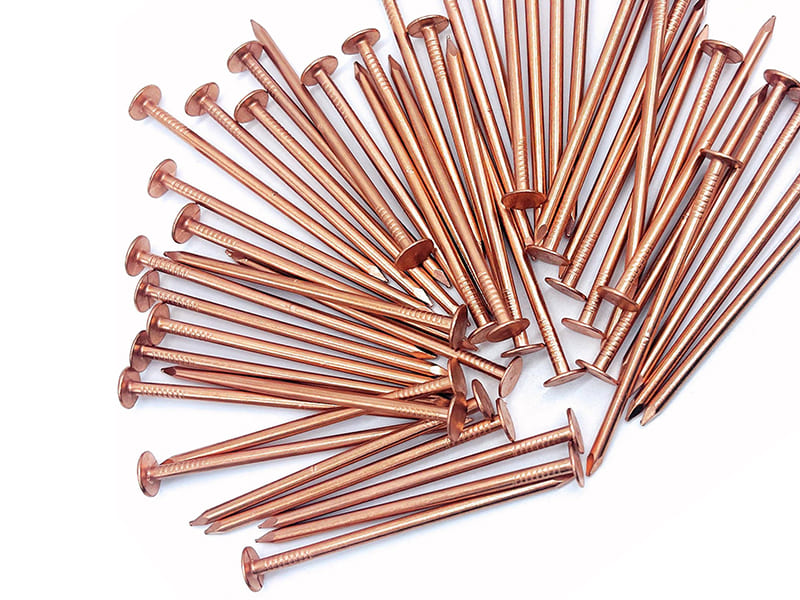
Медные гвозди остаются осознанным инженерным решением — а не возвратом к традиционному строительству. В наружных, морских и химически активных средах они решают задачи, с которыми оцинкованный или углеродистый крепёж просто не может справиться надёжно на горизонте службы 30–50 лет. Основная причина очевидна: медь не ржавеет, а в большинстве атмосферных условий на ней образуются стабильные поверхностные плёнки, которые замедляют дальнейшую коррозию, а не ускоряют её.
Помимо коррозионной стойкости, совместимость материалов определяет значительную долю спецификаций на медные гвозди. Медная кровля, свинцовый оклад, обработанная древесина и сборки из цветных металлов создают условия, в которых стальной или цинковое покрытие крепёж становится самым слабым звеном системы. Медные гвозди устраняют этот вид отказа — при более высокой первоначальной стоимости, но с существенно меньшим риском на протяжении жизненного цикла и сниженной нагрузкой по обслуживанию.
Свойства материала, которые отличают медные гвозди
Большинство медных гвоздей изготавливается из электролитической меди C110 (ETP) или эквивалентных высокочистых медных сплавов — как правило, не менее 99,9% Cu. Отсутствие железа имеет наибольшее значение. Нет железа — нет образования оксида железа, нет расширяющихся продуктов ржавчины, растрескивающих окружающую древесину или системы покрытий, и нет прогрессирующей потери сечения во влажных или насыщенных солью условиях эксплуатации.
Несколько свойств меди напрямую влияют на характеристики крепежа:
Коррозионное поведение: Медь образует стабильный оксид меди (Cu₂O) и со временем — слои основной карбонатной патины. И то, и другое является прочно сцепленным и самоограничивающимся. В отличие от цинковых покрытий на оцинкованных гвоздях, эта защита не истощается со временем — она стабилизируется. В прибрежной или промышленной атмосфере, где оцинкованные цинковые слои расходуются за 5–15 лет, медные гвозди обычно переживают конструкции, которые они скрепляют.
Пластичность и поведение при холодной формовке: Относительное удлинение меди при разрыве превышает 40% в отожжённом состоянии. Когда медный гвоздь забивают, стержень слегка деформируется, приспосабливаясь к волокнам древесины, а не раскалывая их. Что ещё важнее, хвостовик гвоздя можно расклепать или расплющить после установки, создав механический замок — основу систем с заклёпкой и шайбой, используемых в судостроении и тяжёлом деревянном строительстве.
Электрохимическая совместимость: Стандартный электродный потенциал меди (+0,34 В) делает её совместимой со свинцом (+0,13 В) и другими медными материалами. Использование стального крепежа с медным листом или свинцовым окладом создаёт гальванический элемент, который агрессивно корродирует сталь. Медные гвозди полностью устраняют это гальваническое несоответствие.
Типы медных гвоздей: конструктивные характеристики и выбор
Медные гвозди — не взаимозаменяемые товары. Геометрия стержня и конструкция головки определяют путь нагрузки, механизм удержания и то, как соединение работает при длительном воздействии. Выбор неправильного типа обычно означает недооценку сопротивления вырыванию или переоценку несущей способности для данного применения.
Цельные медные гвозди (гладкий стержень)
Базовый крепёж — изготовленный из медной проволоки или прутка с гладким стержнем и плоской или брад-головкой. Механизм удержания — преимущественно трение между стержнем и волокнами древесины. Лучше всего подходит для лёгких и умеренных нагрузок в применениях, где коррозионная стойкость является основным фактором: медный оклад, подкладочные слои кровли и наружная отделка из мягкой древесины.
Значения вырывания для гладкого стержня ниже, чем для кольцевых альтернатив. Для медного гвоздя с плоской головкой диаметром 3,35 мм в типичной мягкой древесине (удельный вес ~0,45) сопротивление вырыванию гладкого стержня составляет примерно 300–450 Н на гвоздь в зависимости от длины заделки. Достаточно для кровельной черепицы и сланца в нормальных ветровых зонах; потенциально недостаточно в применениях с высоким ветровым подъёмом без увеличения плотности крепления.
Гвозди с плоской головкой (клоут-гвозди)
Клоут-гвозди имеют большую плоскую головку (обычно диаметром 8–12 мм) на относительно коротком стержне. Увеличенная головка повышает площадь опирания на тонкие кровельные материалы, снижая продавливание без необходимости в шайбе. Стандартная спецификация для сланцевой и черепичной кровли, кровельного войлока и листовых материалов, где фиксируемый материал имеет ограниченную прочность на растяжение перпендикулярно своей поверхности.
С точки зрения проектирования, клоут-гвозди решают проблему продавливания, а не вырывания. Они не предназначены для применений, где преобладают сдвиговые нагрузки или нагрузки на вырывание.
Гвозди с кольцевым стержнем
Медные гвозди с кольцевым стержнем имеют окружные выступы вдоль стержня через равные интервалы — обычно с шагом 1–2 мм и высотой кольца 0,3–0,5 мм. При забивании гвоздя волокна древесины деформируются вокруг колец и пружинят обратно, создавая механическое зацепление, а не только фрикционное.
Улучшение сопротивления вырыванию по сравнению с гладким стержнем значительно: значения для кольцевого стержня обычно в 2–3 раза выше, чем для гладкого, в эквивалентной древесине. Для ветровой кровли в применениях по BS 5534 медные гвозди с кольцевым стержнем часто являются требуемой спецификацией, а не улучшением. На практике медный клоут-гвоздь с кольцевым стержнем 3,35 × 50 мм в мягкой древесине C16 достигает сопротивления вырыванию, превышающего 900 Н — достаточно для большинства требований по ветровому подъёму domestic roofing без увеличения количества креплений.
Гвозди с квадратным стержнем
Медные гвозди с квадратным стержнем врезаются в волокна древесины по всем четырём углам при забивании, создавая более плотный и надёжный интерфейс, чем круглые стержни, в плотных или твёрдых породах древесины. Квадратная геометрия сопротивляется вращению при циклическом нагружении — что актуально в применениях, подверженных вибрации или повторяющимся термическим перемещениям.
Риск раскалывания выше с квадратными стержнями, чем с круглыми или кольцевыми типами. Предварительное сверление до 80–90% от диагонального размера стержня рекомендуется для твёрдых пород древесины и вблизи краёв досок. Без предварительного сверления забивание гвоздя с квадратным стержнем в пределах 25 мм от края сланца или торца доски надёжно приводит к раскалыванию.
Системы медных заклёпок и шайб
Соединение «заклёпка-шайба» — это высокопроизводительный сегмент медного крепежа. Медная заклёпка вбивается через обе заготовки; медная шайба (обычно диаметром 12–20 мм) надевается на выступающий хвостовик; затем хвостовик обрезается с оставлением ~4 мм запаса и расклёпывается по шайбе шаровым молотком.
Полученное соединение воспринимает нагрузку на срез, а не на вырыв, распределяет нагрузку через опорную площадь шайбы и создаёт постоянный механический зажим, который слегка затягивается при сжатии от циклов увлажнения, а не ослабевает. В деревянном судостроении эта система является стандартной практикой уже более века — именно потому, что она сохраняет целостность соединения при непрерывных циклах увлажнения-высыхания, которые со временем разрушают соединения, работающие на вырыв.
Выбор диаметра заклёпки следует за толщиной substrate: эмпирическое правило — диаметр заклёпки ≥ 1/6 суммарной толщины соединяемых материалов. Для общей толщины древесины 25 мм типичны медные заклёпки диаметром 4–5 мм.
| Тип | Механизм удержания | Относительное сопротивление вырыву | Основное применение |
|---|---|---|---|
| Гладкий стержень (клоут) | Трение | Базовый уровень | Кровля, флешинг, отделка из мягких пород дерева |
| Клоут с большой головкой | Сопротивление продавливанию | Базовый уровень | Шифер, черепица, листовой материал |
| Кольцевой рифлёный стержень | Механическое зацепление | 2–3× гладкого стержня | Кровля под ветровой нагрузкой, наружная облицовка |
| Квадратный стержень | Зацепление с волокнами + защита от проворота | 1,5–2× гладкого стержня | Твёрдая древесина, каркасное строительство |
| Заклёпка + шайба | Сдвиговое зажатие | Очень высокое (определяется сдвигом) | Marine, heavy timber, heritage |
Why Copper Nails Outperform Steel and Galvanized Fasteners in Critical Environments
The performance advantage of copper nails over steel alternatives is environment-dependent — and in the environments where it matters, the gap is substantial.
Corrosion Resistance: The Primary Driver
Carbon steel nails in a coastal roofing application can show surface rust within 2–5 years. Once the shank corrodes, it expands, staining the roofing material and eventually losing cross-section. A 3.35 mm nail reduced to 2.5 mm effective diameter by corrosion has lost approximately 44% of its shear area — far beyond any acceptable structural margin.
Galvanized nails improve on bare steel, but protection depends entirely on zinc coating integrity and thickness. Hot-dip galvanized nails carry 45–85 µm of zinc; electro-galvanized nails 5–25 µm. In salt spray conditions representative of coastal environments, a G90 electro-galvanized nail may exhaust its zinc layer in 3–8 years. Once zinc is gone, the underlying steel corrodes aggressively.
Copper nails sidestep this depletion model entirely. There’s no finite protective coating to consume. The copper itself forms a stable surface condition — and unless the service environment includes strong acids, concentrated ammonia, or continuous seawater immersion, that stability continues for decades.
Material Compatibility: System-Level Thinking
Galvanic compatibility is frequently underweighted in fastener selection until failures start appearing. Steel or galvanized nails used to fix copper flashing create a galvanic cell (copper–steel potential difference ~0.5 V in electrolyte) that corrodes the steel fastener preferentially. The copper sheet is fine; the nails beneath it fail. In lead sheet applications, the same logic applies: only compatible metals (copper, stainless steel 316L in some cases) avoid galvanic attack at the fastener.
Treated timber compounds this problem. Modern ACQ (alkaline copper quaternary) and CA (copper azole) preservative treatments are corrosive to zinc coatings and to carbon steel. ASTM research consistently shows galvanized fasteners in ACQ-treated lumber lose zinc coating meaningfully faster than in untreated wood. Copper nails are the standard recommendation for treated timber in exposed conditions — not because of tradition, but because the copper in the preservative and the copper fastener are electrochemically matched.
Lifecycle Cost vs Unit Price
Copper nails run approximately 4–8× the unit cost of galvanized equivalents. On a 200 m² slate roof using 4 nails per slate at 400 mm gauge, that represents a meaningful cost differential. The engineering calculus, however, compares total ownership cost: material cost plus the cost of access, labor, and material replacement when galvanized fasteners fail at year 15–20 of a 60-year roof system.
In most cases, the premium for copper nails recovers within the first replacement cycle avoided.
| Критерий | Copper Nails | Углеродистая сталь | Hot-Dip Galvanized |
|---|---|---|---|
| Сопротивление ржавчине | Excellent — no rust mechanism | Бедный | Moderate — coating-limited |
| Coastal/salt air performance | Отлично | Очень плохая | Limited (3–10 years zinc life) |
| Compatibility with copper/lead | Отлично | Бедный | Плохо–умеренно |
| Treated timber compatibility | Высокий | Низкий | Умеренный |
| Unit cost | Высокий | Низкий | Средний |
| Lifecycle reliability | Очень высокий | Низкий | Средний |
Where Copper Nails Are Used: Application-Driven Engineering
Roofing: Slate, Tile, and Long-Life Systems
Slate and clay tile roofing is the primary volume application for copper nails in construction. Roofing-grade copper nails — typically 3.35 mm diameter clout nails per BS 6915, 38–50 mm length depending on batten thickness — are specified because the fastener must outlast both the roofing material (slate: 80–150 year design life) and the supporting structure beneath.
Steel or galvanized nails in a slate roof system become the failure point within 20–40 years. The slate is still serviceable; the nails have corroded. Every failed nail requires localized slate removal, a lift-and-relay operation that multiplies labor cost relative to initial installation. Copper nails eliminate that failure mode across the design life.
In terms of fixing pattern, BS 5534 specifies minimum nail lengths and fixing densities for given roof pitches and wind exposure categories. For a 30° pitch roof in exposure zone 3, double nailing with ring shank copper clout nails at alternate courses is often required. Single nailing with smooth shank copper nails may be adequate for sheltered, low-pitch applications with appropriate fixing count.
Marine and Boatbuilding
Copper nails and rivet-rove systems are structural choices in wooden boat construction — not cosmetic ones. Marine environments combine continuous moisture, salt, mechanical vibration, and biological attack in ways that destroy galvanized fasteners within a few seasons.
In traditional lap-straked (clinker) construction, copper nails are driven through overlapping planks and the tails peened — the cold-formed mechanical lock is self-tightening as timber swells with moisture. In carvel construction, copper rivets with roves are standard for frames-to-planking connections. Rivet spacing is typically 100–150 mm for planking fastenings in light boat construction; closer for heavily loaded frames.
Flashing, Gutters, and Lead Sheet
Lead flashing and copper gutter systems represent applications where fastener material compatibility is non-negotiable. A steel screw through a copper gutter end cap creates a galvanic cell that corrodes the steel fastener within 3–5 years in a wet climate. A copper nail or copper screw eliminates the electrochemical mismatch and the hidden failure it produces.
Thermal expansion matching reinforces this choice. Lead’s coefficient of thermal expansion (~29 × 10⁻⁶/°C) is reasonably close to copper’s (~17 × 10⁻⁶/°C), and both are far more compliant than the surrounding masonry or timber. Copper fasteners flex with the sheet material rather than creating stress concentrations at rigid steel points.
Mechanical Performance: Realistic Expectations
Copper nails are softer and weaker than steel — that’s not a flaw, it’s a known design parameter that must be accounted for in specification. Pure copper (C110 annealed) has tensile strength of approximately 220–250 MPa and yield strength around 70–80 MPa. Compare this to carbon steel wire nails at 600–900 MPa tensile. In terms of raw load capacity, copper nails carry significantly less.
What copper nails deliver instead is predictable ductile behavior. Under overload, they bend and deform rather than fracturing. Under cyclic loading from thermal or moisture movement, they accommodate displacement rather than fatigue-cracking. This is why copper rivets in a wooden boat remain secure through decades of wet-dry cycling that would fatigue a steel fastener.
For withdrawal (pull-out) performance, shank geometry dominates over material strength. Ring shank copper nails in typical softwood achieve withdrawal resistance that meets or exceeds smooth-shank galvanized nails of equivalent diameter — not because copper is stronger, but because the ring interlock is more effective than friction on a depleted zinc surface.
Limitations to respect:
- Not appropriate for primary structural connections (roof trusses, joists, load-bearing frames)
- Don’t meet structural steel fastener code requirements where these apply
- Thin, hard substrates (engineered lumber with dense face veneer) limit fiber engagement
- In high shear applications, consult an engineer rather than assuming copper nail capacity is equivalent to steel
Installation: Getting the Best Performance from Copper Nails
Correct installation technique matters more with copper nails than with steel, precisely because copper’s ductility means installation errors directly reduce holding capacity.
Pre-Drilling Strategy
Pre-drilling is mandatory for square shank nails in hardwood, near board edges, and at nail spacing below 25 mm from edges. For clout nails in standard softwood battens, pre-drilling is often omitted — but for slates, pre-drilling nail holes is standard practice because driven nails through slate risk edge spalling.
Pilot hole sizing: 80–90% of shank diameter for hardwoods (preserves fiber engagement while preventing splitting); 70–80% for softwoods; match shank flat-to-flat dimension for square shank nails rather than the diagonal. Drilling slate nail holes: carbide-tipped drill at low speed, no percussion mode, with the slate well supported to prevent cracking from drilling vibration.
Driving Technique
Copper work-hardens. Excessive impact with each blow — particularly after the nail is nearly fully driven — can thin or neck the shank, reducing shear area and pull-out resistance. Use controlled blows of moderate force, particularly for the final 5–10 mm of driving. A nail set is preferable to a hammer face for the final seating to avoid mushrooming the head or marking the roofing material surface.
Avoid overdriving. A copper clout nail driven 1 mm too deep into a slate fastening hole doesn’t grip the slate — it sits loose in the enlarged hole and provides no pull-through resistance.
Peening and Rove Technique
For rivet-and-rove joints, the sequence matters: drive the rivet fully, place the rove over the tail, then cut or nip the excess tail to leave approximately 1.5× the rivet diameter of protruding length. Peen with a ball-peen hammer using progressive, rotating blows working from the center outward to spread the tail evenly over the rove. An uneven peen — thick on one side, thin on the other — concentrates stress and reduces the clamping force the joint provides.
Installation checklist:
- Match nail diameter to substrate density and edge distance
- Pre-drill hardwoods and near-edge positions
- Drive with controlled, moderate force — avoid overdriving
- Peen or rivet where vibration, shear loads, or moisture cycling is expected
- Verify embedment length: minimum 2.5× nail diameter into receiving member
Standards, Specifications, and What to Put on Drawings
For roofing, marine, and long-life applications, “copper nail” on a drawing or BOM is not a sufficient specification. Substitution risk is real — copper-colored steel nails and thin-plated alternatives are commercially available and will be quoted if specifications are ambiguous.
BS 6915 covers copper and copper alloy nails for slate and roof tiling in the UK, defining material purity requirements, dimensional tolerances, head form, and mechanical properties. Compliance with BS 6915 ensures the fastener will perform as part of a BS 5534-compliant roofing system.
BS 5534 (UK) and equivalent national standards govern roofing fixing systems including nail type, size, and fixing density requirements for given exposure categories. Specifying “BS 5534 compliant installation with BS 6915 copper clout nails” defines the entire fastening system, not just the individual fastener.
For marine applications, Lloyd’s Register and various classification society rules reference copper fastener requirements for wooden boat construction — including minimum rivet diameter, rove specifications, and joint spacing.
Procurement specification checklist:
- Material: “solid copper, C110 or equivalent, ≥99.9% Cu minimum” — not “copper-colored” or “copper finish”
- Standard reference: BS 6915 / ASTM F1667 equivalent as applicable
- Dimensions: shank diameter, length, head type and diameter
- Shank type: smooth / ring shank / square shank as required
- Application context: slate roofing / marine / lead flashing etc.
- Surface condition: as-drawn or bright finish as required
How to Choose the Right Copper Nail
Selection comes down to four variables: environment, load type, substrate, and service life expectation. Work through each before settling on a specification.
Environment first: Coastal or marine exposure demands solid copper — no coating to deplete, no zinc to consume. Industrial or polluted atmosphere similarly favors copper over galvanized for multi-decade service. Indoor or dry environments may not justify the cost premium; galvanized is likely adequate.
Load type second: Withdrawal (pull-out) loading — as in wind uplift on roofing — should drive toward ring shank for maximum mechanical interlock. Shear loading — as in planking fastenings in a boat — makes the rivet-and-rove system the right choice. Through-fastening of thin sheet material (flashing, roofing felt) needs the large bearing area of a clout head to control pull-through.
Substrate third: Softwood at standard moisture content — smooth or ring shank clout nails, no pre-drilling required for standard sizes. Hardwood or dense engineered timber — pre-drill, consider square shank. Slate or clay tile — clout nails, pre-drilled holes, minimum 38 mm shank length to clear battens. Lead or copper sheet — gauge-matched length for the sheet thickness plus adequate embedment in the substrate.
Service life expectation last: If the assembly is intended to last 30+ years without fastener access, copper nails are justified on lifecycle grounds regardless of upfront cost. If it’s a temporary structure or easily maintained assembly, the cost premium may not be warranted.
Заключение
Copper nails are a performance specification, not a premium upgrade. In the environments where they’re correctly applied — roofing systems, marine construction, lead and copper flashings, treated timber assemblies — they solve a corrosion and compatibility problem that galvanized and carbon steel fasteners cannot reliably handle across a 30–60 year design life. The upfront cost premium is real; so is the lifecycle cost advantage of eliminating premature fastener replacement from heavily loaded or difficult-to-access assemblies.
Performance is selection-dependent, however. Specifying “copper nails” without defining shank type, head geometry, diameter, length, and applicable standard leaves too much to interpretation. Ring shank vs smooth shank alone can mean the difference between a compliant roofing installation and one that fails pull-out testing in a wind uplift check. Get the specification right — material grade, dimensions, standard reference, and application context — and copper nails deliver exactly the long-term reliability they’re selected for.
Часто задаваемые вопросы
Are copper nails stronger than steel nails?
No — and that’s not the right comparison. Carbon steel nails have 2–3× the tensile strength of copper. Copper nails are selected for corrosion resistance and material compatibility, not load capacity. Where steel or galvanized nails rust away in 10–20 years, copper nails remain structurally intact for 50+ years. Ductility is a secondary benefit: copper deforms rather than fracturing under cyclic loading, which actually improves long-term performance in vibrating or moisture-cycling assemblies.
Why are copper nails standard for roofing and marine applications?
Both environments are corrosion-governed rather than strength-governed. In roofing, the fastener must outlast the slate or tile it secures — often 80–150 years for quality slate. Galvanized nails don’t come close. In marine construction, saltwater and continuous moisture cycling destroy zinc coatings within a few seasons. Copper nails and rivet-rove systems have proven multi-decade reliability in these environments for over a century of documented use.
Do copper nails react with treated timber?
Copper nails are the recommended fastener for ACQ and CA pressure-treated timber. Modern wood preservatives are corrosive to zinc coatings and carbon steel — field and laboratory data show accelerated galvanized fastener corrosion in treated wood. Copper nails are electrochemically compatible with copper-based preservatives and avoid coating breakdown entirely.
How long do copper nails last outdoors?
In most outdoor atmospheric environments, copper nails outlast the assemblies they secure. Service lives of 50–80 years are well-documented in roofing applications. Marine rivet-rove systems in well-maintained wooden boats regularly exceed 40–50 years. Actual service life depends on exposure severity, installation quality, and joint design — but unlike galvanized nails, copper nails don’t have a finite protective coating to deplete.
Are copper nails appropriate for structural connections?
Generally no. Primary structural connections — roof trusses, joist hangers, load-bearing frames — require code-compliant structural steel fasteners with defined tensile and shear capacities. Copper nails are for non-structural and semi-structural applications: roofing fixings, cladding, flashing, marine planking. Where wind uplift calculations are required, ring shank copper clout nails specified to BS 5534 provide documented withdrawal values, but these should be verified against the structural requirement, not assumed.


