
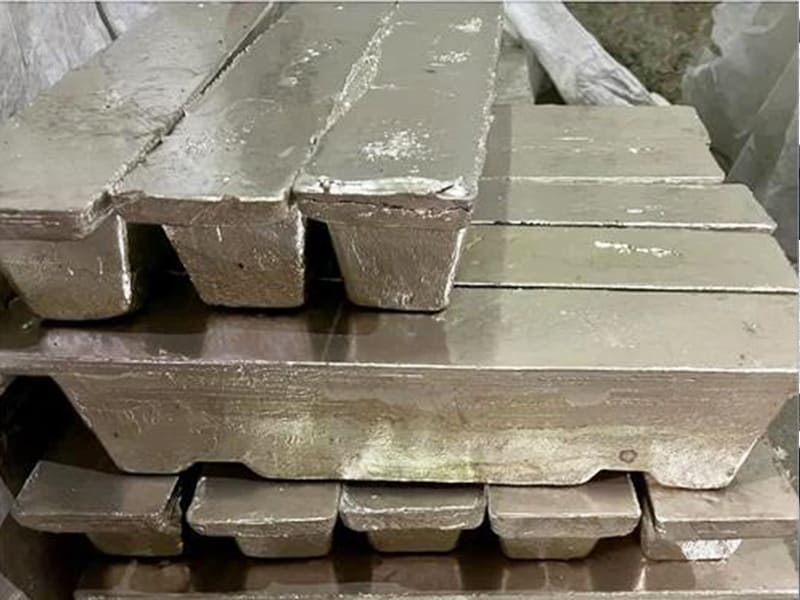
A quality inspector runs a magnet across a batch of tin-plated steel enclosures and flags them as “magnetic tin parts.” A buyer rejects tin-coated connectors because they stick to a magnet during incoming inspection. Both conclusions are wrong — the magnetism comes from the steel substrate, not the tin. We see this confusion in manufacturing regularly, and it leads to incorrect material rejections, unnecessary re-sourcing, and wasted engineering time. So is tin magnetic? No — and understanding exactly why prevents these costly mistakes.
This article explains tin’s magnetic properties from both a scientific and engineering perspective: why tin falls into the non-magnetic category, how its atomic structure determines this behavior, how it compares to ferromagnetic and other non-magnetic metals, why temperature and crystal structure don’t change the answer, why “tin” parts sometimes appear magnetic in practice, and what this means for electronics, soldering, and CNC-machined assemblies. The goal is to give engineers, designers, and buyers a clear, practical foundation for material decisions involving tin.
Is Tin Magnetic? Scientific Classification
Tin is not magnetic in any engineering-relevant sense. It falls into the diamagnetic category — meaning it generates an extremely weak opposing field when exposed to a magnet. This response is so small that it’s measurable only with sensitive laboratory instruments and has zero practical impact in manufacturing.
For context, metals are classified into three magnetic categories:
| Category | Response | Examples |
|---|---|---|
| Ferromagnetic | Strong attraction, retains magnetization | Iron, Cobalt, Nickel |
| Paramagnetic | Very weak attraction, no retention | Aluminum, Titanium |
| Diamagnetic | Extremely weak repulsion | Tin, Copper, Zinc |
Tin cannot be permanently magnetized, does not retain magnetic memory, and any induced response vanishes immediately when the external field is removed. In engineering design and manufacturing, tin behaves as a non-magnetic metal — alongside copper and aluminum.
Why Tin Is Not Ferromagnetic
Ferromagnetism requires unpaired electron spins that align cooperatively to form stable magnetic domains. Tin’s electron configuration ([Kr] 4d¹⁰ 5s² 5p²) doesn’t support this. Its valence electrons are either paired or delocalized in ways that prevent exchange coupling between neighboring atoms. No magnetic domains can form in the crystal lattice.
As a result, the net magnetic moment per tin atom is effectively zero. Any transient local moments cancel out through opposing spins. This is fundamentally different from iron, cobalt, or nickel, where partially filled d-orbitals create the cooperative alignment needed for strong magnetism.
The practical takeaway: tin will not distort magnetic fields, interfere with sensors, or retain magnetization after exposure — making it safe for electronic assemblies, precision components, and magnetically sensitive environments.
Quantifying Tin’s Magnetic Response
Magnetic susceptibility measures how strongly a material responds to an applied field. Tin’s susceptibility is small and negative — the hallmark of diamagnetic materials. The magnitude is orders of magnitude lower than ferromagnetic metals.
| Material | Magnetic Type | Relative Response |
|---|---|---|
| Iron | Ferromagnetic | Very strong |
| Nickel | Ferromagnetic | Strong |
| Aluminum | Paramagnetic | Very weak |
| Copper | Diamagnetic | Very weak |
| Tin | Diamagnetic | Extremely weak |
For designers and manufacturing engineers, tin behaves as magnetically invisible. It doesn’t require special handling, shielding, or qualification related to magnetism. In our production experience, we’ve never encountered a case where pure tin or standard tin-based solder alloys caused magnetic interference in electronic or sensor-adjacent assemblies.
Does Temperature or Crystal Structure Change the Answer?
β-Tin vs. α-Tin
At normal service temperatures, tin exists as β-tin (white tin) — metallic, tetragonal crystal structure. Below ~13.2°C, it can transform to α-tin (gray tin) — a semiconductor with diamond-cubic structure. This transformation (sometimes called “tin pest”) causes volume expansion and mechanical degradation.
However, neither allotrope is ferromagnetic. The structural change affects electrical conductivity and mechanical integrity, but it does not introduce magnetic domains or spontaneous magnetization. Magnetic susceptibility changes only negligibly between phases.
Key point for engineers: Phase transformation affects mechanical reliability — brittleness, dimensional instability, structural failure — not magnetic behavior. Tin remains functionally non-magnetic across its entire temperature range.
Why “Tin” Parts Sometimes Appear Magnetic
This is where most confusion originates in real manufacturing.
Tin-Plated Steel
Many components labeled “tin parts” are actually tin-coated steel. Tinplate sheet, electrical enclosures, and stamped housings use a thin tin layer (typically a few microns) over a ferromagnetic steel substrate. When a magnet sticks, the attraction comes entirely from the steel — not the tin.
One common pitfall we see: incoming inspectors flagging tin-plated parts as “magnetic material” when the drawing specifies “tin finish.” The tin finish is non-magnetic. The base steel is magnetic. Distinguishing between coating and substrate prevents incorrect rejections.
Tin Alloys
Standard tin-based solders (Sn-Pb, Sn-Ag-Cu) remain non-magnetic because their primary constituents don’t introduce ferromagnetism. Bearing alloys (Babbitt metals) with copper or antimony additions also stay non-magnetic.
However, if iron, nickel, or cobalt is present — either intentionally or as contamination — even small fractions dominate the magnetic response. For procurement teams, this highlights why material certification and composition verification matter. A “tin alloy” label alone doesn’t predict magnetic behavior without knowing the full elemental makeup.
Engineering Applications Where This Matters
Electronics and Soldering
Tin appears most commonly in solders and surface finishes. Its non-magnetic nature is critical near high-frequency signals, Hall sensors, current sensing circuits, and magnetic encoders. Tin-based solders don’t generate fields, retain magnetization, or distort external fields — which is precisely why they’re the standard in dense PCB layouts and sensor-adjacent assemblies.
Precision Assemblies and EMI Control
Engineers specify non-magnetic materials to control electromagnetic interference and ensure measurement stability. Tin coatings and tin-containing alloys help avoid field distortion, hysteresis effects, and residual magnetism in magnetic field sensors, precision motion systems, and calibration instruments.
CNC-Machined Assemblies
In CNC-machined products, tin typically appears as a coating, soldered interface, or alloying element combined with steels, aluminum, or copper alloys. Based on our production data, when magnetism is detected in tin-finished assemblies, the source is the CNC-machined base material (usually steel) in 100% of cases — never the tin itself. Understanding this prevents misdiagnosis during inspection and failure analysis.
Magnet Tests vs. Real Measurement
A handheld magnet test only answers one question: “Does this behave like iron?” It cannot detect tin’s weak diamagnetic response. If no attraction occurs, the test confirms the material isn’t ferromagnetic — nothing more.
Magnet tests are easily fooled by tin coatings over steel, residual iron contamination from machining, nearby ferromagnetic fixtures, and mixed-material assemblies. For production and quality control, verifying material composition and substrate type is far more reliable than magnet testing.
Laboratory instruments (SQUID magnetometers, vibrating sample magnetometers) can quantify tin’s diamagnetic response precisely — but this level of measurement is rarely needed in industrial practice since tin’s non-magnetic behavior is well established.
Conclusion
Tin is not a ferromagnetic material. It cannot be permanently magnetized, does not attract magnets, and shows only an extremely weak diamagnetic response that’s irrelevant in manufacturing. Pure tin, standard tin solders, and tin coatings are all functionally non-magnetic.
When magnetism appears in “tin” components, it comes from elsewhere — ferromagnetic substrates (steel) or alloying elements (iron, nickel, cobalt). Correctly distinguishing tin from its substrate or alloy composition prevents incorrect material rejections and unnecessary re-sourcing. Need help specifying non-magnetic materials or tin-coated components for your assemblies? [Contact our engineering team] for material selection and precision manufacturing support.
FAQ
Is pure tin attracted to a magnet?
No. Pure tin shows no attraction to a magnet. It’s diamagnetic with an extremely weak response detectable only by laboratory instruments. In all engineering and manufacturing contexts, pure tin behaves as a non-magnetic metal.
Why do tin cans stick to magnets?
Because most “tin cans” are tin-plated steel, not solid tin. The thin tin coating provides corrosion resistance, while the steel substrate is ferromagnetic. The magnet responds to the steel, not the tin.
Can tin become magnetic under any condition?
No. Tin cannot become ferromagnetic through processing, heat treatment, or mechanical deformation. It lacks the unpaired electron structure needed for magnetic domain formation. Even under strong laboratory fields, its response remains weak, temporary, and reversible.
Do tin alloys behave differently in magnetic fields?
Standard tin solders (Sn-Pb, Sn-Ag-Cu) remain non-magnetic. However, if an alloy contains iron, nickel, or cobalt — even in small amounts — those elements dominate the magnetic response. Always verify alloy composition when magnetic performance matters.
Is tin considered non-magnetic in engineering specifications?
Yes. Tin sits among non-magnetic metals alongside copper and aluminum. Engineers routinely specify tin in electronics, surface finishes, and precision assemblies where magnetic neutrality is required.


