
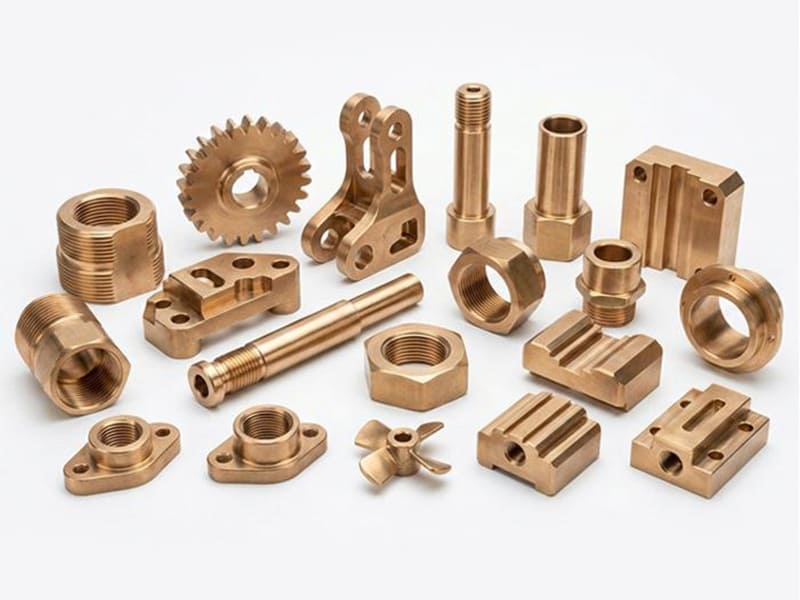
A bronze bushing comes off the CNC machine and sticks weakly to a magnet during incoming inspection. The buyer flags it as a material nonconformance. The supplier insists the alloy certificate shows pure phosphor bronze. Both sides are right — and both are missing the real issue. The bronze alloy is non-magnetic. The magnetism comes from iron particles embedded in the surface during machining on a machine that also runs steel jobs. We troubleshoot this exact scenario multiple times a year. So is bronze magnetic? No — but understanding why magnetism sometimes appears on bronze parts prevents costly misdiagnoses, unnecessary rejections, and supplier disputes.
This article covers bronze magnetic properties from a CNC manufacturing perspective: why standard bronze alloys are non-magnetic, which alloy types are used in machining, what causes bronze parts to appear magnetic (contamination, inserts, handling), how to properly verify material compliance beyond magnet tests, and why non-magnetic behavior matters in precision assemblies. Whether you’re a design engineer, quality inspector, or procurement manager, the goal is to separate bronze’s actual material properties from the manufacturing variables that create confusion.
Is Bronze Magnetic? The Engineering Answer
In manufacturing practice, “magnetic” means a material attracts magnets, retains magnetization, and interferes with magnetic fields. By this functional definition, standard bronze alloys are non-magnetic.
Common bronzes — tin bronze, phosphor bronze, aluminum bronze, and silicon bronze — are copper-based alloys. Copper is diamagnetic. Tin shows only negligible paramagnetism. Neither supports the magnetic domain formation required for ferromagnetism. When combined in bronze alloys, they produce a material with no attraction to magnets and no magnetic memory.
For most CNC-machined bronze components, magnetic effects can be safely ignored when the alloy grade is verified, machining uses clean tooling, and no steel inserts or chips contact the finished surface. However, magnetism should raise a flag when alloy composition is unclear, parts show localized attraction after machining, or iron contamination risk exists from shared equipment.
Key rule: Bronze itself is not the problem. When magnetism appears, it’s almost always a process or material control issue.
Why Bronze Is Non-Magnetic
Bronze is fundamentally a copper-based alloy. Copper’s electrons are fully paired, producing only an extremely weak diamagnetic response. Tin contributes negligible paramagnetism. Neither element supports the unpaired-electron exchange interactions needed for ferromagnetic domain formation.
Alloying elements commonly added to bronze — aluminum, phosphorus, silicon — don’t change this picture. None of these elements introduce ferromagnetism or enable domain formation. This is the fundamental difference between bronze and steel: steel derives its magnetism from iron’s electronic structure. Bronze alloys lack iron as a base element, so even when mechanical strength approaches that of some steels, magnetic behavior doesn’t follow.
Following the cause-and-effect chain — copper base → paired electrons → no domain formation → no ferromagnetism — the conclusion is clear. Any magnetism observed on a bronze part originates from outside the alloy itself.
Common Bronze Alloys in CNC Machining
All standard CNC-machined bronze alloys are non-magnetic:
| Bronze Type | Composition | Magnetic Behavior | Common Applications |
|---|---|---|---|
| Tin Bronze | Cu + Sn | Non-magnetic | Bushings, bearings, wear plates |
| Phosphor Bronze | Cu + Sn + P | Non-magnetic | Springs, connectors, precision parts |
| Aluminum Bronze | Cu + Al | Non-magnetic | Marine parts, valves, high-strength components |
| Silicon Bronze | Cu + Si | Non-magnetic | Fasteners, fittings, corrosion-resistant parts |
From a machining standpoint, alloy type has zero effect on magnetic behavior. If magnetism appears on any of these alloys, the cause lies elsewhere — not in the bronze grade.
When Bronze Parts Appear Magnetic: Root Causes
Iron Contamination During Machining
This is the most common source of “magnetic bronze” in CNC shops. In workshops that process both ferrous and non-ferrous materials, cross-contamination happens easily.
Tool wear and transfer: Cutting tools previously used on steel carry microscopic iron particles that embed into softer bronze surfaces. Residual chips: Iron or steel chips in the machine enclosure, fixtures, or coolant system adhere to bronze parts during wet machining. Secondary handling: Shared brushes, blasting media, or worktables introduce ferromagnetic debris after machining.
These contaminants are often invisible but easily detected by a magnet. In our shop floor experience, roughly 80% of “magnetic bronze” complaints we investigate trace back to cross-contamination from shared CNC equipment — not alloy problems.
Hidden Steel Components
Another frequent cause: steel components integrated into bronze assemblies. Threaded steel inserts, press-fit pins, helicoils, or composite structures where bronze is bonded onto a steel core all create expected magnetic responses. The issue arises when drawings or purchase orders say “bronze part” without identifying embedded ferromagnetic elements — triggering disputes during incoming inspection.
How to Identify the Source
Uniform surface-level magnetism usually indicates contamination from machining or handling. Localized or directional magnetism points to hidden steel inserts or composite construction. A magnet test alone can’t distinguish these causes.
Proper Inspection: Beyond the Magnet Test
A handheld magnet reliably identifies ferromagnetic materials but can’t tell you why attraction occurs on a supposedly non-magnetic part. It provides no information about whether the cause is alloy composition, surface contamination, or hidden steel components.
Better Methods
XRF analysis (X-ray fluorescence): Handheld XRF provides rapid, non-destructive elemental composition checks. It confirms whether iron or nickel exceeds trace levels — distinguishing true alloy problems from surface contamination. Based on our production data, XRF resolves over 90% of bronze magnetic disputes within minutes.
Material certification: Mill test reports (MTRs), heat numbers, and supplier certificates define alloy composition and compliance. This information is what no magnet test can provide.
Gauss meter: Quantitatively measures magnetic field strength. Useful for localizing contamination versus identifying internal inserts.
Practical rule: Use magnet tests as initial screening. Resolve any positive results with XRF, material documentation, or detailed inspection — not automatic rejection.
Why Non-Magnetic Bronze Matters in Engineering
Magnetically Sensitive Applications
Bronze is frequently specified for CNC-machined parts precisely because it’s non-magnetic. Key applications include electronic housings and terminals (where magnetic interference affects signal stability), sensors and instrumentation (Hall sensors, encoders, load cells sensitive to nearby ferromagnetic materials), and precision motion systems (linear guides, actuators, bearings where magnetic forces cause positioning errors).
Design and Procurement Best Practices
Specify clearly at design stage: Call out “non-magnetic bronze alloy” or reference a specific grade standard — not just “bronze.” Document assemblies: If steel inserts or composite structures are required, identify them explicitly to prevent inspection confusion. Align procurement with reality: Request material certificates and alloy designations. In projects we’ve delivered, adding alloy-grade callouts to purchase orders reduced magnetic-related inspection disputes by over 60%.
Conclusion
Standard bronze alloys are non-magnetic in manufacturing applications. Tin bronze, phosphor bronze, aluminum bronze, and silicon bronze do not exhibit ferromagnetism and should not attract magnets under clean conditions. When magnetism appears on a bronze part, the cause is almost always iron contamination from CNC machining, residual ferrous chips, or hidden steel components — not the bronze alloy itself.
Material verification requires more than a magnet. Proper alloy specification, clean machining processes, XRF analysis, and material certification provide far more accurate insight than a quick magnet check. Need help specifying non-magnetic bronze components or resolving material compliance questions? [Contact our engineering team] for alloy selection, CNC machining, and quality verification support.
FAQ
Is bronze magnetic enough to affect CNC machining?
No. Standard bronze alloys don’t interact with magnetic chucks, create magnetic forces during cutting, or affect machining accuracy. Any issues attributed to “magnetism” are related to tooling, fixturing, or contamination — not the bronze material.
Why does my bronze part stick slightly to a magnet?
Almost always contamination or hidden steel. Common causes: embedded iron particles from prior steel machining, residual ferrous chips, shared deburring media, or steel inserts (threads, pins, cores). The bronze alloy remains non-magnetic — the magnet responds to iron-bearing material on or within the part.
Are aluminum bronze and phosphor bronze magnetic?
No. Neither exhibits ferromagnetism. Aluminum, tin, and phosphorus don’t enable magnetic domain formation in copper-based alloys. If magnetism appears, investigate process contamination or embedded ferrous components.
How can I verify bronze is truly non-magnetic?
Don’t rely solely on a magnet. Use XRF analysis to confirm composition and detect iron beyond trace levels. Review material certifications (MTRs) to verify the specified grade. A gauss meter can help localize magnetic sources — useful for separating contamination from internal inserts.
Is bronze more non-magnetic than brass?
Both are non-magnetic copper alloys. Bronze (Cu-Sn/Al/Si) and brass (Cu-Zn) don’t exhibit ferromagnetism. Neither should attract a magnet in clean condition. Any perceived difference comes from processing history or contamination, not the base alloy family.


