
A marine automation manufacturer uses stainless steel brackets in offshore actuator assemblies. After 18 months of saltwater service, surface corrosion increases maintenance intervals and fatigue loading creates reliability concerns. The brackets weigh 4.2 kg each — contributing to excessive moving mass that reduces actuator response speed. Replacing them with Ti-6Al-4V (Grade 5) titanium reduces weight to 2.5 kg — a 40% reduction. The titanium’s self-healing TiO₂ oxide layer eliminates corrosion entirely, and fatigue life extends significantly under cyclic loading. Actuator response improves, efficiency increases, and maintenance drops dramatically. These titanium brackets cost approximately 3× more to manufacture — but reduced maintenance, extended service life, and improved system performance produce lower total lifecycle cost within 2 years. We machine titanium structural components for aerospace, medical, and marine applications where strength-to-weight ratio and corrosion resistance drive material selection. Titanium is not always the strongest metal in absolute terms — certain high-strength steels exceed 2000 MPa tensile strength versus titanium’s ~1100 MPa maximum. What makes titanium exceptional is its strength-to-weight ratio: steel-level mechanical performance at approximately 60% of steel’s weight. Combined with outstanding corrosion resistance, fatigue durability, and biocompatibility, no single competing metal matches this property combination.
This guide covers mechanical properties, titanium vs steel and aluminum comparisons, grade selection, applications, CNC challenges, and a selection framework.
What Makes Titanium Strong
Titanium’s strength originates from its hexagonal close-packed (HCP) crystal structure at room temperature (alpha phase), which transforms to body-centered cubic (BCC) beta phase above 882°C. This phase transformation allows titanium alloys to be heat-treated for different strength, toughness, and fatigue combinations — similar to steel hardening but through different mechanisms.
The oxide layer advantage: Titanium spontaneously forms a thin, stable TiO₂ oxide layer when exposed to oxygen. This passive film self-repairs when damaged and protects against saltwater, chlorides, chemical attack, and biological corrosion. This oxide layer is why titanium outperforms even stainless steel in marine environments and integrates successfully with human tissue in medical implants.
Key Mechanical Properties
| Property | Pure Titanium (Gr 1-4) | Ti-6Al-4V (Gr 5) |
|---|---|---|
| Tensile strength | 240–550 MPa | Up to 1100 MPa |
| Yield strength | 170–485 MPa | Up to 910 MPa |
| Density | ~4.51 g/cm³ | ~4.43 g/cm³ |
| Hardness | Moderate | High |
| Fatigue resistance | Good | Excellent |
| Corrosion resistance | Excellent | Excellent |
| Temperature capability | Good | 300–600°C |
| Machinability | Moderate | Difficult |
Tensile and Yield Strength
Tensile strength measures maximum stress before fracture. Yield strength defines when permanent deformation begins — often more critical for engineering design. Grade 5 titanium achieves up to 1100 MPa tensile and 910 MPa yield — placing it in the same performance category as many high-strength steels while remaining 40–45% lighter.
Fatigue Resistance
Titanium excels under repeated loading — vibration, cyclic stress, rotating loads, and pressure fluctuations. Unlike aluminum, which develops fatigue cracks relatively easily under long-term cyclic stress, titanium alloys maintain excellent crack growth resistance. This is why aircraft structures, turbine components, and medical implants rely on titanium for millions of stress cycles without failure. Based on our production data, titanium aerospace brackets consistently pass fatigue validation at 2–3× the cycle count where equivalent aluminum brackets show crack initiation. The fatigue advantage compounds into dramatically different service life predictions.
High-Temperature Performance
Titanium retains structural strength at 300–600°C — far beyond aluminum’s effective range of 120–200°C. Jet engine compressor blades, exhaust components, and aerospace compressor sections use titanium because aluminum would soften and lose structural integrity at these temperatures. Above ~600°C, nickel-based superalloys replace titanium.
Titanium vs Steel
| Property | Titanium | Steel |
|---|---|---|
| Density | ~4.5 g/cm³ | ~7.8 g/cm³ |
| Max tensile strength | ~1100 MPa (Gr 5) | 2000+ MPa (advanced alloy) |
| Strength-to-weight | Excellent | Moderate |
| Corrosion resistance | Excellent (self-healing oxide) | Requires coatings/alloying |
| Fatigue resistance | Excellent | Good |
| Machinability | Difficult | Easier |
| Cost | High | Lower |
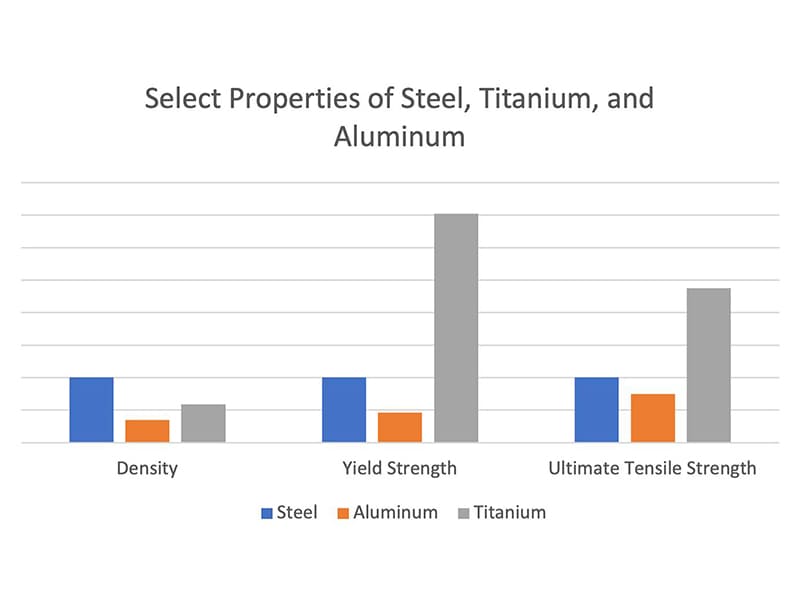
In absolute strength, steel wins. Advanced alloy steels can exceed 2000 MPa — nearly double titanium’s maximum. However, those steels weigh ~7.8 g/cm³ versus titanium’s ~4.5 g/cm³. When you divide strength by density (specific strength), titanium delivers more structural performance per unit of weight. One common pitfall we see: comparing tensile strength alone and concluding steel is “better.” A titanium component carrying the same load weighs 40% less. In aerospace, that translates to fuel savings worth millions over an aircraft’s lifetime.
Corrosion: Titanium’s self-repairing oxide layer resists saltwater, chlorides, and chemical attack without coatings. Most steels require galvanizing, painting, or stainless alloying — and even stainless steel can fail in aggressive chloride environments where titanium thrives.
When to choose steel: General structural engineering, heavy machinery, cost-sensitive high-volume production where weight isn’t critical. Steel provides excellent strength at much lower total cost.
When to choose titanium: Weight reduction is mandatory (aerospace, racing), corrosion environment is aggressive (marine, chemical), fatigue life is critical (aircraft structures), or biocompatibility is required (medical implants).
Titanium vs Aluminum
| Property | Titanium | Aluminum |
|---|---|---|
| Density | ~4.5 g/cm³ | ~2.7 g/cm³ |
| Tensile (Gr 5 vs 7075) | ~1100 MPa | ~570 MPa |
| Strength-to-weight | Excellent | Good |
| Temperature capability | 300–600°C | 120–200°C |
| Fatigue resistance | Excellent | Moderate |
| Corrosion resistance | Excellent | Good |
| Machinability | Difficult | Excellent |
| Cost | High | Lower |
Aluminum is lighter — 2.7 vs 4.5 g/cm³. But titanium is roughly 2× stronger at the alloy level (1100 vs 570 MPa). For applications requiring maximum lightness at moderate strength, aluminum wins. For applications requiring high strength, heat resistance, or fatigue durability, titanium delivers performance aluminum cannot match.
Modern aerospace uses both: Aluminum for lightweight large panels, skins, and interior structures. Titanium for high-load structural brackets, engine components, fasteners, and landing gear — where strength, fatigue, and temperature demand materials aluminum can’t provide. In our shop floor experience, approximately 70% of our aerospace CNC programs use aluminum for volume. The remaining 30% use titanium for critical load-bearing interfaces — the materials complement rather than compete.
Titanium Grades
| Grade | Type | Tensile | Best For |
|---|---|---|---|
| Grade 1 | CP (softest) | ~240 MPa | Chemical equipment, max corrosion resistance |
| Grade 2 | CP (standard) | 345–550 MPa | Marine, industrial, general-purpose |
| Grade 5 (Ti-6Al-4V) | Alloy (strongest) | Up to 1100 MPa | Aerospace, medical, high performance |
| Grade 9 (Ti-3Al-2.5V) | Alloy (medium) | ~620 MPa | Tubing, automotive, bicycles |
Grade 5 (Ti-6Al-4V) accounts for over 50% of all titanium usage worldwide — the industry standard for high-strength applications. Its 6% aluminum and 4% vanadium content dramatically increases tensile strength, yield strength, and fatigue resistance versus commercially pure grades. Based on our production data, approximately 65% of our titanium CNC programs specify Grade 5. The remaining 35% use Grade 2 — chosen when corrosion matters more than strength. Easier machining reduces program cost approximately 25–30%.
Grade 2 is the “general-purpose titanium” — excellent corrosion resistance with moderate strength, good weldability, and significantly easier manufacturing than Grade 5. The standard for marine piping, heat exchangers, chemical processing, and industrial applications.
Grade 9 fills the gap — stronger than Grade 2, more formable and weldable than Grade 5. Common in aerospace tubing, bicycle frames, and automotive exhaust systems.
Applications
| Industry | Titanium Role | Why Titanium |
|---|---|---|
| Aerospace structures | Brackets, fasteners, landing gear | Weight reduction 40% vs steel + fatigue life |
| Jet engines | Compressor blades, fan blades, casings | Heat resistance + low density |
| Medical implants | Bone screws, joints, dental, spinal | Biocompatibility + corrosion in body |
| Marine | Piping, heat exchangers, fasteners | Saltwater immunity + long service life |
| Automotive (performance) | Exhaust, springs, connecting rods | Weight + heat + corrosion resistance |
| Chemical processing | Reactors, heat exchangers | Acid/chloride resistance |
CNC Machining Challenges
Titanium’s thermal conductivity (~7 W/m·K) is roughly 1/6 of steel’s and 1/30 of aluminum’s. Heat concentrates at the cutting edge instead of dissipating into the workpiece. This causes rapid tool wear (often sudden rather than gradual), work hardening, and surface integrity risks.
Practical impact: Cutting speeds 30–60 m/min (vs 200–400 m/min aluminum). Tool consumption 3–5× higher. High-pressure through-spindle coolant mandatory. Carbide tooling with TiAlN coating required. Machining cost 3–5× versus equivalent aluminum geometry. In projects we’ve delivered, DFM-optimized titanium parts (simplified geometry, selective tolerances, appropriate grade selection) cost 25–40% less than initial designs — geometry simplification is the highest-impact cost reduction strategy.
Advantages and Limitations
| Advantages | Limitations |
|---|---|
| Highest strength-to-weight ratio | Expensive raw material |
| Excellent corrosion (self-healing oxide) | Difficult CNC machining |
| Outstanding fatigue resistance | Low thermal conductivity |
| Biocompatible (medical implants) | Higher tool consumption |
| Heat resistance (300–600°C) | Slower production speeds |
| Long service life, low maintenance | Higher total manufacturing cost |
Grade Selection Guide
| Need | Choose |
|---|---|
| Maximum strength + fatigue | Grade 5 (Ti-6Al-4V) |
| Marine/chemical corrosion | Grade 2 |
| Lightweight tubing | Grade 9 |
| Maximum formability/weldability | Grade 1 |
| Aerospace structural | Grade 5 |
| Cost-performance balance | Grade 2 |
| Medical implants | Grade 5 or Grade 23 (ELI) |
Conclusion
Titanium’s strength story isn’t about maximum tensile numbers — it’s about the combination of high strength at low weight with corrosion immunity and fatigue durability. Grade 5 titanium (Ti-6Al-4V) achieves up to 1100 MPa tensile strength at ~4.43 g/cm³ density — steel-like performance at 60% of steel’s weight. This combination is why aerospace, medical, marine, and high-performance industries specify titanium despite 3–5× higher manufacturing cost versus aluminum.
The material selection decision is straightforward: choose titanium when weight + strength + corrosion + fatigue must all be optimized simultaneously. Choose steel when absolute strength at lowest cost matters. Choose aluminum when maximum lightness at moderate strength suffices. Grade selection matters: Grade 5 for strength, Grade 2 for corrosion at lower cost, Grade 9 for tubing. DFM optimization reduces titanium manufacturing cost 25–40%. Need help with titanium material selection or CNC machining? [Contact our engineering team] for grade selection, DFM review, and manufacturing support.
FAQ
How strong is titanium compared to steel?
Grade 5 titanium reaches ~1100 MPa tensile strength — comparable to many high-strength steels. Some advanced steels exceed 2000 MPa in absolute terms. However, titanium weighs ~40% less than steel, giving it a significantly higher strength-to-weight ratio plus superior corrosion resistance and fatigue life.
Is titanium stronger than aluminum?
Yes — approximately 2× stronger at the alloy level (1100 vs 570 MPa for Grade 5 vs 7075). Titanium also provides far better fatigue resistance and heat tolerance (600°C vs 200°C). Aluminum is lighter and cheaper — the right choice when moderate strength suffices.
What is the strongest titanium alloy?
Ti-6Al-4V (Grade 5) — up to 1100 MPa tensile, 910 MPa yield. Accounts for over 50% of global titanium usage. Standard for aerospace structures, jet engines, medical implants, and high-performance parts.
Does titanium rust?
No — titanium forms a self-repairing TiO₂ oxide layer that resists saltwater, chlorides, chemicals, and biological corrosion. This is why it outperforms stainless steel in marine environments and is used in medical implants that remain in the body for decades.
Why is titanium so expensive?
Complex extraction process (Kroll process), energy-intensive refining, difficult CNC machining (3–5× slower than aluminum, 3–5× higher tool consumption), and lower production volumes. However, titanium’s durability and reduced maintenance often produce lower total lifecycle cost in demanding applications.


