
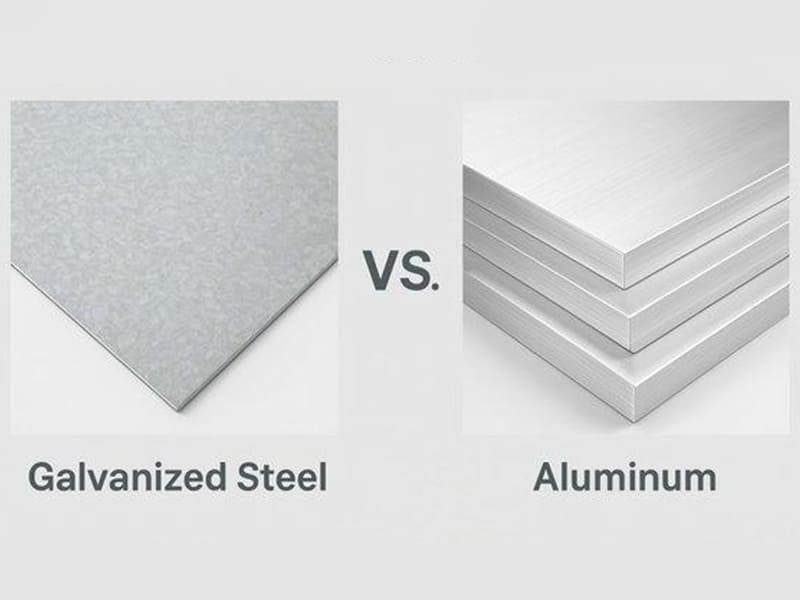
Quick Answer: Galvanized steel (carbon steel with 45–150 µm zinc coating) provides high absolute strength at low material cost with sacrificial corrosion protection — the zinc corrodes preferentially, protecting the underlying steel. Aluminum provides approximately 65% lower density (2.70 vs 7.85 g/cm³), a permanent self-forming Al₂O₃ passive layer that does not deplete over time, and superior thermal and electrical conductivity. Galvanized steel is the correct choice for load-bearing structural applications where weight is not critical. Aluminum is correct for weight-sensitive applications, marine and chloride-rich environments where zinc coatings degrade rapidly, and long-service-life applications where maintenance access is limited.
What Is Galvanized Steel?
Galvanized steel is carbon or low-alloy steel with a zinc coating applied to enhance corrosion resistance. The zinc provides two distinct protective functions: barrier protection (physically separating the steel from moisture and oxygen) and sacrificial (cathodic) protection (zinc is electrochemically active relative to steel — in the presence of an electrolyte, zinc corrodes preferentially as the anode, cathodically protecting the steel even at coating gaps, cut edges, and mechanical damage sites).
Galvanizing Methods and Coating Thickness
| Process | Coating Thickness | Protection Mechanism | Typical Application |
|---|---|---|---|
| Hot-dip galvanizing (ASTM A123) | 45–150 µm | Barrier + sacrificial | Structural steel, outdoor fabrications |
| Continuous hot-dip (ASTM A653) | 14–85 µm | Barrier + sacrificial | Sheet metal, automotive, roofing |
| Electro-galvanizing | 5–25 µm | Primarily barrier | Automotive body panels, thin-gauge sheet |
| Thermal spray zinc | 50–200 µm | Barrier + sacrificial | Repair, large structures |
Zinc coating life in atmospheric exposure correlates directly with coating thickness. According to American Galvanizers Association (AGA) data, hot-dip galvanized steel (85 µm average coating) provides approximately 70 years of maintenance-free service in C2 rural environments and 20–35 years in C3 urban-industrial environments before zinc is fully consumed and steel corrosion begins.
Once the zinc layer is completely depleted, corrosion protection is entirely lost and the steel begins to rust at the same rate as uncoated carbon steel. This is the fundamental lifetime limitation of galvanized steel — the coating is finite and consumed rather than self-renewing.
What Is Aluminum?
Aluminum is a non-ferrous structural metal with density of 2.70 g/cm³ — approximately one-third of steel’s 7.85 g/cm³. Its natural corrosion resistance comes from a self-forming, self-healing aluminum oxide (Al₂O₃) passive layer that forms spontaneously when the metal surface contacts oxygen, reaching its stable thickness of approximately 4–6 nm within milliseconds. Unlike zinc, this oxide layer is not consumed — it is thermodynamically stable in most atmospheric and neutral aqueous environments, and if mechanically damaged, it reforms immediately.
The passive layer’s stability range is pH 4.5–8.5. Outside this range — in strongly acidic or strongly alkaline environments — the oxide dissolves and bare aluminum is exposed to accelerated corrosion. This is the primary environmental limitation of aluminum: it is not universally corrosion resistant, but specifically resistant in near-neutral, non-reducing environments.
Aluminum alloys vary significantly in strength, corrosion resistance, and machinability:
- 1100 (commercially pure): Maximum corrosion resistance, low strength (~95 MPa yield), excellent formability
- 5052, 5083: Best corrosion resistance among structural alloys, particularly in marine environments; 5083 is standard for marine structural applications
- 6061-T6: General-purpose structural alloy (276 MPa yield strength), good machinability, good corrosion resistance — the most widely CNC-machined aluminum grade
- 7075-T6: Very high strength (503 MPa yield), lower corrosion resistance, susceptible to stress corrosion cracking in aggressive environments
Galvanized Steel vs Aluminum: Core Property Comparison
| Property | Galvanized Steel (A36/A572) | Aluminum (6061-T6) | Engineering Implication |
|---|---|---|---|
| Density | 7.85 g/cm³ | 2.70 g/cm³ | Aluminum is 65.6% lighter |
| Yield strength | 250–345 MPa (A36/A572) | 276 MPa (6061-T6) | Comparable in tension; steel higher overall |
| Tensile strength | 400–510 MPa | 310 MPa | Steel higher for structural loading |
| Strength-to-weight ratio | 32–44 MPa·cm³/g | 102–186 MPa·cm³/g | Aluminum 2.5–4× better specific strength |
| Thermal conductivity | 45–60 W/m·K | 167–205 W/m·K | Aluminum 3–4× better for heat management |
| Electrical conductivity | ~10 MS/m | ~35 MS/m | Aluminum ~3.5× more conductive |
| Corrosion protection | Zinc coating (sacrificial, finite life) | Self-forming Al₂O₃ (permanent) | Aluminum more reliable long-term |
| Material cost | Lower | Higher (typically 2–4× per kg) | Galvanized steel cheaper upfront |
| Machinability | Moderate | Excellent | Aluminum faster, lower tool wear |
| Weldability | Good (with coating precautions) | Good (with appropriate process) | Galvanized steel fumes require ventilation |
| Maximum structural temperature | ~400°C (zinc melts at 419°C) | ~150–200°C continuous (6061) | Steel for elevated temperature structural |
Weight and Strength: The Structural Design Trade-Off
Absolute Strength vs Specific Strength
The correct comparison for structural design is not absolute strength (yield strength in MPa) but specific strength (yield strength divided by density, in MPa·cm³/g). This tells you how much structural load a given weight of material can carry — the relevant quantity for anything where weight matters.
- A36 galvanized steel: specific strength ≈ 32 MPa·cm³/g
- 6061-T6 aluminum: specific strength ≈ 102 MPa·cm³/g
- 7075-T6 aluminum: specific strength ≈ 186 MPa·cm³/g
A 6061-T6 aluminum structural member carries approximately 3× more load per kilogram than A36 galvanized steel. This is why aluminum dominates aerospace, transportation, and high-performance applications — not because it is stronger in absolute terms, but because it delivers much more structural capability per unit weight.
However, for applications where weight is irrelevant — static land structures, fixed infrastructure, machinery bases — the per-kilogram metric is not the relevant one. The relevant metric is cost per unit load, and here galvanized steel’s lower material cost gives it a clear advantage. A36 galvanized steel at $0.80–$1.20/kg delivers tensile strength of 400–510 MPa for the same money as 6061-T6 aluminum at $2.50–$4.50/kg delivers 310 MPa tensile strength. For a fixed platform, a warehouse frame, or a bridge deck panel, galvanized steel typically provides higher structural capacity per dollar spent.
Stiffness: Modulus of Elasticity
An important comparison often omitted: steel’s modulus of elasticity is approximately 200 GPa versus aluminum’s 69 GPa. Steel is nearly 3× stiffer per unit cross-section. For deflection-limited structural designs (beams, grating, floor panels), an aluminum section must be significantly thicker than a steel section to achieve the same deflection — which reduces or eliminates the weight advantage. Deflection is often the governing criterion in floor structures, platforms, and large-span components.
Corrosion Resistance: Protection Mechanism Comparison
Galvanized Steel’s Limitation: Consumable Protection
Galvanized steel’s zinc coating provides sacrificial protection — the zinc is anodic to steel in the electrochemical series and corrodes preferentially. This is beneficial (it protects steel even at damage sites) but inherently finite. The protection lasts only as long as sufficient zinc remains. Zinc consumption rate depends on environment:
| Environment Category | Zinc Consumption Rate | Expected Service Life (85 µm coating) |
|---|---|---|
| C1 (very low — indoor, dry) | < 0.1 µm/year | > 100 years |
| C2 (low — rural atmosphere) | 0.1–0.7 µm/year | 70–100 years |
| C3 (medium — urban/industrial) | 0.7–2.1 µm/year | 20–50 years |
| C4 (high — industrial, marine) | 2.1–4.2 µm/year | 15–25 years |
| C5-M (very high — marine) | > 4.2 µm/year | < 10 years |
In marine environments with continuous chloride exposure, zinc consumption accelerates because the protective zinc hydroxide film that normally slows corrosion is continuously dissolved by chlorides. Galvanized steel in seawater splash zones can lose its zinc coating in 5–8 years.
Aluminum’s Advantage: Self-Renewing Passivation
Aluminum’s Al₂O₃ passive layer is not consumed — it is thermodynamically stable and reforms if damaged. This makes aluminum’s corrosion protection effectively permanent in environments within the oxide’s stability range. Marine aluminum alloys (5052, 5083, 5086) have been used in ship hulls, offshore platforms, and coastal structures for 30–50+ years without protective coating requirements, while galvanized steel in the same environments would require re-coating within a decade.
Critical exception — galvanic corrosion: Aluminum is electrochemically active (strongly anodic) relative to stainless steel, copper, and nickel alloys. When aluminum contacts these metals in the presence of an electrolyte, aluminum corrodes rapidly at the contact zone. Galvanized steel is less galvanically aggressive relative to aluminum — zinc is closer to aluminum in the galvanic series — making galvanized steel a less severe galvanic risk when contact with aluminum is unavoidable.
Thermal and Electrical Properties
Aluminum’s significantly higher thermal conductivity (167–205 W/m·K versus 45–60 W/m·K for steel) makes it the dominant material for heat management applications. Heat sinks, electronic enclosures, heat exchangers, and LED modules are almost universally aluminum because the same heat load generates 3–4× lower temperature rise in an aluminum structure compared to an equivalent steel structure.
Aluminum’s electrical conductivity (~35 MS/m, approximately 60% of copper and 3.5× steel) makes it cost-effective for power transmission applications where copper’s higher conductivity is not required. High-voltage transmission lines are almost entirely aluminum (ACSR — aluminum conductor steel reinforced, where the steel provides tensile strength and aluminum provides conductivity), and aluminum busbars are standard in electrical switchgear and power distribution panels.
For galvanized steel, neither thermal nor electrical properties are competitive with aluminum. Steel is used in structural, load-bearing, and mechanical applications where conductivity is irrelevant.
CNC Machining: Productivity and Cost Differences
Aluminum and galvanized steel behave very differently in CNC machining, with aluminum offering substantially better machinability in most production contexts.
Aluminum Machining
Aluminum can be machined at spindle speeds of 15,000–25,000 RPM with feed rates of 3,000–10,000 mm/min using high-speed machining strategies — 3–5× faster than steel machining at equivalent chip load. The low hardness (typically 60–150 HB for structural alloys) produces minimal tool wear, and carbide end mills routinely achieve 10–30 surface meters of machined length before replacement in aluminum versus 1–5 meters in steel. Aluminum chips are ductile and must be managed for chip evacuation, but they do not create the safety and health concerns associated with galvanized steel machining.
Galvanized Steel Machining
Zinc coating hazard: The primary CNC machining complication for galvanized steel is the zinc coating. Machining through the zinc layer generates zinc oxide fume — particularly during grinding and high-speed cutting operations where cutting temperatures exceed zinc’s vaporization temperature. Zinc oxide inhalation causes metal fume fever (flu-like symptoms, typically self-resolving in 24–48 hours, but requiring medical evaluation for repeated exposures). OSHA’s permissible exposure limit (PEL) for zinc oxide fume is 5 mg/m³ (8-hour TWA). Machining operations through galvanized steel coating require ventilation, and operators should use respiratory protection.
Strength-related machining parameters: Base steel hardness (typically 120–200 HB for mild structural grades) requires lower cutting speeds than aluminum (80–150 m/min versus 200–600 m/min for aluminum with carbide tooling), higher cutting forces, and more frequent tool replacement.
Post-machining coating repair: CNC machining removes the zinc coating at machined surfaces, cut edges, and drill holes — these areas must be treated with cold galvanizing compound or zinc-rich primer to restore sacrificial protection, or the bare steel at these locations will corrode preferentially.
Applications by Industry
Where Galvanized Steel Dominates
Structural construction: Warehouse frames, industrial buildings, steel framing, utility poles, and highway guardrails use galvanized steel because the application requires high load capacity at minimum cost, weight is not a design constraint, and the C3 atmospheric environment is within galvanized steel’s adequate service life.
Agricultural and outdoor structures: Farm buildings, fencing, outdoor frameworks, and agricultural equipment use galvanized steel because it provides cost-effective durability for 20–40 years in rural atmospheric exposure.
Automotive body structure: Hot-dip galvanized and electro-galvanized steel sheet is used for automotive body panels and underbody components — where the combination of high strength, formability, and zinc corrosion protection matches the requirements of a 15–20 year vehicle life at lower cost than aluminum.
Where Aluminum Dominates
Aerospace: Aircraft primary structure (fuselage, wing skins, frames) is predominantly aluminum (2024, 7075, 7050 series) because high strength-to-weight ratio is the overriding design constraint, and galvanized steel’s weight penalty is incompatible with flight performance requirements.
Marine structures: Aluminum 5083 and 5086 are standard materials for ship superstructures, pleasure boat hulls, and coastal infrastructure precisely because aluminum’s self-renewing corrosion resistance requires no maintenance coating in marine environments where galvanized steel would require re-galvanizing within 5–10 years.
Transportation: Automotive lightweight applications (body panels in premium vehicles, structural castings, wheels), rail car bodies, and truck trailer bodies shift from steel to aluminum when fuel economy regulations or payload efficiency demands drive weight reduction.
Electronics and thermal management: Heat sinks, electronic enclosures, LED housings, and power electronics substrates are predominantly aluminum for thermal management effectiveness.
Material Selection Decision Framework
The selection between galvanized steel and aluminum should follow a structured analysis of the application’s specific requirements rather than defaulting to either material based on cost or familiarity.
Step 1: Structural Load Requirement
Is absolute strength or specific strength the relevant metric?
- Static structure, weight irrelevant: Use cost-per-unit-strength → typically favors galvanized steel
- Weight-critical structure: Use specific strength (strength per kg) → typically favors aluminum
Also consider deflection: for beam or panel applications, compare the required section depth for equivalent stiffness (aluminum section must be approximately 2.7× deeper than steel to achieve equivalent stiffness per unit weight) — this may reduce or eliminate aluminum’s weight advantage.
Step 2: Service Environment and Corrosion Risk
- Marine (seawater, chloride-rich coastal): Strongly favor aluminum — galvanized coating life < 10 years; aluminum alloys 5083/5086 require no protective coating
- Industrial or urban atmosphere (C3): Both acceptable; galvanized steel adequate for 20–35 years; aluminum lifetime maintenance-free
- Aggressive chemicals: Verify Al₂O₃ stability in the specific chemical environment (strong alkalis dissolve the oxide); consult corrosion compatibility data for both materials
- Mild indoor or controlled environment: Cost often drives selection to galvanized steel
Step 3: Lifecycle Cost Analysis
Include all cost components:
| Cost Component | Galvanized Steel | Aluminum |
|---|---|---|
| Material cost | Lower | Higher (2–4× per kg) |
| Fabrication cost | Moderate (welding, zinc fume management) | Moderate (excellent machinability) |
| Transportation cost | Higher (3× heavier) | Lower |
| Installation cost | Higher (heavier, crane requirements) | Lower |
| Maintenance | Regular re-coating in harsh environments | Minimal to none |
| Replacement frequency | Sooner in aggressive environments | Much longer service life |
Step 4: Practical Selection Summary
| Application Requirement | Best Material | Primary Reason |
|---|---|---|
| Load-bearing structure, weight not critical | Galvanized steel | Highest strength per dollar |
| Weight-critical design (aerospace, transport) | Aluminum | Best specific strength |
| Marine or chloride environment | Aluminum (5083, 5086) | Self-renewing corrosion resistance |
| Outdoor atmospheric, cost-sensitive | Galvanized steel | Lower cost, adequate life |
| Long-service-life, minimal maintenance | Aluminum | Permanent corrosion resistance |
| Thermal management (heat sinks, electronics) | Aluminum | 3–4× higher thermal conductivity |
| Electrical conductivity | Aluminum | 3.5× higher than steel |
| CNC machining, high production volume | Aluminum | 3–5× faster machining, lower tool cost |
Common Material Selection Mistakes
Using Galvanized Steel in Marine Environments
The most consequential mistake: specifying galvanized steel for coastal, marine, or high-chloride-exposure applications based on its general outdoor corrosion resistance. Galvanized steel performs well in C2 rural and C3 urban-industrial atmospheres for 20–50 years. In C5-M marine environments, zinc consumption rates exceed 4 µm/year — meaning an 85 µm hot-dip galvanized coating is fully consumed within 15–20 years, and under-coating corrosion of the steel substrate may begin earlier from chloride-induced delamination. For fixed offshore or coastal structures, aluminum 5083 or duplex stainless steel are technically correct; galvanized steel is an economically and technically inferior choice.
Ignoring Total Weight Consequence
Selecting galvanized steel without calculating the total assembly weight consequence on transportation, installation, and operating costs. For structures shipped long distances, lifted by crane, or installed at height, the 3× weight difference between galvanized steel and aluminum translates directly into crane capacity requirements, transportation freight rates, and installation labor. These costs are sometimes substantial enough to favor aluminum even when the material itself is more expensive.
Assuming Aluminum Has Universal Corrosion Resistance
Aluminum’s passive layer is stable between approximately pH 4.5 and pH 8.5. Strong alkalis — concrete (pH 12–13), sodium hydroxide, cement grout — dissolve the Al₂O₃ layer and attack bare aluminum aggressively. Embedded aluminum or aluminum in contact with wet concrete corrodes rapidly without isolation. Galvanized steel actually handles alkaline environments better than aluminum in some cases — zinc is more stable than aluminum oxide in moderately alkaline conditions.
Key Takeaways
- Galvanized steel combines steel’s high strength (250–510 MPa) with sacrificial zinc corrosion protection — the correct material for load-bearing structures where weight is not a constraint and the environment is within zinc’s service life capability.
- Aluminum is 65% lighter than steel, has 3× better specific strength, self-renewing Al₂O₃ corrosion protection that doesn’t deplete over time, and 3–4× better thermal conductivity — the correct material for weight-sensitive, marine, and thermally demanding applications.
- The zinc coating on galvanized steel is finite: consumption rates range from < 0.1 µm/year (indoor) to > 4 µm/year (marine) — in severe marine environments, coating life can be less than 10 years. Aluminum provides permanent passive protection in the same environments.
- Specific strength (yield MPa / density) favors aluminum by 2.5–4×: 6061-T6 aluminum delivers 102 MPa·cm³/g versus A36 steel’s 32 MPa·cm³/g. Where weight matters, aluminum’s structural efficiency is substantially better.
- Steel is stiffer (200 GPa modulus vs 69 GPa for aluminum): deflection-limited designs require a much deeper aluminum section, partially reducing the weight advantage for beams and panels.
- CNC machining of aluminum is 3–5× faster with significantly lower tool wear than galvanized steel — machined aluminum components carry lower machining cost despite higher material cost.
- For OEM procurement teams: specifying galvanized steel without verifying zinc coating thickness class and expected service life in the specific environment is a common source of premature structural failure. Specify coating class per ASTM A123 (structural fabrications) or A653 (sheet) with the minimum coating thickness required for the application’s environment and service life.
Frequently Asked Questions
What is the main difference between galvanized steel and aluminum?
Galvanized steel is carbon steel coated with zinc to provide sacrificial corrosion protection — the zinc corrodes preferentially, protecting the steel underneath until the zinc layer is fully consumed. Its primary advantage is high absolute strength (250–510 MPa) at low material cost. Aluminum is a lightweight metal (2.70 g/cm³ versus steel’s 7.85 g/cm³) with a self-forming, self-healing Al₂O₃ oxide layer that provides permanent corrosion protection without consuming itself. Aluminum is 65% lighter and has 2.5–4× better strength-to-weight ratio, but costs 2–4× more per kilogram than galvanized steel.
Which is better for corrosion resistance: galvanized steel or aluminum?
In most engineering environments, aluminum provides more reliable long-term corrosion resistance because its protection mechanism (Al₂O₃ passive layer) is permanent and self-renewing, while galvanized steel’s protection (zinc coating) is consumable and finite. In marine environments, the difference is decisive: zinc coatings degrade rapidly in chloride exposure (potentially < 10 years in marine splash zones), while aluminum alloys 5083 and 5086 are used in marine structures for 30–50+ years without protective coating. In mild atmospheric environments (rural, urban), both materials provide adequate corrosion protection and cost typically drives selection. Aluminum’s limitation: strong alkalis (pH > 8.5) dissolve its passive layer — in concrete or alkali-containing environments, galvanized steel may actually be more appropriate.
Which is cheaper: galvanized steel or aluminum?
Galvanized steel has lower initial material cost — typically 2–4× less per kilogram than aluminum. For large structures where material weight is high, this cost advantage is significant. However, the total lifecycle cost comparison is more complex: aluminum typically requires minimal maintenance over its service life, while galvanized steel may require re-coating in harsh environments within 10–20 years. Transportation and installation costs favor aluminum significantly for large or remote structures because of its 3× lower weight. Over a 20–30 year service life in moderate environments, aluminum’s total cost of ownership frequently approaches or falls below galvanized steel’s when all cost components are included.
Which material is better for outdoor use?
Both materials can perform well outdoors, but the appropriate choice depends on the specific outdoor environment. In rural and urban atmospheric environments (away from sea coast), galvanized steel provides 20–50 years of corrosion protection at lower cost and is frequently the better economic choice for structures. Aluminum provides longer maintenance-free service life but at higher initial cost. In coastal and marine environments (within 1–2 km of seacoast or with direct seawater exposure), aluminum is clearly the better choice — zinc coating degradation is too rapid for cost-effective galvanized steel service in these environments.
When should I choose aluminum over galvanized steel?
Choose aluminum when: weight is a design constraint and specific strength (strength per kg) matters — aerospace, transportation, mobile equipment; the service environment is marine, coastal, or high-chloride where zinc coatings degrade rapidly; the service life requirement exceeds what a zinc coating can provide without re-coating; thermal or electrical conductivity is needed for the application; or high-volume CNC machining is required (aluminum machines 3–5× faster with lower tool cost). Choose galvanized steel when: high absolute load capacity is required for heavy structural applications; weight is not a design constraint; the initial material cost is a primary constraint; or the service environment is mild enough that zinc coating life matches the required service life.
Written by the CMS engineering team with 15+ years of precision CNC machining and fabrication experience in galvanized steel, aluminum alloys, and structural components for construction, transportation, marine, and industrial OEM manufacturing applications. Technical references: ASTM A123 (Hot-Dip Galvanizing of Structural Steel), ASTM A653 (Steel Sheet, Galvanized), ISO 12944 (Paints and Varnishes — Corrosivity Categories), American Galvanizers Association (AGA) Galvanizing Performance Data, ASM International Metals Handbook (Aluminum Alloys and Steel Corrosion).
Sourcing CNC Machined Structural Components in Galvanized Steel or Aluminum?
At CMS, we machine structural components in carbon steel, galvanized steel, 6061 aluminum, 5083 marine aluminum, and other alloys — providing DFM review for material selection, coating compatibility, and dimensional planning for post-coat inspection. Every material selection is reviewed for environment-specific corrosion requirements before production begins.
[Request a material selection review and CNC machining quote →]


