
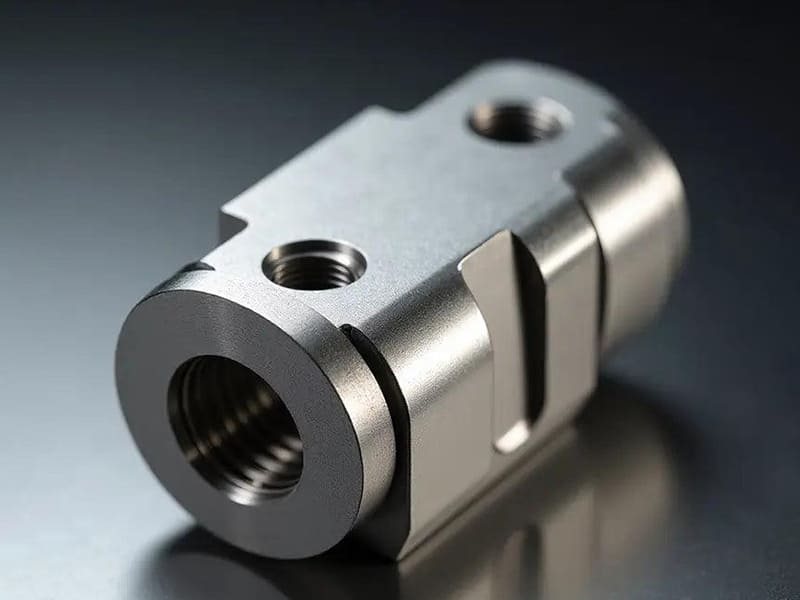
Tungsten does not rust. Rust is specifically iron oxide (Fe₂O₃) formed when iron reacts with oxygen and moisture — and tungsten contains no iron. At room temperature, tungsten remains highly stable with excellent atmospheric corrosion resistance. However, tungsten is not chemically inert: at elevated temperatures (above ~400–600°C) in oxygen-rich environments, it oxidizes to form tungsten trioxide (WO₃), which can degrade the surface over time. For room-temperature industrial applications, tungsten corrosion is not a concern. For high-temperature systems, oxidation protection (vacuum, inert gas, coatings) becomes critical.
A semiconductor equipment manufacturer uses tungsten heating elements in a vacuum furnace operating at 2,200°C. After 6 months of continuous operation, they switch to a controlled-atmosphere furnace with nitrogen purge during cooling cycles — but residual oxygen during the purge causes visible yellow-brown WO₃ oxide scaling on the tungsten elements. Surface material loss reaches 0.15 mm after 2,000 hours. Switching to a higher-purity inert gas purge (argon, <5 ppm O₂) eliminates oxide formation entirely — the same elements run 8,000+ hours without measurable degradation. The tungsten didn’t fail from wear or fatigue. It failed from oxygen exposure during what seemed like a minor procedural step. We specify tungsten and tungsten carbide components for high-temperature, high-wear, and radiation shielding applications where conventional metals cannot survive. Understanding the difference between tungsten’s room-temperature corrosion immunity and its high-temperature oxidation vulnerability is essential for reliable material selection.
This guide covers whether tungsten rusts, how oxidation differs from rust, corrosion resistance mechanisms, performance in various environments, comparison with steel and titanium, durability factors, industrial applications, tungsten carbide vs pure tungsten, machining challenges, and a material selection framework.
How Does Tungsten Oxidation Differ from Rust?
Rust and tungsten oxidation are fundamentally different chemical processes with different triggers, behaviors, and consequences.
| Property | Iron Rust | Tungsten Oxidation |
|---|---|---|
| Chemical reaction | Fe + O₂ + H₂O → Fe₂O₃ | 2W + 3O₂ → 2WO₃ |
| Occurs at room temp | Yes (readily) | Very limited |
| Requires moisture | Yes | No — heat + oxygen |
| Appearance | Red-brown, porous | Yellow/blue oxide layers |
| Protective? | No — porous, accelerates | Partially — slows further attack |
| Main trigger | Water + oxygen | High temperature (>400–600°C) |
Iron rust is porous and non-protective — corrosion continues deeper into the material, progressively weakening the structure. Tungsten oxidation occurs primarily at elevated temperatures and progresses more slowly under controlled conditions. At very high temperatures, WO₃ can volatilize, accelerating material loss — which is why vacuum or inert atmosphere protection is standard practice for tungsten components above 600°C. Based on our production data, tungsten components operating below 400°C in atmospheric conditions show no measurable oxidation after 5+ years of service — the room-temperature stability is effectively permanent for industrial purposes.
Why Does Tungsten Resist Corrosion?
Atomic Bond Strength
Tungsten atoms are held together by extremely strong metallic bonds — requiring very high energy to separate or react. This strong bonding produces tungsten’s record-high melting point (3,422°C), low diffusion rate, and reduced chemical reactivity. Few chemical environments at room temperature provide enough energy to break these bonds. According to ASM International materials data, tungsten’s bond dissociation energy is among the highest of all transition metals — directly correlating with its exceptional chemical stability.
Chemical Resistance
| Environment | Tungsten Resistance |
|---|---|
| Water / humidity | Excellent |
| Mild acids | Good |
| Weak alkalis | Good |
| Oxidizing acids (hot) | Moderate to poor |
| High-temp oxygen | Requires protection |
Tungsten handles water, moisture, mild acids, and weak alkalis without degradation. Aggressive oxidizing acids (particularly hot HNO₃ + HF mixtures) can attack tungsten — a consideration for chemical processing applications. One common pitfall we see: assuming tungsten’s corrosion resistance extends to all chemical environments equally. It performs excellently in neutral and mildly aggressive conditions but requires validation for strong oxidizing chemistries.
Moisture and Marine Performance
Tungsten does not rust in humid or marine environments because no iron is present. Surface stability remains high under moisture exposure. However, in mixed-metal marine assemblies, galvanic corrosion between tungsten and dissimilar metals must be evaluated — electrical isolation or protective coatings prevent accelerated degradation at metal interfaces.
What Are Tungsten’s Key Properties?
| Property | Value | Engineering Significance |
|---|---|---|
| Melting point | 3,422°C | Highest of all pure metals |
| Density | ~19.3 g/cm³ | 2.5× denser than steel |
| Hardness | Very high | Excellent wear/abrasion resistance |
| Thermal conductivity | ~173 W/m·K | Good heat transfer |
| Corrosion resistance | Excellent (room temp) | No rust, stable in most environments |
Tungsten is a refractory metal — meaning it maintains structural integrity at temperatures where steel softens (above ~800°C), aluminum melts (~660°C), and titanium oxidizes rapidly. In our shop floor experience, tungsten is the only practical pure metal option for components operating continuously above 2,000°C in vacuum — no steel, titanium, or nickel alloy survives these conditions.
How Does Tungsten Compare to Steel and Titanium?
| Property | Tungsten | Steel | Titanium |
|---|---|---|---|
| Rusts? | No | Yes (carbon steel) | No |
| Melting point | 3,422°C | ~1,370–1,510°C | 1,668°C |
| Density | 19.3 g/cm³ | 7.8 g/cm³ | 4.5 g/cm³ |
| Hardness | Very high | Moderate-high | Moderate |
| Strength-to-weight | Moderate | Moderate | Excellent |
| Corrosion resistance | Excellent | Moderate | Excellent |
| Machinability | Very difficult | Moderate | Difficult |
| Cost | High | Low | High |
Tungsten vs steel: Steel rusts without protection. Tungsten doesn’t. Steel is far cheaper, easier to machine, and lighter — the standard for structural applications. Tungsten is selected only when extreme heat resistance (>1,500°C), wear resistance, or high density is required.
Tungsten vs titanium: Both resist corrosion excellently. Titanium offers superior strength-to-weight ratio for aerospace weight reduction. Tungsten provides far higher heat resistance (3,422°C vs 1,668°C) and density. Different materials for different extremes — titanium for lightweight performance, tungsten for thermal and wear survival.
What Affects Tungsten Durability?
High-temperature oxidation is the primary degradation mechanism. Above 400–600°C in oxygen, WO₃ forms and progressively degrades the surface. At very high temperatures, oxide volatilization accelerates material loss. Protection: vacuum, inert gas, or coatings.
Mechanical wear — tungsten’s extreme hardness provides exceptional abrasion resistance, but pure tungsten can be brittle under impact loading. Sudden shock or thermal cycling can initiate cracks. Based on our production data, tungsten components in impact-loaded applications benefit from tungsten alloy selection (W-Ni-Fe or W-Re) that improves toughness 2–3× versus pure tungsten.
Alloy composition significantly affects durability. Tungsten-rhenium alloys improve ductility and thermal fatigue resistance for aerospace thermocouples. Heavy tungsten alloys (W-Ni-Fe) improve machinability and impact resistance for radiation shielding and counterweights.
What Is the Difference Between Tungsten and Tungsten Carbide?
| Feature | Pure Tungsten | Tungsten Carbide (WC) |
|---|---|---|
| Structure | Pure metal | Metal-ceramic composite (W + C + binder) |
| Hardness | Very high | Extremely high |
| Wear resistance | High | Exceptional |
| Brittleness | Moderate | Higher |
| Heat resistance | Excellent (3,422°C) | Excellent |
| Best for | High-temp systems, shielding | Cutting tools, mining, wear parts |
Tungsten carbide is not pure tungsten — it’s a sintered composite of tungsten carbide particles bonded with cobalt or nickel. This composite achieves hardness and wear resistance far beyond pure tungsten, making it the dominant material for CNC cutting tools, mining drill bits, and industrial wear components. Pure tungsten excels in thermal applications (furnace elements, aerospace thermal systems) where its superior high-temperature ductility and lower brittleness outperform tungsten carbide. According to the Cemented Carbide Producers Association, tungsten carbide cutting tools last 3–10× longer than high-speed steel tools in equivalent machining operations.
What Are Tungsten’s Main Industrial Applications?
| Industry | Application | Why Tungsten |
|---|---|---|
| CNC tooling | Carbide inserts, end mills, drills | Extreme hardness + wear resistance |
| Aerospace | Rocket nozzles, thermal shields, counterweights | 3,422°C melting point + high density |
| Mining | Drill bits, rock-cutting tools, wear inserts | Abrasion resistance + compressive strength |
| Medical | Radiation shielding, collimators, CT scanner components | High density (19.3 g/cm³) + non-toxic |
| Semiconductor | Heating elements, vacuum contacts, thin-film deposition | Thermal stability + low vapor pressure |
| Defense | Counterweights, kinetic penetrators, armor components | Density + hardness |
Why Is Tungsten Difficult to Machine?
Tungsten’s extreme hardness, high density, and brittleness make it one of the most challenging engineering metals to CNC machine. Cutting forces are very high. Tool wear is rapid — conventional tooling degrades quickly against tungsten’s abrasion resistance. Heat generation concentrates at the cutting edge. Pure tungsten and tungsten carbide often require grinding, EDM, or diamond tooling rather than conventional milling.
DFM essentials: Avoid thin fragile walls (cracking risk). Increase corner radii (reduce stress concentration). Design for slower feeds and rigid setups. Consider near-net-shape powder metallurgy to minimize machining volume. In projects we’ve delivered, tungsten parts designed with adequate corner radii and wall thickness machine approximately 40% faster with 60% lower scrap rate versus designs with sharp corners and thin sections — geometry optimization is the most impactful cost reduction strategy.
Key Takeaways
- Tungsten does not rust — it contains no iron and does not form iron oxide
- At room temperature, tungsten provides excellent corrosion resistance with no measurable degradation over years of service
- Above 400–600°C in oxygen, tungsten oxidizes to WO₃ — requiring vacuum, inert gas, or coating protection
- Tungsten’s 3,422°C melting point makes it the highest-melting pure metal — essential for extreme thermal applications
- Tungsten carbide (WC composite) provides dramatically higher wear resistance than pure tungsten — dominant in CNC cutting tools
- Tungsten is brittle and difficult to machine — DFM optimization and alloy selection significantly improve manufacturability
Conclusion
Tungsten does not rust — its corrosion resistance at room temperature is excellent and effectively permanent for industrial applications. The real engineering concern is high-temperature oxidation: above 400–600°C in oxygen-rich environments, WO₃ formation progressively degrades the surface unless vacuum or inert atmosphere protection is provided. This distinction between room-temperature corrosion immunity and high-temperature oxidation vulnerability is the key to reliable tungsten material selection.
Tungsten’s value lies in its unique combination of the highest melting point among pure metals (3,422°C), exceptional hardness, 19.3 g/cm³ density, and outstanding wear resistance — properties no other single metal matches. It’s expensive and difficult to machine, but in extreme thermal, wear, and radiation environments, no conventional metal survives where tungsten does. Need help with tungsten or tungsten carbide component manufacturing? [Contact our engineering team] for material selection, DFM optimization, and precision machining support.
Written by [Company] engineering team with 15+ years in precision CNC machining and high-performance materials manufacturing.
FAQ
Does tungsten rust in water?
No — tungsten contains no iron and cannot form iron oxide (rust). It maintains excellent corrosion resistance and surface stability under water and moisture exposure. Performance in aggressive water chemistries (high chloride, acidic) depends on temperature and exposure duration, but standard atmospheric moisture causes no degradation.
Can tungsten corrode over time?
At room temperature, tungsten shows no measurable corrosion in normal industrial environments. At elevated temperatures (>400–600°C) with oxygen exposure, tungsten oxidizes to form WO₃. Strong oxidizing acids can also attack tungsten. For most applications below 400°C, corrosion is not a practical concern.
Is tungsten better than stainless steel for corrosion resistance?
Tungsten provides better rust resistance than carbon steel and comparable performance to stainless steel in most environments. Stainless steel is far cheaper, easier to machine, and lighter — making it the standard for general corrosion-resistant applications. Tungsten is selected only when extreme heat resistance, hardness, density, or wear performance is also required.
What is the difference between tungsten and tungsten carbide?
Pure tungsten is a metal element with 3,422°C melting point — used in high-temperature systems and radiation shielding. Tungsten carbide is a sintered composite (WC + cobalt/nickel binder) with dramatically higher hardness — used in CNC cutting tools, mining equipment, and wear parts. Different materials for different applications.
Why is tungsten so heat resistant?
Extremely strong atomic bonding produces the highest melting point of any pure metal (3,422°C). Tungsten maintains structural integrity, hardness, and mechanical stability at temperatures where aluminum melts, steel softens, and titanium oxidizes rapidly. Essential for furnace elements, aerospace thermal systems, and semiconductor vacuum equipment.
Is tungsten carbide harder than steel?
Yes — tungsten carbide is dramatically harder than any steel, including hardened tool steel. This extreme hardness provides 3–10× longer tool life in CNC cutting applications versus high-speed steel tooling. However, tungsten carbide is more brittle and fracture-sensitive under impact loading than steel.
What industries use tungsten most?
CNC tooling (carbide cutting tools), aerospace (rocket nozzles, thermal systems), mining (drill bits, wear tools), medical (radiation shielding), semiconductor manufacturing (vacuum heating elements), and defense (counterweights, kinetic systems). Selected when extreme heat, wear, density, or radiation absorption requirements exceed conventional metal capabilities.


