
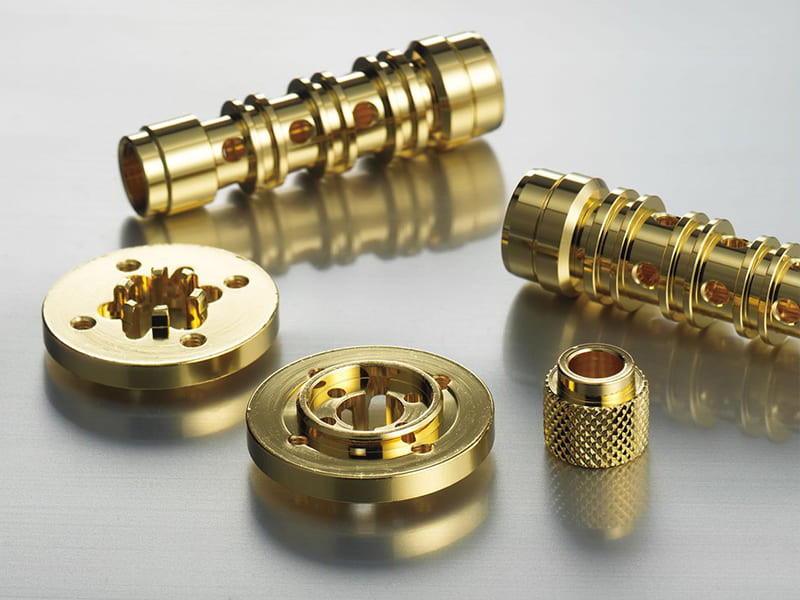
A quality inspector flags dark spots on gold-plated connector contacts as “corrosion” — and the procurement team initiates a gold plating supplier change. After root cause analysis, the dark spots trace to copper substrate exposure at sharp edges where plating thickness was below 0.1 µm. The gold itself was completely intact. The supplier wasn’t the problem — the edge geometry specification was. We investigate surface-change issues on gold-plated components regularly across our production programs. The answer to “does gold rust” is straightforward: no. But understanding why — and what’s actually happening when gold-containing parts show surface changes — prevents misdiagnosis that leads to unnecessary material changes and incorrect specifications.
Gold sits at the top of the noble metal hierarchy — chemically reluctant to react, electrochemically resistant to oxidation, and stable in virtually every environment engineered components encounter. This guide covers the materials science behind gold’s resistance, clarifies the difference between rust, corrosion, and tarnish, explains what happens with gold alloys and plated components, and provides a practical framework for engineering decisions around gold plating thickness, alloy selection, and service life.
Does Gold Rust? The Direct Answer
No. Rust is hydrated iron oxide (Fe₂O₃·nH₂O) — formed when iron reacts with oxygen and water. Gold contains no iron and doesn’t participate in that reaction. By strict definition, rust cannot form on gold.
Key facts:
- Rust = hydrated iron oxide. Not a general term for metal degradation.
- Pure gold is chemically inert under normal conditions.
- Gold is a noble metal with standard electrode potential of +1.50 V (vs iron at −0.44 V).
- Surface changes on gold-containing parts are almost always from alloying elements, substrate corrosion, or mechanical wear — not gold oxidation.
Rust vs. Corrosion vs. Tarnish
Engineers use these terms precisely because each describes a different mechanism requiring a different response.
| Term | Definition | Metals | Engineering Impact |
|---|---|---|---|
| Rust | Hydrated iron oxide (Fe + O₂ + H₂O) | Iron, carbon steel | Structural weakening, volume expansion |
| Corrosion | General electrochemical degradation | Most metals | Mechanism determines severity |
| Tarnish | Thin surface film (sulfides/oxides) | Silver, copper alloys | Mostly cosmetic; affects contact resistance |
| Patina | Stable adherent oxide/carbonate layer | Copper, bronze | Often protective |
Treating tarnish as rust overestimates structural risk. Treating active corrosion as cosmetic tarnish underestimates service life risk. For gold-containing components, what looks like “rust” is almost always tarnish from alloying elements or substrate corrosion through worn plating — neither calls for the same response as iron rusting.
Why Gold Doesn’t Rust: The Science
Electrochemical Position
Gold’s electrode potential of +1.50 V means it requires enormous driving force to oxidize. Iron at −0.44 V oxidizes readily in ambient air. The difference isn’t marginal — it’s the difference between a metal degrading in atmosphere and one remaining unchanged for decades.
This stability is why gold appears on electrical contacts, connector surfaces, and PCB edge fingers. Even a thin oxide film on copper raises contact resistance enough for intermittent signal loss. Gold’s resistance to oxide formation keeps contact resistance stable over full service life.
Electronic Structure
Gold’s outer electrons are tightly bound due to relativistic orbital contraction — a quantum effect in heavy elements stabilizing the 6s shell. This makes gold’s electrons substantially harder to remove than periodic table trends would predict, further reducing its tendency to form oxides.
Logic chain: Stable electron configuration → high electrode potential → thermodynamic reluctance to oxidize → no oxide under normal conditions → no rust under any conditions.
Can Gold Corrode?
Technically yes — but conditions required are far outside normal service.
Aqua regia (specific mixture of concentrated nitric and hydrochloric acids) dissolves gold through a combined oxidation-complexation mechanism. Neither acid alone attacks gold. No practical engineering environment replicates this chemistry.
When gold-containing parts show degradation, the investigation should focus on: plating thickness (worn through?), barrier layer integrity (nickel underlayer intact?), substrate corrosion (copper or steel corroding at defects?), alloy tarnish (copper/silver reacting?), or mechanical wear (friction removing plating?). Based on our production data, plating thickness below specification and edge geometry issues account for over 80% of “gold corrosion” complaints we investigate — not gold chemistry.
Gold Alloys: Tarnish, Not Rust
Pure gold (24K) is too soft (~25 HV) for contact applications. Engineering uses alloys — 18K (75% Au) or 14K (58.3% Au) with copper, silver, or nickel for hardness. Plating runs 0.1–5 µm depending on application.
Those alloying elements carry different electrochemical behavior:
Copper: Oxidizes readily — dark or reddish-brown spots in humid environments. Silver: Reacts with trace sulfur compounds (H₂S from air, rubber, adhesives) — dark sulfide tarnish. Nickel: Used as barrier layer (1–5 µm). Can diffuse through thin gold at elevated temperatures, changing surface chemistry.
| Aspect | Pure Gold (24K) | Gold Alloys (14K/18K) |
|---|---|---|
| Rust | Impossible | Impossible |
| Tarnish | No | Yes — from Cu, Ag, or Ni |
| Chemical stability | Extremely high | Reduced, composition-dependent |
| Hardness | ~25 HV | 100–200+ HV |
| Engineering usability | Limited | Practical and widely applied |
Gold alloys don’t rust, but they can tarnish. Managing tarnish means selecting alloy composition for the service environment — limiting copper and silver in sulfur-rich atmospheres, increasing gold purity where surface stability is priority, or applying conformal coating over assembled PCBs.
Environmental Effects
| Environment | Risk Mechanism | What Happens |
|---|---|---|
| High humidity | Accelerates alloying element reactions | Gold unchanged; Cu/Ag may spot |
| Salt spray / chloride | Substrate corrosion at defects | Gold unaffected; substrate corrodes |
| Sulfur atmosphere | Sulfidation of Cu/Ag alloy elements | Tarnish on alloy surfaces; gold inert |
| Mechanical wear | Friction removes plating | Substrate exposed and corrodes |
In controlled environments (sealed electronics, precision instruments), gold maintains integrity for multi-year service lives. In harsh environments (outdoor connectors, automotive underhood), plating specifications must account for extended exposure. MIL-DTL-45204 specifies gold plating grades — hard gold (Grade C, cobalt-alloyed, 130–200 HV) provides substantially better wear resistance than soft pure gold for connector contacts.
Engineering Applications
Why Engineers Specify Gold
Stable contact resistance. Gold doesn’t form insulating oxides. On copper, native oxide forms immediately — sufficient to cause intermittent failures in low-voltage, low-force contacts (under 100 mV, under 10 g). Gold eliminates this entirely. Standard for SIM cards, PCB edge connectors, and instrument terminals.
Long service life in inaccessible locations. Satellites, implantable medical devices, aircraft wiring — contact resistance at installation approximates resistance after 10 years. No base metal surface matches this.
Conductivity without drift. Gold’s resistivity (~2.44 µΩ·cm) is higher than copper (~1.72 µΩ·cm), but its resistance is stable. In precision measurement and communications equipment, stable resistance outweighs slightly higher absolute value.
Plating Stack Architecture
Typical connector: CNC-machined copper substrate → nickel barrier (1–5 µm) → hard or soft gold (0.1–5 µm).
In our shop floor experience, substrate quality directly determines plating performance. Surface at Ra 0.8 µm holds plating more uniformly than Ra 3.2 µm. Sharp edges produce thin plating; generous radii (≥0.1 mm) maintain consistent thickness. One common pitfall we see: specifying gold plating without controlling substrate surface finish and edge geometry — the most frequent cause of premature plating failure.
Gold vs. Common Metals
| Metal | Corrosion Tendency | Product | Protective? | Implication |
|---|---|---|---|---|
| Gold | Extremely low | None normally | N/A | Ideal for contacts |
| Iron / Carbon steel | Very high | Rust (Fe₂O₃·nH₂O) | No — destructive | Requires coatings |
| Copper | Moderate | Oxides, patina | Partial | Affects electrical performance |
| Silver | Low–moderate | Sulfide tarnish | No | Degrades contacts in sulfur |
| Aluminum 6061 | Low | Al₂O₃ (self-passivating) | Yes | Good structural; oxide insulates |
| Stainless 316L | Very low | Chromium oxide | Yes | Excellent corrosion resistance |
Gold vs copper/silver: Both good conductors, but both form surface films affecting electrical performance. Gold is specified when the electrical consequence of oxide/tarnish exceeds the plating cost premium.
Stainless 316L comparison: Both highly corrosion-resistant but serve different functions. Stainless is structural with corrosion resistance. Gold is a surface treatment for electrical reliability. They don’t compete in the same selection category.
Conclusion
Does gold rust? No — not by any mechanism in engineering service conditions. Surface changes on gold-containing components trace to alloying elements, substrate exposure through worn plating, or contamination. These diagnoses call for different responses than treating gold as the failure point.
The practical framework: specify gold where stable surface electrical properties genuinely drive the requirement. Match plating thickness to wear and environment (0.1–0.5 µm for light-duty contacts, 1.25–2.5 µm for harsh-environment connectors). Control substrate finish and edge geometry for uniform coverage. When surface changes appear, investigate the non-gold elements first — alloy composition, barrier integrity, substrate condition, plating process. In almost every case, that’s where the answer is. Need help specifying gold-plated or precision-machined connector components? [Contact our engineering team] for material guidance and manufacturing support.
FAQ
Does gold rust in water or air?
No. Gold doesn’t rust in any normal condition. Rust requires iron — gold contains none. Gold’s +1.50 V electrode potential makes it thermodynamically resistant to oxidation in atmospheric environments whether dry, humid, or submerged.
Why does gold jewelry develop dark spots?
Not rust — tarnish from alloying elements. In 14K gold (41.7% non-gold content), copper oxidizes reddish-brown and silver forms dark sulfide films in sulfur-containing environments. The gold atoms remain chemically unchanged. Higher gold purity (18K, 22K) reduces tarnish tendency at the cost of hardness.
Can gold-plated parts corrode?
The gold itself doesn’t corrode, but the system can fail. Gold plating at 0.1–5 µm thick can wear through, have pinholes, or thin at edges — exposing the substrate to corrosion. Plating specification must address thickness, barrier layer, substrate finish, and edge geometry together.
Is gold corrosion-proof?
For practical engineering purposes, yes. Aqua regia (laboratory acid mixture) dissolves gold, but no normal service environment replicates this. Salt spray, humidity, industrial atmospheres, fuels, and cleaning chemicals don’t attack gold.
Why is gold used in electronics if it’s soft?
Electronics uses gold for surface properties (no insulating oxide, stable contact resistance), not bulk strength. Softness is managed through hard gold alloys (cobalt-gold at ~200 HV), plating only on contact surfaces, and nickel underlayers providing mechanical support. Thickness and hardness specifications match contact force and expected mating cycles.


