
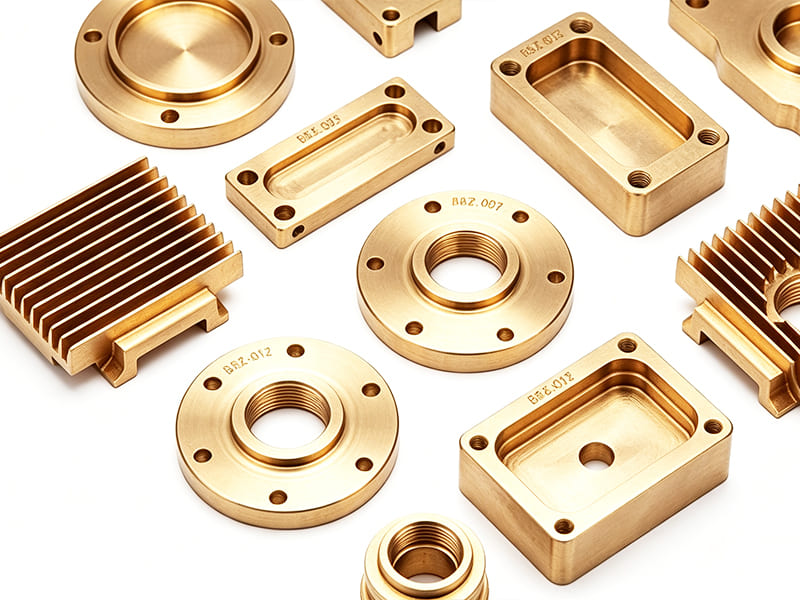
A marine pump manufacturer replaces carbon steel impeller housings with aluminum bronze after repeated rust-related failures in seawater service. The steel housings develop porous iron oxide (rust) within 6–12 months — the rust layer flakes off, exposing fresh metal to continued attack in a self-accelerating cycle. Aluminum bronze housings develop a thin, adherent oxide film in the same seawater environment and show no measurable material loss after 5+ years. The bronze costs approximately 2.5× more per unit but eliminates the annual replacement cycle — reducing total lifecycle cost by over 60%. We specify bronze alloys for marine and corrosion-critical CNC machined components regularly. Bronze does not rust — rust is specifically iron oxide (Fe₂O₃/Fe₃O₄), and bronze contains no iron. Instead, bronze corrodes through copper-based reactions that typically form a stable, protective patina (brown to green surface film) rather than the destructive, progressive degradation that characterizes steel rust. Understanding this distinction — protective patina versus harmful corrosion — is the key to selecting and maintaining bronze in real engineering applications.
This guide covers why bronze doesn’t rust, how it corrodes instead, the critical difference between protective patina and harmful corrosion, types of bronze corrosion, factors affecting resistance, comparison with brass, copper, and stainless steel, environment-specific performance, applications, cost and maintenance considerations, and prevention strategies.
Why Bronze Does Not Rust
Rust requires iron. Bronze is a copper-based alloy (typically copper + tin, aluminum, phosphorus, or silicon) containing little to no iron. The fundamental chemistry for rust formation — iron reacting with oxygen and moisture to form porous, flaking iron oxide — simply cannot occur in bronze.
| Material | Contains Iron? | Rusts? | Surface Reaction |
|---|---|---|---|
| Carbon steel | Yes | Yes | Porous iron oxide (non-protective) |
| Stainless steel | Yes | Rarely | Chromium oxide passive film |
| Bronze | No | No | Copper oxide/carbonate patina |
| Brass | No | No | Tarnish; dezincification risk |
| Copper | No | No | Green patina (protective) |
Carbon steel’s rust is porous and flaky — it falls off, exposing fresh metal to continued attack. This makes rust self-accelerating. Bronze’s corrosion products (copper oxides and carbonates) are dense and adherent — they form a barrier that slows further corrosion. This is why bronze outperforms plain steel in virtually every corrosive environment without requiring coatings.
How Bronze Corrodes
Bronze undergoes copper-based corrosion reactions that typically produce a protective surface layer rather than destructive material loss.
Corrosion Pathway
Copper reacts with oxygen, moisture, CO₂, sulfur compounds, and chlorides through a predictable sequence. Initial oxidation forms Cu₂O (reddish-brown). Further oxidation produces CuO (dark brown/black). Long-term atmospheric exposure creates basic copper carbonates (the characteristic green/blue-green patina). Each stage produces a denser, more adherent surface layer — slowing the corrosion rate over time.
Patina vs Harmful Corrosion
| Condition | Appearance | Risk | Meaning |
|---|---|---|---|
| Brown patina | Dark brown, uniform | Low | Stable oxide, protective |
| Green patina | Green film, adherent | Low-Medium | Mature carbonate, usually protective |
| Powdery green spots | Loose, spreading | High | Bronze disease (chloride-driven) |
| Pitting | Small holes, localized | High | Active corrosion, material loss |
Protective patina (good): Adherent, uniform, non-powdery. Functions as a barrier reducing oxygen and moisture access. Widely accepted — even desired — in architectural, marine, and outdoor applications. Based on our production data, properly specified bronze components with stable patina show less than 0.01 mm/year material loss in normal atmospheric exposure — functionally negligible over decades of service.
Harmful corrosion (bad): Powdery, loose, spreading green deposits indicate “bronze disease” — a chloride-driven autocatalytic reaction where CuCl forms and regenerates, causing progressive metal loss. Pitting corrosion creates localized holes that can lead to leakage or structural failure. One common pitfall we see: assuming all green surface discoloration on bronze is harmless patina — powdery green that transfers to a cloth when wiped indicates active chloride attack requiring immediate cleaning and treatment.
Types of Bronze Corrosion
Patina formation: Natural protective oxidation. Low risk. Self-limiting barrier. No intervention needed in most environments.
Bronze disease: Chloride-driven active corrosion. High risk. Powdery green products that spread and regenerate. Requires cleaning, chloride removal, and inhibitor treatment (e.g., benzotriazole). Occurs in coastal/marine environments, de-icing salt exposure, and contaminated storage.
Galvanic corrosion: Electrochemical attack when bronze contacts dissimilar metals (steel, aluminum, zinc) in an electrolyte. The less noble metal corrodes preferentially. Control through electrical isolation (gaskets, sleeves) and compatible material pairing.
Pitting corrosion: Localized film breakdown creating deep holes. Driven by chlorides, stagnant water, and differential aeration. Control through alloy selection (aluminum bronze resists best), design for drainage, and maintaining clean surfaces.
Factors Affecting Corrosion Resistance
| Factor | Impact | Strategy |
|---|---|---|
| Alloy composition | Determines baseline resistance | Aluminum bronze for marine, tin bronze for general |
| Environment | Controls corrosion rate | Match alloy to exposure conditions |
| Surface finish | Affects initiation sites | Smoother = fewer initiation points |
| Galvanic contact | Drives localized attack | Isolate dissimilar metals |
| Coatings | Adds protection layer | Apply for harsh or appearance-critical use |
Alloy Selection (Primary Driver)
| Bronze Type | Key Element | Best For |
|---|---|---|
| Tin bronze | Cu + Sn | General wear, bearings, bushings |
| Aluminum bronze | Cu + Al | Marine, seawater, high strength |
| Phosphor bronze | Cu + Sn + P | Springs, fatigue resistance |
| Silicon bronze | Cu + Si | Weldability, corrosion resistance |
Aluminum bronze forms a strong Al₂O₃ film — providing the best seawater corrosion resistance of any bronze family. In our shop floor experience, aluminum bronze marine components consistently outperform tin bronze in chloride environments by 3–5× service life — the aluminum oxide film is significantly more resistant to chloride penetration than copper oxide alone.
Bronze vs Other Metals
| Material | Best For | Corrosion Risk |
|---|---|---|
| Bronze | Marine, wear, outdoor durability | Chloride pitting (controllable) |
| Brass | Decorative, low-load fittings | Dezincification in water |
| Copper | Architecture, electrical | Stable patina (minimal risk) |
| Stainless steel (316) | Structural, food, medical | Pitting in chlorides (grade-dependent) |
| Carbon steel | Low-cost structures | Continuous rust (requires coating) |
Marine/saltwater: Bronze (especially aluminum bronze) provides the best combination of corrosion resistance, wear performance, and biofouling resistance. 316 stainless is an alternative but carries pitting risk if the wrong grade is used.
Outdoor/atmospheric: Bronze and copper both form stable protective patina. Carbon steel requires continuous coating maintenance.
Indoor/structural: Stainless steel often wins on strength and standardization. Bronze is preferred where wear resistance or low friction is also needed.
Environment-Specific Performance
| Environment | Performance | Notes |
|---|---|---|
| Indoor | Excellent | Negligible corrosion |
| Outdoor rain | Good | Protective patina forms naturally |
| Fresh water | Good | Stable; avoid stagnant zones |
| Saltwater | Medium-Excellent | Aluminum bronze preferred |
| Polluted air | Medium | Sulfide darkening; usually cosmetic |
| Soil burial | Variable | Depends on pH, chlorides, moisture |
Applications
| Application | Common Parts | Why Bronze |
|---|---|---|
| Marine | Propellers, bushings, fittings | Seawater resistance + anti-biofouling |
| Machinery | Bearings, bushings, wear plates | Low friction + self-lubricating |
| Architecture | Statues, doors, panels | Protective patina + aesthetics |
| Oil & gas | Valve bodies, pump parts | Corrosion + wear in fluid systems |
| Electrical | Springs, connectors | Conductivity + fatigue resistance |
Cost and Maintenance
Bronze costs more than carbon steel (2–3× typical) but frequently delivers lower lifecycle cost through eliminated replacement cycles, reduced maintenance, and longer service life in corrosive or high-wear environments. In projects we’ve delivered, bronze bearing replacements run approximately once every 5–7 years versus annual steel bearing replacements in the same marine application — the 2.5× material premium pays back within the first replacement cycle.
Maintenance strategy: Accept natural patina for lowest maintenance. Apply clear coating or wax for maintained appearance (adds ongoing cost). For harsh chloride environments, select aluminum bronze and inspect periodically for active corrosion signs.
Prevention Checklist
Clean regularly with mild soap and water — removes salts and contaminants. Avoid harsh chemicals and abrasives that damage the protective patina. Isolate from dissimilar metals (steel, aluminum, zinc) in wet environments using gaskets or bushings. Select the right alloy — aluminum bronze for marine, silicon bronze for welded fabrications, tin bronze for general wear. Apply coatings (wax, lacquer) only if bright appearance must be maintained. Inspect for bronze disease — powdery green deposits require immediate chloride removal and inhibitor treatment.
Conclusion
Bronze does not rust — it lacks the iron content required for rust formation. Instead, bronze corrodes through copper-based reactions that typically form a protective, self-limiting patina rather than the destructive progressive degradation characteristic of steel rust. This fundamental difference makes bronze one of the most durable metals for marine, outdoor, and high-wear environments.
The critical engineering judgment: distinguish protective patina (adherent, uniform, beneficial) from harmful corrosion (powdery, spreading, chloride-driven). Select the right alloy for the environment — aluminum bronze for seawater, tin bronze for general wear, phosphor bronze for fatigue applications. Bronze costs more upfront but frequently delivers lower lifecycle cost through eliminated rust-related failures and reduced maintenance. Need help selecting the right bronze alloy for your application? [Contact our engineering team] for material guidance, DFM review, and manufacturing support.
FAQ
Does bronze rust?
No — rust requires iron, and bronze is a copper-based alloy with no iron content. Bronze forms copper oxide/carbonate patina instead, which is typically protective rather than destructive.
Does bronze corrode?
Yes — but through copper-based reactions that usually form a stable, protective patina. Harmful corrosion (pitting, bronze disease) occurs primarily in chloride-rich environments and requires specific alloy selection and maintenance.
Why does bronze turn green?
Copper in the alloy reacts with moisture, oxygen, and CO₂ to form green copper carbonates over time. This green patina is usually protective and self-limiting — not a sign of damage unless it’s powdery and spreading.
Is green patina bad?
Not usually. Stable, adherent green patina is protective and often desired. Powdery, loose green deposits that spread indicate bronze disease (chloride-driven active corrosion) requiring treatment.
Is bronze good for outdoor and marine use?
Excellent — especially aluminum bronze for seawater. Bronze forms protective patina outdoors and resists the continuous rusting cycle that destroys uncoated steel. With proper alloy selection, bronze delivers decades of reliable service in marine and atmospheric environments.


