
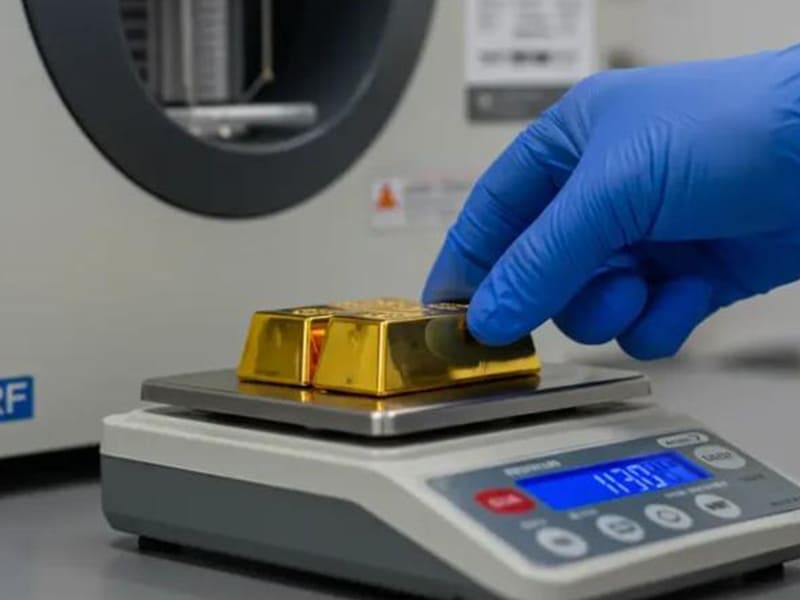
Gold’s density, about 19.32 g/cm³ at room temperature, is more than a reference value in engineering and manufacturing. It directly influences design feasibility, weight-to-volume relationships, and cost decisions in compact, high-precision components.
In production and quality control, gold’s well-defined density is also a practical tool for material verification, helping detect alloying, porosity, or substitution through mass–volume checks. Understanding how density affects design, inspection, and cost is essential when working with gold in precision manufacturing.
What Is the Density of Gold and How Is It Defined?
Standard Density Value of Gold at Room Temperature
The density of gold is a well-established material constant, defined as 19.32 g/cm³ at 20 °C for pure (24K) gold under standard atmospheric conditions. This value represents the mass of gold per unit volume and is one of the highest among commonly used engineering metals.
For engineering calculations and cross-industry communication, this density is often expressed in multiple unit systems:
| Unit System | Density of Gold |
| g/cm³ | 19.32 |
| kg/m³ | 19,320 |
| lb/ft³ | ~1,205 |
Such conversions are not academic details. In CAD-based mass property calculations, logistics planning, and cost estimation, using the correct unit system ensures consistency between design intent, manufacturing output, and procurement accounting.
It is also important to note that this value applies to pure gold. Any alloying, porosity, or internal defects will reduce the effective density, which has direct implications for quality control and material verification.
Density vs. Specific Gravity
In technical discussions, density is often confused with specific gravity, but the two are not identical. Density is an absolute property with units (mass per unit volume), while specific gravity is a dimensionless ratio comparing a material’s density to that of water at a reference temperature.
For gold, the specific gravity is numerically close to its density in g/cm³—approximately 19.3—because water’s density is defined as 1 g/cm³. In engineering and inspection practice, specific gravity is frequently used in immersion and displacement tests to quickly assess material authenticity or detect deviations caused by alloying or voids.
The practical distinction is this: density is used for design and calculation, while specific gravity is commonly used for testing and verification. Understanding both allows engineers and quality teams to apply the correct metric at each stage of design, manufacturing, and inspection.
Why Is Gold So Dense from a Materials Science Perspective?
Gold’s exceptionally high density is not a coincidence or a single-factor outcome. It is the result of atomic-scale mass, electronic effects, and crystal packing efficiency working together, translating microscopic characteristics into a macroscopic material property that engineers rely on.
Atomic Mass and Electron Configuration
Gold has a high atomic number (Au, Z = 79), which means each atom contains a large number of protons and neutrons concentrated into a very small atomic volume. This high atomic mass per atom is the first and most direct contributor to density.
Beyond simple mass, gold’s electron configuration plays a subtle but important role. Relativistic effects—arising because inner electrons move at a significant fraction of the speed of light—cause orbital contraction, particularly in the s orbitals. This contraction pulls electrons closer to the nucleus, allowing atoms to pack slightly closer together than classical models would predict. While this effect is not visible at the component scale, it contributes measurably to gold’s unusually high density compared with lighter metals of similar structure.
Face-Centered Cubic (FCC) Crystal Structure
Gold crystallizes in a face-centered cubic (FCC) structure, one of the most efficiently packed crystal lattices in metallurgy. FCC structures have an atomic packing factor (APF) of approximately 0.74, meaning 74% of the crystal volume is occupied by atoms, with minimal void space.
Many engineering metals—such as aluminum, copper, and nickel—also adopt FCC structures, yet none approach gold’s density. This highlights an important point for engineers: crystal structure determines how tightly atoms can pack, but atomic mass determines how much mass occupies that packed volume.
Atomic Packing vs. Macroscopic Density
Macroscopic density is the combined result of how heavy each atom is and how efficiently those atoms are arranged. Gold represents an extreme case where both factors align: very heavy atoms arranged in a highly efficient FCC lattice.
For engineers and manufacturers, this explains why gold remains exceptionally dense even when compared to other FCC metals, and why substituting gold with visually similar materials often results in noticeable weight differences. Understanding this atomic-to-macroscopic logic chain helps designers, quality engineers, and buyers interpret density not as an abstract number, but as a predictable outcome of gold’s fundamental material structure.
How Does Temperature Affect the Density of Gold?
Thermal Expansion and Density Change
Gold’s density is not an absolute constant—it varies predictably with temperature due to thermal expansion. As temperature increases, gold atoms vibrate with greater amplitude, increasing the average interatomic spacing. This causes the material’s volume to expand, while mass remains constant, resulting in a decrease in density.
For gold, the linear coefficient of thermal expansion at room temperature is approximately 14.2 × 10⁻⁶ /K. Because density is inversely proportional to volume, even modest temperature changes can produce measurable density shifts. For example, a gold component measured at elevated temperature will exhibit a slightly lower apparent density than the standard value of 19.32 g/cm³ defined at 20 °C.
Although the magnitude of this change is small in everyday terms, it becomes non-negligible in precision mass–volume calculations, particularly for high-value or tight-tolerance parts.
Engineering Significance of Temperature Effects
From an engineering standpoint, temperature-dependent density matters most in two situations: manufacturing at elevated temperatures and high-accuracy measurement or verification.
During high-temperature processes such as casting, brazing, or thermal treatment, gold’s instantaneous density is lower than its room-temperature value. While designers rarely size components based on hot-state density, engineers must account for thermal contraction upon cooling, which affects final dimensions and internal stress states.
In inspection and quality control, temperature effects are a common source of measurement discrepancy. Density or specific gravity tests performed without temperature correction can misinterpret normal thermal expansion as alloying, porosity, or material substitution. This is especially critical when gold content is inferred from mass–volume relationships, where small errors translate directly into cost and compliance risk.
The practical takeaway is straightforward: gold density values are only meaningful when temperature is specified. For reliable engineering decisions, density measurements should be referenced to standard conditions or corrected for temperature—ensuring that design intent, process control, and material verification remain aligned.
How Is the Density of Gold Measured in Practice?
In engineering, manufacturing, and quality control, the density of gold is rarely inferred from theory alone. It is measured using mass–volume relationships, with methods selected based on required accuracy, part geometry, and traceability needs. The goal is not just to obtain a number, but to verify material integrity and consistency.
Water Displacement Method
The water displacement method is based on Archimedes’ principle: the volume of an object equals the volume of fluid it displaces. By measuring a gold sample’s mass in air and the volume of water displaced, density can be calculated directly.
This method is simple and effective for regularly shaped or relatively large parts, making it common in preliminary inspection or low-risk verification. However, its accuracy is limited by several factors: surface tension effects, trapped air bubbles, temperature variation of water, and reading resolution. For small or high-value gold components, these error sources can become significant, leading to misleading results.
Hydrostatic Weighing (Hydrostatic Balance)
For higher accuracy, hydrostatic weighing is the preferred method in both industrial and laboratory environments. Instead of directly measuring displaced volume, the part is weighed in air and then weighed while fully submerged in a fluid of known density. The difference in apparent weight corresponds precisely to the buoyant force, allowing density to be calculated with much higher resolution.
Hydrostatic balances offer superior repeatability and precision, making them suitable for purity verification, alloy differentiation, and high-value quality control. In precision manufacturing and procurement contexts, this method provides confidence that observed density deviations reflect real material differences rather than measurement noise.
Laboratory and Industry Standards
In regulated or high-stakes applications, density measurement follows standardized testing frameworks to ensure repeatability and traceability. ASTM and ISO standards define testing logic, environmental controls, and calibration practices rather than prescribing a single instrument.
From an engineering perspective, standards-based density measurement ensures that results are comparable across suppliers, batches, and facilities. For procurement managers and quality engineers, this traceability is often more important than absolute numerical precision, as it underpins supplier qualification and material acceptance decisions.
In practice, the most effective approach is selecting a measurement method that matches the risk profile and tolerance requirements of the application—using simple displacement for screening, and hydrostatic or standards-based methods where accuracy directly impacts performance or cost.
How Does Gold Purity and Alloying Affect Density?
Gold’s density is closely tied to its purity, but the relationship is not linear nor exclusive. In engineering, manufacturing, and quality verification, understanding how alloying alters density—and where density-based assumptions break down—is essential to avoid misinterpretation.
Density of Pure Gold (24K)
Pure gold (24K) has a theoretical density of 19.32 g/cm³ at 20 °C. In practice, measured values for high-purity gold typically fall within a narrow range slightly below this number. Minor deviations are usually caused by residual porosity, microstructural defects, temperature variation, or measurement uncertainty, rather than changes in chemical composition.
For precision parts and high-value components, even a small density deviation can be meaningful. Engineers and quality teams therefore treat 24K gold density as a reference benchmark, not an absolute guarantee of purity.
Density Changes in 18K, 14K, and Other Alloys
When gold is alloyed, its density decreases because most common alloying elements are significantly less dense than gold. Typical effects are summarized below:
| Alloy | Approx. Gold Content | Typical Density Range (g/cm³) | Primary Alloying Elements |
| 24K | 99.90% | ~19.3 | — |
| 18K | 75% | ~15.5–16.5 | Ag, Cu |
| 14K | 58.50% | ~12.5–14.0 | Ag, Cu, Ni |
| 10K | 41.70% | ~11.0–12.0 | Ag, Cu, Ni |
The physical reason is straightforward: replacing gold atoms with lighter atoms reduces average atomic mass per unit volume. In addition, alloying can slightly alter lattice parameters, further changing the mass–volume relationship.
For designers, this affects weight-sensitive components. For procurement and costing, it directly impacts material value per unit volume. For quality control, it provides a useful—but incomplete—screening signal.
Why Density Alone Cannot Fully Define Purity
A common misconception is that density can uniquely determine gold purity. In reality, different alloy combinations can yield similar densities. For example, a gold–silver alloy and a gold–copper alloy with different compositions may overlap in measured density. Porosity, internal voids, or manufacturing defects can further mask true composition.
From an engineering and sourcing standpoint, density should be treated as a necessary but insufficient indicator. It is effective for detecting gross substitution or dilution, but it cannot replace compositional analysis (such as XRF or chemical assay) when purity must be confirmed.
The key takeaway is that gold density reflects both chemistry and structure. Used correctly, it is a powerful screening and design parameter—but relying on density alone to define purity introduces avoidable technical and financial risk.
How Does Gold’s Density Compare with Other Metals?
Gold vs Silver, Copper, Platinum
Gold’s density stands out even among heavy and precious metals. A direct comparison highlights how dramatically mass–volume relationships differ:
| Metal | Density (g/cm³, ~20 °C) | Relative to Gold | Engineering Implication |
| Gold (Au) | 19.32 | 1.00× | Extremely high mass in compact volume |
| Platinum (Pt) | ~21.45 | 1.11× | Even denser, but harder to process and costlier |
| Silver (Ag) | ~10.49 | 0.54× | ~Half the density of gold |
| Copper (Cu) | ~8.96 | 0.46× | Less than half the density of gold |
For a fixed volume, gold weighs ~2.2× more than silver and ~2.15× more than copper. Conversely, achieving the same mass with silver or copper requires significantly more volume. These differences are not academic—they directly affect component size, balance, inertia, and handling.
Why Density Matters in Material Selection
From an engineering perspective, density becomes decisive in two contrasting scenarios:
-
Weight- and volume-constrained designs: In compact assemblies (e.g., counterweights, micro-mechanical parts, electrical contacts with space limits), gold’s high density allows designers to achieve required mass without increasing footprint. This can simplify packaging and improve dynamic balance.
-
High-reliability and verification-driven applications: Gold’s density also aids material verification and quality control. Large density gaps versus common metals make substitution or dilution easier to detect through mass–volume checks—an advantage in high-value or regulated manufacturing.
However, high density also increases material cost per unit volume and influences machining dynamics (tool load, fixturing, and handling). Compared with platinum, gold offers a balance of very high density with better manufacturability and broader industrial familiarity, which often drives selection.
In short, gold’s density is not merely “high”—it is strategically distinctive, shaping decisions wherever mass, volume, reliability, and verification intersect.
What Does the Density of Gold Mean for Engineering and Manufacturing?
Gold’s high density has direct, practical consequences in engineering design and CNC manufacturing, particularly for precision and high-value components. It influences not only how parts are designed, but also how they are machined, handled, and costed throughout the production lifecycle.
Weight and Volume Control in Precision Parts
With a density of approximately 19.32 g/cm³, gold delivers a large amount of mass in a very small volume. For designers, this creates both an advantage and a constraint. In applications where mass must be concentrated in limited space—such as counterweights, micro-mechanical elements, or compact electrical contacts—gold enables precise weight targets without increasing part size.
At the same time, this density magnifies the impact of small geometric changes. Minor dimensional deviations can result in disproportionately large mass differences, which affects balance, inertia, and functional performance. As a result, tight dimensional control and accurate CAD mass-property validation are especially important when designing gold components.
Machining, Handling, and Cost Considerations
In CNC machining, gold’s density directly affects handling forces, fixturing strategy, and perceived material behavior. Although gold is relatively soft compared with many engineering metals, its high mass increases clamping loads and inertia during dynamic operations. Stable workholding and conservative cutting strategies help maintain dimensional accuracy and surface integrity.
From a cost perspective, density translates into high material value per unit volume. Scrap, excessive stock allowance, or inefficient toolpaths can quickly escalate cost. This makes process planning, material utilization, and chip recovery more critical than with lower-density base metals. For procurement managers, density-driven mass calculations are also central to accurate cost forecasting and yield control.
Applications in Electronics, Medical, and Specialized Components
Gold’s density supports its role in high-reliability, high-value applications. In electronics, dense gold contacts and coatings provide stable mechanical engagement and predictable mass distribution alongside excellent conductivity and corrosion resistance. In medical and specialized equipment, gold’s density and chemical stability support components where long-term reliability, traceability, and material verification are essential.
Across these applications, density is not an isolated property—it interacts with geometry, cost, machining strategy, and quality control. For engineers and manufacturers, understanding what gold’s density implies in practice enables better design decisions, more efficient production, and lower risk when producing custom gold parts.
When Should Designers and Buyers Pay Special Attention to Gold Density?
Designers and buyers should pay close attention to gold’s density whenever mass–volume relationships directly affect performance, cost, or compliance. In these cases, density is not a background material property—it becomes a controlling parameter.
From a design perspective, density is critical in weight-sensitive or volume-constrained components. Examples include counterweights, balance-critical mechanisms, micro-scale electrical contacts, and precision assemblies where small dimensional changes lead to measurable mass variation. In such applications, gold’s high density enables compact designs but also demands tight dimensional tolerances and accurate mass-property validation during CAD and prototyping stages.
Density also deserves heightened attention when material authenticity or purity is part of the risk profile. In procurement and incoming inspection, density-based checks are valuable for detecting gross substitution, dilution, or unexpected porosity—especially in high-value or regulated parts. However, density alone cannot uniquely define gold purity. Different alloy systems or internal defects can produce overlapping density ranges.
For this reason, density should be treated as a screening and consistency metric, not a standalone verification tool. When material value, regulatory compliance, or long-term reliability matters, density measurements should be combined with compositional analysis (e.g., XRF), certified material documentation, and process traceability.
The most effective approach is coordination between design and procurement: designers specify when density is functionally critical, and buyers ensure that sourcing, inspection, and testing methods are aligned with that requirement. Used this way, gold’s density becomes a reliable decision aid—rather than a misunderstood or over-relied-upon number.
Summary
Gold has an exceptionally high density of about 19.32 g/cm³, driven by its heavy atomic mass and tightly packed FCC crystal structure. This property strongly affects weight–volume relationships and must be considered when designing compact or high-value components.
In practice, observed density varies with temperature, alloying, porosity, and measurement method. Density therefore plays a role beyond material data—supporting design decisions, quality verification, and cost control. Reliable use of gold requires interpreting density in context rather than relying on a single nominal value.
FAQ
What is the exact density of gold at room temperature?
The accepted standard density of pure (24K) gold is 19.32 g/cm³ at 20 °C under normal atmospheric pressure. This value is widely used in engineering calculations, quality control, and material reference data. Small deviations in measured density usually arise from temperature variation, measurement method, or microstructural factors rather than changes in the intrinsic property.
Does gold density change with temperature?
Yes. Gold density decreases slightly as temperature increases due to thermal expansion. As gold heats up, its volume expands while mass remains constant, lowering density. Although the change is small, it can become relevant in high-precision measurement, purity screening, or elevated-temperature processing, where uncorrected temperature differences may introduce measurable error.
Can density be used to verify gold purity?
Density is a useful screening tool, but it cannot fully define purity on its own. Pure gold has a well-known density, so significant deviation can indicate alloying, porosity, or substitution. However, different gold alloys—or combinations of alloying elements—can produce overlapping density ranges. In engineering and procurement, density checks should be combined with compositional analysis (such as XRF) and certified documentation for reliable purity verification.
Why is gold denser than silver or copper?
Gold’s density is higher because it combines a very high atomic mass with an efficient face-centered cubic (FCC) crystal structure. Silver and copper share the same FCC structure but have much lower atomic masses. As a result, gold packs far more mass into the same volume, making it roughly twice as dense as silver or copper.
How accurate are density-based tests?
Accuracy depends strongly on the method used. Simple water displacement can provide reasonable estimates for larger parts but is sensitive to surface tension, trapped air, and reading resolution. Hydrostatic weighing offers much higher precision and repeatability and is commonly used in industrial and laboratory environments. Even with precise methods, density results must be interpreted in context, accounting for temperature, geometry, and manufacturing condition.


