
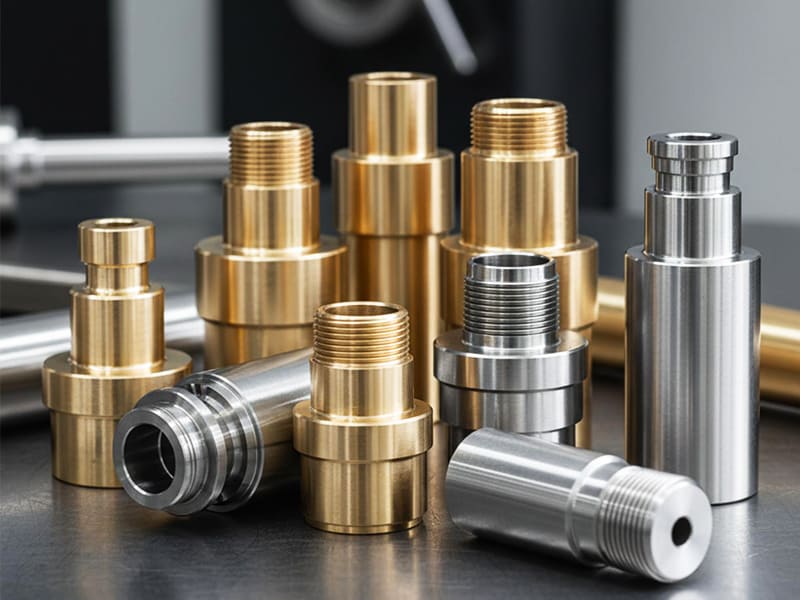
Quick Answer: Brass (copper-zinc alloy) and steel (iron-carbon alloy) are selected for fundamentally different engineering functions. Steel provides high tensile strength (400–1000+ MPa depending on grade) at low material cost — the correct material for structural frames, load-bearing components, gears, shafts, and high-stress mechanical parts. Brass provides natural corrosion resistance, high electrical conductivity (15–30% IACS versus 1–3% IACS for steel), and superior machinability (approximately 100% machinability rating versus 40–70% for carbon steel) — the correct material for plumbing fittings, electrical connectors, precision CNC components, marine hardware, and decorative parts. Higher material cost for brass is typically offset by lower machining, finishing, and maintenance cost. The material selection decision should be based on operating environment, load requirement, conductivity need, and total lifecycle cost — not raw material price alone.
Fundamental Composition and Property Differences
Brass and steel are not interchangeable structural alternatives with different costs — they are chemically and mechanically distinct materials optimized for different engineering requirements. Understanding the composition difference explains every downstream performance distinction.
Brass is a non-ferrous alloy of copper and zinc. The copper content (typically 60–90%) governs corrosion resistance and electrical conductivity; zinc content governs strength and machinability. Common engineering brass grades:
- C36000 (free-machining brass, 360 brass): 61.5% Cu, 35.5% Zn, 3% Pb — the standard CNC machining grade with the highest machinability
- C26000 (cartridge brass): 70% Cu, 30% Zn — higher strength, excellent formability
- C46400 (naval brass): 60% Cu, 39.25% Zn, 0.75% Sn — optimized for seawater resistance
Steel is a ferrous alloy of iron and carbon, with alloying additions (chromium, molybdenum, nickel, vanadium) added to improve specific properties. Common engineering steel grades:
- A36 / S235 (structural carbon steel): 250 MPa yield, 400–550 MPa UTS — low cost, general structural use
- 4140 alloy steel: 415 MPa yield (annealed), up to 1000+ MPa when heat-treated — standard for shafts, gears, and load-bearing components
- 304 stainless steel: 215 MPa yield, 505 MPa UTS, 18% Cr / 8% Ni — corrosion-resistant general purpose
- 316 stainless steel: 210 MPa yield, 515 MPa UTS, 16% Cr / 10% Ni / 2% Mo — elevated chloride resistance for marine and chemical environments
Core Property Comparison
| Property | Brass (C36000) | Carbon Steel (A36) | Stainless Steel (304) |
|---|---|---|---|
| Tensile strength | ~340–470 MPa | 400–550 MPa | 505–700 MPa |
| Yield strength | ~130–310 MPa | ~250 MPa | ~215 MPa |
| Hardness (Brinell) | 80–100 HB | 120–160 HB | 160–200 HB |
| Density | 8.50 g/cm³ | 7.85 g/cm³ | 8.00 g/cm³ |
| Electrical conductivity | 15–28% IACS | ~1.5% IACS | ~2.5% IACS |
| Thermal conductivity | 109–120 W/m·K | 50–60 W/m·K | 16–20 W/m·K |
| Machinability rating | ~100% (C36000) | 55–65% | 45–55% |
| Natural corrosion resistance | Excellent (no iron, oxide passive film) | Poor (requires coating) | Good (Cr₂O₃ passive film) |
| Magnetic | No | Yes | No (austenitic grades) |
| Raw material cost | Higher (copper price) | Lower | Medium to high |
Strength: Where Steel Is the Only Option
Steel’s dominant engineering advantage is strength. The tensile strength range achievable in steel (250 MPa in mild structural steel up to 1800+ MPa in high-strength alloy steel) spans a range that brass cannot approach, particularly in its heat-treatable condition.
Why Brass Cannot Replace Steel in Structural Applications
Brass’s yield strength of 130–310 MPa (depending on alloy and temper) is comparable to low-grade structural steel in absolute terms, but brass is not heat-treatable to higher strength levels in the way that alloy steel is. A 4140 steel shaft in the quenched-and-tempered condition achieves 900–1100 MPa tensile strength — more than twice the maximum achievable in any standard brass alloy. For rotating shafts, gear components, structural brackets, and load-bearing frames, this strength difference is decisive.
Brass also has significantly lower fatigue strength than steel — the ratio of fatigue limit to tensile strength (endurance ratio) is lower for brass than for most steels, making brass unsuitable for components subjected to high-cycle fatigue loading such as connecting rods, crankshafts, and alternating-load structural members.
Applications where steel is the only correct choice:
- Structural frames, beams, and columns in construction and machinery
- Rotating shafts, axles, and spindles under significant bending or torsional loads
- Gears and sprockets under continuous Hertzian contact stress
- Fasteners and bolts in structural joints (high-strength steel grades)
- Springs and resilient elements requiring high elastic strain energy storage
- Cutting tools and dies requiring high hardness and wear resistance
Steel Grade Selection for Strength-Critical Applications
| Requirement | Recommended Grade | Reason |
|---|---|---|
| General structural load, low cost | A36 / S235 carbon steel | Adequate strength, widely available, weldable |
| High strength shaft, gear | 4140 / 4340 alloy steel (Q&T) | Heat-treatable to 900–1100 MPa, good toughness |
| Corrosion + moderate strength | 304 or 316 stainless steel | Passive film without coating, sufficient strength for many applications |
| Maximum strength, aerospace | 300M / 4340 VAR high-strength alloy | Premium strength at high cost |
Corrosion Resistance: The Environment Determines the Answer
Corrosion behavior is the most environment-specific property comparison between brass and steel, and the most consequential for lifecycle cost.
Carbon Steel: Requires Protection
Carbon steel (including common grades A36, 1018, 1045) is highly susceptible to corrosion in any environment containing oxygen and moisture. The iron oxide (rust) that forms is porous and non-adherent — unlike the passive films formed by copper alloys or chromium-containing stainless steel, rust does not protect the underlying metal. Instead, it creates a permeable layer that allows corrosion to continue beneath, eventually producing section loss and structural failure.
In outdoor, humid, marine, or aqueous environments, uncoated carbon steel’s service life is measured in months to a few years. Maintaining carbon steel in corrosive environments requires:
- Protective coatings (paint, galvanizing, powder coating) — effective but require maintenance and eventual renewal
- Regular inspection and coating repair — labor and cost that adds significantly to lifecycle expense
- Scheduled replacement when section loss reaches structural limits
Stainless Steel: Self-Protecting but Alloy-Specific
Stainless steel’s corrosion resistance comes from a thin, self-renewing chromium oxide (Cr₂O₃) passive film that forms in air and most aqueous environments. This film is self-healing — minor damage is repaired by re-oxidation. The critical limitation is chloride resistance:
- 304 stainless: Adequate for most atmospheric and freshwater environments; susceptible to pitting and crevice corrosion in chloride-containing environments (seawater, de-icing salts, swimming pool water)
- 316 stainless (2% Mo addition): Significantly improved chloride resistance; the standard for coastal environments and applications with periodic seawater exposure
- 2205 duplex stainless: Higher strength than 304/316, excellent chloride resistance — appropriate for marine structural applications where 316 performance is marginal
Brass: Naturally Corrosion-Resistant Without Coating
Brass forms a stable copper oxide / zinc oxide passive film that provides natural corrosion resistance in most atmospheric, water, and non-oxidizing acid environments without any protective coating. This makes brass the preferred material for:
- Water supply and plumbing fittings: Brass valves, fittings, and connectors have been the industry standard for potable water systems for over a century. The material is compatible with drinking water regulations (NSF/ANSI 61 for lead-free brass grades), provides reliable thread sealing, and does not contaminate the water stream.
- Marine hardware above the waterline: Naval brass (C46400) and silicon bronze are standard for above-waterline marine fittings because of their seawater resistance without coating maintenance.
- Electrical outdoor hardware: The combination of conductivity and corrosion resistance makes brass the standard for outdoor electrical connectors and terminals.
Dezincification risk: In certain water compositions (soft water with high bicarbonate, or low-pH water), the zinc component of brass can be selectively dissolved, leaving a porous copper structure (dezincification). This is prevented by specifying dezincification-resistant (DZR) brass grades for aggressive water conditions.
Corrosion Selection Summary
| Environment | Best Material | Notes |
|---|---|---|
| Indoor, dry | Carbon steel | No corrosion risk; lowest cost |
| Outdoor atmospheric (non-coastal) | Carbon steel (coated) or 304 SS | Steel requires coating maintenance |
| Coastal outdoor | 316 stainless or naval brass | Chloride resistance critical |
| Marine (seawater contact) | 316 SS (structural) or naval brass (fittings) | 304 SS insufficient for seawater |
| Potable water plumbing | Lead-free brass (C69300, C87850) or 316 SS | NSF/ANSI 61 compliance required |
| Industrial acid or chemical | Application-specific — consult corrosion data | Brass has acid limitations |
| Humid / condensation-prone | Brass or stainless steel | Avoid uncoated carbon steel |
Machinability: Brass’s Manufacturing Advantage
Machinability is the most important practical advantage of brass for precision CNC component manufacturing, and it is consistently undervalued in material selection decisions that focus only on raw material cost.
The Machinability Difference
The machinability index rates how efficiently a material can be cut relative to a standard reference (AISI B1112 free-machining steel = 100%). C36000 free-machining brass has a machinability rating of approximately 100% on this scale — this means brass cuts at the same efficiency as the reference steel used to establish the benchmark.
| Material | Machinability Rating | Notes |
|---|---|---|
| C36000 free-machining brass | ~100% | Benchmark reference for non-ferrous machining |
| C26000 cartridge brass | ~70% | Less free-machining than C36000 |
| 1018 carbon steel | ~65% | Medium free-machining carbon steel |
| 4140 alloy steel (annealed) | ~55% | Common engineering steel |
| 304 stainless steel | ~45–55% | Work-hardening tendency reduces efficiency |
| 316 stainless steel | ~40–50% | Lower than 304 |
| 17-4 PH stainless steel | ~25–35% | Challenging to machine |
What the Machinability Difference Means in Production
Cutting speed and cycle time: Brass can be machined at cutting speeds of 150–300 m/min for turning operations, compared to 80–150 m/min for mild steel and 60–120 m/min for 304 stainless steel. For a component with 5 minutes of cutting time in steel, brass machining time may be 2–3 minutes — a 40–60% cycle time reduction.
Tool life: Brass’s lower hardness and excellent chip-breaking characteristics result in minimal tool wear. A carbide insert that produces 500–1000 parts from 304 stainless may produce 3000–5000 parts from C36000 brass, reducing tooling cost by 70–80% on equivalent production runs.
Surface finish: Brass produces surface finishes of Ra 0.4–1.6 µm as-machined on standard CNC turning and milling operations. Achieving equivalent finish on steel often requires additional polishing or grinding operations.
Chip behavior: Brass produces short, brittle chips that break cleanly and clear the cutting zone without tangling. Steel produces long continuous chips that tangle in tooling, require chip breakers, and can cause safety issues in high-speed machining.
Total Cost Analysis: Brass vs Steel for Precision CNC Parts
For precision small-to-medium components (connectors, fittings, valve bodies, precision inserts), the total manufacturing cost comparison often favors brass despite its higher raw material cost:
| Cost Component | Brass (C36000) | 304 Stainless Steel |
|---|---|---|
| Raw material cost per kg | Higher (~3–5× 304 SS per kg in some markets) | Medium |
| Machining time per part | Lower (40–60% faster cycle) | Higher |
| Tooling cost per part | Lower (2–4× longer tool life) | Higher |
| Finishing operations | Fewer (good as-machined finish) | More frequent (grinding, polishing) |
| Rejection rate | Lower (better dimensional stability) | Higher (work-hardening issues) |
| Total manufacturing cost (typical precision part) | Often 15–30% lower than 304 SS | Reference |
This analysis varies with part geometry and production volume, but for small precision components where machining time dominates the cost structure, brass’s lower processing cost frequently offsets the higher material cost.
Electrical and Thermal Conductivity: No Contest
For applications where current must flow or heat must transfer, brass is the only practical choice between these two materials. The conductivity difference is not marginal — it is an order of magnitude.
Electrical conductivity:
- C36000 brass: ~26% IACS (International Annealed Copper Standard, where 100% = pure annealed copper)
- Carbon steel: ~1.5% IACS
- 304 stainless steel: ~2.5% IACS
At 26% versus 1.5–2.5% IACS, brass conducts electricity approximately 10–17× more efficiently than either steel type. For electrical connectors, terminals, switch contacts, bus bars, and grounding components, this difference translates directly to:
- Lower contact resistance → less resistive heating at connections
- Lower voltage drop across the connector
- More stable signal transmission in low-voltage electronics
Thermal conductivity:
- C36000 brass: ~109–120 W/m·K
- Carbon steel: ~50–60 W/m·K
- 304 stainless steel: ~16–20 W/m·K
Brass conducts heat 2× faster than carbon steel and 6–7× faster than stainless steel. For heat exchangers, thermally managed housings, and components where heat dissipation is a design requirement, this difference is substantial.
Steel’s role in electrical assemblies: Steel is appropriate for the structural elements of electrical systems — housings, enclosures, cable trays, mounting brackets — where strength is the requirement. Steel is not used for current-carrying conductors, contact surfaces, or thermally active elements in electrical systems.
The Complete Selection Decision Framework
Primary Selection Criteria
Start with environment:
- Corrosive (water, humidity, marine, outdoor): brass or stainless steel; not uncoated carbon steel
- Non-corrosive (dry indoor): all three options viable; cost and strength govern
Then check load requirement:
- Structural, high load, fatigue: steel (alloy or structural grade)
- Functional, moderate load, precision: brass
Then check functional requirements:
- Electrical conductivity required: brass (or copper for maximum conductivity)
- Heat dissipation required: brass
- Neither: cost and strength govern
Finally evaluate machinability and total manufacturing cost:
- High complexity, precision, high volume: brass often lower total cost
- Large structural sections, simple geometry: steel lower total cost
Selection Decision Table
| Application Requirement | Brass | Carbon Steel | Stainless Steel |
|---|---|---|---|
| High structural load capacity | Not suitable | Correct choice | Possible (lower strength) |
| Corrosive environment (atmospheric) | Correct | Needs coating | Correct |
| Marine/coastal corrosion | Correct (naval grade) | Not suitable | Correct (316 grade) |
| Electrical conductivity | Correct | Not suitable | Not suitable |
| Precision CNC, high volume | Correct (lower total cost) | Possible | Possible (higher cost) |
| Decorative, premium appearance | Correct | Needs finishing | Possible |
| Potable water plumbing | Correct (lead-free grades) | Not suitable | Possible (316) |
| Budget-sensitive, large structure | Not suitable | Correct choice | Possible |
Common Material Selection Mistakes
Comparing Only Raw Material Price
The most frequent error: selecting steel because its raw material cost is lower per kilogram, without calculating the full cost of machining, finishing, corrosion protection, and maintenance.
For a precision connector produced at 10,000 units/year: steel raw material savings of $0.30/part can be fully offset by an additional $0.25/part in machining time and $0.10/part in tooling — net saving essentially zero. In outdoor applications, annual coating maintenance for carbon steel can exceed the original cost premium of using stainless steel or brass within 2–3 years.
Using Carbon Steel Where Corrosion Resistance Is Required
Carbon steel without adequate coating will rust in any environment with moisture and oxygen. The error occurs most commonly when designing components that start indoors but move to outdoor or humid environments, or when a project assumes coating durability that is not maintained. The consequence is accelerated corrosion requiring early replacement — a lifecycle cost far exceeding the initial material savings.
Using Brass for Structural Load-Bearing Applications
Brass’s moderate yield strength (130–310 MPa) and lower fatigue limit make it unsuitable for structural members, load-bearing brackets, shafts under significant bending moment, and any application where mechanical failure under load would have safety consequences. This mistake typically occurs when designers extend brass from a precision functional component (where it is correct) to a structural element without verifying the load analysis.
Ignoring Dezincification Risk for Brass in Specific Water Conditions
Standard brass (C36000, C26000) can suffer selective zinc dissolution (dezincification) in aggressive water conditions — particularly soft, slightly acidic water with high dissolved CO₂. For plumbing applications in regions with such water quality, specify dezincification-resistant (DZR) brass grades or use alternative materials.
Key Takeaways
- Steel and brass are not interchangeable — they are optimized for different engineering functions. Steel for strength and structural load; brass for corrosion resistance, conductivity, and precision machining.
- Steel’s dominant advantage is strength: tensile strength of 400–1000+ MPa across structural and alloy grades, heat-treatable to high hardness, with better fatigue performance than brass.
- Brass’s dominant advantages are corrosion resistance (no iron, no rust), electrical conductivity (15–28% IACS versus 1–3% for steel), and machinability (approximately 100% versus 45–65% for most steel grades).
- Carbon steel requires coating in any corrosive environment — unprotected carbon steel in outdoor, humid, or aqueous service has a service life of months to a few years.
- Stainless steel (304 for general; 316 for marine) provides the combination of adequate strength and corrosion resistance when both properties are required simultaneously.
- Brass’s higher material cost is typically partially or fully offset by lower machining cost for precision CNC components — cycle time is 40–60% shorter, tool life is 2–4× longer, and finishing requirements are reduced.
- For OEM procurement teams: material selection decisions should include: operating environment (corrosion exposure), load requirement (structural or functional), conductivity requirement, annual production volume (affects relative machining cost impact), and maintenance cost projection — not raw material cost alone.
Frequently Asked Questions
Is brass stronger than steel?
No. Steel is significantly stronger than brass. Structural carbon steel (A36/S235) has tensile strength of 400–550 MPa; common engineering alloy steel (4140, quenched and tempered) achieves 900–1100 MPa. Brass tensile strength ranges from approximately 340–470 MPa for C36000 at its strongest temper — less than most engineering steels and far below heat-treated alloy steel. For structural frames, shafts, gears, and load-bearing components, steel is the required material. Brass is appropriate for functional components — fittings, connectors, precision parts — where its corrosion resistance and machinability properties are the governing requirements, and where structural loads do not approach the material’s limits.
Does brass corrode or rust like steel?
Brass does not rust because it contains no iron. It forms a stable copper-zinc oxide surface film (and, over time, a green patina from copper carbonate) that passivates the surface and slows further corrosion. This passive layer is stable in most atmospheric and freshwater environments without any protective coating. Carbon steel, by contrast, forms iron oxide (rust) that is porous and non-protective — corrosion continues beneath the rust layer, causing progressive section loss. For any application involving moisture, humidity, outdoor exposure, or water contact, brass provides substantially better durability than uncoated carbon steel without requiring coating maintenance.
Which machines better in CNC: brass or steel?
Brass machines significantly better than steel for precision CNC work. C36000 free-machining brass has a machinability rating of approximately 100% (compared to the reference standard), versus 55–65% for mild carbon steel and 45–55% for 304 stainless steel. In practical terms, brass can be cut at higher speeds, produces short brittle chips that clear easily, causes minimal tool wear, and achieves excellent surface finish (Ra 0.4–1.6 µm) as-machined without secondary finishing. For a precision component with significant machining content, brass can reduce total production cost by 15–30% versus 304 stainless steel despite the higher raw material cost, because machining time and tooling cost are a larger fraction of total cost than raw material for precision small parts.
Why is brass used in plumbing instead of steel?
Brass has been the standard material for potable water fittings, valves, and connectors for over a century because of three properties that steel cannot provide simultaneously without significant cost and complexity: natural corrosion resistance in water (no coating required, no rust contamination), reliable thread sealing performance with pipe thread systems, and compatibility with potable water regulations. Carbon steel in water contact rusts rapidly, contaminating the water stream and degrading structural integrity. Stainless steel is a viable alternative but at significantly higher material and machining cost. For modern lead-free plumbing requirements, brass grades compliant with NSF/ANSI 61 (C69300, C87850, and others) provide the required corrosion performance and regulatory compliance.
When should I choose stainless steel over both brass and carbon steel?
Choose stainless steel when a component requires both meaningful structural strength and reliable corrosion resistance simultaneously — a combination that neither brass (limited strength) nor carbon steel (requires coating) provides without trade-offs. Typical scenarios: structural components in marine or coastal environments (316 stainless, where brass lacks load capacity and 304 stainless may pit in chloride); food processing equipment requiring cleanable, corrosion-resistant surfaces that support structural loads; medical device components requiring both dimensional precision under load and sterilization compatibility; and architectural structures where coating maintenance is impractical and appearance must be maintained long-term. The cost premium of stainless steel relative to carbon steel is justified when the alternative is continuous coating maintenance or component replacement in service.
Written by the CMS engineering team with 15+ years of precision CNC machining experience in C36000 brass, 4140 and 4340 alloy steel, 304 and 316 stainless steel, and naval brass components for plumbing, electrical, automotive, marine, and industrial OEM manufacturing applications. Technical references: ASTM B16 (Free-Machining Brass Rod), ASTM A36 (Structural Steel), ASTM A276 (Stainless Steel Bars), NSF/ANSI 61 (Drinking Water System Components), ASTM B837 (Dezincification-Resistant Brass).
Sourcing CNC Machined Components in Brass, Steel, or Stainless Steel?
At CMS, we machine components in C36000 brass, 4140 alloy steel, 304 and 316 stainless steel, naval brass, and other engineering alloys — providing material selection guidance for environment, load, conductivity, and machinability requirements before production begins. Every order includes DFM review for material compatibility with specified tolerances, surface finish, and any required secondary operations.
[Request a material selection review and CNC machining quote →]


