
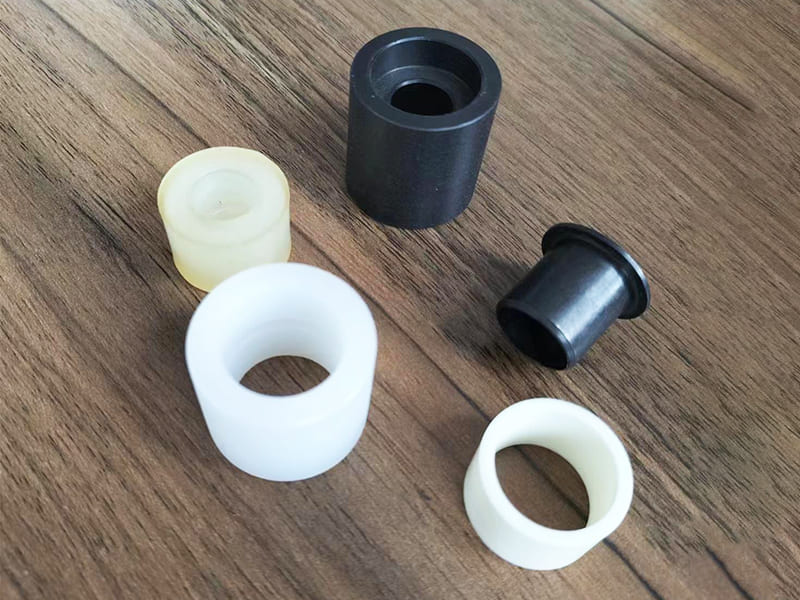
Quick Answer: Delrin (POM, polyacetal) and Nylon (PA, polyamide) overlap extensively in CNC-machined mechanical components — both are used for gears, bushings, rollers, and sliding parts. The governing difference is moisture: Delrin absorbs approximately 0.2% moisture and maintains dimensional stability across environments; Nylon absorbs 2–3%+ and can swell enough to close clearances on precision fits. For precision CNC parts with tight tolerances (±0.02–0.05 mm), Delrin is the standard choice because it machines cleanly, holds dimensions after machining, and stays stable in service. Nylon is the correct choice when impact resistance and high wear load are the governing requirements — it absorbs shock energy better than Delrin and lasts longer under abrasive, high-load sliding conditions. The most common material selection error is choosing Nylon for cost savings in a precision application, then discovering dimensional drift after the parts are installed in service.
Why Delrin and Nylon Are Compared
Delrin and Nylon compete for the same components in the same industries — gears, bushings, rollers, bearing housings, valve components, and sliding guides. Both are engineering-grade thermoplastics with good machinability, low friction, and moderate mechanical strength. Both are available in rod, sheet, and tube stock suitable for CNC turning and milling. At the quotation stage, the same drawing is frequently quoted against both materials.
The engineering decision, however, is not interchangeable. These materials are optimized for fundamentally different performance priorities, and selecting the wrong one is a source of repeatable field failures that are expensive to diagnose and correct after production.
The comparison exists because the applications overlap. The selection decision exists because the performance profiles do not.
The Fundamental Difference: Precision vs Resilience
The single most useful engineering characterization of these two materials:
Delrin (POM) — designed for precision, stability, and consistency. Its highly crystalline polymer structure produces uniform, predictable behavior. Dimensions stay consistent after machining, across humidity cycles, and over service life. The material produces clean chips, holds tight tolerances, and behaves more like a machinable metal than a soft plastic.
Nylon (PA) — designed for toughness, wear durability, and impact absorption. Its semi-crystalline polymer structure absorbs energy rather than resisting it, making it far more resistant to cracking under shock loading. The self-lubricating properties under load improve with slight moisture uptake. Under abrasive, high-contact-pressure sliding conditions, Nylon typically outlasts Delrin.
The engineering trade-off is explicit: the same property that makes Nylon tough (ability to absorb energy, including water) is the property that makes it dimensionally unreliable for precision fits.
Material Properties Comparison
| Property | Delrin (POM Homopolymer) | Nylon PA66 | Engineering Implication |
|---|---|---|---|
| Tensile strength | ~65 MPa | ~75–85 MPa (dry) / ~55 MPa (conditioned) | Similar; neither governs most selection decisions |
| Flexural modulus | ~2.8–3.1 GPa | ~1.6–3.0 GPa (dry) / ~0.8 GPa (conditioned) | Delrin stiffer; Nylon more flexible when conditioned |
| Impact strength (notched Izod) | ~75 J/m | ~55–65 J/m (dry) / ~200 J/m (conditioned) | Nylon dramatically tougher in conditioned state |
| Moisture absorption | ~0.2% | ~2.8% (PA66, 50% RH) / up to 8–9% saturation | The critical difference for most selection decisions |
| Dimensional change from moisture | Negligible | 0.3–1.0%+ linear, depending on exposure | Nylon may change dimensions significantly in service |
| Continuous service temperature | ~90–105°C | ~105–120°C | Nylon tolerates slightly higher temperatures |
| Friction coefficient (unlubricated) | 0.20–0.35 | 0.30–0.50 | Delrin lower and more consistent |
| Machinability | Excellent | Good (but stringy chips, softer) | Delrin easier to hold tolerance |
| Hardness (Rockwell R) | ~120 | ~108–118 (conditioned lower) | Delrin harder |
| Chemical resistance | Good (fuels, oils, weak acids) | Good (oils, greases), weaker vs acids | Similar for most industrial environments |
The table reveals the key insight: in dry, controlled conditions, the mechanical properties overlap significantly. In real-world operating conditions — particularly where humidity or moisture is present — the materials diverge substantially because of Nylon’s hygroscopic behavior.
Moisture Absorption: The Critical Engineering Difference
What Moisture Does to Nylon
Nylon is hygroscopic — it absorbs moisture from ambient humidity, not just from direct water contact. PA66 at 50% relative humidity reaches approximately 2.8% moisture content at equilibrium; in water immersion, it can absorb up to 8–9%. This moisture absorption:
Changes dimensions: For a 50 mm Nylon part, 0.5% linear dimensional change produces a 0.25 mm expansion — 12× a ±0.02 mm tolerance. A part machined to specification under dry workshop conditions will be out of specification after equilibrating to service humidity.
Changes mechanical properties: Moisture acts as a plasticizer in Nylon, reducing stiffness (flexural modulus drops from ~3.0 GPa dry to ~0.8 GPa conditioned) while improving toughness. The material becomes more ductile, more impact-resistant, but significantly less rigid.
Creates time-dependent behavior: These changes occur over hours to days depending on ambient conditions, creating a situation where parts measure correctly immediately after machining, pass incoming inspection, then fail dimensional acceptance after installation in humid environments.
Practical Dimensional Impact
A precision clearance fit designed with 0.02 mm running clearance between a Nylon bushing and a steel shaft:
- Machined correctly → 0.02 mm clearance → passes inspection
- Installed in 65% RH environment, PA66 absorbs ~2.5% moisture → bushing diameter increases ~0.5% → for a 20 mm bushing, +0.10 mm expansion → clearance becomes approximately −0.08 mm (interference)
- Result: shaft binds, friction increases, seizure risk
The same part in Delrin: ~0.2% moisture absorption → ~0.01 mm expansion for the same 20 mm bushing → clearance remains effectively unchanged.
When Moisture Absorption Is Acceptable for Nylon
In some applications, Nylon’s moisture response is not a limitation:
- Parts without precision fits where dimensional stability is not a design requirement
- High-impact or high-load wear applications where improved conditioned toughness is valuable
- Applications where the designer compensates for moisture expansion in the clearance design
- PA12 (lower moisture absorption ~1.4%) where reduced hygroscopicity is required with Nylon’s wear properties
CNC Machinability Comparison
Delrin Machining
Delrin (POM) is one of the most machinist-friendly engineering plastics. Its highly crystalline structure cuts cleanly:
Chip formation: Short, brittle chips that clear easily from the cutting zone without tangling. This is important at the production level — chip packing in blind holes and recesses is a common cause of surface defects and tool wear in plastic machining.
Dimensional stability during machining: Minimal springback or elastic recovery during cutting. Features measure consistently immediately after machining and remain stable after the part is removed from the fixture. Tolerances of ±0.010–0.025 mm are routinely achievable in production CNC turning and milling of Delrin.
Surface finish: Ra 0.4–1.6 µm as-machined with standard carbide tooling. The crystalline structure produces clean, sharp edges and consistently smooth surfaces.
Tool wear: Very low — Delrin’s hardness and abrasiveness are both moderate, and carbide tooling in Delrin production runs achieves 5–10× longer tool life than equivalent stainless steel operations.
Nylon Machining
Nylon (PA) machines adequately but presents additional process control challenges:
Chip behavior: Nylon produces long, continuous, stringy chips that tend to wrap around tooling, clog chip evacuation systems, and require more active chip management. This increases operator attention, interruptions, and sometimes cycle time.
Elastic deflection: Nylon’s lower modulus produces more springback under cutting forces, particularly on thin walls and small features. Dimensions measured under cutting load may differ from dimensions measured after load release. For tight-tolerance features, this requires reduced depth of cut on finish passes and careful fixturing.
Moisture effects on machining stock: Nylon rod and sheet stock absorbs moisture from storage conditions. Parts machined from moisture-saturated stock and subsequently dried may change dimensions. For precision work, Nylon stock should be moisture-conditioned (or dried) to the expected service humidity before final machining.
Post-machining dimensional stability: Unlike Delrin, Nylon parts may change dimensions measurably in the 24–48 hours after machining as internal stresses redistribute and moisture equilibrates to ambient. Parts should be allowed to stabilize before final measurement and assembly for precision applications.
CNC Machinability Comparison
| Factor | Delrin (POM) | Nylon (PA) | Practical Impact |
|---|---|---|---|
| Chip formation | Short, brittle, clean | Long, stringy, tangling | Delrin cleaner shop operation |
| Dimensional stability during machining | Excellent | Moderate — springback | Delrin easier to hold tolerance |
| Post-machining dimensional change | Negligible | Can shift 24–48h after | Nylon needs stabilization before inspection |
| Typical achievable tolerance | ±0.010–0.025 mm | ±0.025–0.075 mm (with moisture control) | Delrin significantly better |
| Surface finish (as-machined) | Ra 0.4–1.6 µm | Ra 0.8–2.5 µm | Delrin better finish |
| Tool wear | Very low | Low-moderate | Both acceptable |
| Edge quality | Sharp, clean | May show fuzz or burrs | Delrin better edge definition |
Wear and Friction Performance
Both materials are used in low-friction and wear-resistant applications, but the type of wear load should govern the selection.
Delrin (POM) Wear Characteristics
Delrin provides lower, more consistent friction than Nylon in controlled conditions. The friction coefficient of 0.20–0.35 (unlubricated, on steel) is stable across humidity and temperature ranges because the material does not absorb the environmental moisture that changes Nylon’s surface properties.
For precision sliding mechanisms — gear pairs, linear slides, small rotating assemblies — Delrin produces more predictable motion with less stick-slip behavior. Gear systems using Delrin run quieter and maintain more consistent backlash than Nylon equivalents, because the tooth geometry remains stable.
Delrin’s wear rate is moderate under contact pressure. It is not the best choice for the highest-load abrasive wear applications — under high contact pressure and abrasive surface conditions, Delrin wears faster than Nylon.
Nylon (PA) Wear Characteristics
Nylon’s combination of toughness and self-lubricating behavior under load makes it superior for abrasive, high-contact-pressure applications. The slight moisture absorption in service conditions actually improves Nylon’s friction coefficient in real-world environments — moisture acts as a mild lubricant that reduces boundary friction and wear rate.
For conveyor wear strips, heavily loaded bushings, and impact-prone rollers, Nylon typically provides longer service life than Delrin because it deforms rather than cracks under point loading, distributes contact stress more evenly, and tolerates surface asperities better.
The trade-off is dimensional predictability: the same moisture absorption that improves Nylon’s wear performance under load also produces the dimensional changes that disqualify it from precision fits.
Wear Application Selection
| Application | Governing Factor | Better Material |
|---|---|---|
| Precision gear pair | Dimensional stability, low backlash | Delrin |
| Heavy-load bushing (high contact pressure) | Wear durability under load | Nylon |
| Linear slide guide | Low friction, dimensional fit | Delrin |
| Conveyor wear strip | Abrasion resistance, impact tolerance | Nylon |
| Valve seat | Sealing stability, no swelling | Delrin |
| High-impact gear (shock loading) | Impact absorption, crack resistance | Nylon |
| Precision roller (tight clearance) | Dimensional stability | Delrin |
| Structural load-bearing block | Load distribution, deformation tolerance | Nylon |
Application Selection Guide
When Delrin Is the Correct Choice
Precision CNC machined parts with tight tolerances: Any part requiring tolerances tighter than approximately ±0.05 mm in service — not just at time of machining — should use Delrin by default. The dimensional stability benefit is decisive.
Parts in variable humidity environments: Outdoor equipment, food processing environments, marine or coastal installations — any application where ambient humidity varies significantly should use Delrin to prevent dimensional drift.
Precision gear mechanisms: Where gear tooth spacing, backlash, and meshing consistency determine system performance (instrumentation drives, conveyor positioning systems, precision actuation mechanisms), Delrin’s dimensional stability produces better results than Nylon regardless of absolute load level.
Multi-part assemblies with tolerance stack-up: When several plastic parts with related tolerances assemble together, Delrin’s predictable dimensions allow tighter tolerance stack-up analysis than Nylon’s humidity-dependent behavior allows.
Electrical and electronic housings: Delrin’s good electrical insulation properties combined with dimensional stability and clean machinability make it standard for precision plastic housings in electronics.
When Nylon Is the Correct Choice
High-impact or shock-loaded applications: Cam followers, stop buffers, impact absorbers, and any part regularly subjected to sudden load — Nylon’s energy absorption is clearly superior to Delrin.
High-load abrasive wear: Heavy conveyor rollers, gear racks under continuous high load, agricultural equipment wear plates — applications where surface wear rate under sustained load is the governing factor.
Applications where slight moisture uptake is tolerable and its lubrication effect is beneficial: Large-clearance bushings in food processing equipment that is regularly washed down, marine hardware components — where the improved lubrication from moisture uptake improves rather than damages performance, and clearances are designed to accommodate expansion.
Cost-sensitive non-precision parts: Where tolerances are loose (±0.1 mm or greater), impact resistance matters, and cost control is important, Nylon’s typically lower material cost is a legitimate factor.
Common Selection Mistakes
Replacing Delrin with Nylon to Reduce Cost
The most frequent and costly mistake. Nylon is typically 10–25% cheaper per kilogram than Delrin. For precision applications, however, the cost reduction is usually consumed by:
- Wider tolerance allowances required in machining
- Increased rejection rate from dimensional drift
- Post-machining stabilization time
- Field failures from moisture-induced dimensional change that require replacement
For a precision part requiring ±0.025 mm tolerance in service, specifying Nylon to save $1–2 in material typically costs $20–50 in additional machining control and $200+ in field failures.
Using Nylon in Fluid or Wet Environments for Sealing Applications
Valve seats, sealing faces, fluid port covers, and O-ring mating surfaces in Nylon absorb moisture and swell. The swelling is not uniform — it depends on which surfaces are exposed to fluid — and can create stress in the sealing assembly, distort sealing faces, or increase sealing force to the point of functional failure. Delrin does not have this limitation.
Not Conditioning Nylon Parts Before Final Measurement
Parts machined from Nylon stock should be measured after they have had time to equilibrate to the expected service humidity — not immediately after machining in a dry shop. A part that passes dimensional inspection in a dry workshop may be out of specification within 24 hours after installation in a humid factory environment.
Key Takeaways
- Delrin (POM) is the correct default for precision CNC machined plastic parts: ~0.2% moisture absorption provides dimensional stability in service, clean chip formation improves machining consistency, and tolerance of ±0.010–0.025 mm is routinely achievable.
- Nylon (PA) is the correct choice when impact resistance and high wear load govern: Nylon absorbs shock energy better than Delrin, provides superior wear life under high contact pressure, and performs better in demanding abrasive applications.
- Moisture absorption is the critical difference: Nylon’s 2.8%+ moisture uptake can cause 0.25–0.5 mm dimensional change on a 50 mm part — enough to close precision fits and cause assembly failures.
- The materials overlap in application but not in performance profile: using the same drawing specification for both materials without engineering review is a systematic source of field failures.
- Machining differences are real and economically significant: Delrin produces cleaner cuts, shorter chips, better edge quality, and more stable post-machining dimensions than Nylon — production yield on tight-tolerance Delrin parts is consistently higher than equivalent Nylon operations.
- Temperature performance is the one category where Nylon holds a clear advantage: ~120–150°C continuous service (PA66) versus ~90–105°C for Delrin. For applications near heat sources or where frictional heat is significant, Nylon’s higher thermal tolerance may be decisive.
- For OEM procurement teams: material specifications for plastic machined parts should explicitly state whether the part is specified in Delrin (POM homopolymer or copolymer), PA6, PA66, or PA12 — “Nylon” and “acetal” are not precise enough for procurement. Specify the grade, moisture conditioning requirement for inspection, and dimensional tolerance class as measured under specified humidity conditions.
Frequently Asked Questions
Is Delrin stronger than Nylon?
Neither is definitively stronger — the comparison depends on what “strength” means in context. In dry conditions, tensile strength values are similar: Delrin approximately 65 MPa, Nylon PA66 approximately 75–85 MPa. However, in conditioned service conditions, Nylon’s impact resistance (notched Izod up to ~200 J/m conditioned) is dramatically higher than Delrin’s (~75 J/m), making Nylon substantially tougher under shock loading. Delrin has higher flexural modulus (~3 GPa versus Nylon’s ~0.8 GPa conditioned), meaning it is stiffer and resists deformation better under sustained load. For most precision machined parts, stiffness and dimensional stability matter more than either tensile strength or impact resistance.
Which machines better for CNC work: Delrin or Nylon?
Delrin machines better for precision CNC work. It produces short, brittle chips that clear easily, holds tolerances of ±0.010–0.025 mm consistently, shows minimal springback after machining, and dimensions remain stable after the part is removed from the fixture. Nylon produces long stringy chips that tangle around tooling, shows more elastic springback during cutting that complicates tight-tolerance work, and can change dimensions measurably in the 24–48 hours after machining as moisture and internal stresses equilibrate. For tight-tolerance features, Nylon typically requires wider tolerance allowances in the machining program to achieve the same dimensional compliance as Delrin.
Does Nylon really absorb enough water to affect precision parts?
Yes, and the effect is often underestimated. PA66 at 50% relative humidity — a common indoor factory condition — reaches approximately 2.8% moisture content at equilibrium. For a 20 mm diameter Nylon bushing, this produces approximately 0.06 mm diameter expansion. For a bushing with 0.02 mm running clearance, this swells the clearance to interference and the shaft binds. In outdoor environments or food processing with regular washdown, exposure approaches water saturation (8–9% for PA66), with proportionally larger dimensional changes. These are not rare worst-case scenarios — they are normal operating conditions for many industrial applications.
Is Delrin better for gears?
For most precision gear applications, yes. Delrin’s low friction coefficient (0.20–0.35 versus Nylon’s 0.30–0.50), dimensional stability, and clean machining produce gear teeth with consistent geometry and backlash. Delrin gear systems run quieter and maintain more predictable performance over service life. Nylon gears are preferred when shock loading is the governing failure mode — Nylon’s toughness prevents tooth fracture under sudden load that might crack Delrin. In practice, many gear applications use Delrin for the precision-critical stage and Nylon for stages subjected to sudden loading.
Can Nylon replace Delrin to reduce cost in precision parts?
This substitution is the most common source of plastic part field failures in precision applications. The cost saving is typically 10–25% on material cost. The cost of field failures from Nylon’s dimensional drift in humid environments is typically 10–100× the material savings. For any part requiring dimensional tolerance tighter than approximately ±0.05 mm in service, under variable humidity, or in fluid environments, Nylon should not replace Delrin without specific engineering review and dimensional compensation in the design.
Written by the CMS engineering team with 15+ years of precision CNC machining experience in Delrin (POM), Nylon PA6/PA66/PA12, PEEK, and other engineering plastics for automotive, electronics, medical, industrial, and food processing OEM manufacturing applications. Technical references: DuPont Delrin Acetal Resins Design and Processing Guide, DSM Stanyl PA46 Engineering Plastics Guide, ASTM D638 (Tensile Properties of Plastics), ISO 62 (Plastics — Determination of Water Absorption), ASTM D256 (Impact Resistance of Plastics).
Sourcing CNC Machined Delrin or Nylon Components?
At CMS, we machine Delrin, Nylon PA6/PA66/PA12, and other engineering plastics with material-specific cutting parameters, humidity conditioning guidance, and tolerance compensation advice for production runs. Every plastic machining order includes DFM review for moisture sensitivity, dimensional stability, and surface finish achievability before production begins.
[Request a material selection review and plastic CNC machining quote →]


