
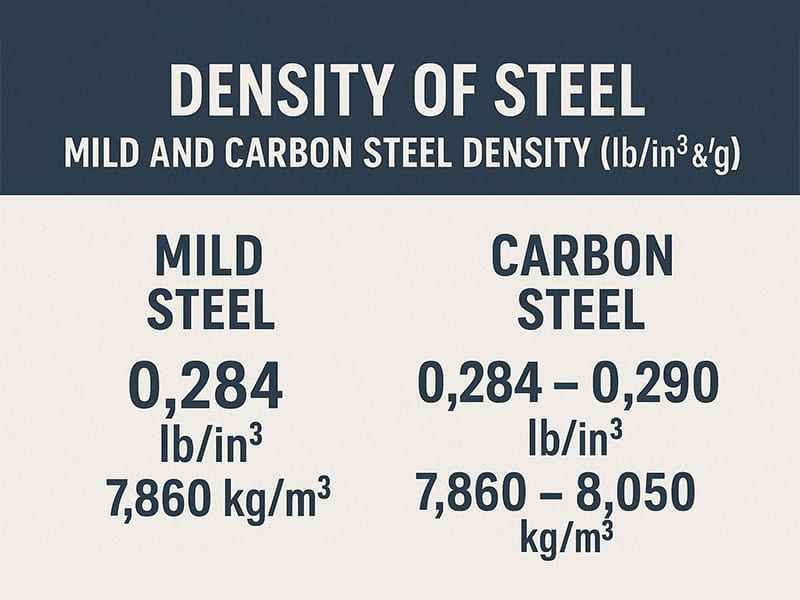
Quick Answer: The density of steel is approximately 7.85 g/cm³ (7850 kg/m³) for carbon and low-alloy steels — the standard engineering reference value. Actual density varies by grade: stainless steel runs 7.7–8.0 g/cm³ depending on chromium and nickel content; tool steels with tungsten can reach 8.1–8.2 g/cm³. For weight calculations: Weight (kg) = 7850 × Volume (m³). Steel is roughly 3× denser than aluminum (2.7 g/cm³) and 1.77× denser than titanium (4.43 g/cm³) — a density trade-off against steel’s significantly lower material cost and high absolute strength.
What Is the Density of Steel?
The density of steel is the mass per unit volume of the material. For most engineering applications, it is standardized at 7.85 g/cm³, equivalent to 7850 kg/m³ or approximately 0.284 lb/in³ in imperial units. This value applies to plain carbon steels and most low-alloy structural steels.
Density is not just a reference number — it is a foundational parameter that connects geometry to mass, mass to structural load, and load to foundation sizing, transportation cost, machining time, and procurement cost. Steel priced per kilogram makes density the direct multiplier between part volume (determined by design geometry) and raw material cost. In structural engineering, density determines dead load — the baseline load a building, bridge, or machine frame imposes regardless of service conditions.
For engineers designing components and OEM procurement teams estimating costs, density is the quantity that converts a CAD model into a weight, and a weight into structural, logistical, and financial consequences.
Why Steel Density Varies by Grade
The standard 7.85 g/cm³ value works well for quick calculations and preliminary design. For precision applications — large-scale fabrication, aerospace structural analysis, or bulk procurement — grade-specific density matters.
What Causes the Variation
Density variation in steel grades results from two mechanisms: alloying element atomic mass and microstructural phase differences.
Alloying element effects: Different elements have different atomic masses. Heavy alloying elements increase density measurably:
- Tungsten (W): atomic mass 184 g/mol — significantly increases density in high-speed and tool steels
- Molybdenum (Mo): atomic mass 96 g/mol — moderate increase in alloy and stainless grades
- Chromium (Cr) and Nickel (Ni): atomic masses 52 and 58 g/mol — produce the density increase in stainless steels relative to carbon steel
Microstructural phase effects: Steel can exist in different crystal structure phases:
- Ferrite (body-centered cubic, BCC): lower atomic packing efficiency, slightly lower density
- Austenite (face-centered cubic, FCC): higher packing efficiency, slightly higher density
- Martensite: distorted BCC, intermediate density
Austenitic stainless steels (304, 316L — FCC structure) have densities of approximately 7.93–8.00 g/cm³. Ferritic stainless steels (430 — BCC structure) run closer to 7.7–7.8 g/cm³.
Steel Density by Grade
| Steel Grade / Type | Density (g/cm³) | Notes |
|---|---|---|
| Low carbon steel (A36, 1018) | ~7.85–7.87 | Standard structural steel baseline |
| Medium carbon steel (1045) | ~7.85 | General engineering use |
| High carbon steel (1095) | ~7.84 | Slight decrease with higher carbon |
| 4140 alloy steel | ~7.85 | Cr-Mo addition, minimal density change |
| 4340 alloy steel | ~7.85 | Ni-Cr-Mo, still near baseline |
| 304 stainless steel | ~7.93 | Austenitic FCC, Cr-Ni increases density |
| 316L stainless steel | ~7.99 | Mo addition further increases density |
| 430 ferritic stainless | ~7.70 | BCC structure, lower than austenitic |
| H13 tool steel | ~7.80 | Cr-Mo-V, slight decrease from V content |
| D2 tool steel | ~7.70 | High Cr, FCC carbides lower effective density |
| M2 high-speed steel | ~8.15 | W, Mo, Cr, V — heavy elements elevate density |
For most structural and engineering steels (A36, 1045, 4140), the standard 7.85 g/cm³ introduces negligible error. For stainless and tool steels in weight-sensitive or cost-sensitive applications, use grade-specific datasheet values.
How to Calculate Steel Weight: Formula and Worked Examples
Steel weight calculation is the most practical engineering application of density. Steel is typically priced per kilogram, structural loads are expressed in kilonewtons (from weight), and shipping costs scale directly with mass — so converting part geometry to weight is a constant requirement across design, manufacturing, and procurement.
The Core Formula
Weight (kg) = Density (kg/m³) × Volume (m³)
With steel density at 7850 kg/m³:
Weight (kg) = 7850 × V (m³)
All dimensions must be converted to meters before calculating volume. Mixing millimeters with m³ density values produces errors of three orders of magnitude. Convert all linear dimensions to meters first, then calculate volume.
Worked Examples by Geometry
Steel plate (rectangular block):
Dimensions: 1000 mm × 500 mm × 10 mm
- Convert: 1.0 m × 0.5 m × 0.010 m
- Volume: 1.0 × 0.5 × 0.010 = 0.0050 m³
- Weight: 7850 × 0.0050 = 39.25 kg
Round bar (solid cylinder):
Dimensions: 50 mm diameter, 1000 mm length
- Radius: 0.025 m; Length: 1.0 m
- Volume: π × (0.025)² × 1.0 = 0.001963 m³
- Weight: 7850 × 0.001963 = 15.4 kg
Steel pipe (hollow cylinder):
Dimensions: 100 mm OD, 80 mm ID, 1000 mm length
- Outer radius: 0.050 m; Inner radius: 0.040 m
- Volume: π × (0.050² − 0.040²) × 1.0 = 0.002827 m³
- Weight: 7850 × 0.002827 = 22.2 kg
Complex machined parts:
For parts with holes, pockets, and profiled features, CAD software mass properties (SOLIDWORKS, CATIA, Fusion 360) calculate volume directly from the 3D model. With density set to 7850 kg/m³, the software returns accurate mass for any geometry. For procurement estimation without a 3D model, decomposing the part into geometric primitives and summing volumes provides adequate accuracy.
Weight Calculation Quick Reference
| Geometry | Volume Formula (all dimensions in meters) | Weight at 7850 kg/m³ |
|---|---|---|
| Rectangular block | L × W × H | 7850 × L × W × H |
| Solid cylinder | π × r² × L | 7850 × π × r² × L |
| Hollow cylinder (pipe) | π × (R_o² − R_i²) × L | 7850 × π × (R_o² − R_i²) × L |
| Sphere | (4/3) × π × r³ | 7850 × (4/3) × π × r³ |
Density of Steel vs Other Engineering Materials
Full Material Density Comparison
| Material | Density (g/cm³) | Ratio vs Steel | Key Engineering Characteristic |
|---|---|---|---|
| Polypropylene (PP) | 0.90–0.91 | 0.12× | Lightweight polymer, low structural strength |
| Aluminum 6061 | 2.70 | 0.34× | Lightweight structural metal, excellent machinability |
| Aluminum 7075 | 2.81 | 0.36× | High-strength aluminum alloy |
| Titanium Ti-6Al-4V | 4.43 | 0.56× | High strength-to-weight, corrosion resistant |
| Cast iron (grey) | 7.20 | 0.92× | Vibration damping, good in compression |
| Carbon steel (1045) | 7.85 | 1.00× | Standard reference, balanced cost-performance |
| Stainless steel 316L | 7.99 | 1.02× | Corrosion resistance, slightly denser |
| Copper | 8.90 | 1.13× | High electrical and thermal conductivity |
| Tungsten | 19.3 | 2.46× | Extreme heat resistance, radiation tooling |
When Steel’s High Density Is an Engineering Advantage
Steel’s density is not always a limitation. In several applications, high mass provides direct functional value:
Machine tool stability: Heavy machine bases in CNC machining centers, grinding machines, and coordinate measuring machines use high-mass cast iron or steel specifically to provide inertia that resists vibration. A granite or polymer-concrete base on a precision grinding machine achieves similar vibration isolation through density and material damping, but steel provides comparable vibration mass at lower fabrication cost. Manufacturers intentionally exploit density for dynamic stability.
Counterweight and ballast: Steel’s density makes it compact for applications requiring heavy mass in small volume — crane counterweights, elevator counterbalances, and ship ballast. The same counterweight function in aluminum would require 2.9× the volume, creating geometric constraints or increased complexity.
Radiation shielding: High-density steel attenuates gamma radiation. Specialty high-density steel compositions (and lead) are used in medical imaging shielding, radiation therapy rooms, and nuclear facility structures where compact shielding is required.
When Steel’s Density Creates Engineering Challenges
Weight-critical structures: In aerospace primary structure, automotive body-in-white, and precision robotic systems, every kilogram of unnecessary mass has a measurable operational cost. Aluminum at 34% of steel’s density, or titanium at 56% with superior strength-to-weight ratio, justifies material cost premiums through weight reduction that compounds across service life.
Transportation economics for large components: Fabricated steel assemblies shipped globally or frequently repositioned incur logistics costs proportional to mass. For OEM supply chains, the cost difference between shipping a 400 kg steel weldment versus a 135 kg aluminum equivalent of the same geometry — multiplied by hundreds of shipments annually — can be significant enough to shift material selection.
Foundation and floor loading: Structural steel dead load must be carried by foundations, floor slabs, and lifting equipment. In multi-story industrial facilities, offshore platforms, and long-span structures, excess structural steel weight requires additional foundation capacity, often at higher marginal cost than the weight-reduction material premium.
Why Steel Density Matters in CNC Machining
Steel density affects CNC machining economics through three direct mechanisms: raw material cost, cycle time, and tool wear rate.
Raw Material Cost
Steel purchased for CNC machining is priced per kilogram. The initial raw material cost equals the buy-weight (weight of starting stock) multiplied by the per-kilogram price. Because CNC machining removes material — sometimes 50–80% by weight for complex aerospace or automotive components — the buy-weight substantially exceeds the finished part weight.
For a complex machined bracket finishing at 2 kg, machined from 10 kg of bar stock (80% material removal), the raw material cost is based on 10 kg, not 2 kg. The scrap chips recover only a fraction of the bar price as scrap metal value. Density determines the buy-weight from the starting stock geometry — this is why using buy-weight rather than finished part weight is essential for accurate material cost estimation on heavily machined steel components.
Cycle Time
Steel requires lower cutting speeds than aluminum to manage thermal load and tool life. Typical CNC milling speeds for 1045 carbon steel run approximately 80–150 m/min with carbide tooling, compared to 200–400 m/min for aluminum 6061. Combined with higher density producing more mass per unit volume of material removed, steel machining cycle times are substantially longer than aluminum for equivalent geometries. In environments where machine time is priced hourly, longer cycle times multiply directly into higher per-part cost.
Tool Wear
Steel’s hardness, strength, and the presence of hard carbide phases in alloy steels accelerate cutting tool wear compared to aluminum. Higher cutting forces increase mechanical stress on carbide edges. Tool replacement frequency for carbide end mills in steel is typically 3–8× higher than equivalent aluminum operations at comparable chip load. For high-volume production runs, tooling cost becomes a significant component of total machining cost in steel — a factor that disappears or becomes negligible in aluminum machining.
Steel Density Applications by Industry
Construction and Infrastructure
In structural steel design, density determines dead load — the weight of the structure itself before service loading. For a multi-story building with several hundred tonnes of structural steel, dead load is a primary input to foundation design and column sizing. AISC (American Institute of Steel Construction) standards and Eurocode 3 both standardize steel density at 7850 kg/m³ for structural calculations.
Rebar (reinforcement bar) for concrete is weight-priced and quantity-specified by mass. Accurate density values are essential for material takeoff estimates that drive procurement quantities and project budgets. An error of even 0.5% in density assumption on a large concrete structure represents significant material misestimation at scale.
Automotive: Managing Weight With High-Strength Steel
Automotive manufacturers face regulatory fuel economy and emissions targets that drive constant pressure to reduce vehicle mass. Steel remains dominant because it offers the best cost-to-structural-performance ratio — but its density drives continuous engineering effort to reduce wall thickness, optimize cross-sections, and substitute advanced high-strength steel (AHSS) grades where weight savings justify the material cost increase.
AHSS grades (dual-phase, transformation-induced plasticity, martensitic steels) allow thinner sections at equivalent structural strength, partially compensating for density disadvantage through geometry optimization. A structural member in DP980 dual-phase steel can be substantially thinner than the equivalent in mild steel, reducing the volume — and therefore density impact — while maintaining performance.
Industrial Machinery
Precision machine tool bases, grinding machines, and coordinate measuring machine structures intentionally use high-mass materials to maximize dynamic stability. Heavy machine beds damp the high-frequency vibrations that degrade dimensional accuracy during cutting. In this application class, density is not a limitation — it is a specification requirement. Engineers designing precision equipment may actually increase base mass beyond minimum structural requirements to improve vibration isolation.
Design Considerations Using Steel Density
Match Material to Functional Requirements, Not Default Assumptions
The most common design error involving steel density is specification by default — using steel because “we always use steel” rather than because the functional requirements specifically favor steel’s properties. For weight-critical assemblies, this practice carries a real cost: a component over-specified in steel that could perform identically in aluminum carries unnecessary weight, additional machining cost, and potentially higher logistics cost.
The discipline of material selection should follow functional analysis: What is the load environment? What is the temperature range? Is corrosion resistance required? What weight budget does the assembly have? What is the lifecycle cost, including maintenance and energy consumption? Only after these questions are answered should material density enter the selection as one parameter in the trade-off.
Optimize Cross-Section Before Specifying Thickness
Steel’s high density means that geometry optimization delivers larger weight savings than with low-density materials. Replacing solid rectangular sections with hollow tube sections, removing material from non-stressed regions through pocketing, and designing for minimum section consistent with structural requirements are more effective weight reduction tools for steel than for aluminum — because the starting mass is higher. Structural optimization tools (FEA-based topology optimization) can identify which material in a component can be removed without compromising load path, often reducing steel component weight by 20–40% with no performance loss.
Account for Buy-Weight in Cost Estimation
For heavily machined steel components, cost estimation based on finished part weight significantly understates material cost. Include the starting stock geometry and estimate buy-weight from density × starting stock volume. For parts with high material removal (>50%), the buy-weight can be 3–10× the finished part weight — and this difference directly affects material procurement cost and the economics of the manufacturing approach.
Common Calculation Mistakes
Unit Inconsistency
The most consequential calculation error is applying density in kg/m³ to dimensions that have not been converted to meters. A 100 mm cube:
- Correct: V = 0.1 × 0.1 × 0.1 = 0.001 m³; Weight = 7850 × 0.001 = 7.85 kg
- Incorrect: V = 100 × 100 × 100 = 1,000,000 mm³ used with kg/m³ = wrong result by a factor of 10⁶
The safest practice: convert all linear dimensions to meters first, calculate volume in m³, then apply 7850 kg/m³.
Assuming All Steel Grades Have Identical Density
Using 7.85 g/cm³ for M2 high-speed steel (actual ~8.15 g/cm³) introduces a 4% weight underestimate — negligible for a single small part, but meaningful when calculating material requirements for hundreds of components or when weight budgets are tight. For precision applications, use grade-specific density from the material datasheet.
Using Finished Part Weight Instead of Buy-Weight for Material Cost
Estimating raw material cost for CNC-machined steel parts based on finished part weight understates procurement cost for all parts with significant material removal. Multiply starting stock volume by density to determine buy-weight, then apply the per-kilogram material price. This is especially critical for parts machined from solid bar or billet with complex pocketed or profiled geometry.
Key Takeaways
- Density of steel is 7.85 g/cm³ (7850 kg/m³) for carbon and low-alloy steels — the standard reference for structural calculations and weight estimation.
- Grade variation is real but modest: stainless steels run 7.7–8.0 g/cm³; tool steels with heavy alloying elements reach 8.1–8.2 g/cm³. Use grade-specific values for precision applications.
- Weight = 7850 × Volume (m³) — convert all dimensions to meters before applying.
- Steel is 3× denser than aluminum and 1.77× denser than titanium — this density premium drives weight, logistics cost, and machining time comparisons in material selection.
- High density has functional advantages in machine tool bases, counterweights, and radiation shielding — it is an engineering resource, not simply a limitation.
- CNC machining cost scales with density through raw material buy-weight, slower cutting speeds than aluminum, and higher tool wear rates.
- For OEM procurement, use buy-weight (starting stock volume × density) not finished part weight for material cost estimation on machined components.
Frequently Asked Questions
What is the density of steel in g/cm³ and kg/m³?
The density of steel is approximately 7.85 g/cm³, equivalent to 7850 kg/m³ or 0.284 lb/in³. This applies to plain carbon steels and most low-alloy structural steels (A36, 1018, 1045, 4140). Stainless steels are slightly denser: 304 stainless runs approximately 7.93 g/cm³, 316L approximately 7.99 g/cm³, due to chromium and nickel additions. High-speed tool steels with significant tungsten content can reach 8.1–8.2 g/cm³. For most structural and engineering steel calculations, 7850 kg/m³ is adequate. For weight-critical precision applications, use grade-specific density from the material datasheet.
How do you calculate the weight of a steel part?
Steel weight is calculated using Weight (kg) = 7850 × Volume (m³), where all dimensions must be converted to meters before calculating volume. For a rectangular block: Volume = L × W × H (all in meters). For a solid cylinder: Volume = π × r² × Length. For a hollow pipe: Volume = π × (R_outer² − R_inner²) × Length. For complex machined geometries with holes, pockets, and profiled features, CAD software mass properties provide the most accurate volume — set density to 7850 kg/m³ and the software returns mass directly. For procurement estimation without a 3D model, decomposing the part into geometric primitives and summing volumes provides adequate accuracy.
How does the density of steel compare to aluminum and titanium?
Steel (7.85 g/cm³) is approximately 2.9× denser than aluminum 6061 (2.70 g/cm³) and approximately 1.77× denser than titanium Ti-6Al-4V (4.43 g/cm³). However, density alone does not determine material selection — the relevant metric is strength-to-weight ratio. A36 steel (yield strength ~250 MPa) at 7.85 g/cm³ provides a specific strength of ~32 MPa·cm³/g. Aluminum 6061-T6 (yield strength ~276 MPa) at 2.70 g/cm³ provides ~102 MPa·cm³/g — roughly 3× better specific strength. Ti-6Al-4V (yield strength ~880 MPa) at 4.43 g/cm³ provides ~199 MPa·cm³/g — roughly 6× better than structural steel, at 5–10× higher material cost. Steel’s material cost advantage per kilogram offsets its density disadvantage in cost-sensitive, non-weight-critical structural applications.
Why does stainless steel have different density than carbon steel?
Stainless steel’s higher density relative to carbon steel results from the alloying elements — primarily chromium (18–20% in austenitic grades) and nickel (8–12%) — which have higher atomic masses than iron’s own contribution to carbon steel. These heavier atoms increase the mass per unit volume. Additionally, austenitic stainless steels (304, 316L) have a face-centered cubic (FCC) crystal structure, which packs atoms more efficiently than the body-centered cubic (BCC) structure of carbon steel ferrite, also contributing to slightly higher density. Ferritic stainless steels (430, which remain BCC) have densities closer to carbon steel (7.7–7.8 g/cm³) than austenitic grades.
Does steel density affect CNC machining cost?
Yes, substantially. Steel density affects machining cost through three mechanisms. First, material cost: steel is purchased by weight, and higher density means more mass per unit volume of starting stock — heavier buy-weight at the same per-kilogram price. Second, cycle time: steel requires lower cutting speeds than aluminum (80–150 m/min for 1045 carbon steel versus 200–400 m/min for 6061 aluminum), producing longer machining cycles for equivalent geometries. Third, tool wear: steel’s higher hardness and abrasiveness wear carbide tools faster than aluminum, typically 3–8× faster, increasing tooling cost per part. Combined, these factors make CNC machining a given steel geometry 2–4× more expensive than equivalent aluminum work, depending on part complexity and volume.
What is the most common mistake when using steel density for calculations?
The most common and consequential mistake is unit inconsistency — applying density in kg/m³ to dimensions that have not been converted to meters. For example, calculating volume in mm³ (from millimeter dimensions) and then multiplying by 7850 kg/m³ produces a result that is 10⁹× too large. The correct practice is to convert all dimensions to meters first, calculate volume in m³, and then multiply by 7850 kg/m³. The second most common mistake is using finished part weight instead of buy-weight (starting stock weight) for material cost estimation on machined components — for parts with 50–80% material removal, this understates material cost by a factor of 2–5×.
Written by the CMS engineering team with 15+ years of precision CNC machining and fabrication experience in carbon steel, alloy steel, stainless steel, and tool steel for automotive, industrial, and OEM manufacturing applications. Technical references: AISC Steel Construction Manual (Structural Steel Properties), ASTM A36 and A572 (Structural Steel Standards), MatWeb Material Property Database, Shigley’s Mechanical Engineering Design (Material Selection).
Sourcing Precision CNC Machined Steel Components?
At CMS, we machine carbon steel, alloy steel, stainless steel, and tool steel to tight tolerances with full material certification and CMM inspection. Every steel machining job includes DFM review for weight optimization, tolerance appropriateness, and process sequence — so your parts meet structural and dimensional requirements at the right weight and cost.
[Request a DFM review and steel machining quote →]


