
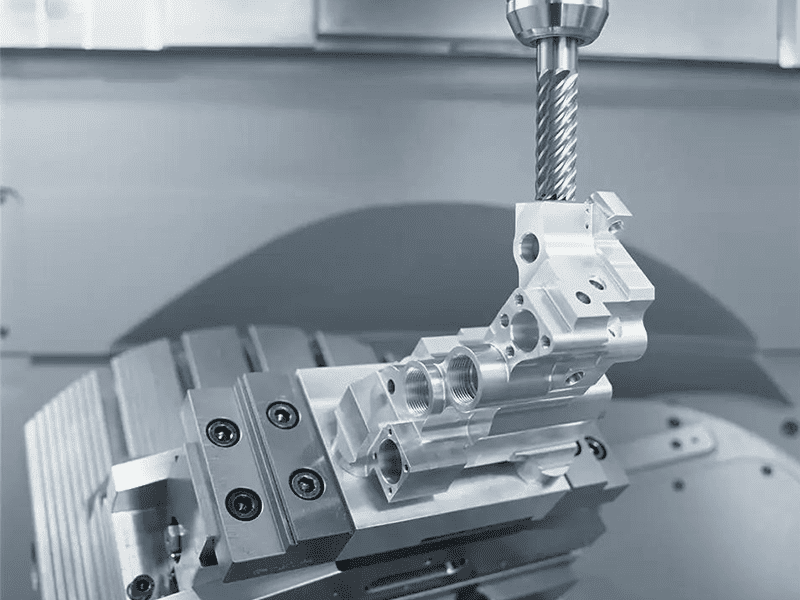
Two quotes for the same aluminum housing — one at $35/part, the other at $85/part. Same material, same drawing, same quantity. The price difference comes down to how each shop interprets the tolerances (one assumes ±0.01 mm everywhere, the other reads the drawing correctly and machines non-critical features to ±0.05 mm), whether they run it in two setups or four, and how they sequence the operations. Understanding what actually drives CNC machining parts cost helps engineers design cheaper parts and helps buyers spot overpriced quotes — or dangerously underpriced ones.
This article breaks down CNC machining cost from a production perspective: the main cost factors, how material choice affects price, why machining time dominates the equation, how part design drives cost up or down, the real impact of tight tolerances, surface finishing costs, the economics of prototype vs. batch production, and practical strategies for reducing cost without sacrificing quality.
What Determines CNC Machining Cost?
The pricing formula is straightforward: Material + Machining Time + Setup + Finishing + Inspection = Part Cost. Each factor contributes differently depending on geometry, tolerance, and quantity.
| Cost Factor | What Drives It |
|---|---|
| Material | Alloy type, stock size, waste ratio |
| Machining time | Geometry complexity, number of operations, cutting parameters |
| Setup | Programming, fixturing, tool preparation — fixed per batch |
| Surface finishing | Anodizing, plating, coating, bead blasting |
| Inspection | CMM measurement, dimensional verification, documentation |
Machining time typically accounts for 50–70% of total cost on precision parts. Setup cost is fixed per batch — devastating on prototypes, negligible on large runs. Based on our production data, a well-optimized program on the same part can reduce machining time by 20–35% compared to an unoptimized approach — making programming quality one of the biggest hidden cost variables.
How Material Choice Affects Cost
Material selection drives cost through three channels: raw material price, machinability (cutting speed and tool wear), and cycle time.
| Material | Machinability | Relative Cost vs. Aluminum |
|---|---|---|
| Aluminum (6061/7075) | Excellent — high speeds, low tool wear | 1× (baseline) |
| Stainless steel (304/316) | Moderate — slower speeds, higher tool wear | 1.5–2× |
| Titanium (Ti-6Al-4V) | Difficult — very slow, rapid tool wear | 3–5× |
| Engineering plastics (POM, PEEK) | Good — fast cutting, low forces | 0.8–1.5× (PEEK is expensive) |
Aluminum machines fastest and cheapest. High spindle speeds, low cutting forces, and excellent chip evacuation make it the default for cost-sensitive parts. Stainless steel costs 1.5–2× more due to slower speeds and higher tool wear. Titanium costs 3–5× more — heat concentrates at the cutting edge, tools wear fast, and feed rates drop significantly. In our shop floor experience, switching from 316L stainless to 6061 aluminum (where the application allows) typically cuts machining cost by 40–50%.
Machining Time: The Biggest Cost Driver
CNC machines bill by operating time. The longer the spindle runs, the higher the cost. Machine hourly rates (typically $50–150/hr depending on equipment) include depreciation, tooling, power, and operator overhead.
What increases machining time: complex geometry requiring more toolpaths, deep pockets and thin walls forcing slower feeds, multiple tool changes, tight tolerances requiring finishing passes, and multi-setup operations from limited machine access.
Real example from our production: A simple aluminum bracket — face milling, drilling, chamfering — runs 12 minutes. A similar-sized housing with deep pockets, thin walls, threaded holes, and ±0.02 mm tolerances runs 55 minutes. Same material, same machine, nearly 5× the cycle time.
| Part Type | Typical Cycle Time | Cost Range |
|---|---|---|
| Simple bracket (aluminum) | 10–15 min | Low |
| Multi-feature housing (stainless) | 60–90 min | Medium–high |
| Complex aerospace part (5-axis) | 2–4 hours | High |
How Part Design Drives Cost
Design decisions made in CAD have more impact on machining cost than most engineers realize.
Thin walls (below 1.0 mm in aluminum, 2.0 mm in steel) force slower feeds to prevent vibration and deformation. Deep cavities (depth > 4× width) require long tools with higher deflection risk and slower cutting. Sharp internal corners demand small end mills that cut slowly — specifying R1 instead of R0.3 on internal corners can reduce pocket machining time by 25–30%. Tight tolerances add finishing passes, slower feeds, and CMM inspection time.
One common pitfall we see: designers specifying ±0.01 mm on every dimension when only 2–3 features actually need it. Applying tight tolerances selectively per ISO 2768 general tolerance classes for non-critical features is the fastest way to cut cost without affecting function.
Tolerance and Cost
| Tolerance | Cost Impact | When to Use |
|---|---|---|
| ±0.1 mm | Low — standard parameters | Non-critical features |
| ±0.05 mm | Moderate — controlled machining | General mechanical fits |
| ±0.01 mm | High — finishing passes, CMM inspection | Bearing seats, mating surfaces |
| ±0.005 mm | Very high — grinding may be needed | Precision fits, sealing surfaces |
Each step tighter increases machining time, tool cost, and inspection requirements. Based on our production data, moving from ±0.05 mm to ±0.01 mm on an aluminum housing typically adds 30–40% to machining cost. Moving to ±0.005 mm can double it — often requiring grinding operations on top of CNC work.
Surface Finishing Costs
Post-machining finishing typically adds 5–30% to total part cost depending on the process.
| Finish | Cost Impact | Best For |
|---|---|---|
| Bead blasting | Low | Uniform matte texture, pre-anodize prep |
| Anodizing | Low–medium | Aluminum corrosion/wear protection |
| Powder coating | Medium | Thick durable coating for industrial use |
| Electroplating | Medium–high | Corrosion protection, conductivity |
Bead blasting + anodizing is the most common combination for aluminum CNC parts — good cosmetics, corrosion protection, and reasonable cost. For stainless steel, passivation or electropolishing adds less cost than plating but provides adequate protection for most applications.
Prototype vs. Batch Production
Setup costs (programming, fixturing, tool prep, first-article inspection) are fixed per batch. On a prototype, the entire setup cost lands on one part. On a 1,000-piece run, it spreads to pennies per unit.
| Quantity | Typical Cost Per Part (example) |
|---|---|
| 1 piece (prototype) | $120 |
| 10 pieces | $40 |
| 100 pieces | $18 |
| 1,000 pieces | $10 |
Prototypes are expensive by nature — and should be. They validate designs before committing to production tooling and fixtures. Once the design stabilizes, transitioning to batch production drops unit cost dramatically. In projects we’ve delivered, stabilizing the design before scaling from prototype to 500+ units typically reduces per-part cost by 70–85%.
How to Reduce CNC Machining Cost
Simplify geometry. Eliminate unnecessary pockets, reduce cavity depths, and avoid features that force extra setups. Every eliminated setup saves 15–30 minutes of non-cutting time.
Relax tolerances selectively. Apply ±0.01 mm only to functional fits. Use ±0.05–0.1 mm for everything else. This single change often cuts 20–30% from machining cost.
Choose machinable materials. Aluminum over stainless steel where the application allows. POM over PEEK for non-structural plastic parts.
Increase batch size. Even moving from 5 to 50 pieces drops setup cost per unit by 80–90%.
Get DFM feedback early. A 10-minute design review before programming can save hours of machining time. In our experience, early DFM input reduces total project cost by 15–25% on average.
Conclusion
CNC machining parts cost depends on material, machining time, part design complexity, tolerances, surface finishing, and production volume. Machining time dominates — driven by geometry, number of operations, and tolerance requirements. Material choice sets the baseline. Production volume determines how fixed costs distribute. The best way to reduce cost is designing with manufacturability in mind from the start — not renegotiating with the supplier after programming is done.
Understanding these cost drivers helps engineers make better design decisions and helps buyers evaluate quotes on substance rather than price alone. Need help optimizing your CNC part design for cost? [Contact our engineering team] for DFM review and competitive precision machining quotes.
FAQ
How much do CNC machining parts cost?
Widely variable. Simple aluminum parts in small batches: $20–80/part. Complex stainless or titanium parts with tight tolerances and multi-axis machining: several hundred dollars each. Cost drops significantly with volume — setup and programming costs spread across more units.
Why are CNC machined parts expensive?
Machining time, material cost, setup, and quality inspection all contribute. Complex geometry with deep pockets, tight tolerances, and multiple setups increases cycle time — the largest cost driver. Prototypes carry disproportionate setup cost because those fixed costs apply to just a few parts.
What’s the cheapest material for CNC machining?
Aluminum alloys (6061, 7075) — highest cutting speeds, lowest tool wear, shortest cycle times among metals. Engineering plastics like POM and nylon also machine efficiently at low cost. Stainless steel and titanium cost significantly more due to slower machining and higher tool wear.
Does tighter tolerance increase cost?
Yes — measurably. Each step tighter requires slower speeds, finishing passes, better tooling, and additional inspection. For most mechanical parts, ±0.05 mm suffices. Specify ±0.01 mm or tighter only for functionally critical features to avoid unnecessary cost.
How can I reduce CNC machining cost?
Simplify geometry, relax non-critical tolerances, choose machinable materials, increase batch size, and get DFM feedback before finalizing the design. Combining these strategies typically reduces total cost by 20–40% compared to designs optimized only for function.


