
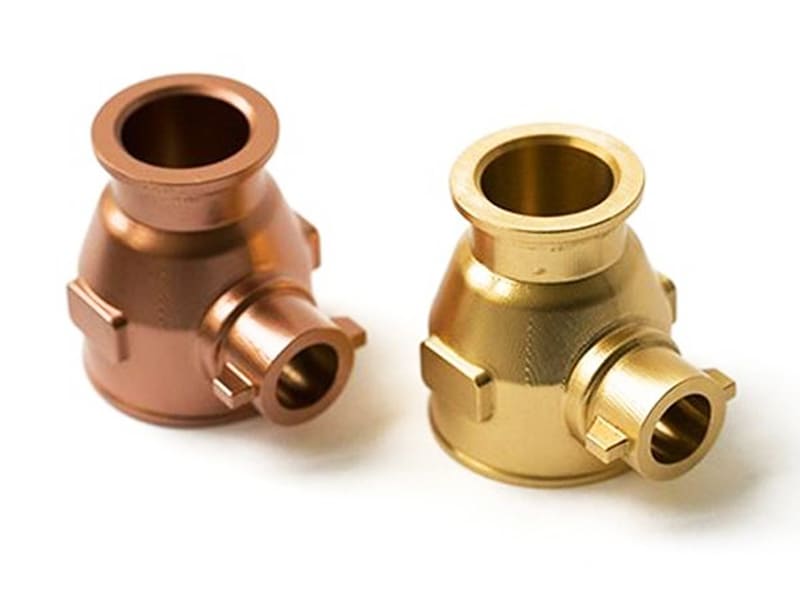
Quick Answer: Copper displays a bright reddish-orange color with high surface reflectivity — a result of its pure metallic electronic structure selectively reflecting red and orange light wavelengths. Bronze, an alloy of copper and tin (plus often aluminum, silicon, or phosphorus), appears darker brown to muted gold with lower brightness, because alloying elements alter electron interaction with light and produce more diffuse reflection. Over time, copper develops a distinctive green patina (copper carbonate); bronze darkens more gradually and uniformly. These color differences are reliable visual identifiers in engineering environments and directly reflect the materials’ different functional properties.
Why Copper and Bronze Look Different
The color difference between copper and bronze is not a surface treatment or coating effect — it originates from the fundamental physics of how electrons in each material interact with visible light.
Why Copper Is Reddish-Orange
Copper is one of very few metals with a naturally non-silver color. Most metals — aluminum, steel, nickel, chrome — appear grey or silvery because they reflect all visible wavelengths roughly equally. Copper is different because its electronic band structure contains filled 3d electron orbitals that absorb blue and green light wavelengths, while allowing red and orange wavelengths to be reflected back to the observer. This selective reflection mechanism produces copper’s characteristic warm reddish-orange tone.
The same electronic structure that produces copper’s color is also responsible for its exceptional electrical conductivity — the partially delocalized 3d and 4s electrons that give copper its optical properties are the same electrons that carry electrical current with minimal resistance. Copper’s electrical conductivity of approximately 5.8 × 10⁷ S/m (58 MS/m) is second only to silver among common metals, and the high-purity copper required for electrical applications is also the copper with the most vivid, undiluted red color.
Why Bronze Is Darker and More Muted
Bronze is not a pure element — it is a copper-based alloy whose primary alloying element is tin, typically in proportions of 3–12% tin by weight depending on the application. Additional elements (aluminum, silicon, manganese, phosphorus, lead) are added in specific bronze alloys for targeted property improvements.
When tin or other elements are added to copper, they dissolve into the copper crystal lattice and alter its electronic structure. The selective red-wavelength reflection that gives pure copper its vivid color is weakened — the alloy electrons interact with light more uniformly across wavelengths, producing a darker, more muted brown to dull gold appearance with lower overall reflectivity. The more tin or other alloying elements present, the greater this shift away from copper’s characteristic red.
Bronze’s darker, less reflective appearance is therefore a reliable visual indicator of its alloy nature — and indirectly indicates the properties that come with alloying: greater hardness and strength than pure copper, better wear resistance, improved corrosion resistance in seawater and industrial environments, and reduced electrical conductivity.
Visual Characteristics: Copper vs Bronze Side by Side
Copper Appearance
Freshly polished or newly processed copper is unmistakable: bright reddish-orange with high specular reflectivity, almost mirror-like on a polished surface. In natural or overhead lighting, copper’s surface appears warm and luminous. The color is consistent across the surface for high-purity copper — any grey or brown patches on freshly processed copper indicate surface contamination, oxidation, or alloying.
As copper ages in air, it goes through a predictable color progression driven by oxidation:
- Bright reddish-orange (fresh surface)
- Darker brownish-red (copper oxide, Cu₂O, forming within days to weeks)
- Brown to black (copper oxide thickening, CuO)
- Green or blue-green patina (copper carbonate, Cu₂CO₃, typically taking months to years in natural environments)
The green patina on aged copper is both an aesthetic signature — most recognizable on architectural copper roofing and sculptures like the Statue of Liberty — and a functional protective layer that actually slows further corrosion by forming a barrier against moisture and oxygen.
Bronze Appearance
Bronze begins at a darker brown to dull gold tone, with less surface brightness than copper even when freshly polished. The specific hue depends on alloy composition: tin bronzes appear warmer brown; aluminum bronzes show a darker, more golden tone; silicon bronzes have a slightly redder cast closer to copper but distinctly more muted.
Bronze’s aging behavior is more gradual and visually stable than copper’s. Rather than the dramatic red-to-green progression of copper, bronze typically darkens progressively from its initial brown toward deeper brown tones, developing subtle greenish-brown oxide layers in prolonged outdoor or humid exposure. This more stable appearance is one reason bronze is often preferred for long-term outdoor sculptures and architectural hardware where consistent appearance over decades is required.
Color Identification Reference
| Property | Copper | Bronze |
|---|---|---|
| Fresh appearance | Bright reddish-orange | Brown to dull gold |
| Surface brightness | High (specular) | Medium to low (diffuse) |
| Aged appearance | Green patina (Cu₂CO₃) | Darker brown, minimal green |
| Color stability over time | Dramatic change (red to green) | Gradual darkening, stable |
| Color uniformity | Very consistent (pure metal) | Varies by alloy composition |
How to Identify Copper vs Bronze in Engineering Environments
The Quick Visual Test
In a well-lit workshop or inspection environment, the color distinction between copper and bronze is usually clear on freshly processed or polished surfaces:
- Bright, vivid reddish-orange with mirror-like sheen → copper
- Darker brown, dull gold, or muted metallic tone → bronze
This test works reliably for unaged material. The challenge comes with aged or patinated surfaces, where both metals may appear brownish or darkened in intermediate oxidation stages.
Combining Color With Context
Color identification is most reliable when combined with application context and physical characteristics:
Weight and density: Copper has a density of approximately 8.96 g/cm³. Bronze density varies by alloy — tin bronzes typically 8.7–8.9 g/cm³, aluminum bronzes 7.5–8.2 g/cm³, silicon bronzes approximately 8.3 g/cm³. The density difference is generally too small to distinguish by hand, but in combination with other indicators it supports identification.
Application context: An electrical wiring component, busbar, or transformer winding → copper (conductivity requirement). A bearing, bushing, valve component, or marine fitting → bronze (wear or corrosion requirement). The application tells you which material the function demands, reinforcing visual identification.
Chip character in machining: Copper produces long, stringy, ductile chips that are difficult to break and tend to adhere to cutting tools. Bronze produces shorter, more brittle chips that clear cleanly — particularly tin bronze, which has brittle fracture behavior from its microstructure. If you have access to a fresh machined edge, chip character confirms identification.
Magnetic response: Neither copper nor bronze is magnetic. This does not distinguish them from each other, but it immediately distinguishes both from steel — useful if there is any question about whether a reddish-orange component might be a copper-colored anodized aluminum or steel.
The Brass Confusion
Brass (copper + zinc) is frequently confused with bronze because both are copper alloys with similar warm metallic tones. The distinction matters because brass and bronze have different mechanical properties and different machining behavior.
Brass appears distinctly yellower — it reflects green as well as red wavelengths, producing the characteristic yellow-gold color. Zinc alloying pushes copper’s color toward yellow more effectively than tin alloying pushes it toward brown. The result:
- Copper: bright reddish-orange
- Bronze: brown to dull gold (darker, warmer than brass)
- Brass: yellow to bright gold (distinctly yellower than bronze)
In low or warm lighting, brass and bronze can appear similar. In natural or neutral lighting, brass’s yellow character is usually distinguishable from bronze’s browner tone. The engineering consequence of misidentification matters — brass is significantly easier to machine than most bronzes (especially aluminum bronze), has different strength characteristics, and different corrosion behavior. Brass should not be substituted for bronze in marine seawater applications where dezincification (selective dissolution of zinc from the alloy) would cause structural failure.
How Oxidation Changes Color Over Time
Understanding how copper and bronze age visually is critical for material specification in outdoor, marine, and long-service applications.
Copper’s Oxidation Progression
Copper oxidation is a multi-stage electrochemical process driven by atmospheric oxygen, moisture, carbon dioxide, and sulfur compounds:
- Cuprous oxide (Cu₂O): Reddish-brown oxide layer, forms within days of atmospheric exposure. The surface loses its fresh red brightness and takes on a darker, dull tone.
- Cupric oxide (CuO): Black oxide layer, forms as Cu₂O oxidizes further. Surface appears dark brown to black.
- Copper carbonate patina (Cu₂CO₃ and Cu₃(CO₃)₂(OH)₂): The characteristic green or blue-green patina that forms over months to years in outdoor environments with carbon dioxide and moisture. This layer is actually protective — once fully formed, it significantly slows further corrosion.
The rate of patina formation depends strongly on environment: maritime air with salt and sulfur compounds accelerates it; dry indoor environments dramatically slow it. Historical copper architectural installations in coastal European cities may show full green patina within a decade; identical copper in arid inland climates may remain brownish-red for many decades.
Bronze’s More Stable Oxidation
The alloying elements in bronze — particularly tin — form stable oxide layers that are more uniform and less chemically reactive than copper’s own oxides. Bronze’s oxidation progression is:
- Initial darkening from brownish to deeper brown (tin oxide and copper oxide forming together)
- Gradual development of a stable brown to dark brown surface layer
- In prolonged outdoor or marine exposure, slight greenish-brown patina may develop, but much less dramatically than pure copper
This relative stability makes bronze the preferred choice for applications where consistent appearance over an extended service life is a design requirement — outdoor sculpture, architectural hardware, marine deck fittings. The bronze patina also provides corrosion protection, but from a lower-contrast starting point than copper.
Copper vs Bronze: Full Property Comparison
Color is the first visual differentiator, but engineering selection requires evaluating the properties that the color difference reflects.
Comprehensive Property Comparison
| Property | Copper | Bronze (Tin Bronze) | Engineering Implication |
|---|---|---|---|
| Color (fresh) | Bright reddish-orange | Brown to dull gold | Visual identification; aesthetic selection |
| Density | ~8.96 g/cm³ | ~8.7–8.9 g/cm³ | Negligible difference for most applications |
| Hardness | ~35–40 HB (annealed) | ~60–200 HB depending on alloy | Bronze better for wear-loaded components |
| Tensile strength | ~220–250 MPa (annealed) | ~280–620 MPa depending on alloy | Bronze significantly stronger |
| Electrical conductivity | ~58 MS/m (58% IACS) | ~5–15% IACS (varies) | Copper required for electrical applications |
| Thermal conductivity | ~385–400 W/(m·K) | ~50–70 W/(m·K) | Copper preferred for heat exchangers |
| Corrosion resistance | Good (general environments) | Better (especially marine) | Bronze for seawater and chemical exposure |
| Machinability | Good but produces stringy chips | Better chip control, especially tin bronze | Bronze preferred for automated CNC production |
| Cost (raw material) | Higher per kg (pure metal premium) | Varies; often comparable to copper on volume basis | Application-specific lifecycle cost analysis required |
The Conductivity-Hardness Trade-Off
The most fundamental engineering trade-off between copper and bronze is conductivity versus mechanical performance. This trade-off is not a compromise in either direction — the materials are designed for different applications:
Copper’s 58 MS/m electrical conductivity is approximately 4–12× higher than bronze, depending on alloy. Even a small amount of tin or other alloying elements dissolved in copper dramatically reduces conductivity — a 3% tin bronze alloy has roughly 8–10% IACS versus copper’s 100% IACS reference. This is why electrical windings, busbars, wiring, and heat exchanger tubes are almost always copper rather than bronze: the conductivity loss from alloying would directly increase electrical losses and thermal resistance.
Bronze’s hardness (60–200 HB depending on alloy, versus copper’s ~35 HB annealed) makes it suitable for sliding bearings, bushings, gears, and mechanical components where copper would deform and wear under load. The standard phosphor bronze (C51000, containing 5% tin and 0.2% phosphorus) achieves hardness of approximately 75–100 HB with good wear resistance — far better than copper for bearing surfaces. Aluminum bronze (8–11% aluminum) reaches 140–200 HB and is used in heavy-duty marine propellers, pump impellers, and industrial gears operating under high load.
Applications by Color and Function
Copper Applications
Electrical and electronic systems represent the dominant copper application category — copper’s electrical conductivity is essentially irreplaceable in electrical wiring, transformer windings, busbar systems, motor windings, and printed circuit board traces. Substitutes (aluminum) are used where weight reduction outweighs the conductivity difference, but for high-efficiency systems where electrical losses directly translate to energy cost, copper’s conductivity advantage is decisive.
Heat exchangers and thermal management exploit copper’s thermal conductivity of ~385–400 W/(m·K), which is approximately 6–8× higher than bronze. HVAC heat exchangers, refrigeration coils, and industrial process heat exchangers predominantly use copper tubing and fins because thermal efficiency directly affects energy consumption.
Decorative and architectural applications exploit copper’s vivid color and distinctive aging behavior. Copper roofing, cladding, gutters, and architectural details are specified for their aesthetic character — both the fresh reddish-orange and the aged green patina are considered design elements. The Guggenheim Museum in Bilbao’s titanium cladding is famously compared to the copper-patinated roofs of Paris — the visual language of aged copper is recognizable globally.
Bronze Applications
Bearings, bushings, and sleeve bearings are the canonical bronze application. In rotating machinery, pumps, and industrial equipment, sliding contact between shaft and housing requires a bearing material that resists adhesive wear (galling), has low friction against the mating shaft material, and maintains dimensional stability under load and temperature cycling. Standard tin bronze (C93200, SAE 660 bushing bronze) is the default material for plain bearings in industrial equipment. The darker bronze color distinguishes these components immediately in disassembly and maintenance situations.
Marine hardware — propellers, through-hull fittings, seacock valves, shaft couplings, and deck hardware — requires resistance to seawater corrosion, including crevice corrosion and galvanic corrosion in a salt-water electrochemical environment. Copper-based alloys resist seawater well; aluminum bronze and naval brass (brass with tin addition for dezincification resistance) are the primary marine hardware materials. Bronze propellers on large vessels are visually identifiable by their distinctive brown-gold color against the grey hull.
Sculpture and decorative casting historically used bronze because it pours well into sand molds, can be detailed finely, and develops a desirable patina over decades. The bronze casting tradition spans thousands of years — the term “Bronze Age” reflects the material’s historical importance. Contemporary architectural bronze typically uses silicon bronze (copper with 2–4% silicon) for its excellent castability, weldability, and stable patina behavior.
CNC Machining: How Copper and Bronze Behave Differently
Material selection affects not just end-use performance but the machining strategy required to produce the component accurately and economically.
Copper Machining Challenges
Copper’s ductility and softness create specific machining challenges. The material deforms plastically under cutting forces, producing long, continuous, stringy chips that wrap around tooling, cause workpiece surface damage if they are not cleared, and can jam chip evacuation systems in high-volume automated machining.
Built-up edge (BUE) — the adhesion of work material to the cutting tool’s rake face — is common in copper machining because of its tendency to cold-weld to carbide and high-speed steel tools at the cutting temperatures generated during machining. BUE causes erratic cutting forces, poor surface finish, and occasional tool failure from the sudden ejection of the built-up material.
Effective copper machining requires: very sharp cutting edges with large positive rake angles to shear the material cleanly rather than pushing it; high cutting speeds (which generate enough heat to suppress BUE formation); flood coolant or cutting oil to lubricate and cool; and toolpath strategies that prevent chip wrapping.
Surface finish achievable on copper is excellent — when correctly machined, copper can reach Ra 0.2 µm or better on mirror-polished surfaces, making it suitable for optical and electrical contact applications requiring very smooth surfaces.
Bronze Machining Characteristics
Tin bronze produces short, brittle chips — the tin content reduces the material’s ductility enough that the chip fractures rather than forming long continuous curls. This is a significant production advantage in automated CNC machining: short chips clear the cutting zone readily, do not wrap around tooling, and are easily managed by chip conveyors. For this reason, bronze is often easier to machine in production environments than copper despite its greater hardness.
BUE is less common in bronze than in copper because the tin content reduces the material’s tendency to cold-weld to tool surfaces. The cutting interface in bronze machining is more stable, producing more consistent chip geometry and surface finish across a production run.
Aluminum bronze (8–11% aluminum) is significantly harder (140–200 HB) and more abrasive than tin bronze, and behaves more like machining a medium-hardness steel. It requires lower cutting speeds, higher rigidity, and coated carbide tooling (TiAlN or AlCrN) to manage the higher cutting forces and heat generation. The chip control is generally good due to work-hardening during chip formation, but tool wear rates are higher than for tin bronze.
In our production experience machining bronze components for industrial automation and marine hardware customers, phosphor bronze (C51000) and SAE 660 bearing bronze consistently produce the most stable and predictable machining results — short chips, low BUE tendency, and good dimensional stability across production runs. Copper, by contrast, requires more careful parameter management and chip evacuation attention to achieve consistent surface finish.
How to Choose Between Copper and Bronze
Decision Framework
| Functional Requirement | Recommended Material | Reason |
|---|---|---|
| Electrical conductivity (wiring, busbars, motors) | Copper | Bronze conductivity is 4–12× lower |
| Thermal conductivity (heat exchangers, cooling) | Copper | Bronze thermal conductivity is 6–8× lower |
| Bright reddish aesthetic finish | Copper | Bronze is inherently darker and more muted |
| Aged patina aesthetic over time | Copper or bronze | Copper → green patina; bronze → darker stable brown |
| Sliding bearings and bushings | Bronze | Hardness and wear resistance; copper is too soft |
| Marine hardware, seawater exposure | Bronze (naval or aluminum bronze) | Better corrosion and crevice resistance |
| Heavy mechanical load, gears, impellers | Aluminum or manganese bronze | High hardness (140–200 HB) for structural load |
| Decorative casting, sculpture | Silicon bronze | Best castability, stable patina, good weldability |
| Automated CNC production, precision parts | Bronze (tin or phosphor) | Short chip control, dimensional stability |
When the Decision Is Not Clear
Some applications sit at the boundary between copper and bronze suitability. Electrical connectors with contact surfaces that also experience mechanical wear are one example — pure copper provides maximum conductivity but wears quickly at the contact interface; high-copper (low-tin) bronze (C19400, for example) is used to balance conductivity and wear resistance for connectors that must last through many mating cycles.
In these boundary cases, the engineering decision requires quantifying the trade-off: how much conductivity loss is acceptable for the gain in mechanical durability? Connector and relay engineering standards typically provide guidance on acceptable contact resistance increases as a function of alloy composition and surface treatment.
Key Takeaways
- Copper’s reddish-orange color results from its electronic structure selectively reflecting red wavelengths — the same electron behavior that gives copper its exceptional conductivity. Pure copper = vivid red color = maximum conductivity.
- Bronze’s darker, muted color results from alloying — tin and other elements disrupt copper’s selective light reflection, producing brown to dull gold tones. Darker color = alloy composition = higher hardness, better wear resistance, better corrosion resistance.
- Color is a reliable visual identifier for unaged material: bright vivid red is copper; brown-gold or muted tones are bronze. Always combine color with application context and material certification for critical identification.
- Oxidation changes both colors over time: copper transitions dramatically from red to green (copper carbonate patina); bronze darkens progressively from brown to deeper brown. Aged surfaces can blur the distinction.
- Do not confuse bronze with brass: brass (copper + zinc) is distinctly yellower than bronze (copper + tin); the engineering properties and machining behavior differ substantially.
- The fundamental application divide: copper for electrical and thermal conductivity; bronze for mechanical wear resistance, corrosion resistance in harsh environments, and bearing applications.
- For OEM procurement, color serves as a first-pass visual verification of material compliance, but must be supported by material certification for safety-critical and electrical applications.
Frequently Asked Questions
What color is copper compared to bronze?
Copper is a bright reddish-orange with high surface reflectivity — the classic “copper color” known globally. Bronze is distinctly darker, appearing brown to dull gold with lower brightness and a more matte finish. The color difference is most visible on freshly polished or processed surfaces. As both materials age, copper transitions toward green patina while bronze darkens progressively toward deep brown, which can reduce the visual distinction on aged components. The color difference directly reflects their composition: copper is a pure element with characteristic red optical behavior; bronze is a copper alloy whose tin content disrupts pure copper’s vivid red reflection.
How can I tell copper from bronze without testing equipment?
Visual color is the most reliable first indicator: bright vivid red indicates copper; brown-gold or muted tones indicate bronze. Combine this with application context — electrical components are almost always copper; bearings, bushings, and marine hardware are almost always bronze. If chips are accessible from a fresh machined surface, copper produces long, stringy chips while most tin bronzes produce short, brittle chips. For aged material where oxidation has obscured the original color, surface texture (copper tends to show more dramatic color variation with oxidation; bronze tends to be more uniform) provides additional clues. For safety-critical applications, material certification or spectroscopic testing is always the correct approach rather than visual identification alone.
Why does copper turn green and bronze turn brown?
Copper forms a green patina (primarily copper carbonate, Cu₂CO₃) when exposed to atmospheric carbon dioxide and moisture over months to years. The patina forms in stages: copper oxide (brownish-red) first, then copper hydroxide and carbonate compounds that appear green. This patina is actually protective. Bronze does not develop the same vivid green because tin and other alloying elements preferentially oxidize and form more stable, less reactive oxide layers than copper carbonate. Bronze’s tin oxide and copper oxide layers produce the characteristic darker brown coloration without the same carbonate chemistry that generates copper’s distinctive green.
Is bronze stronger than copper?
Yes, significantly. Copper in the annealed condition has hardness of approximately 35–40 HB and tensile strength of 220–250 MPa. Standard tin bronzes achieve 60–100 HB and 280–400 MPa depending on composition and temper; aluminum bronzes reach 140–200 HB and 500–700 MPa in heat-treated conditions. The strength increase from copper alloying to bronze makes bronze suitable for bearing surfaces, mechanical gears, and structural marine hardware where copper would deform and wear rapidly under load. However, this strength increase comes with a corresponding decrease in electrical conductivity — from copper’s 58 MS/m to bronze’s typically 3–8 MS/m — which is why copper remains the material of choice for all electrical applications.
When should I specify copper versus bronze for a machined part?
Specify copper when the part requires high electrical conductivity (electrical contacts, busbars, motor components), high thermal conductivity (heat exchanger components, cooling blocks), or a bright, vivid reddish appearance for aesthetic requirements. Specify bronze when the part operates under mechanical wear (bearing, bushing, gear, or cam applications), requires corrosion resistance in seawater or industrial chemical environments, or needs greater structural strength than copper provides. For automated CNC production, bronze (particularly phosphor bronze or SAE 660 bearing bronze) typically provides more stable chip control and better dimensional consistency than copper due to its short-chip behavior and lower tendency for built-up edge formation.
Written by the CMS engineering team with 15+ years of precision CNC machining experience in copper alloys, tin bronze, aluminum bronze, and silicon bronze for electrical, marine, industrial automation, and OEM manufacturing applications. Technical references: ASTM B150 (Aluminum Bronze Rod and Bar), ASTM B139 (Phosphor Bronze Rod and Bar), ASTM B505 (Copper Alloy Continuous Castings), Copper Development Association (CDA) Alloy Data.
Sourcing Precision CNC Machined Copper and Bronze Components?
At CMS, we machine copper, phosphor bronze, aluminum bronze, silicon bronze, and bearing bronze to tight tolerances with full material certification and dimensional inspection. Every job includes DFM review for alloy selection, chip management strategy, and surface finish achievability — so your components meet both functional performance and visual appearance requirements.
[Request a DFM review and copper/bronze machining quote →]


