
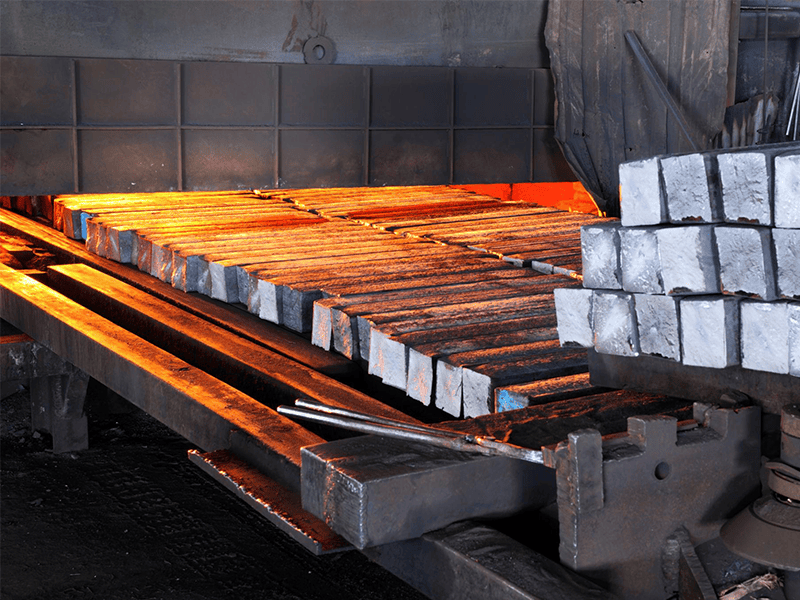
Quick Answer: The density of pure iron is approximately 7.87 g/cm³ (7870 kg/m³) at room temperature — one of the most widely referenced values in structural and mechanical engineering. Cast iron, which contains significant graphite from higher carbon content, runs 7.1–7.3 g/cm³. Wrought iron falls between at approximately 7.75–7.85 g/cm³. Iron’s density is nearly identical to steel (7.85 g/cm³), heavier than aluminum by a factor of 2.9×, and slightly lighter than copper (8.96 g/cm³). For weight calculations: Weight (kg) = 7870 × Volume (m³).
What Is the Density of Iron?
The density of iron is the mass per unit volume of the material. For pure iron (α-iron, ferrite phase) at room temperature, the standard engineering reference value is:
- 7.87 g/cm³
- 7870 kg/m³
- 0.284 lb/in³ (imperial)
This value applies to commercially pure iron under standard conditions (approximately 20°C, atmospheric pressure). It is the baseline from which all iron alloy densities — steel, cast iron, wrought iron — are derived, and it is the reference density used in structural engineering calculations, material weight estimation, and procurement cost forecasting.
For practical engineering work, density is not just a material constant — it is the parameter that connects part geometry to weight, and weight to structural load, transportation cost, machining requirements, and raw material procurement cost. A 0.01 m³ volume of iron weighs 78.7 kg; that same volume in aluminum weighs only 27 kg. The factor-of-three density difference between iron and aluminum is what drives the material selection conversation in virtually every weight-conscious engineering application.
Density of Different Iron Forms
Although 7.87 g/cm³ is the pure iron reference, engineering practice uses iron in several distinct material forms, each with meaningfully different density due to composition and microstructure.
Pure Iron
Density: ~7.87 g/cm³
Commercially pure iron is rarely used in engineering applications — its low strength and poor wear resistance make it impractical for structural or mechanical service. It serves as the reference baseline and is used in specialist applications including electromagnetic cores (where high purity reduces eddy current losses) and certain chemical processing equipment.
Cast Iron
Density: ~7.1–7.3 g/cm³
Cast iron is significantly less dense than pure iron because the high carbon content (typically 2–4%) forms graphite during solidification. Graphite (density approximately 2.1 g/cm³) is far less dense than iron, and its presence — as graphite flakes in grey cast iron, nodules in ductile (spheroidal graphite) iron, or a combination in compacted graphite iron — reduces the bulk density of the material substantially.
Grey cast iron, with large flake graphite, runs approximately 7.1–7.2 g/cm³. Ductile (nodular) cast iron, with more compact spheroidal graphite and less total graphite volume, runs approximately 7.0–7.2 g/cm³. White cast iron, where carbon is retained as iron carbide (cementite) rather than precipitating as graphite, has density closer to 7.5–7.7 g/cm³.
The graphite also gives cast iron its characteristic vibration damping and good machinability from graphite acting as a lubricant — both engineering properties that matter as much as the density value in many applications.
Wrought Iron
Density: ~7.75–7.85 g/cm³
Wrought iron is almost pure iron with slag inclusions — it contains less than 0.1% carbon, with the slag giving it a fibrous microstructure rather than the cast structure of cast iron. Its density is close to pure iron and similar to mild steel. Wrought iron has largely been replaced by mild steel in modern engineering, though it remains in historical structures and some specialty applications.
Iron Form Density Comparison
| Iron Form | Density (g/cm³) | Carbon Content | Key Characteristic |
|---|---|---|---|
| Pure iron | ~7.87 | ~0% | Scientific reference, electromagnetic cores |
| Wrought iron | ~7.75–7.85 | < 0.1% | Fibrous microstructure, historical structures |
| Ductile (nodular) cast iron | ~7.0–7.2 | 2.5–4% | Nodular graphite, good toughness |
| Grey cast iron | ~7.1–7.2 | 2.5–4% | Flake graphite, excellent damping |
| White cast iron | ~7.5–7.7 | 2–4% | Cementite (no graphite), very hard, brittle |
| Carbon steel (for comparison) | ~7.84–7.87 | 0.1–1.5% | Iron + carbon reference alloy |
How to Calculate Iron Weight: Formula and Examples
Iron weight calculation is essential for structural load analysis, procurement cost estimation, and transportation planning. The approach is identical to steel weight calculation, using the appropriate density for the iron form.
The Core Formula
Weight (kg) = Density (kg/m³) × Volume (m³)
For pure iron: Weight (kg) = 7870 × V(m³) For grey cast iron: Weight (kg) = 7150 × V(m³) (using 7.15 g/cm³ midpoint)
All dimensions must be converted to meters before calculating volume. Applying density in kg/m³ to dimensions in millimeters produces errors of 10⁹×.
Worked Examples
Iron plate:
Dimensions: 1200 mm × 600 mm × 20 mm
- Convert: 1.2 m × 0.6 m × 0.020 m
- Volume: 1.2 × 0.6 × 0.020 = 0.01440 m³
- Weight: 7870 × 0.01440 = 113.3 kg
Solid round iron shaft:
Dimensions: 80 mm diameter, 1500 mm length
- Radius: 0.040 m; Length: 1.5 m
- Volume: π × (0.040)² × 1.5 = 0.007540 m³
- Weight: 7870 × 0.007540 = 59.3 kg
Grey cast iron machine base:
Dimensions: 2000 mm × 800 mm × 150 mm (simplified solid rectangular block before pocketing)
- Convert: 2.0 m × 0.8 m × 0.150 m
- Volume: 2.0 × 0.8 × 0.150 = 0.2400 m³
- Weight using cast iron density (7150 kg/m³): 7150 × 0.2400 = 1716 kg
Using pure iron density for this cast iron machine base would overestimate weight by approximately 10%, a meaningful error when calculating crane capacity requirements or foundation loading.
When to Use CAD Mass Calculation
For complex machined parts with pockets, holes, and profiled features, CAD mass properties (available in SOLIDWORKS, CATIA, Fusion 360, and all major platforms) calculate volume automatically from the 3D model. Setting the material density in the model (7870 kg/m³ for iron, 7150 kg/m³ for grey cast iron) provides accurate mass for any geometry. This is the standard approach for procurement quotation from drawings.
Density of Iron vs Other Engineering Materials
Material density comparison is one of the first-order tools in engineering material selection. It establishes the weight consequence of any geometry choice before detailed structural analysis is needed.
Density Comparison Table
| Material | Density (g/cm³) | Ratio vs Iron | Key Engineering Characteristic |
|---|---|---|---|
| Polypropylene (PP) | 0.90–0.91 | 0.11× | Lightweight polymer |
| Aluminum 6061 | 2.70 | 0.34× | Lightweight structural metal |
| Titanium Ti-6Al-4V | 4.43 | 0.56× | High strength-to-weight ratio |
| Grey cast iron | 7.15 | 0.91× | Vibration damping, castable |
| Wrought iron | 7.80 | 0.99× | Near-pure iron with slag |
| Carbon steel (1045) | 7.85 | 1.00× | Reference structural alloy |
| Pure iron | 7.87 | 1.00× | Reference baseline |
| 316L stainless steel | 7.99 | 1.02× | Corrosion resistance |
| Copper | 8.96 | 1.14× | Electrical/thermal conductivity |
Engineering Interpretation
The most important observation from this table for material selection is that iron, steel, and stainless steel are all within approximately 1–2% of each other in density. The weight consequence of choosing 316L stainless steel over carbon steel is negligible from a mass perspective — the selection is driven by corrosion and mechanical requirements, not density. The meaningful density step changes are between iron/steel and aluminum (factor of ~3×), and between aluminum and titanium (factor of ~1.6× in favor of aluminum).
For any structural application where weight reduction is a design driver, the comparison that matters is iron/steel versus aluminum — not between different steel or iron grades.
What Factors Affect Iron Density?
Temperature Effects
Iron expands with increasing temperature through thermal expansion (coefficient approximately 11–12 µm/m·K for iron). As volume increases at constant mass, density decreases. For most room-temperature engineering applications, this effect is negligible — but in high-temperature processing, heat treatment calculations, and precision metrology, temperature-induced density changes are a real engineering variable.
Additionally, iron undergoes crystallographic phase transformations at elevated temperatures that produce discrete density changes:
| Phase | Crystal Structure | Temperature Range | Approximate Density |
|---|---|---|---|
| Alpha iron (α) | Body-centered cubic (BCC) | Below ~912°C | ~7.87 g/cm³ |
| Gamma iron (γ) | Face-centered cubic (FCC) | ~912–1394°C | ~8.0 g/cm³ (more densely packed) |
| Delta iron (δ) | Body-centered cubic (BCC) | ~1394–1538°C | Slightly less than gamma |
The alpha-to-gamma transformation at ~912°C causes a detectable volume contraction — the FCC structure packs atoms more tightly than BCC. This is one reason why cooling rate control during heat treatment of iron alloys matters for dimensional stability: the gamma-to-alpha transformation on cooling causes measurable expansion that must be accounted for in precision components.
Alloying Element Effects
Carbon is the primary alloying element in iron engineering materials. In steel, carbon remains in solid solution or as fine carbides (cementite, Fe₃C) — the density effect is minor. In cast iron, carbon precipitates as graphite, which has density of only ~2.1 g/cm³. Substantial graphite content (3–4% carbon, much of which precipitates as graphite in grey cast iron) reduces overall density by 8–10% relative to pure iron.
Heavy alloying elements increase density when added — nickel (atomic mass 58 g/mol) and chromium (52 g/mol) are heavier than iron (56 g/mol) and increase density when present in significant quantities, as in stainless steel.
Why Iron Density Matters in Engineering Applications
Structural Load and Foundation Design
In construction, iron and steel density directly determines dead load — the self-weight that every structure must carry before any service loading is applied. For a large factory building with several hundred tonnes of structural iron and steel, dead load is a primary input to column design, beam sizing, and foundation capacity calculations. Building codes standardize iron density at approximately 7870 kg/m³ for structural calculations.
In bridge engineering, the weight of iron and steel structural members must be precisely calculated to determine the structural demand on pier foundations. A small error in density assumption multiplied across hundreds of structural members can produce meaningful total load discrepancy.
Automotive: Cast Iron’s Thermal and Damping Advantages
Grey cast iron engine blocks remain common in modern automotive manufacturing despite significant pressure to reduce vehicle weight, specifically because cast iron’s graphite microstructure provides properties that aluminum cannot match at equivalent cost:
- Thermal stability: Cast iron’s lower thermal expansion coefficient (approximately 10–11 µm/m·K versus 23 µm/m·K for aluminum) reduces bore geometry distortion under thermal cycling.
- Vibration damping: Graphite flakes in grey cast iron dissipate mechanical vibration far more effectively than aluminum, reducing noise, vibration, and harshness (NVH) levels in engine operation.
- Wear resistance: Cylinder bore surfaces in grey cast iron maintain dimensional accuracy and surface finish throughout engine life with appropriate lubrication, without requiring cylinder sleeves.
The density penalty (cast iron engine block versus aluminum block of equivalent geometry is approximately 3× heavier) is accepted where these functional advantages justify it — typically in commercial vehicles, heavy-duty engines, and diesel powertrains where longevity, thermal stability, and durability outrank weight minimization.
Industrial Machinery: Intentional Use of High Density
Precision machine tool bases, surface grinders, CNC machining center beds, and coordinate measuring machine structures are designed with mass as a primary specification requirement. The inertia of a heavy base resists dynamic deflection under cutting forces and provides vibration isolation that lightweight structures cannot achieve.
A precision surface grinder with a cast iron bed weighing 3–5 tonnes damps the high-frequency vibrations that would otherwise degrade the surface quality of ground workpieces. An aluminum or polymer concrete bed would require active vibration isolation systems to achieve comparable performance — often more expensive than the mass advantage gained. In this application, cast iron density is an engineering feature, not a limitation.
Machining and Manufacturing Cost
Iron density affects CNC machining economics similarly to steel, through the weight of starting stock (raw material cost), cutting force requirements, tool wear, and machine handling logistics. Grey cast iron, however, has a distinct machining character that differentiates it from steel:
Natural lubrication from graphite: The graphite flakes in grey cast iron act as solid lubricants at the cutting interface, reducing friction and improving chip flow. This makes grey cast iron relatively easy to machine compared to steel of equivalent hardness — often achievable at higher cutting speeds with acceptable tool life.
Brittle chip formation: Cast iron’s brittle fracture behavior produces short, fragmented chips rather than the long, continuous chips of ductile steel. Brittle chips are easier to manage from a chip evacuation standpoint and reduce the risk of chip packing in drilled holes or milled pockets.
Abrasive wear from graphite and inclusions: Despite the lubrication benefit, graphite is abrasive at the microscopic scale. Cast iron machining causes significant flank wear on cutting tools, particularly at higher cutting speeds. Coated carbide tools (AlTiN, CVD coatings) are standard for production cast iron machining.
In our production experience machining grey cast iron machine bases and ductile iron automotive components, the optimum cutting speed for grey cast iron (150–250 m/min with coated carbide) is notably higher than for carbon steel (80–150 m/min) due to the graphite lubrication effect — partially offsetting the density-driven cycle time increase from material removal mass.
Iron vs Steel vs Aluminum: Material Selection Guide
When to Choose Iron (Cast Iron Specifically)
Cast iron is the correct specification when the application requires the specific combination of properties only cast iron provides: vibration damping, castability to complex geometric shapes, wear resistance, and thermal stability at moderate service temperature — at lower cost than steel fabrications of equivalent complexity.
Machine tool bases, engine blocks, brake rotors, pump housings, and heavy-duty industrial components are the canonical cast iron applications. The geometry of these parts — complex internal passages, uniform thick sections, integrated bosses and ribs — is often more economically produced by casting than by welding or machining from solid steel.
When to Choose Structural Steel
Structural steel (A36, S275, Q235 and higher-strength grades) is the dominant construction and fabrication material when tensile strength, weldability, and standardized section availability are the primary requirements. Steel’s higher tensile strength compared to grey cast iron (yield strength 250–550+ MPa for structural grades versus 180–320 MPa for cast iron tensile strength, noting cast iron is weak in tension) makes it the correct choice for members under tensile and bending loads.
When to Choose Aluminum
Aluminum is the correct choice when weight reduction is the primary design driver and thermal environment does not exceed aluminum’s capability. Aluminum 6061-T6 at 2.70 g/cm³ and 276 MPa yield strength provides a specific strength of approximately 102 MPa·cm³/g — roughly 3× better than structural steel at 32 MPa·cm³/g. In any application where weight directly affects performance (aerospace structure, automotive body, mobile equipment), this superior specific strength justifies aluminum’s higher material cost.
Selection Decision Framework
| Application Requirement | Recommended Material | Primary Reason |
|---|---|---|
| Complex geometry, vibration damping | Grey cast iron | Castability, graphite damping |
| Tensile/bending structural load | Structural steel | Tensile strength, weldability |
| Weight-critical structure | Aluminum | Superior specific strength |
| High strength + weight reduction | Titanium | Best strength-to-weight ratio (highest cost) |
| Corrosion + structural load | Stainless steel | Corrosion resistance + adequate strength |
| Precision machine base | Grey cast iron or polymer concrete | Vibration isolation, dimensional stability |
DFM and Procurement Considerations for Iron Components
Material Selection Drives Casting vs Machining Decision
Parts specified in grey cast iron are almost always intended for casting — not machining from solid billet. The economics of complex cast iron geometry depend on the casting producing near-net-shape geometry that minimizes the subsequent CNC machining required. Parts with complex passages, ribs, bosses, and integrated features are ideal cast iron candidates; simple prismatic geometry is typically more economical in steel bar stock or fabricated steel.
When reviewing designs for manufacturability, the key question for cast iron parts is: does the geometry take advantage of castability? If a part specified in cast iron could be economically machined from steel bar with fewer setup operations, the casting designation may not be optimized. Conversely, complex fluid passages, large-volume low-stress housings, and vibration-critical bases gain maximum benefit from the casting process.
Weight Estimation for Heavy Cast Iron Components
Cast iron machine bases, motor housings, pump bodies, and manifolds often weigh hundreds of kilograms. Accurate weight estimation before procurement affects freight cost planning, crane and lifting equipment specifications, and foundation loading calculations. For complex casting geometries, CAD mass properties are the most accurate estimation method — but they require a 3D model and the correct density value.
Applying steel density (7850 kg/m³) to grey cast iron geometries overestimates weight by approximately 8–10%. For a 2000 kg machine base, this produces a 160–200 kg weight overestimate — potentially causing over-specification of handling equipment or incorrect foundation loading calculations.
Machining Cast Iron: What OEM Buyers Should Know
Cast iron machining is specialized work that differs meaningfully from steel machining. Suppliers should have:
- Experience with grey and ductile iron cutting parameters (cast iron is not machined like steel)
- Appropriate coolant strategy — some cast iron machining is done dry or with minimal lubrication due to graphite’s natural lubrication; others require flood coolant to manage thermal effects in finish operations
- Tool management for abrasive wear — cast iron consumes coated carbide tools through abrasion, and suppliers without defined tool life management produce inconsistent bore dimensions across production runs
- Inspection capability for bore geometry (roundness, cylindricity) — critical for bearing housings and cylinder bore applications where form tolerances are as important as diameter
Common Mistakes When Using Iron Density
Unit Inconsistency
The classic error is applying density in kg/m³ to dimensions that remain in millimeters. A grey cast iron bracket with dimensions 300 mm × 150 mm × 25 mm:
- Correct: V = 0.3 × 0.15 × 0.025 = 0.001125 m³; Weight = 7150 × 0.001125 = 8.04 kg
- Incorrect approach (conceptually): If units are mixed, the numerical result will be wrong by orders of magnitude
Convert to meters first; multiply by density in kg/m³.
Using Steel Density for Cast Iron
Grey cast iron density (7.1–7.2 g/cm³) is approximately 8–10% lower than steel or pure iron (7.85–7.87 g/cm³). Using steel density for cast iron weight estimation overestimates mass. For a single small part, this error is negligible. For a large machine base procurement involving several tonnes of material, it can produce meaningful discrepancies in weight, freight, and foundation design.
Ignoring Graphite Pores and Voids in Casting Weight
Actual cast iron components sometimes contain casting porosity (small voids from trapped gas or shrinkage during solidification) that reduce actual part density below the theoretical value. For precision weight-critical applications, actual component weight should be measured rather than calculated from nominal density after casting — the variation from part to part can be ±1–3% of theoretical weight.
Key Takeaways
- Iron density is 7.87 g/cm³ (7870 kg/m³) for pure iron — the reference value for all iron-based material calculations.
- Cast iron runs 7.1–7.3 g/cm³ due to graphite precipitation from high carbon content — use this lower value for cast iron weight calculations, not the steel/pure iron value.
- Weight = Density × Volume — convert all dimensions to meters before applying density in kg/m³.
- Iron is approximately 2.9× denser than aluminum — this density difference is the primary driver of the iron-versus-aluminum material selection debate in weight-sensitive applications.
- High density has functional value in machine bases, counterweights, and vibration-damping structures — cast iron’s combination of density and graphite damping makes it specifically valuable in precision equipment.
- Grey cast iron has better machinability than steel at equivalent hardness due to graphite lubrication — but is more abrasive on tools, requiring coated carbide tooling.
- For OEM procurement, the critical discipline is using the correct iron form density (not generic “iron density”) for accurate weight estimation and freight planning.
Frequently Asked Questions
What is the density of iron in g/cm³ and kg/m³?
The density of pure iron is approximately 7.87 g/cm³ (7870 kg/m³) at room temperature. This is the standard engineering reference value. Cast iron — the form of iron most widely used in engineering components — has lower density of approximately 7.1–7.3 g/cm³ because graphite precipitated from high carbon content reduces the bulk density significantly. Wrought iron, with very low carbon and a fibrous microstructure, runs approximately 7.75–7.85 g/cm³. For weight calculations, use the appropriate density for the specific iron form: 7870 kg/m³ for pure iron, 7100–7200 kg/m³ for grey cast iron, 7000–7200 kg/m³ for ductile iron.
How do you calculate the weight of an iron component?
Iron weight follows the formula Weight (kg) = Density (kg/m³) × Volume (m³). For pure iron: Weight = 7870 × V. For grey cast iron: Weight = approximately 7150 × V. All dimensions must be converted to meters before calculating volume. For a rectangular plate: V = L × W × H (in meters). For a cylinder: V = π × r² × L. For complex machined geometries, CAD mass properties provide the most accurate volume calculation — set the material density to the appropriate iron form value and the software returns accurate mass. For initial procurement estimation, decomposing parts into geometric primitives and summing volumes is adequate.
Why is cast iron less dense than pure iron?
Cast iron contains 2–4% carbon by weight, most of which precipitates as graphite during solidification (in grey and ductile cast irons). Graphite has a density of only approximately 2.1 g/cm³ — far less dense than iron (7.87 g/cm³). The presence of graphite in the microstructure, whether as flakes (grey cast iron), nodules (ductile cast iron), or worm-like vermicular graphite (compacted graphite iron), displaces iron from the volume and reduces the bulk density to approximately 7.0–7.3 g/cm³ depending on carbon content and graphite morphology. White cast iron, where carbon is retained as iron carbide (cementite, Fe₃C) rather than graphite, has density closer to 7.5–7.7 g/cm³ because cementite is denser than graphite.
How does iron density compare to steel?
Pure iron (7.87 g/cm³) and carbon steel (7.84–7.87 g/cm³) are essentially identical in density — the small difference results from the minor density effect of carbon and other alloying elements in solid solution or as fine carbides. From an engineering calculation perspective, iron and carbon steel can use the same 7850–7870 kg/m³ density value without meaningful error. The significant density difference in the iron material family is between carbon steel and cast iron: grey cast iron at 7.1–7.2 g/cm³ is approximately 8–10% less dense than carbon steel, due to the substantial graphite present in cast iron microstructures.
What industries use iron most, and why does density matter?
Iron in its various forms is used across construction, automotive, industrial machinery, and infrastructure applications. In construction, iron and steel density determines structural dead load for beam sizing and foundation design. In automotive engineering, cast iron engine blocks remain common because grey cast iron’s vibration damping, thermal stability, and wear resistance justify the weight penalty in commercial and heavy-duty applications. In industrial machinery, heavy cast iron machine bases provide the inertial mass needed to damp cutting vibrations in precision machining equipment. In each case, density is not merely a material property — it is a functional parameter that directly determines whether the material is appropriate for the application.
How does iron’s density affect CNC machining cost?
Iron density affects machining cost through raw material weight (material is priced per kilogram, and density determines mass from geometry), cutting force requirements (higher density and strength both increase cutting force relative to aluminum), and tool wear. Grey cast iron has a distinctive machining characteristic: graphite in the microstructure provides natural solid lubrication at the cutting interface, allowing higher cutting speeds than carbon steel at equivalent hardness, and producing brittle short chips that are easy to evacuate. However, graphite and oxide inclusions in cast iron are abrasive, causing significant flank wear on carbide tools. Production cast iron machining requires coated carbide tooling (AlTiN, CVD coatings), defined tool life intervals, and high-volume flood coolant or dry cutting depending on operation type.
Written by the CMS engineering team with 15+ years of precision CNC machining and fabrication experience in grey cast iron, ductile iron, carbon steel, and alloy steel for automotive, industrial machinery, and OEM manufacturing applications. Technical references: ASTM A48 (Grey Iron Castings), ASTM A536 (Ductile Iron Castings), AISC Steel Construction Manual (Iron and Steel Material Properties), ASM International Metals Handbook (Iron and Steel).
Sourcing Precision CNC Machined Iron and Steel Components?
At CMS, we machine grey cast iron, ductile iron, carbon steel, and alloy steel to tight tolerances with full material certification and CMM inspection. Every iron and steel machining job includes DFM review for casting feasibility, weight optimization, and tolerance appropriateness — so your parts meet structural and dimensional requirements at the right weight and cost.
[Request a DFM review and iron machining quote →]


