
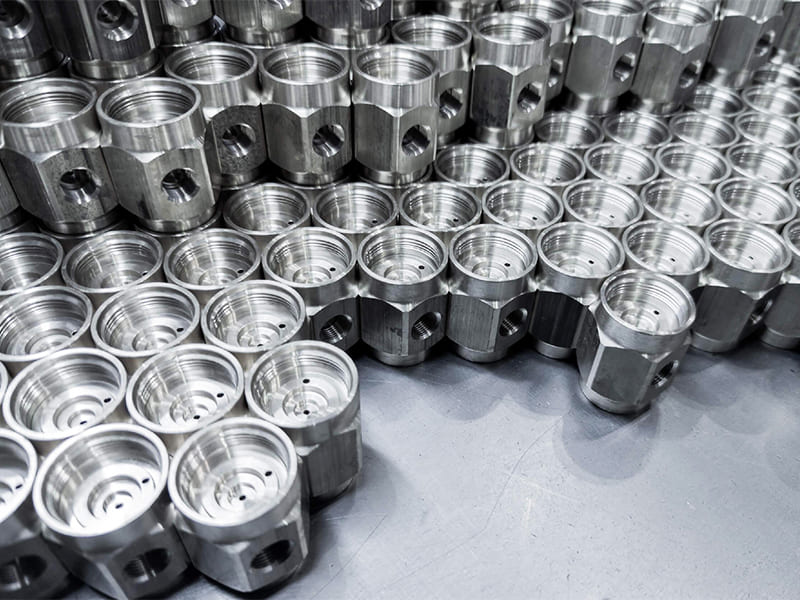
Quick Answer: Alloy steel adds chromium, nickel, molybdenum, or vanadium to iron and carbon, producing higher strength, better fatigue resistance, improved corrosion resistance, and superior heat treatment response. Carbon steel relies on carbon content alone — making it cheaper, easier to machine, and better for welding, but more vulnerable to corrosion and less suited for high-load applications. Choosing the right steel material directly affects CNC machining cost, tool life, product durability, and long-term lifecycle economics.
What Is the Difference Between Alloy Steel and Carbon Steel?
Alloy steel and carbon steel are both iron-based engineering materials — but their compositions, properties, and ideal applications differ in ways that matter significantly for OEM manufacturers, CNC machining buyers, and product engineers.
Carbon steel is defined by iron and carbon as its primary components, with minimal additional alloying. Carbon content controls hardness, strength, and ductility. The trade-off is straightforward: as carbon increases, the steel gets harder and stronger but becomes less ductile, less weldable, and more brittle.
Alloy steel intentionally incorporates additional elements — most commonly chromium, nickel, molybdenum, and vanadium — in controlled quantities to enhance specific properties. These additions allow engineers to target characteristics that carbon alone cannot deliver: deep hardenability in thick sections, resistance to corrosive environments, stable strength at elevated temperatures, and superior fatigue life under cyclic loading.
For OEM procurement teams, this distinction has direct cost implications. Alloy steel typically carries a 20–50% higher raw material premium over equivalent carbon steel grades — but in fatigue-critical or corrosion-exposed applications, that premium often pays back through reduced maintenance, fewer component replacements, and lower downtime over the product’s service life.
What Is Alloy Steel? Composition and Key Properties
Alloy steel is engineered by adding controlled amounts of metallic elements to a base of iron and carbon. According to ASTM A322 and related specifications, a steel is classified as alloy steel when the total alloying content exceeds defined thresholds — typically when elements like chromium, nickel, or molybdenum are present above trace levels.
Common Alloying Elements and Their Effects
Each alloying element targets a specific performance characteristic:
| Alloying Element | Primary Effect | Typical Grades |
|---|---|---|
| Chromium (Cr) | Corrosion resistance, hardenability, wear resistance | 4140, 52100, D2 |
| Nickel (Ni) | Toughness, impact resistance, low-temperature ductility | 4340, 8620 |
| Molybdenum (Mo) | High-temperature strength, creep resistance, hardenability | 4140, H13 |
| Vanadium (V) | Wear resistance, grain refinement, edge retention | Tool steels, V-grades |
| Manganese (Mn) | Hardenability, strength, deoxidation | Most alloy steels |
The reason many alloy steels combine multiple elements is to achieve balanced performance — high strength without sacrificing toughness, or improved corrosion resistance without excessive hardness that would complicate machining.
4140 alloy steel is one of the most widely used CNC machining grades: its chromium-molybdenum composition delivers excellent hardenability, fatigue resistance, and tensile strength (typically 655–1000 MPa depending on heat treatment condition) while remaining machinable in the annealed or pre-hardened state. In our production experience machining 4140 for industrial shaft and gear applications, pre-hard 4140 (28–34 HRC) offers a reliable balance of performance and CNC efficiency that justifies its higher material cost over 1045 carbon steel in demanding applications.
Why Alloy Steel Is Preferred for High-Performance Applications
Alloy steels are used in aerospace landing gear, automotive transmission components, industrial gears, and precision tooling because they can be heat-treated to achieve mechanical properties that carbon steel simply cannot reach reliably — particularly in thick sections where carbon steel’s limited hardenability produces soft cores after quenching.
What Is Carbon Steel? Classifications and Typical Grades
Carbon steel is the most widely produced and consumed engineering steel globally. Its properties are primarily governed by carbon percentage, with three main categories defined by ASTM standards:
Low Carbon Steel (< 0.25% C)
Low carbon steel — often called mild steel — offers excellent ductility, outstanding weldability, and low cost. Common grades include 1018, A36, and Q235. These grades machine freely, form easily, and weld without preheating or post-weld heat treatment. However, they cannot be hardened significantly through heat treatment, which limits their wear resistance and load-bearing capability.
Best for: Structural frames, welded assemblies, sheet metal fabrication, automotive body panels.
Medium Carbon Steel (0.25–0.60% C)
Medium carbon steel provides a useful balance of strength, toughness, and machinability. Grades like 1045 and S45C respond well to quenching and tempering, making them suitable for shafts, gears, and machine components that require moderate fatigue resistance. Surface hardening processes like induction hardening are highly effective on these grades.
Best for: Shafts, gears, forged machine parts, general CNC machined components.
High Carbon Steel (0.60–1.25% C)
High carbon steel achieves very high hardness after heat treatment, making it suitable for cutting tools, springs, and wear-resistant dies. The trade-off is significantly reduced ductility and weldability — high carbon grades are brittle when hardened and require careful heat treatment to avoid cracking.
Best for: Cutting tools, springs, dies, knives, wear-resistant components.
Carbon Steel Classification Summary
| Category | Carbon Content | Hardness Range | Primary Advantage | Main Limitation |
|---|---|---|---|---|
| Low carbon | < 0.25% | 90–140 HB | Weldability, low cost | Low wear resistance |
| Medium carbon | 0.25–0.60% | 150–250 HB | Balanced strength/toughness | Moderate weldability |
| High carbon | 0.60–1.25% | 250–700 HB | Very high hardness | Brittle, poor weldability |
Alloy Steel vs Carbon Steel: Core Property Comparison
Strength and Hardness
Alloy steel generally achieves higher tensile strength and more uniform hardness through the cross-section of thick components — a property called hardenability. Carbon steel hardens primarily at the surface during quenching; the core remains softer because carbon diffusion limits how deep the hardening transformation penetrates.
A concrete example: a 100 mm diameter shaft in 1045 carbon steel may achieve 50–55 HRC at the surface after quenching but only 25–30 HRC at the core. The same shaft in 4340 alloy steel can achieve consistent 50+ HRC through-hardness, delivering significantly better fatigue resistance under bending and torsional loads. For rotating industrial shafts — exactly the application in our case study below — this through-hardening advantage is decisive.
Corrosion Resistance
Carbon steel is highly vulnerable to oxidation. Without protective coatings, even moderate humidity exposure causes iron oxide (rust) formation that progressively degrades the surface. Alloy steel with chromium content above approximately 1% begins to show meaningful improvement in oxidation resistance, as chromium forms a thin stable oxide layer that slows further corrosive attack.
That said, only stainless steels (with ≥10.5% Cr) provide substantial long-term corrosion resistance without coatings. For most structural alloy steel grades like 4140 or 4340, corrosion resistance is improved over carbon steel but still requires surface protection in harsh environments.
Practical implication for OEM buyers: If your component operates outdoors, in humid industrial environments, or with any chemical exposure, specify alloy steel and discuss surface treatment options (zinc plating, phosphating, or protective coating) with your CNC supplier. Relying on uncoated carbon steel in these conditions is a maintenance cost waiting to happen.
Toughness and Ductility
Nickel is the primary toughness-enhancing element in alloy steels. Grades like 4340 (containing ~1.8% Ni) maintain excellent impact resistance even at low temperatures — a property critical for aerospace and defense applications subject to cold-weather operation. High carbon steel, by contrast, can become dangerously brittle at low temperatures after hardening, particularly above 0.8% carbon.
Heat Resistance
At elevated temperatures, carbon steel loses hardness and strength as the martensitic microstructure begins to temper. Molybdenum and chromium in alloy steels slow this softening process significantly. Tool steels like H13 (containing Mo, Cr, and V) maintain usable hardness at temperatures exceeding 500°C — essential for die casting tooling and hot forging dies where carbon steel would fail rapidly.
Machinability
Carbon steel, particularly in the low and medium carbon range, is generally easier to machine than alloy steel. Lower hardness means lower cutting force, better chip formation, and less tool wear — translating directly to shorter cycle times and lower tooling cost. From a CNC machining standpoint, 1018 or 1045 steel can typically run 30–50% faster than heat-treated 4140 or 4340 under equivalent setups.
However, machinability varies significantly by condition. Annealed 4140 machines reasonably well; pre-hard 4140 at 28–34 HRC requires lower speeds, more rigid toolholding, and carbide inserts with appropriate edge geometry. The machining difficulty escalates further for tool steels like D2 or H13 in the hardened condition.
Alloy Steel vs Carbon Steel: Full Comparison Table
| Property | Low Carbon Steel | Medium Carbon Steel | Alloy Steel (4140) | Alloy Steel (4340) |
|---|---|---|---|---|
| Tensile strength (typical) | 400–550 MPa | 550–750 MPa | 655–1000 MPa | 980–1470 MPa |
| Hardness (heat-treated) | Low | Moderate | 28–55 HRC | 35–55 HRC |
| Corrosion resistance | Poor | Poor | Moderate | Moderate |
| Machinability | Excellent | Good | Moderate | Moderate |
| Weldability | Excellent | Moderate | Moderate (preheat needed) | Difficult |
| Fatigue resistance | Low | Moderate | High | Very high |
| Heat treatment response | Limited | Moderate | Excellent | Excellent |
| Relative material cost | Lowest | Low | Moderate | Higher |
| Typical applications | Fabrication, frames | Shafts, gears | Gears, shafts, tooling | Aerospace, heavy machinery |
How Does Each Material Perform in CNC Machining?
Material selection has a direct impact on CNC machining cost and quality. For OEM buyers sourcing precision components, understanding how steel grade affects machining economics is as important as understanding the mechanical properties.
Cutting Speed and Tool Wear
Higher hardness and carbide content in alloy steel increase cutting force, generate more heat at the cutting interface, and accelerate tool wear. Based on our production data running carbide inserts on various steel grades, tool life in annealed 4140 alloy steel typically runs 40–60% shorter than equivalent cuts in 1045 medium carbon steel — before factoring in the speed reduction needed to control heat.
Hard carbides in alloy steel, particularly vanadium carbides in tool steels and chromium carbides in high-alloy grades, are abrasive enough to cause rapid edge rounding even on TiAlN-coated carbide inserts. Tool selection matters considerably: variable-pitch end mills, positive-rake geometry inserts, and high-pressure coolant delivery all help maintain acceptable tool life in alloy steel machining.
Surface Finish Considerations
Properly machined alloy steel often produces excellent surface finish because of its more uniform, stable microstructure. Medium carbon and alloy steels at moderate hardness support clean, consistent chip formation. The challenge is at the extremes: very soft low carbon steel tends to smear rather than cut cleanly (producing built-up edge and rough surfaces), while hardened alloy steel requires conservative parameters to avoid chatter and thermal damage.
Recommended CNC Approach by Steel Grade
| Steel Grade | Condition | Recommended Strategy |
|---|---|---|
| 1018 low carbon | As-supplied | High speed, standard carbide, flood coolant |
| 1045 medium carbon | Normalized | Moderate speed, carbide, good chip evacuation |
| 4140 alloy steel | Annealed | Moderate speed, carbide inserts, climb milling |
| 4140 pre-hard | 28–34 HRC | Reduced speed, rigid setup, AlTiN-coated carbide |
| 4340 alloy steel | Hardened | Conservative parameters, rigid toolholding, high-pressure coolant |
| D2 / H13 tool steel | Hardened | EDM preferred; CNC milling with CBN or ceramic if required |
Corrosion Resistance and Environmental Performance
Why Carbon Steel Rusts Rapidly
Carbon steel contains no significant barrier against oxidation. Exposed to moisture and oxygen, the iron surface reacts to form iron oxide (rust) in a self-accelerating process: as rust forms, it creates porous, non-adherent scale that exposes fresh metal beneath, continuing the degradation cycle. Without surface protection, structural carbon steel components can lose several hundred micrometers of material per year in humid or marine environments.
How Alloy Steel Improves Environmental Performance
Chromium-containing alloy steels resist oxidation by forming a more stable, adherent oxide layer than iron alone produces. Nickel improves electrochemical stability. Molybdenum provides resistance to pitting corrosion — a particularly aggressive form of localized attack common in chloride-containing environments like coastal facilities and marine systems.
For components exposed to industrial chemicals, saltwater, or outdoor weather cycles, alloy steel with protective surface treatment (phosphate coating, zinc plating, or electroless nickel) is substantially more cost-effective over a 5–10 year service life than bare carbon steel with periodic recoating maintenance.
When Surface Coatings Are Needed
Both steel types benefit from surface treatment in corrosive environments. Common options include:
- Hot-dip galvanizing — highly effective for carbon steel structural components; the zinc layer sacrificially corrodes before the base steel
- Phosphate + oil — standard protection for machined alloy steel components in moderate environments
- Electroless nickel plating — excellent dimensional consistency for precision alloy steel parts requiring both corrosion resistance and tight tolerances
- PVD coatings — used on tool steels for wear and corrosion resistance in tooling applications
Heat Treatment: How Each Steel Responds
Heat treatment is one of the most powerful ways to optimize steel mechanical properties — and alloy steel responds significantly better than carbon steel in most heat treatment scenarios.
Quenching and Tempering
Both steel types can be quenched (rapidly cooled from austenitizing temperature to form hard martensite) and tempered (reheated to reduce brittleness). The critical difference is hardenability: alloy steels harden more deeply and uniformly in thick sections.
According to ASTM A255 Jominy hardenability testing standards, 4140 alloy steel maintains useful hardness at significantly greater distance from the quenched surface than 1045 carbon steel — typically 3–4× deeper in large cross-sections. For shafts, gears, and structural components over 50 mm in diameter, this difference is decisive for fatigue resistance.
Annealing
Annealing softens steel for improved machinability and formability. For alloy steels, proper annealing is often essential before CNC machining to reach acceptable cutting conditions — particularly for grades that would otherwise be too hard for efficient production machining. In projects we’ve delivered involving D2 tool steel, annealing before rough machining followed by hardening and finish grinding is standard practice to control tool wear and maintain dimensional tolerances.
Case Hardening
Case hardening creates a hard, wear-resistant outer surface over a tougher, impact-resistant core. Alloy steels develop deeper, more consistent case depth than equivalent carbon steels, and maintain better dimensional stability through the carburizing and quenching cycle. 8620 alloy steel is the standard grade for case-hardened transmission gears in automotive applications precisely because of this combination of case depth, core toughness, and dimensional control.
Heat Treatment Comparison
| Process | Carbon Steel Response | Alloy Steel Response |
|---|---|---|
| Quench hardening | Limited depth in thick sections | Deep, uniform hardness |
| Tempering | Good toughness recovery | Excellent toughness + retained strength |
| Case hardening | Moderate case depth | Deep, consistent case |
| Dimensional stability | Moderate | Better |
| Complexity | Lower | Higher (more parameters to control) |
Applications by Industry
Automotive
The automotive industry uses both steel types extensively, selecting based on component function and cost targets.
Alloy steel dominates in drivetrain and powertrain components — transmission gears, crankshafts, connecting rods, camshafts, and axle shafts — where cyclic fatigue loading, surface wear, and elevated temperatures are constant operational conditions. Carbon steel (structural grades like A36 or HSLA steels) is used for vehicle frames, body structural reinforcements, and mounting brackets where formability and weldability matter more than fatigue resistance.
Aerospace
Aerospace structures demand extremely high strength-to-weight ratios, consistent fatigue performance across wide temperature ranges, and reliable structural integrity. Alloy steel grades like 4340, 300M, and maraging steels are used for landing gear, structural fittings, and high-strength fasteners. Carbon steel is rarely specified for primary aerospace structures because it cannot reliably meet the fatigue life and toughness requirements under certification standards.
Oil and Gas
Downhole tools, valve bodies, wellhead components, and pressure vessels in oil and gas applications operate under high pressure, abrasive flow conditions, and exposure to hydrogen sulfide (H₂S) — a particularly aggressive corrosive agent that causes sulfide stress cracking in poorly selected steels. NACE MR0175/ISO 15156 specifies alloy steel grades with controlled hardness limits (typically ≤22 HRC for sour service) to prevent cracking failures. Carbon steel is used in less aggressive service conditions and in structural infrastructure where corrosion protection can be applied and maintained.
Industrial Machinery
Power transmission components — gears, shafts, couplings, and bearing races — are standard alloy steel territory because of wear resistance and fatigue requirements. Structural frames, guards, covers, and non-load-critical supports are typically carbon steel, optimizing the balance between material cost and manufacturing simplicity.
Construction and Infrastructure
Carbon steel dominates construction because structural grades like A36 and A572 provide adequate strength for beam and column applications at the lowest possible material and fabrication cost. Weldability is paramount in construction — field welding requirements make low-carbon, low-hardenability steels far more practical than alloy grades that require preheating and post-weld heat treatment to avoid cracking.
DFM Considerations: Choosing Steel for Manufacturability
Material specification is one of the highest-impact design decisions affecting CNC machining cost and production efficiency. Based on our shop floor experience reviewing parts for OEM customers, over-specification of steel grade is one of the most common and expensive DFM mistakes — and one of the easiest to correct.
Avoid Over-Specification
Not every structural bracket needs 4140. Not every housing needs heat-treated alloy steel. When a medium carbon steel like 1045 meets the strength and wear requirements of the application, specifying it instead of alloy steel reduces material cost, machining cycle time, and heat treatment complexity — often by 20–40% in total manufacturing cost.
The structured question to ask is: what are the actual failure modes this part must resist? If the answer is static overload in a protected indoor environment, carbon steel is almost certainly sufficient. If the answer includes fatigue, corrosion, elevated temperature, or through-section hardness, then alloy steel earns its premium.
Balance Hardness to Application
Every point of additional hardness increases machining difficulty. Specifying heat-treated alloy steel at 48–52 HRC when 30–35 HRC would meet wear requirements is a common over-specification that dramatically increases machining cost (often requiring grinding as the final operation) without proportional benefit.
Work with your CNC supplier to define the minimum acceptable hardness range for the application — not the maximum achievable by the material.
Consider Process Sequence
Machining before final hardening — roughing in the annealed condition, then heat treating, then finish grinding or light finishing — is standard practice for precision alloy steel components. This sequence minimizes machining difficulty, controls heat treatment distortion, and allows tight final tolerances to be achieved efficiently. Specifying material in the pre-hardened condition simplifies procurement but reduces the supplier’s flexibility to optimize the process sequence.
Weldability Implications
Any design requiring welding should default to low or medium carbon steel unless performance requirements clearly mandate alloy steel. Alloy steels above 0.3% carbon equivalent (a combined measure of carbon and alloy content) require preheating before welding and controlled cooling afterward to prevent heat-affected zone cracking. In production fabrication environments, these requirements add cost, slow throughput, and increase the risk of quality escapes.
DFM Steel Selection Checklist
| Design Question | Implication |
|---|---|
| Does the part require welding? | Favor low carbon steel |
| Is through-hardness critical? | Specify alloy steel |
| Is corrosion exposure significant? | Specify alloy steel + surface treatment |
| Is the part over 50 mm thick and fatigue-loaded? | Carbon steel hardenability may be insufficient |
| Is cost minimization the priority? | Carbon steel, standard grade |
| Is it a high-volume structural part? | Carbon steel, optimize for welding and machining |
Cost Comparison: Alloy Steel vs Carbon Steel
Raw Material Cost
Low carbon steel is the baseline. Medium carbon steel (1045) typically runs 10–20% higher. Alloy steel (4140) runs 30–60% higher depending on chromium and molybdenum market pricing, which fluctuates with global mining and energy costs. High-alloy tool steels (D2, H13) can be 4–8× the cost of equivalent-weight low carbon steel.
These are raw material costs only — the total cost picture changes significantly when machining, heat treatment, and lifecycle factors are included.
Machining Cost
Carbon steel’s better machinability translates directly to lower machining cost: faster cycle times, longer tool life, and less downtime for tool changes. For a high-volume CNC production run, this difference can offset a significant portion of the raw material price premium of alloy steel — or make carbon steel the clear winner for cost-sensitive applications.
Lifecycle Cost
For components subject to wear, fatigue, or corrosion, the calculation reverses. A drive shaft in medium carbon steel that requires replacement every 18 months has a higher 5-year lifecycle cost than an alloy steel shaft lasting 4–5 years, even accounting for the higher initial material and machining cost. In projects we’ve supported for industrial automation customers, the switch from 1045 to heat-treated 4140 on loaded shaft applications has consistently shown 40–60% reduction in total lifecycle cost when maintenance and downtime are included.
How to Reduce Total Steel Manufacturing Cost
- Use standard grades (1018, 1045, 4140) wherever possible — specialty grades add sourcing cost and lead time
- Specify realistic tolerances — unnecessarily tight tolerances on alloy steel require grinding operations that multiply cost
- Sequence heat treatment correctly — machining in annealed condition before hardening reduces cycle time and tool wear
- Avoid over-specifying surface finish — alloy steel finishing operations are expensive; specify Ra values based on functional requirements, not cosmetics
Case Study: Upgrading from Carbon Steel to Alloy Steel for Industrial Drive Shafts
Background: A manufacturer of industrial automation equipment was experiencing repeated field failures on drive shafts running in continuous-duty conveyor systems. The original specification was 1045 medium carbon steel, selected for its low cost and straightforward machinability.
Operating conditions: Continuous rotation at moderate speed under significant bending and torsional load, with occasional impact loading during jam events. Operating environment: indoor, with lubricant exposure and moderate temperature cycling.
Failure analysis: The shafts were failing by fatigue crack initiation at stress concentration points (keyways and shaft shoulders) after 12–18 months of service. Surface wear at bearing contact zones was also noted, contributing to dimensional drift and bearing noise before final fracture.
Root cause: 1045 carbon steel in the normalized condition (approximately 170–210 HB) provided insufficient fatigue strength for the actual cyclic load spectrum. The core hardness was limited by hardenability — quenching the 60 mm diameter shafts produced surface hardness of ~48 HRC but core hardness of only ~22–25 HRC, leaving the cross-section with inadequate fatigue resistance in the critical subsurface zone.
Material upgrade: The engineering team specified 4140 alloy steel, quenched and tempered to 30–36 HRC through the full cross-section.
Process changes implemented:
| Parameter | Before (1045) | After (4140 Q&T) |
|---|---|---|
| Material | 1045 normalized | 4140 Q&T (30–36 HRC) |
| Core hardness | 22–25 HRC | 30–36 HRC |
| Machining approach | Standard carbide, high speed | Carbide inserts, reduced speed, climb milling |
| Surface treatment | Bare steel | Phosphate + oil |
| Toolpath strategy | Standard | Optimized for harder material |
Results:
| Metric | Before | After |
|---|---|---|
| Average shaft service life | 12–18 months | 48–60 months |
| Annual shaft replacement cost | Baseline | Reduced ~65% |
| Maintenance downtime events | 4–6 per year | < 1 per year |
| Total 5-year lifecycle cost | Higher | Lower despite higher material cost |
Engineering lesson: The initial cost of 4140 alloy steel and the slightly higher machining cost were recovered within the first replacement cycle avoided. For OEM buyers, this case illustrates why specifying steel based on lowest raw material cost — without evaluating the actual failure mode and lifecycle economics — consistently leads to higher total cost of ownership.
Key Takeaways
- Alloy steel outperforms carbon steel in strength, hardenability, fatigue resistance, and corrosion resistance — but at higher material and machining cost.
- Carbon steel is the right choice for structural fabrication, welding-intensive production, cost-sensitive parts, and indoor applications where extreme performance is not required.
- Machinability favors carbon steel — low and medium carbon grades machine faster, with lower tool wear and shorter cycle times than equivalent alloy steel grades.
- Heat treatment response strongly favors alloy steel in thick sections — carbon steel’s limited hardenability leaves soft cores in components over 40–50 mm diameter.
- Lifecycle cost, not raw material price, is the correct metric for steel selection in wear-critical or fatigue-loaded applications.
- Over-specification is expensive — matching steel grade to actual application requirements is a high-value DFM activity that reduces total manufacturing cost without compromising product reliability.
- For OEM buyers, asking your CNC supplier to review steel grade selection as part of a DFM analysis is worth the conversation — especially for rotating components, fatigue-loaded parts, and anything operating in corrosive environments.
Frequently Asked Questions
What is the main difference between alloy steel and carbon steel?
The fundamental difference is chemical composition. Carbon steel relies on iron and carbon as its primary components, with carbon percentage controlling hardness and strength. Alloy steel adds specific metallic elements — most commonly chromium, nickel, molybdenum, and vanadium — to enhance properties that carbon alone cannot achieve: deep hardenability in thick sections, elevated corrosion resistance, improved toughness at low temperatures, and stable strength at high temperatures. In practice, alloy steel outperforms carbon steel in demanding applications but costs more to procure and machine.
Which steel is stronger — alloy steel or carbon steel?
Alloy steel is generally stronger, particularly after heat treatment and in large cross-sections. 4140 alloy steel achieves tensile strengths of 655–1000 MPa depending on temper condition; 4340 reaches 980–1470 MPa. Medium carbon steel (1045) typically delivers 550–750 MPa. High carbon steel can achieve very high hardness (60+ HRC) after quenching, but at the cost of brittleness. For applications requiring high strength combined with useful toughness — gears, shafts, aerospace components — alloy steel is the correct choice. For applications where hardness and cutting edge retention matter most (cutting tools, springs), high carbon steel remains relevant.
Is alloy steel more corrosion resistant than carbon steel?
Yes, in most cases. Chromium-containing alloy steels form a more stable oxide layer than plain carbon steel, improving oxidation and rust resistance. However, the improvement is incremental for most structural alloy grades like 4140 — meaningful corrosion protection still requires surface treatment. Only stainless steel grades (≥10.5% Cr) provide substantial bare-metal corrosion resistance for aggressive environments. For moderate corrosion exposure, alloy steel with phosphating or zinc plating is typically the practical solution; for severe environments, stainless steel or a heavily coated carbon steel may be evaluated instead.
Which steel is easier to machine in CNC production?
Carbon steel, particularly in low and medium carbon grades, is easier to machine than alloy steel. Lower hardness means lower cutting forces, better chip formation, longer tool life, and higher achievable cutting speeds. From a production economics standpoint, 1018 and 1045 are among the most CNC-friendly steel grades available. Alloy steel — especially in pre-hardened or fully hardened condition — requires lower speeds, more rigid setups, specialized tooling, and more careful thermal management. For high-volume production of non-critical components, carbon steel’s machinability advantage is a meaningful cost factor.
When should I specify alloy steel instead of carbon steel for a CNC machined part?
Specify alloy steel when one or more of the following conditions apply: the component experiences significant cyclic fatigue loading (rotating shafts, gears, connecting rods); the cross-section is large enough that carbon steel hardenability is insufficient for through-hardening; the operating environment involves corrosion, moisture, or chemical exposure; elevated temperature operation reduces carbon steel strength unacceptably; or long service life with minimal maintenance is a priority. For static structural parts in protected environments, standard medium carbon steel is usually sufficient.
Can carbon steel be heat treated effectively?
Yes — medium and high carbon steels respond well to quenching and tempering, and surface hardening processes like induction hardening are very effective on grades like 1045 and 1050. The limitation is hardenability: carbon steel achieves full hardness only near the surface in thicker sections, leaving softer cores. For components under 30–40 mm diameter or wall thickness, this limitation is often manageable. In larger sections, the core strength deficit becomes a fatigue risk that alloy steel’s superior hardenability addresses more reliably.
Why does alloy steel cost more, and is it worth the premium?
Alloy steel costs more because it contains chromium, nickel, molybdenum, and other elements that are mined, refined, and alloyed at additional expense. Machining cost also increases due to higher hardness and more demanding process requirements. Whether the premium is justified depends entirely on the application. According to SME manufacturing engineering data, the total lifecycle cost of alloy steel components in fatigue or wear-critical applications is frequently lower than equivalent carbon steel parts that require more frequent replacement — often decisively so when unplanned downtime costs are included. For structural or weld-intensive fabrication where extreme performance is not required, carbon steel’s lower cost is the correct engineering and economic choice.
What are the best steel grades for CNC machining?
For general CNC machining, 1018 (easy, low-strength structural parts) and 1045 (moderate strength shafts and machine components) are the most productive carbon steel grades. For alloy steel CNC machining, 4140 in the annealed or pre-hard condition (28–34 HRC) offers an excellent combination of mechanical performance and machining efficiency. Fully hardened tool steels (D2, H13 above 54 HRC) are typically finished by grinding or EDM rather than conventional CNC milling and turning.
Written by the CMS engineering team with 15+ years of precision CNC machining experience in alloy steel, carbon steel, and engineered materials for aerospace, automotive, and industrial OEM applications. Technical references: ASTM A322 (Alloy Steel Bar), ASTM A255 (Hardenability Testing), NACE MR0175/ISO 15156 (Sour Service Materials), SME Manufacturing Engineering Handbook.
Sourcing Precision CNC Components in Alloy Steel or Carbon Steel?
At CMS, we machine both alloy steel and carbon steel to tight tolerances, with in-house heat treatment coordination, DFM material review, and surface treatment options. Whether you’re sourcing drive shafts, gears, structural brackets, or custom industrial components, our engineering team can help you select the right steel grade for your performance requirements and production budget.
[Request a DFM review and machining quote →]


