
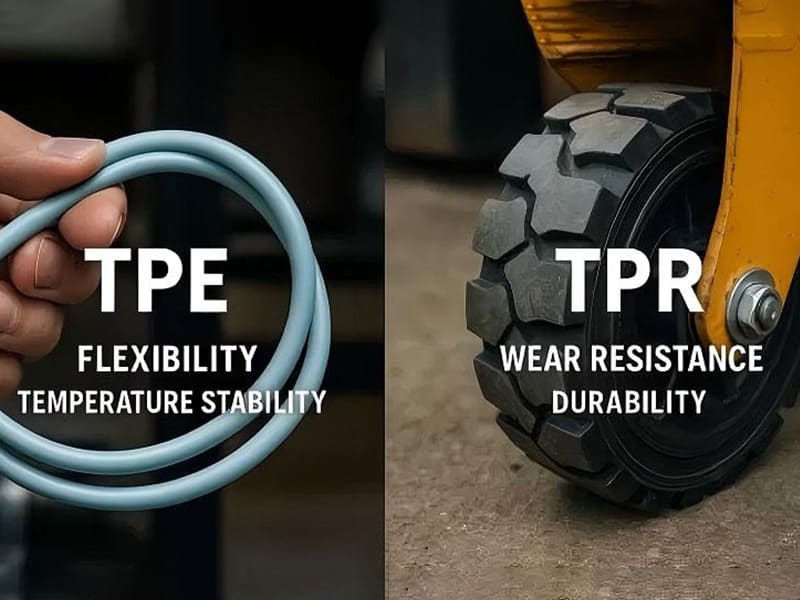
An OEM manufacturer produces industrial hand-tool grips using compression-molded vulcanized rubber bonded to ABS handles. The process requires vulcanization, secondary bonding operations, and manual assembly — creating long cycle times, high scrap rates, and difficult recycling. Switching to TPR overmolding onto ABS via two-shot injection molding eliminates vulcanization, secondary bonding, and manual assembly entirely. Manufacturing cost drops approximately 25%, cycle time reduces 35%, and material waste decreases significantly because TPR runners and rejects can be reground and reprocessed. The grip comfort, surface consistency, and production scalability all improve simultaneously. We specify TPR and TPE materials for injection-molded and overmolded flexible components based on the specific combination of cost, durability, UV resistance, and surface quality each application requires. TPR (Thermoplastic Rubber) and TPE (Thermoplastic Elastomer) are frequently confused because both combine rubber-like flexibility with thermoplastic processing. However, TPR is a subtype within the broader TPE family — typically based on SBS (Styrene-Butadiene-Styrene) chemistry, while advanced TPE materials use SEBS, TPV, TPU, or TPO systems that deliver significantly better UV resistance, aging stability, and surface quality at higher cost.
This guide covers what each material is, the structural and performance differences, key properties, injection molding and overmolding behavior, applications, advantages and limitations, and a practical selection framework.
What Is TPR?
TPR (Thermoplastic Rubber) is a flexible polymer based on SBS block copolymer systems — containing rigid plastic segments and elastic rubber segments that produce rubber-like behavior at room temperature while remaining melt-processable like standard thermoplastics. Unlike vulcanized rubber, TPR requires no curing — it melts, molds, cools, and can be reprocessed repeatedly.
| Property | Typical Value |
|---|---|
| Hardness range | 20 Shore 00 – 85 Shore D |
| Density | 0.90–1.30 g/cm³ |
| Tensile strength | 2–15 MPa |
| Elongation at break | 200–800% |
| Operating temperature | −40°C to 120°C |
| Recyclability | Excellent |
Key advantages over vulcanized rubber: Faster injection molding cycles. No vulcanization or curing required. Recyclable scrap. Easier automation and color customization. Lower total production cost.
What Is TPE?
TPE (Thermoplastic Elastomer) is the broader material family that includes TPR as a subtype. Advanced TPE materials use hydrogenated polymer systems (SEBS) or alternative chemistries (TPV, TPU, TPO) that eliminate the unsaturated butadiene segments found in SBS-based TPR — producing significantly better UV stability, weather resistance, and long-term aging performance.
The fundamental chemistry difference: SBS (TPR) contains unsaturated double bonds vulnerable to UV degradation and oxidation. SEBS (advanced TPE) is the hydrogenated version — saturated bonds resist UV, ozone, and thermal aging far better. This single structural difference drives most of the performance gap between TPR and TPE.
Key Differences
| Feature | TPR (SBS-based) | TPE (SEBS/TPV/TPU) |
|---|---|---|
| Base structure | SBS block copolymer | SEBS / TPV / TPU systems |
| Material cost | Lower | Higher |
| Soft touch | Good | Excellent (smoother, less tacky) |
| UV resistance | Moderate | Better |
| Weather resistance | Moderate | Excellent |
| Durability | Good | Better |
| Chemical resistance | Moderate | Better |
| Overmolding adhesion | Good | Excellent |
| Surface quality | Good | Premium |
| Medical compatibility | Limited | Better |
| Outdoor suitability | Moderate | Recommended |
| Long-term aging | May harden over time | More stable |
Based on our production data, SBS-based TPR parts exposed to continuous outdoor UV show measurable surface cracking and hardening within 12–18 months, while equivalent SEBS-based TPE parts maintain flexibility and surface quality for 3–5+ years — the hydrogenated chemistry provides dramatically better outdoor durability.
Properties Compared
Softness and Touch
Both produce soft, flexible surfaces. TPR delivers a slightly rubbery feel with higher grip friction — suitable for tool handles and industrial grips. TPE typically provides a smoother, premium touch with lower tackiness — preferred for consumer electronics, medical devices, and wearable products. For consumer product perception, this tactile difference significantly affects quality impression. One common pitfall we see: specifying TPR for premium consumer electronics where users expect smooth, refined touch — the slightly tackier TPR surface reads as “lower quality” versus the cleaner TPE feel, even though both materials perform adequately mechanically.
Durability and Aging
TPE outperforms TPR in fatigue resistance, compression set resistance, tensile strength, and long-term aging stability. TPR remains competitive for moderate-duty indoor applications with limited UV exposure and moderate lifecycle requirements. Standard SBS-based TPR may gradually harden, crack, or lose elasticity under prolonged UV, ozone, or heat exposure — the unsaturated butadiene segments oxidize over time.
Chemical and Temperature Resistance
TPR handles water, mild acids, mild alkalis, and household chemicals well. Limited resistance to oils, fuels, and strong solvents. Operating range −40°C to 120°C. TPE (especially TPV and TPU variants) provides better chemical resistance and higher temperature tolerance for automotive and industrial applications. For continuous heat above 120°C, silicone rubber is typically required.
Waterproof and Electrical
Both materials provide good waterproof performance and electrical insulation. TPR is commonly used in cable insulation, electronic device overmolding, and outdoor protective housings. Flame-retardant or UL-certified grades available for safety-critical electronics.
Injection Molding and Overmolding
Both materials excel in injection molding — but with different processing characteristics.
TPR processing: Faster flow, easier mold filling, lower material cost, shorter cycles. Processed at 160–220°C. Excellent for high-volume cost-sensitive production. TPE processing: Better dimensional consistency, improved overmolding adhesion, better appearance quality, more stable shrinkage control. Preferred for multi-shot molding, precision overmolding, and medical applications.
Overmolding compatibility: Both bond with PP, ABS, PC, and nylon substrates. TPE generally provides stronger adhesion and more consistent bonding — critical for products experiencing repeated flex or impact. In our shop floor experience, TPE overmolding onto ABS produces approximately 30% higher peel strength than equivalent TPR formulations — the adhesion difference becomes significant in products that experience daily handling stress.
DFM Considerations
Maintain uniform wall thickness (1.0–4.0 mm typical) to prevent sink marks and warpage. Draft angles: 1–2° smooth surfaces, 3–5° textured. Verify substrate-elastomer compatibility before tooling. Add mechanical locking features for critical bonding zones. Gate location affects surface quality — optimize with mold flow analysis for precision components.
Applications
| Application | TPR | TPE |
|---|---|---|
| Tool/industrial grips | ✅ Standard | ✅ Premium |
| Footwear soles | ✅ Cost-effective | For high-performance |
| Consumer electronics | Budget products | ✅ Premium devices |
| Automotive interior | Basic trim | ✅ Low-VOC, UV-stable |
| Medical devices | Limited | ✅ Biocompatible grades |
| Outdoor equipment | Short-term | ✅ Long-term UV stable |
| Toothbrush grips | ✅ Standard | ✅ Premium |
| Toys | ✅ Cost-effective | For safety-critical |
| Seals/gaskets | ✅ Indoor/mild | ✅ Chemical/outdoor |
| Kitchen utensils | ✅ Standard | High-temperature |
Advantages and Limitations
TPR Advantages
Lower material cost. Faster injection molding. Excellent recyclability. Good impact absorption. Wide hardness range (Shore 00 20 – Shore D 85). Excellent color customization. Simple processing with standard thermoplastic equipment.
TPR Limitations
Lower UV resistance — outdoor degradation within 12–18 months. Lower heat resistance than silicone (max ~120°C). May harden over time with aging. Lower chemical resistance to oils/solvents. Tackier surface feel than premium TPE.
TPE Advantages
Better UV and weather resistance. Superior aging stability. Premium smooth surface feel. Better overmolding adhesion. Better chemical resistance. Medical-grade options available. Lower VOC for automotive interiors.
TPE Limitations
Higher material cost. More complex formulations. Higher-performance additives add expense. May require more precise processing control.
Selection Guide
| Requirement | Choose |
|---|---|
| Low-cost soft-touch parts | TPR |
| Fast high-volume molding | TPR |
| Moderate indoor flexibility | TPR |
| Economical consumer products | TPR |
| Outdoor UV resistance | TPE |
| Premium surface feel | TPE |
| Long-term weather stability | TPE |
| Medical-grade stability | TPE |
| Automotive low-VOC interior | TPE |
| High-end appearance quality | TPE |
Decision logic: Indoor + cost-sensitive + moderate lifecycle → TPR. Outdoor + UV exposure + premium positioning + long service life → TPE. Medical or automotive compliance → TPE. When uncertain, prototype testing with both materials validates real-world performance before production commitment. Based on our production data, approximately 60% of our flexible component programs use TPR (cost-driven indoor applications) and 40% use TPE (performance-driven outdoor, medical, or premium consumer applications).
Conclusion
TPR and TPE both combine rubber-like flexibility with thermoplastic processing efficiency — but they serve different market segments. TPR (SBS-based) delivers lower cost, faster molding, and excellent recyclability for indoor consumer products, industrial grips, footwear, and moderate-duty applications. TPE (SEBS/TPV/TPU) provides superior UV resistance, aging stability, premium surface quality, and medical/automotive compliance for outdoor, long-life, and high-end applications.
The cost difference is real — but so is the performance gap. TPR parts that harden and crack after 12–18 months of outdoor exposure create warranty costs that exceed the initial material savings. Match material chemistry to the actual service environment, not just the production budget. Need help selecting between TPR and TPE for your injection molding program? [Contact our engineering team] for material selection, DFM optimization, and manufacturing support.
FAQ
What is the difference between TPR and TPE?
TPR is a subtype of TPE — typically SBS-based with lower cost and moderate UV resistance. Advanced TPE materials use SEBS/TPV/TPU with better UV stability, aging, surface quality, and chemical resistance at higher cost.
Is TPR safe?
Yes — food-grade, BPA-free, RoHS-compliant, and REACH-compliant TPR compounds are widely available for consumer, toy, and kitchenware applications. Medical-grade requires specific validation for biocompatibility and sterilization.
Can TPR be recycled?
Yes — unlike vulcanized rubber, TPR melts and reprocesses repeatedly. Runners and rejects can be reground and reused. Repeated recycling may gradually reduce elasticity and surface quality, so recycled content is typically controlled in precision applications.
TPR or silicone — which is better?
Different applications. TPR for cost-effective mass production, soft-touch overmolding, and recyclability. Silicone for high-temperature resistance (200°C+), extreme weather durability, and medical sterilization. TPR costs less and molds faster. Silicone performs better in heat and long-term aging.
What hardness is available?
Shore 00 20 (gel-like) through Shore D 85 (semi-rigid). Most overmolding uses Shore A 40–70 for optimal comfort-durability balance. Lower Shore = softer touch, better grip. Higher Shore = better structural stability and wear resistance.


