
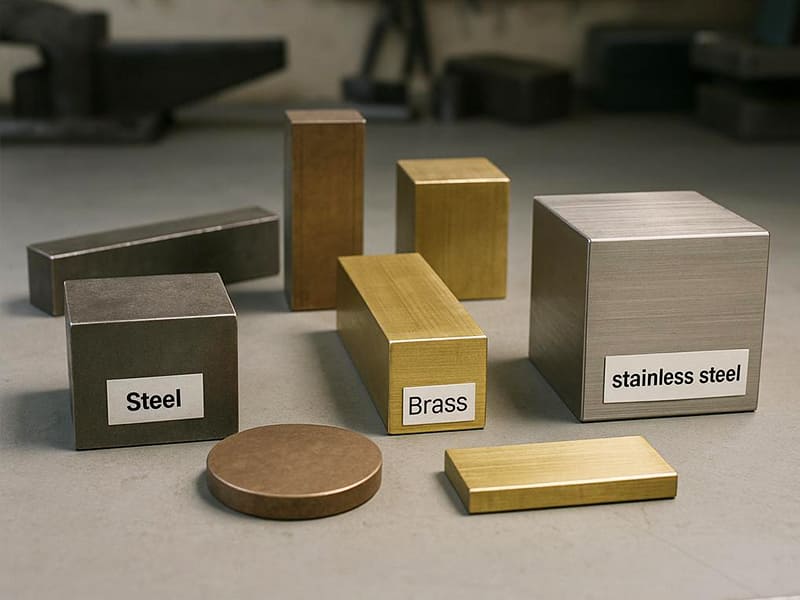
In the brass vs stainless steel comparison, neither material is universally “better” — the right choice depends on application requirements. Stainless steel offers superior strength (520–900+ MPa tensile vs 300–500 MPa for brass), excellent corrosion resistance (especially 316 grade with molybdenum), and meets food-grade and medical hygiene standards, making it the preferred choice for structural, food processing, marine, and harsh chemical environments. Brass excels in machinability (often 100% machinability index for free-cutting C36000), electrical and thermal conductivity (10× higher than stainless steel), low friction characteristics, and aesthetic gold-like appearance — making it ideal for plumbing fittings, electrical connectors, valves, bushings, and decorative hardware. Total part cost favors brass for complex CNC-machined parts despite higher raw material price, as machining time and tool wear dominate cost in production volumes. The selection decision should match material properties to dominant performance requirements: function, environment, conductivity, appearance, and manufacturability.
Introduction
Four months ago, a customer asked us to quote two material options for a precision flow-control valve assembly: C36000 free-machining brass versus 316 stainless steel. The valve required tight thread tolerances on six interfaces, water service at moderate pressure (8 bar), 50,000 unit annual production volume, and a 10-year service life specification. Initial procurement instinct favored 316 stainless steel — “stainless is always better, right?” Our quote revealed the complete picture: 316 stainless steel raw material was 30% cheaper per kg than brass, but the machined part cost was 47% higher due to 2.8× longer cycle time and 3× higher tool consumption on the precision threads. More importantly, our reliability analysis showed C36000 brass would deliver equivalent service life in this water application (no chloride exposure, controlled pH) at significantly lower total cost. The customer ultimately specified C36000 lead-free brass (C69300 specifically for water contact), saving approximately $284,000 annually on production cost while meeting all performance requirements.
That project captures why understanding brass vs stainless steel matters beyond material name reputation — the optimal choice often contradicts intuitive “premium material equals better” assumptions when total cost and actual performance requirements are properly analyzed. Based on our production data across 600+ programs comparing brass and stainless steel options, approximately 40% of customers initially specify the wrong material based on reputation rather than application analysis, leaving 15–50% cost savings available through proper material selection. In our shop floor experience, the engineers who understand both materials’ specific strengths make better specification decisions, while those defaulting to either material category miss optimization opportunities that compound across production volumes. This guide walks through brass and stainless steel fundamentals individually, then compares them across the dimensions that actually drive engineering decisions: strength, corrosion resistance, conductivity, machinability, cost, applications, and finishing options.
Quick Answer: Brass vs Stainless Steel
The fastest way to decide between brass vs stainless steel is matching material strengths to your dominant application requirement — neither material wins universally, but each clearly dominates specific use cases.
Quick Selection Guide
| Requirement | Choose Brass | Choose Stainless Steel |
|---|---|---|
| Strength / load-bearing | ❌ | ✅ |
| Corrosion resistance (harsh environments) | ⚠️ Moderate | ✅ Excellent |
| Machinability / cost efficiency | ✅ Excellent | ⚠️ Moderate |
| Electrical / thermal conductivity | ✅ High | ❌ Low |
| Low friction / wear behavior | ✅ Good | ⚠️ Moderate |
| Food-grade / hygiene | ⚠️ Limited | ✅ Excellent |
| Appearance (gold-like finish) | ✅ Yes | ❌ No (silver/gray) |
| Plumbing / valve fittings | ✅ Excellent | ⚠️ Sometimes |
| Marine environment | ⚠️ Special grades only | ✅ 316 grade |
| Decorative architectural | ✅ Traditional appeal | ✅ Modern appeal |
Engineering Insight
Choose stainless steel when:
- High strength and durability are required for structural applications
- Food-grade or medical hygiene standards apply
- Marine or chemical exposure dictates corrosion resistance
- Long service life in harsh environments matters
Choose brass when:
- Machinability and cost-effective production are priorities
- Electrical conductivity is critical (terminals, connectors)
- Plumbing fittings or valve components require sealing
- Decorative gold-like appearance matches design intent
- Low friction characteristics matter (bushings, sliding parts)
Key Takeaway
Stainless steel equals strength, durability, and hygiene. Brass equals machinability, conductivity, and cost efficiency. The right choice balances performance requirements, environment, and manufacturing cost rather than defaulting to material reputation.
What Is Brass?
Brass is a copper-zinc alloy with copper content of 60–90% and zinc content of 10–40%, optimized for machinability, corrosion resistance in mild environments, electrical conductivity, and aesthetic appearance. Specific grades add elements like lead (improving machinability) or tin (enhancing corrosion resistance) for targeted performance.
Common Brass Alloys and Their Properties
| Alloy | Composition | Key Characteristic | Typical Application |
|---|---|---|---|
| C22000 (commercial bronze) | 90 Cu / 10 Zn | Lower zinc, better corrosion | Outdoor architectural |
| C26000 (cartridge brass) | 70 Cu / 30 Zn | Best cold-formability | Drawn parts, ammunition cases |
| C28000 (Muntz metal) | 60 Cu / 40 Zn | Higher strength | Marine hardware, condenser plates |
| C36000 (free-machining brass) | 60 Cu / 35 Zn / 3 Pb | 100% machinability rating | CNC machined parts |
| C46400 (naval brass) | 60 Cu / 39 Zn / 1 Sn | Tin improves corrosion | Marine fasteners |
| C69300 (lead-free brass) | 75 Cu / 24 Zn / Si, Bi | NSF/ANSI 61 compliant | Drinking water |
| C28000 (high-zinc brass) | 60 Cu / 40 Zn | Hot-workable | Forgings |
| C85700 (yellow brass) | 60 Cu / 38 Zn / 1 Pb | Cast alloy | Cast hardware |
Key Material Properties
Mechanical properties:
- Tensile strength: 300–500 MPa (typical)
- Yield strength: 100–250 MPa (typical)
- Hardness: 65–95 HRB
- Elongation: 15–60% (depends on alloy and condition)
- Density: 8.4–8.7 g/cm³
Physical properties:
- Electrical conductivity: 20–30% IACS
- Thermal conductivity: 100–150 W/m·K
- Melting point: 900–940°C
- Coefficient of thermal expansion: 19–21 × 10⁻⁶/°C
Functional properties:
- Excellent machinability (free-cutting brass rated 100% on the standard machinability scale)
- Good corrosion resistance in water and mild atmospheres
- High thermal and electrical conductivity (better than steel)
- Low friction characteristics ideal for sliding parts
- Attractive gold-like appearance for decorative applications
- Antimicrobial properties (copper-rich surfaces inhibit bacterial growth)
Typical Brass Applications
Plumbing and fluid systems:
- Pipe fittings and connectors
- Valve bodies and components
- Faucets and water hardware
- Pressure regulators
Electrical components:
- Terminals and connectors
- Switch components
- Conductive parts in low-voltage systems
- Battery terminals
Mechanical parts:
- Bushings and bearings (low-friction sliding)
- Gears (where strength requirements are moderate)
- Wear-resistant components
- Decorative mechanical elements
Decorative hardware:
- Door handles and locks
- Architectural elements
- Light fixtures
- Furniture hardware
- Musical instruments
Engineering Insight
- Designers choose brass when surface appearance matters and moderate strength is sufficient
- Engineers benefit from easier machining (shorter cycle times, stable chip formation, longer tool life)
- Procurement sees lower total cost despite higher raw material price due to manufacturing efficiency
Key Takeaway
Brass is a versatile copper-based alloy combining machinability, corrosion resistance, conductivity, and aesthetics. Its value comes from balanced multi-property performance rather than excelling in any single dimension — making it especially valuable for fittings, connectors, and components where ease of manufacturing and reliable performance matter more than maximum strength.
What Is Stainless Steel?
Stainless steel is an iron-based alloy containing chromium (minimum 10.5%, typically 16–18%), often combined with nickel, molybdenum, and other elements that provide its characteristic corrosion resistance and mechanical properties. The chromium creates a passive oxide layer (Cr₂O₃) that prevents underlying iron from rusting and self-heals when scratched.
Why Is Stainless Steel “Stainless”?
The corrosion resistance mechanism:
- Chromium reacts with atmospheric oxygen forming Cr₂O₃
- The oxide layer is very thin (1–5 nm) but tightly adherent
- Layer prevents oxygen and moisture from reaching underlying iron
- When scratched, fresh chromium re-oxidizes, restoring protection
- Self-healing behavior makes stainless steel durable despite mechanical damage
This passivation is fundamentally different from carbon steel, where iron oxide (rust) is porous and continuously progresses inward, consuming the metal.
Common Stainless Steel Grades
| Grade | Type | Composition Focus | Key Characteristics | Typical Use |
|---|---|---|---|---|
| 304 | Austenitic | 18 Cr / 8 Ni | General-purpose, good corrosion | Food equipment, general parts |
| 316 | Austenitic | 16 Cr / 10 Ni / 2 Mo | Superior corrosion (chlorides) | Marine, chemical, medical |
| 316L | Austenitic | Low carbon variant of 316 | Better welding, intergranular corrosion | Welded marine components |
| 410 | Martensitic | 12 Cr | Heat-treatable, magnetic | Cutlery, fasteners |
| 420 | Martensitic | 13 Cr | Higher hardness | Surgical instruments, blades |
| 430 | Ferritic | 17 Cr | Lower cost, magnetic | Appliances, decorative |
| 17-4 PH | Precipitation-hardening | 17 Cr / 4 Ni / Cu | Very high strength | Aerospace, valves |
| 2205 | Duplex | 22 Cr / 5 Ni / 3 Mo | High strength, corrosion resistance | Process equipment |
Key Material Properties
Mechanical properties (304 stainless reference):
- Tensile strength: 520–750 MPa (annealed)
- Tensile strength: up to 900+ MPa (cold-worked)
- Yield strength: 200–300 MPa (annealed)
- Hardness: 70–90 HRB (annealed)
- Elongation: 40–60%
- Density: 7.7–8.0 g/cm³
Corrosion resistance ranking (best to worst):
- 316L > 316 > 304L > 304 > 430 > 410
Physical properties:
- Electrical conductivity: 2–3% IACS (very poor conductor)
- Thermal conductivity: 15–25 W/m·K (poor conductor)
- Melting point: 1400–1530°C
- Coefficient of thermal expansion: 16–17 × 10⁻⁶/°C (austenitic)
Typical Applications
Food processing equipment:
- Mixing vessels and tanks
- Conveyors and processing equipment
- Hygienic fittings and connections
- Storage containers
Medical devices:
- Surgical instruments
- Implantable components (specific grades)
- Diagnostic equipment housings
- Sterilizable hardware
Marine components:
- Boat hardware and fittings
- Underwater fasteners
- Saltwater pump components (316 grade)
- Off-shore platform parts
Industrial and structural:
- Chemical processing equipment
- Pressure vessels
- Architectural cladding
- Structural fasteners
Consumer products:
- Kitchen equipment and appliances
- Cookware and utensils
- Sinks and countertops
- Decorative hardware
Engineering Insight
- Designers use stainless steel when corrosion resistance, hygiene, or strength are critical
- Engineers select grade based on environment (chlorides, chemicals) and mechanical requirements
- Procurement balances cost vs performance (316 > 304 > 430 in both performance and cost)
Key Takeaway
Stainless steel’s corrosion resistance comes from its chromium-based passive layer, with different grades optimized for different applications. Material selection requires matching specific grade to specific environment — generic “stainless steel” specification is inadequate for critical applications.
Brass vs Stainless Steel: Properties Comparison
The differences between brass and stainless steel come from their fundamental compositions and microstructures, which directly affect strength, corrosion behavior, machinability, conductivity, and cost. Understanding these property differences enables informed material selection.
Core Property Comparison
| Property | Brass | Stainless Steel | Engineering Implication |
|---|---|---|---|
| Main composition | Copper + zinc | Iron + chromium + carbon | Determines corrosion behavior |
| Tensile strength | 300–500 MPa | 520–900+ MPa | Stainless better for structural |
| Yield strength | 100–250 MPa | 200–300+ MPa | Stainless handles higher loads |
| Hardness | 65–95 HRB | 70–95 HRB (annealed) | Comparable in annealed state |
| Corrosion resistance | Good (mild environments) | Excellent (grade-dependent) | Stainless better in harsh conditions |
| Electrical conductivity | 20–30% IACS | 2–3% IACS | Brass 10× better |
| Thermal conductivity | 100–150 W/m·K | 15–25 W/m·K | Brass 5× better |
| Machinability | Excellent (100% rating) | Moderate to difficult | Brass faster, lower cost |
| Density | 8.4–8.7 g/cm³ | 7.7–8.0 g/cm³ | Both heavy; weight rarely decisive |
| Maximum service temperature | 200–300°C | 800–1100°C | Stainless for high-temperature |
| Color | Yellow/gold | Silver/gray | Aesthetic difference |
| Magnetism | Non-magnetic | Varies (austenitic non-magnetic) | Affects some applications |
| Welding | Possible but challenging | Excellent (most grades) | Stainless better for fabrication |
| Cost (raw material) | Medium-high | Medium-high (varies by grade) | Comparable per kg |
| Cost (finished part) | Lower (machining advantage) | Higher (machining cost) | Brass cheaper for complex parts |
Strength Comparison Detail
Brass strength typical values:
| Brass Type | Condition | Tensile Strength | Yield Strength |
|---|---|---|---|
| C36000 (free-machining) | Half-hard | 380 MPa | 310 MPa |
| C26000 (cartridge brass) | Annealed | 325 MPa | 105 MPa |
| C26000 | Hard | 540 MPa | 435 MPa |
| C46400 (naval brass) | Annealed | 380 MPa | 170 MPa |
| C28000 (Muntz metal) | Annealed | 380 MPa | 140 MPa |
Stainless steel strength typical values:
| Stainless Type | Condition | Tensile Strength | Yield Strength |
|---|---|---|---|
| 304 | Annealed | 520 MPa | 210 MPa |
| 304 | Cold-drawn | 750 MPa | 580 MPa |
| 316 | Annealed | 520 MPa | 220 MPa |
| 17-4 PH | H900 condition | 1310 MPa | 1170 MPa |
| 2205 duplex | Annealed | 620 MPa | 450 MPa |
Engineering Interpretation
Strength vs machinability trade-off:
Stainless steel offers higher tensile strength and durability, while brass enables easier machining and faster production. Choice depends on whether load requirements or manufacturing efficiency dominates the application.
Corrosion resistance depends on environment:
Brass performs well in water and mild environments (typical plumbing applications). Stainless steel performs better in saltwater, chemicals, and hygienic applications, particularly in 316 grade. Neither is universally “more corrosion resistant” — environment matters more than material name.
Conductivity is a major differentiator:
Brass conducts electricity and heat 5–10× better than stainless steel. This makes brass essentially mandatory for electrical terminals and heat transfer components, while making stainless steel preferable when thermal isolation is desired.
Cost is both material plus machining:
Brass typically costs more per kg as raw material but less per part as machined component due to faster cutting speeds and longer tool life. Total cost analysis must include manufacturing operations, not just material price.
Practical Decision Framework
| Priority | Recommended Material |
|---|---|
| Conductivity (electrical/thermal) | Brass |
| Maximum strength | Stainless steel |
| Easy machining | Brass |
| Corrosion in saltwater | 316 stainless |
| Corrosion in mild water | Either works |
| Food-grade hygiene | Stainless steel |
| Decorative gold appearance | Brass |
| High-temperature service | Stainless steel |
| Sliding/wear surfaces | Brass |
| Welded fabrications | Stainless steel |
Key Takeaway
Brass vs stainless steel involves trade-offs between machinability and performance. Brass offers easier machining and better conductivity. Stainless steel offers higher strength and superior corrosion resistance. The optimal choice depends on which property dominates application requirements rather than general material reputation.
Strength: Is Brass Stronger Than Stainless Steel?
In most engineering applications, stainless steel is stronger than brass — particularly for load-bearing and structural parts. Brass offers moderate strength but excels in machinability, low friction, and conductivity rather than mechanical performance.
Quantified Strength Comparison
| Material/Grade | Tensile Strength (MPa) | Yield Strength (MPa) | Engineering Notes |
|---|---|---|---|
| Brass C36000 (half-hard) | 380 | 310 | Adequate for moderate loads |
| Brass C26000 (annealed) | 325 | 105 | Soft; needs cold work for strength |
| Brass C26000 (hard) | 540 | 435 | Cold-worked maximum |
| Brass C46400 (naval) | 380 | 170 | Marine applications |
| 304 stainless (annealed) | 520 | 210 | General-purpose structural |
| 304 stainless (cold-drawn) | 750 | 580 | Higher strength condition |
| 316 stainless (annealed) | 520 | 220 | Marine/chemical service |
| 17-4 PH stainless (H900) | 1310 | 1170 | Aerospace, high-stress parts |
| 2205 duplex stainless | 620 | 450 | Process equipment |
Engineering Interpretation
Structural and load-bearing applications equal stainless steel:
For applications with significant mechanical loads, stainless steel is the clear choice:
- Brackets and structural frames
- Fasteners and pressure components
- Safety-critical parts
- Components with cyclic loading
- Parts subject to impact
Stainless steel maintains integrity under repeated loads, impact, and vibration in ways that brass typically cannot match.
Medium-load plus functional performance equals brass:
Brass works well for applications with moderate loads where its other properties matter more:
- Plumbing fittings and valves (pressure but not extreme)
- Electrical connectors (current capacity matters more than strength)
- Low-load mechanical parts (bushings, sliding components)
- Decorative hardware (load secondary to appearance)
The advantages of low friction, easy machining, and conductivity often outweigh the strength limitation in these applications.
Strength vs Function Trade-off
Stainless steel prioritizes mechanical performance:
When you need maximum strength, stainless steel delivers — particularly in heat-treated grades like 17-4 PH that can exceed 1300 MPa tensile strength.
Brass prioritizes manufacturability and functional properties:
When easy machining, conductivity, or sliding behavior matters more than maximum strength, brass is the better choice despite lower mechanical capability.
Choosing based on strength alone often leads to overdesign (specifying stainless where brass would work) or unnecessary cost (rejecting brass for moderate-load applications where it’s appropriate).
Practical Decision Logic
- If load is high or structural → choose stainless steel
- If pressure, fatigue, or safety-critical → choose stainless steel
- If moderate load plus conductivity needed → choose brass
- If moderate load plus low friction needed → choose brass
- If cost-sensitive plus easy machining critical → brass often better
- If maximum strength essential → 17-4 PH stainless or other high-strength grades
Practical Insight
For engineers, the key is evaluating actual load requirements rather than defaulting to stainless steel for “premium” applications. Many components specified as stainless could use brass at significantly lower cost without functional compromise — especially in plumbing, electrical, and decorative applications where moderate loads are typical.
For procurement, recognizing that stainless steel may increase machining cost and lead time helps balance the strength advantages against production economics.
Key Takeaway
Brass is generally not stronger than stainless steel. Stainless steel is better for strength, durability, and structural integrity. Brass is better for machinability, conductivity, and moderate-load applications. Selection should be based on real load requirements, not material reputation.
Corrosion Resistance: Brass vs Stainless Steel
Comparing brass vs stainless steel corrosion resistance requires considering specific environments and alloy grades — neither material is universally “corrosion-proof,” and each performs differently depending on moisture, chemicals, chlorides, and pH.
Corrosion Performance by Environment
| Environment | Better Choice | Reason |
|---|---|---|
| Indoor dry environment | Both | Minimal corrosion risk |
| Outdoor (rain/humidity) | Stainless / coated brass | Stainless maintains appearance |
| Plumbing (water systems) | Brass often used | Good corrosion plus machinability |
| Food contact / hygiene | Stainless 304 or 316 | Non-reactive, food-grade |
| Marine / saltwater | 316 stainless or marine brass | Chloride resistance critical |
| Chemical exposure | Stainless (grade-dependent) | 316+ resists most chemicals |
| Acidic environments | Stainless (316L typical) | Better acid resistance |
| Decorative indoor | Brass | Acceptable patina, gold appearance |
| High-temperature corrosive | High-grade stainless | Brass softens above 200°C |
| Underground | 316 with cathodic protection | Soil chemistry varies widely |
Brass Corrosion Behavior
Where brass performs well:
- Fresh water systems (drinking water, plumbing)
- Indoor atmospheric environments
- Mild chemical environments
- Sealed water systems (boiler feedwater)
Brass corrosion modes:
- Tarnish/oxidation: surface darkening (cosmetic, self-limiting)
- Patina formation: green coating develops (often acceptable or desirable)
- Dezincification: zinc selectively leaches from high-zinc brass in aggressive water or chloride environments — leaves porous structure with reduced strength
- Stress corrosion cracking: ammonia exposure on cold-worked brass causes “season cracking”
Dezincification is the major brass-specific concern:
In high-zinc brass (above 15% Zn), aggressive environments cause selective zinc leaching:
- Surface becomes pink/copper-colored as zinc disappears
- Mechanical strength drops dramatically (up to 80% loss)
- Structure becomes porous and weak
- Can occur subsurface even with intact-appearing surface
- Common in: hard water, chloride exposure, low pH conditions
Prevention strategies for dezincification:
- Use inhibited brass (with arsenic addition, like CW602N)
- Choose lower-zinc alloys (C22000, C23000)
- Use lead-free brass for water (C69300, C87850)
- Specify dezincification-resistant brass for marine
Stainless Steel Corrosion Behavior
Where stainless steel performs well:
- Most atmospheric environments
- Food processing (304 sufficient for most)
- Marine applications (316 required)
- Chemical processing (grade-specific)
- High-temperature applications
Stainless steel corrosion modes:
- Pitting: localized chloride attack creating deep holes
- Crevice corrosion: stagnant areas where passivation breaks down
- Stress corrosion cracking: chloride plus tensile stress on austenitic
- Galvanic corrosion: when contacting more anodic metals
- Intergranular corrosion: sensitization of welded heat-affected zones (preventable with L-grade)
Grade selection drives performance:
- 304: general-purpose; fails in chloride environments
- 316: chloride-resistant due to molybdenum addition
- 316L: better welding without sensitization
- 2205 duplex: superior to 316 in many environments
- Higher alloyed grades for extreme chemical service
Important: Environment Matters More Than Material Name
Critical insight: when comparing brass vs stainless steel corrosion, you’re not really choosing between two materials — you’re choosing a specific alloy grade for a specific environment.
A 304 stainless steel in saltwater performs worse than C46400 naval brass. A C26000 cartridge brass in chloride-contaminated drinking water performs worse than 316 stainless steel. Generic specifications miss these crucial distinctions.
Practical Decision Logic
- Indoor decorative → brass is suitable
- Outdoor humid → stainless steel preferred (or coated brass)
- Water fittings (controlled chemistry) → brass widely used
- Food/hygiene → stainless steel 304/316 mandatory
- Marine/salt → 316 stainless or naval brass
- Chemical exposure → match stainless grade to specific chemicals
- Drinking water → lead-free brass or 304/316 stainless
Practical Insight
For designers, considering exposure conditions and required service life is essential. For engineers, evaluating chloride content, pH, and chemical exposure determines proper grade selection. For procurement, avoiding generic specifications like “stainless steel” or “brass” — always specify exact grade (304, 316, C36000, C46400) — prevents costly failures.
Key Takeaway
Stainless steel generally offers better corrosion resistance than brass, especially in harsh environments — but only when the correct grade is used. Brass performs well in water systems and indoor applications but may tarnish or degrade in aggressive conditions. The right choice matches specific material grade to actual environment, not just compares material names.
Conductivity: Brass vs Stainless Steel
The difference between brass and stainless steel conductivity is dramatic — brass conducts electricity and heat approximately 5–10× better than stainless steel, making conductivity one of the clearest differentiators between the two materials.
Quantified Conductivity Comparison
| Property | Brass | 304 Stainless | 316 Stainless | Pure Copper Reference |
|---|---|---|---|---|
| Electrical conductivity | 20–30% IACS | 2–3% IACS | 2–3% IACS | 100% IACS |
| Thermal conductivity (W/m·K) | 100–150 | 15–25 | 14–17 | 400 |
| Specific resistance (μΩ·cm) | 6–7 | 70–80 | 75–85 | 1.7 |
| Heat capacity (J/g·K) | 0.38 | 0.50 | 0.50 | 0.39 |
Note: IACS = International Annealed Copper Standard, where pure copper at 100% serves as reference. Higher percentage means better electrical conductivity.
Engineering Interpretation
Brass equals preferred for conductivity applications:
Brass is the standard material choice when electrical or thermal conduction matters:
- Electrical terminals and connectors (low resistance, durable)
- Switch components (current carrying capacity)
- Grounding parts (electrical safety)
- Heat transfer fittings (efficient thermal flow)
- Electrical hardware (conductivity plus machinability)
- Battery terminals (power transfer)
The conductivity advantage isn’t marginal — it’s an order of magnitude difference that makes brass essentially mandatory for many electrical applications.
Stainless steel equals not for conductivity, but for durability:
While stainless steel is a poor conductor, its other properties make it the right choice when conductivity isn’t the priority:
- High strength (structural applications)
- Corrosion resistance (chemical exposure)
- Heat resistance (high-temperature service)
- Hygienic surfaces (food/medical applications)
For applications combining mechanical or environmental performance with electrical isolation, stainless steel can actually be advantageous (intentional poor conductor).
Practical Application Examples
Where brass conductivity matters:
- Battery terminals: brass provides reliable electrical contact while resisting corrosion from battery acids
- Plumbing fittings: thermal conductivity helps even temperature distribution
- Electrical outlet contacts: low resistance ensures full current capacity
- Heat exchanger components: rapid thermal transfer
Where stainless steel’s poor conductivity is intentional:
- High-voltage equipment: prevents unintended current paths
- Cryogenic equipment: minimizes heat transfer to cold zones
- Thermal insulation supports: structural without thermal bridging
- Specialized electronics housings: shielding without conduction
Trade-off Between Performance and Function
Brass characteristics:
- Excellent conductivity (electrical and thermal)
- Moderate strength
- Good corrosion resistance in mild environments
- Easy machining
Stainless steel characteristics:
- Low conductivity (electrical and thermal)
- High structural performance
- Excellent corrosion resistance (proper grade)
- Higher machining cost
Practical Selection Logic
- If electrical or thermal transfer needed → choose brass
- If structural plus corrosion resistance critical → choose stainless steel
- If mixed requirements (conductivity plus strength) → consider hybrid design with brass conductors and stainless structural elements
- If electrical isolation needed → stainless steel can be advantageous
Practical Insight
For designers, brass should be specified for current-carrying components and heat exchange interfaces. For engineers, evaluating resistive heating and thermal management needs informs material selection. For procurement, brass may reduce energy loss and cooling requirements in high-current applications, often justifying its cost premium.
Key Takeaway
Brass significantly outperforms stainless steel in both electrical and thermal conductivity. Stainless steel should be selected when strength, corrosion resistance, or hygiene outweigh conductivity needs. Material selection should match the dominant performance requirement — for conductivity-critical applications, brass is essentially mandatory, while for non-conductive structural applications, stainless steel offers other advantages.
Machinability: CNC Machining Comparison
When evaluating brass vs stainless steel for CNC machining, the difference is substantial — brass is one of the easiest metals to machine while stainless steel is more demanding. This directly impacts machining time, tool consumption, surface quality, and overall part cost in production.
CNC Machining Comparison
| Factor | Brass | Stainless Steel | Difference |
|---|---|---|---|
| Machinability rating | 100% (free-cutting) | 30–45% (304 typical) | 2–3× advantage to brass |
| Cutting speed (m/min) | 250–400 | 80–150 | 2–3× faster brass |
| Tool wear | Very low | Higher (especially austenitic) | 3–5× longer tool life on brass |
| Heat generation | Low | High (poor thermal conductivity) | Cooling more critical for stainless |
| Chip control | Excellent (short chips) | Difficult (stringy chips) | Brass easier to handle |
| Surface finish (achievable) | Easily Ra 0.8–1.6 µm | Ra 1.6–3.2 µm typical | Comparable but brass easier |
| Burr formation | Manageable | Can be significant | Less deburring on brass |
| Coolant requirements | Optional in many cases | Mandatory | Lower coolant cost on brass |
| Cycle time impact | Baseline | 2–3× longer | Significant cost difference |
Engineering Interpretation
Brass equals high machining efficiency:
Brass’s excellent machinability traces to several factors:
- Free-cutting structure produces short, controlled chips
- Lead content (in C36000) acts as solid lubricant during cutting
- Low cutting forces minimize tool stress
- Excellent thermal conductivity removes heat from cutting zone
- Minimal work hardening tendency
These properties result in:
- Faster cycle times (2–3× compared to stainless)
- Lower per-part machining cost
- Longer tool life (300–500% longer typically)
- Better surface finish with less effort
- Reduced setup time and operator intervention
Stainless steel equals more challenging to machine:
Stainless steel presents specific machining challenges:
- Lower thermal conductivity keeps heat in cutting zone
- Tendency for work hardening (especially austenitic 304/316)
- Tougher, stringy chips that wrap around tools
- Higher cutting forces require more rigid setups
- Tendency to form built-up edge on tools
These characteristics lead to:
- Increased tool wear and frequent replacement
- Slower machining speeds
- More frequent tool changes
- Higher coolant consumption and management
- More post-machining operations (deburring, finishing)
Surface Finish Achievability
Brass:
- Naturally produces smooth finishes (Ra 0.8–1.6 µm typical)
- Easier to achieve cosmetic-quality surfaces
- Polishable to mirror finish
- Less post-processing required
Stainless steel:
- Can achieve excellent finishes with proper parameters
- Requires tighter parameter control
- Often needs post-processing (polishing, electropolishing)
- More complex deburring procedures
Cost Implications
Brass typical cost factors:
- Lower machining time per part
- Lower tooling cost (longer tool life)
- Less coolant consumption
- Reduced operator intervention
- Lower scrap rates
Stainless steel typical cost factors:
- Higher machining time per part
- Higher tooling cost (frequent replacement)
- More coolant consumption
- More setup time and operator attention
- Potentially higher scrap rates
For complex CNC parts, total machining cost difference can reach 30–60% in moderate to high volume production — significant enough to justify material substitution when other requirements permit.
Practical Selection Logic
- If high efficiency / low-cost machining priority → choose brass
- If complex precision parts → brass offers substantial production advantages
- If high-strength or hygienic part required → stainless steel necessary despite cost
- If high-volume production → brass cost advantage compounds significantly
- If moderate-load fittings or fixtures → brass typically wins economically
Practical Insight
For designers, choosing brass when geometry is complex but load is moderate optimizes total cost. For engineers, optimizing stainless steel machining requires proper tooling (coated carbide), controlled parameters (slower speeds, appropriate feeds), and adequate coolant. For procurement, evaluating total machining cost rather than just material price reveals brass’s frequently superior economics for complex parts.
Key Takeaway
Brass is significantly easier and cheaper to machine than stainless steel, with 2–3× advantages in cutting speed and 3–5× advantages in tool life. Stainless steel requires more control, time, and tooling but delivers higher strength and corrosion resistance when those properties matter. Material choice should balance machining efficiency with performance requirements rather than defaulting to either material.
Cost Comparison: Brass vs Stainless Steel
When comparing brass vs stainless steel cost, looking beyond raw material price is essential — total CNC machined part cost includes material, machining time, tooling, finishing, and inspection, with machining typically dominating for complex parts.
Cost Breakdown
Raw Material Cost:
| Material | Approximate Price (per kg) | Cost Driver |
|---|---|---|
| Brass C36000 | $7–10 | Copper market plus zinc |
| Brass C46400 | $8–11 | Copper plus tin |
| 304 stainless | $4–6 | Iron base, moderate alloy |
| 316 stainless | $6–9 | Adds molybdenum |
| 17-4 PH stainless | $10–15 | Premium grade |
| Lead-free brass (C69300) | $9–13 | Premium grade for water |
Brass typically costs more per kg than common stainless grades, but this represents only 15–35% of typical machined part cost.
Machining Cost (Major Factor):
For a typical precision component:
| Cost Component | Brass C36000 | 304 Stainless | 316 Stainless |
|---|---|---|---|
| Material | $4 | $3 | $4.50 |
| Cycle time per part | 4 min | 11 min | 13 min |
| Machine time cost | $12 | $33 | $39 |
| Tool wear allocation | $0.50 | $1.50 | $2 |
| Setup amortization | $1 | $1 | $1 |
| Total machining | $13.50 | $35.50 | $42 |
| Total per part | $17.50 | $38.50 | $46.50 |
In this representative example, despite brass costing 30% more per kg, total brass part cost is 55% lower than 316 stainless steel because machining cost dominates.
Tooling and Production Efficiency
Brass production characteristics:
- Tool life: 300–800 parts per insert typical
- Feed rates: 0.2–0.5 mm/rev typical
- Spindle speeds: 2000–4000 RPM common
- Coolant: optional for many operations
- Chip evacuation: simple
Stainless steel production characteristics:
- Tool life: 50–150 parts per insert typical
- Feed rates: 0.1–0.3 mm/rev typical
- Spindle speeds: 800–1500 RPM common
- Coolant: mandatory, high volume
- Chip evacuation: requires careful management
Surface Finishing Cost
Brass typical finishing:
- Polishing for decorative ($1–3 per part)
- Anti-tarnish coating (lacquer): $1–2 per part
- Plating (nickel, chrome): $2–8 per part
- Total: typically $0–8 depending on requirements
Stainless steel typical finishing:
- Passivation: $0.50–2 per part (often required)
- Polishing: $2–5 per part (food-grade)
- Electropolishing: $5–15 per part (medical)
- Total: typically $0.50–15 depending on requirements
Total Cost Logic
| Cost Factor | Brass | Stainless Steel |
|---|---|---|
| Material cost | Medium-high | Medium (304) to high (316) |
| Machining cost | Low | Medium-high |
| Tooling cost | Low | Higher |
| Finishing cost | Moderate | Moderate to high |
| Total part cost | Often lower for complex parts | Often higher |
Engineering Interpretation
For CNC parts:
Machining cost typically dominates total cost for complex precision parts. Brass’s machining advantages often outweigh higher raw material costs, making it the economic winner for many applications — particularly fittings, valves, electrical components, and decorative hardware.
For simple parts:
For simple geometries where machining is minimal (cut-to-length stock, simple stamped shapes), raw material cost matters more. Stainless steel may be cheaper for these applications.
For high-strength applications:
When stainless steel is required for performance reasons, the cost premium is justified by capability rather than economics. Don’t substitute brass for stainless steel based on cost when stainless is needed for strength or environment.
Volume Effects
Cost advantage of brass typically:
- Increases with production volume (machining advantage compounds)
- Increases with part complexity (more cuts to make)
- Increases with tight tolerances (slower stainless cutting)
- Decreases for simple parts with minimal machining
For prototype quantities (1–10 parts), raw material cost matters more. For production volumes (1,000+ parts), machining cost dominates.
Practical Insight
For designers, using brass when complex geometry plus cost efficiency matter optimizes total project economics. For engineers, optimizing stainless steel machining (proper tools, parameters, coolant) reduces but doesn’t eliminate the cost gap. For procurement, comparing total cost per part rather than material price prevents incorrect decisions based on raw material cost alone.
Key Takeaway
Brass is often cheaper to machine despite higher raw material cost per kg. Stainless steel may appear cheaper as raw material but machining and tooling costs often increase total price by 50–150%. The most cost-effective choice depends on part complexity, production volume, and finishing requirements rather than material cost alone.
Brass vs Stainless Steel by Application
The optimal material choice varies significantly by application — understanding which material excels in specific use cases enables informed selection that delivers performance plus economics.
Application-Based Selection Guide
| Application | Better Choice | Reason |
|---|---|---|
| Plumbing fittings | Brass (lead-free for water) | Machinability, sealing, water-compatibility |
| Food processing equipment | 304/316 stainless | Hygiene, food-grade compliance |
| Electrical connectors | Brass | High conductivity, low contact resistance |
| Decorative hardware | Brass | Gold-like appearance, polishability |
| Structural brackets | Stainless steel | Higher strength and load capacity |
| Marine fittings | 316 stainless or naval brass | Chloride resistance critical |
| Bushings / bearings | Brass / bronze | Low friction, wear characteristics |
| Medical instruments | Stainless 316L or 17-4 PH | Sterilizability, biocompatibility |
| Pressure vessels | Stainless steel | Strength plus corrosion resistance |
| Heat exchangers | Brass (mild conditions) or stainless (harsh) | Conductivity vs corrosion priority |
| Aerospace fasteners | 17-4 PH stainless or specialty alloys | Strength critical |
| Architectural cladding | 304 stainless or anodized brass | Weather resistance |
| Outdoor furniture hardware | Stainless or coated brass | UV plus moisture resistance |
Detailed Application Analysis
Fluid and sealing applications equal brass:
Brass is widely used for valves, pipe fittings, and water connectors due to:
- Easy machining produces tight thread tolerances
- Good sealing performance from controlled surface finish
- Resistance to water corrosion (controlled chemistry)
- Cost-effective for mass production
- Lead-free grades meet drinking water regulations (NSF/ANSI 61)
Hygiene-critical applications equal stainless steel:
Stainless steel (304/316) dominates food processing, medical devices, and sanitary applications because:
- Smooth, non-porous surface enables cleaning to bacterial-free standards
- Easy sterilization (steam, EO, gamma radiation)
- Corrosion resistance to cleaning chemicals
- Meets regulatory requirements (FDA, EU, USP Class VI for medical)
Electrical and thermal applications equal brass:
Brass is preferred for terminals, connectors, and switches because:
- High electrical conductivity reduces resistive losses
- Low contact resistance ensures full current capacity
- Easy machining produces precise contact geometries
- Good mechanical properties for repeated mating cycles
Structural and load-bearing parts equal stainless steel:
Stainless steel is used for frames, brackets, and mechanical supports because:
- Higher strength supports higher loads
- Better fatigue resistance for cyclic loading
- Excellent weldability for fabricated assemblies
- Long service life with minimal maintenance
Marine and harsh environments require careful selection:
Marine applications need specific grades:
- Standard brass risks dezincification in saltwater
- Naval brass (C46400) with tin addition resists better
- 316 stainless steel handles most marine applications
- 2205 duplex or higher grades for severe service
Industry-Specific Examples
Plumbing industry:
- Lead-free brass (C69300) for drinking water
- Brass C36000 for non-potable applications
- Stainless steel for high-pressure or industrial systems
- Stainless steel for cleaning-intensive applications (dairy, food)
Electrical industry:
- Brass for general connector applications
- Brass with gold plating for premium contacts
- Stainless steel only for structural/enclosure components
- Copper alloys for highest conductivity needs
Marine industry:
- 316 stainless steel for general marine hardware
- Naval brass for traditional marine fittings
- Copper-nickel alloys for severe seawater service
- Bronze for propellers and through-hull fittings
Food and beverage industry:
- 304 stainless for general processing
- 316 stainless where chlorides present
- Lead-free brass for water connections
- Avoid lead-containing brass entirely
Practical Selection Summary
- Plumbing → brass (lead-free for water, standard for industrial)
- Food/hygiene → 304/316 stainless steel
- Marine → 316 stainless or naval-grade brass
- Electrical → brass with appropriate plating
- Decorative → brass (traditional) or stainless (modern)
- Structural → stainless steel (304 minimum)
- Medical → stainless steel (specific grades by application)
- Bearings/sliding → brass (or bronze)
Engineering Insight
For designers, choosing material based on environment plus appearance plus function matches material to application. For engineers, evaluating corrosion risk plus mechanical performance plus regulatory requirements ensures appropriate selection. For procurement, specifying exact alloy (not just “brass” or “stainless steel”) prevents costly substitution errors.
Key Takeaway
There is no single “better” material between brass and stainless steel — only the right material for each application. Brass excels in machinability, conductivity, plumbing, and decorative applications. Stainless steel dominates in strength, hygiene, marine, and harsh chemical environments. Match material to application requirements rather than defaulting to either category.
Surface Finishes for Brass and Stainless Steel
Both materials support a wide range of surface finishes, but the goals differ significantly — brass finishing typically focuses on appearance and tarnish protection, while stainless steel finishing emphasizes corrosion resistance, hygiene, and cleanability.
Surface Finish Options Comparison
| Finish Type | Brass Application | Stainless Steel Application |
|---|---|---|
| Polishing (mirror) | Bright gold-like finish | Mirror silver finish (Ra below 0.4 µm) |
| Brushing/satin | Decorative linear texture | Architectural standard (#4 finish) |
| Plating (nickel, chrome) | Common (decoration, durability) | Less common, possible |
| Plating (gold, silver) | Premium decorative | Specialty applications |
| Passivation | Not typical | Standard for corrosion enhancement |
| Lacquer/clear coat | Common (anti-tarnish) | Rarely needed |
| Bead blasting | Matte texture | Industrial matte finish |
| Electropolishing | Possible but uncommon | Common for hygiene/cleanability |
| Black oxide | Available | Available |
| Patination | Artistic green/brown | Heat coloring possible |
| Anodizing | Not applicable | Not applicable |
Brass Finishing Approaches
Polishing:
Buffed and polished brass produces brilliant mirror-like gold finish. Process:
- Sequential abrasive polishing (180 grit → 320 → 600 → buff)
- Final compound polishing
- Cleaning to remove residues
- Optional clear coat to maintain finish
Plating:
Common platings on brass:
- Nickel plating (5–25 µm) for durability and silver appearance
- Chrome plating (decorative) over nickel base
- Gold plating (0.5–10 µm) for premium electrical contacts
- Tin plating for solderability
Clear coating:
Lacquer or polymer coating prevents tarnish:
- Acrylic lacquer (3–7 year life)
- Polyurethane (5–10 year life)
- Specialized clear coats (Permalac, Incralac) for architecture (15+ years)
- Thickness: 15–25 µm typical
Patination (intentional aging):
Chemical treatments produce specific aged appearances:
- Liver of sulfur for black-brown
- Cupric nitrate for green
- Heat coloring for graduated effects
- Wax sealing to lock in chosen finish
Stainless Steel Finishing Approaches
Standard mill finishes:
- #1: Hot-rolled, annealed, descaled (rough)
- #2B: Cold-rolled, annealed, pickled (semi-bright)
- #3: Coarse abrasive grain (50–80 grit)
- #4: Standard satin/brushed (architectural)
- #6: Fine satin
- #7: Mechanical polish (mirror-like)
- #8: Mirror polish (highest)
Passivation:
Chemical treatment removes free iron and enhances passive layer:
- Nitric acid solution typical (Type 2 per ASTM A967)
- Citric acid (Type 6) increasingly common for environmental reasons
- Improves corrosion resistance
- Required for medical and food applications
Electropolishing:
Electrochemical removal of surface metal:
- Reduces surface roughness (Ra below 0.2 µm achievable)
- Removes embedded contamination
- Enhances cleanability
- Standard for pharmaceutical and medical equipment
Bead blasting:
Pressurized media against surface:
- Glass bead for matte appearance
- Aluminum oxide for more aggressive
- Used industrially or as base for further finishing
Surface Roughness and Performance
Lower Ra (smoother surface):
- Reduces friction and contamination
- Improves sealing performance
- Better for cleanability
- Required for hygiene-critical applications
Higher Ra (textured surface):
- Better grip and tactile feel
- Hides machining marks
- Visual texture effects
- Adequate for non-functional surfaces
Typical surface finish targets:
| Application | Typical Ra (µm) |
|---|---|
| Decorative polished | 0.05–0.4 |
| Functional smooth | 0.4–1.6 |
| Architectural satin | 1.6–3.2 |
| Industrial matte | 3.2–6.3 |
| Food/medical | 0.4–0.8 (often electropolished) |
| Sealing surfaces | Below 1.6 |
Practical Selection Logic
- Decorative gold appearance → polished brass (with optional clear coat)
- Hygienic/corrosion-critical → electropolished or passivated stainless
- Industrial matte appearance → bead-blasted (either material)
- Long-term outdoor exposure → stainless preferred, or coated brass
- Premium electrical contact → gold-plated brass
Practical Insight
For designers, choosing finish based on visual requirements plus tactile feel plus functional performance optimizes user experience. For engineers, defining specific surface roughness (Ra) plus functional requirements (sealing, hygiene, friction) prevents miscommunication. For procurement, considering added cost of polishing/coating plus maintenance needs (brass may require periodic recoating) prevents budget surprises.
Key Takeaway
Brass finishes focus on appearance and anti-tarnish protection. Stainless steel finishes focus on corrosion resistance, cleanliness, and durability. Selecting the right finish is as important as selecting the right material — both directly impact performance, lifespan, cost, and user perception.
Engineering Decision Guide: When to Use Each Material
Choosing between brass and stainless steel should be based on function, environment, and manufacturing priorities — using clear If-Then logic prevents defaulting to either material based on reputation rather than analysis.
If-Then Material Selection Logic
- If strength and load-bearing are critical → choose stainless steel (better tensile/yield strength)
- If electrical or thermal conductivity is critical → choose brass (10× better conduction)
- If food contact or medical cleaning is required → choose stainless steel 304 or 316 (hygienic)
- If plumbing fittings or valve components needed → choose brass (machinability plus sealing)
- If appearance requires gold-like decorative finish → choose brass (natural color)
- If chloride or marine exposure exists → compare 316 stainless vs naval brass (both work)
- If machining cost and efficiency are critical → choose brass (significantly faster)
- If welded fabrication is primary → choose stainless steel (excellent weldability)
- If high-temperature service required → choose stainless steel (better than brass above 200°C)
- If sliding or wear surfaces → choose brass (low friction)
- If structural welded assembly → choose stainless steel
- If electrical terminal or connector → choose brass (mandatory for performance)
Decision Summary Matrix
| Priority | Recommended Material | Specific Grade |
|---|---|---|
| Maximum strength | Stainless steel | 17-4 PH or 2205 duplex |
| Conductivity | Brass | C36000 or pure copper alloys |
| Hygiene/food-grade | Stainless steel | 304 minimum, 316 for chlorides |
| Plumbing/fittings | Brass | C36000 (industrial), C69300 (potable) |
| Decorative appearance | Brass | C26000 or C22000 |
| Marine environment | Stainless steel | 316 minimum |
| Marine traditional | Brass | C46400 naval brass |
| Machining cost | Brass | C36000 free-machining |
| Electrical | Brass | C26000 with appropriate plating |
| Welded fabrication | Stainless steel | 304L or 316L |
| Bearings/sliding | Brass or bronze | C36000 brass or specialty bronze |
| Medical instruments | Stainless steel | 316L, 17-4 PH, or 420 |
Combined-Use Considerations
Some applications work best with both materials in different roles:
- Faucet assemblies: brass valve body (machined precision) plus stainless steel handle (durability)
- Heat exchangers: brass tubes (conductivity) plus stainless steel housing (strength)
- Marine equipment: stainless steel structure plus naval brass fittings
- Architectural: stainless steel structural plus brass decorative elements
Engineering Insight by Stakeholder
For designers:
Start from functional requirements rather than material preference. Match material to dominant property need.
For engineers:
Balance mechanical performance, environment, and manufacturability. Verify alloy grade matches specific application — generic specifications are inadequate.
For procurement:
Always specify exact alloy (304 vs 316, C36000 vs C46400). Compare total cost per part, not raw material cost alone. Verify supplier can provide specified grade with proper certification.
Practical Decision Process
When facing a brass vs stainless steel choice:
- Identify dominant requirement (strength, conductivity, hygiene, corrosion, cost)
- Evaluate environment (chemicals, temperature, humidity, chlorides)
- Calculate total cost (material plus machining plus finishing)
- Verify regulatory requirements (food-grade, drinking water, medical)
- Specify exact grade (not just material category)
- Validate with supplier capability (production, certification)
Key Takeaway
Brass vs stainless steel isn’t about which material is universally better — it’s about which fits your specific application. Brass is best for conductivity, machinability, and fittings. Stainless steel is best for strength, hygiene, and corrosion resistance. The optimal choice comes from matching material properties to real engineering needs, not material reputation.
Key Takeaways
- Stainless steel and brass excel in different domains — stainless wins on strength (520–900+ MPa vs 300–500 MPa), corrosion resistance (especially 316 grade), and food-grade hygiene; brass wins on machinability (100% rating vs 30–45%), conductivity (10× better), and cost-effective production for complex parts.
- Total part cost often favors brass for CNC machined components — despite 30–40% higher raw material price, machining advantages typically deliver 30–60% lower total cost on complex parts in production volumes.
- Material grade matters more than category — generic “stainless steel” or “brass” specifications are inadequate. Specifying exact alloy (304 vs 316, C36000 vs C46400) prevents costly performance failures.
- Approximately 40% of customers initially specify the wrong material based on reputation rather than application analysis, leaving 15–50% cost savings available through proper selection. Cost optimization through material selection is one of the highest-leverage engineering decisions available.
- Application drives optimal choice clearly — plumbing fittings favor brass; food/medical requires stainless; electrical needs brass; structural needs stainless; marine requires specific grades of either material.
- Consider conductivity, environment, strength, machinability, and aesthetics together — single-factor optimization usually leads to suboptimal overall results. The best material balances multiple priorities for the specific application.
Conclusion: Which Material Is Better?
The brass vs stainless steel comparison ultimately resolves to matching material strengths with application requirements rather than identifying a universal winner. Brass excels in functionality and manufacturability — best for electrical conductivity, thermal transfer, easy machining, decorative gold-like appearance, and plumbing fittings where precision threads and sealing matter most. Stainless steel dominates in performance and durability — preferred for strength, hygiene, structural applications, and corrosion-critical environments such as food processing, medical devices, marine equipment, and chemical industries. The optimal material depends on application needs across multiple dimensions: load requirements, environmental exposure, conductivity needs, appearance specifications, machining cost considerations, and regulatory compliance. There is no universal winner in brass vs stainless steel — the right choice is the one that best matches your specific engineering and manufacturing priorities.
If you’re specifying brass or stainless steel components for an upcoming program or evaluating which material best suits your application, our engineering team can review your designs, recommend appropriate alloy grades for your specific environments and requirements, identify DFM opportunities for cost optimization, and deliver both prototype and production volumes with comprehensive material certification and quality control. We’ve completed over 600 programs comparing brass and stainless steel options across plumbing, electrical, food processing, medical device, marine, automotive, and industrial automation sectors, operating to ISO 9001:2015 quality standards with AS9100 aerospace capability, ISO 13485 medical device capability, IATF 16949 automotive capability, and full material certification per ASTM specifications (ASTM B16/B36/B124/B453 for brass, ASTM A276/A479/A484 for stainless steel) plus NSF/ANSI 61 lead-free water compliance and food-grade verification. Send us your part drawings along with service environment, performance requirements, and production volume — we’ll return a material recommendation, alternative comparison if appropriate, and quote with DFM feedback within two business days.
FAQ
Is brass better than stainless steel?
It depends on the application — neither material is universally better. Brass is better for applications requiring electrical conductivity, easy machining, plumbing fittings, decorative gold appearance, and low-friction surfaces. Stainless steel is better for applications requiring high strength, food-grade hygiene, marine environments, chemical exposure, or structural integrity. Brass excels at conductivity (10× better than stainless), machinability (often 100% rating vs 30–45% for stainless), and produces beautiful gold-colored decorative finishes. Stainless steel excels at strength (520–900+ MPa tensile vs 300–500 MPa for brass), corrosion resistance in harsh environments (especially 316 grade), and hygienic surfaces for food and medical applications. The right choice matches material strengths to your specific application requirements rather than defaulting to either category based on reputation.
Is brass stronger than stainless steel?
Generally no — stainless steel is stronger than brass in most engineering applications. Typical brass tensile strength runs 300–500 MPa with yield strength 100–250 MPa. Stainless steel ranges from 520 MPa tensile / 200 MPa yield (304 annealed) up to 1310 MPa tensile / 1170 MPa yield (17-4 PH H900 condition). For load-bearing structural applications, fasteners, pressure vessels, and safety-critical components, stainless steel’s higher strength is essential. Brass works well for moderate-load applications like plumbing fittings, electrical connectors, and decorative hardware where strength isn’t the primary concern. Cold-worked brass can reach 540 MPa tensile (C26000 hard condition), but cold-worked stainless steel can exceed 900 MPa, maintaining the strength advantage. Material selection should match actual load requirements rather than defaulting to stronger material when not needed.
Does brass corrode faster than stainless steel?
It depends on environment and specific alloy grade. Brass performs well in fresh water and indoor atmospheric conditions but may tarnish (cosmetic darkening), oxidize (forming patina), or experience dezincification (zinc leaching causing structural weakness in high-zinc alloys). Stainless steel generally resists corrosion better, but lower grades like 304 can pit and corrode in chloride environments where 316 grade resists. In specific environments: drinking water (both work well, brass often preferred); saltwater (316 stainless or naval brass; standard brass fails); food contact (stainless mandatory; brass not allowed); chemical exposure (depends on specific chemicals; usually higher-grade stainless). Neither material is universally “more corrosion resistant” — proper grade selection (316 vs 304 stainless; naval vs standard brass) for specific environment matters more than choosing material category alone.
Is brass or stainless steel better for plumbing?
Brass is widely used for plumbing fittings due to excellent machinability for precision threads and seals, good corrosion resistance in water systems, reliable sealing performance, and cost-effective mass production. Lead-free brass (C69300, C87850) is required for potable water applications under NSF/ANSI 61 regulations, replacing leaded brass in modern plumbing. Stainless steel is preferred for plumbing in: higher pressure applications, hygienic systems (food/dairy/pharmaceutical processing), aggressive water chemistry (high chloride, low pH), and applications where dezincification risk exists. For typical residential and commercial plumbing, lead-free brass (C69300) remains the standard due to cost-effective production and reliable performance. For industrial process plumbing or specialty applications, 304 or 316 stainless steel often becomes the appropriate choice. The decision depends on specific water chemistry, pressure, temperature, and regulatory requirements rather than blanket preference for either material.
Is brass or stainless steel easier to machine?
Brass is significantly easier to machine than stainless steel — by 2–3× in cutting speed and 3–5× in tool life. Free-machining brass C36000 carries the industry standard 100% machinability rating, while typical stainless steels like 304 rate 30–45%. Brass advantages include short controlled chips (lead in C36000 acts as solid lubricant), low cutting forces, low heat generation (excellent thermal conductivity removes heat from cutting zone), minimal work hardening, and excellent surface finish naturally. Stainless steel challenges include stringy chips that wrap around tools, higher cutting forces, heat retention in cutting zone (poor thermal conductivity), tendency to work-harden during cutting (especially austenitic 304/316), and built-up edge formation on tools. Practical implications for production: brass typically costs 30–60% less to machine despite higher raw material cost, making it economically advantageous for complex CNC parts in production volumes. Use stainless steel when its strength or corrosion advantages are required despite the machining cost premium.
Can brass and stainless steel be joined together?
Yes, but joining brass and stainless steel requires specific techniques to avoid galvanic corrosion in the joint. The two materials have different positions in the galvanic series — stainless steel is more cathodic than brass, meaning brass becomes the sacrificial anode in any moisture-containing joint. Joining methods include: (1) Mechanical fastening with insulating washers preventing direct contact and using appropriate thread sealants. (2) Soldering with appropriate flux and filler (silver-bearing solders work well; lead-tin solders adequate for non-pressure applications). (3) Brazing with filler metal compatible with both materials (Sil-Fos or BCuP-3 brazing alloys typical). (4) Threading (one material threaded into the other with sealant). Welding brass to stainless steel directly is challenging due to different melting points and metallurgical incompatibilities — typically avoided in favor of mechanical, soldering, or brazing approaches. For long-term assembly in moist environments, dissimilar metal isolation prevents galvanic corrosion.
Which is more environmentally sustainable: brass or stainless steel?
Both materials are highly recyclable and used in sustainability-conscious applications, with neither being clearly superior overall. Brass advantages include: highly recyclable (most brass production uses 50%+ recycled content), low embodied energy compared to many alternatives, long service life with minimal maintenance, and antimicrobial properties reducing chemical sanitization needs. Stainless steel advantages include: highly recyclable (typical 60%+ recycled content), extremely long service life (often decades), corrosion resistance prevents premature replacement, and food-safe for closed-loop applications. Manufacturing energy use favors brass for similar parts due to lower processing temperatures and faster machining. End-of-life recycling rates exceed 90% for both materials in industrial applications. Environmental considerations for specific applications: lead-free brass requirements in plumbing reduced lead environmental impact significantly; stainless steel coating reduces chromium emissions versus uncoated alternatives; both materials contribute to reduced replacement cycles versus less durable alternatives. Sustainability decisions should consider full lifecycle including service life and end-of-life recyclability rather than just primary production impacts.


