
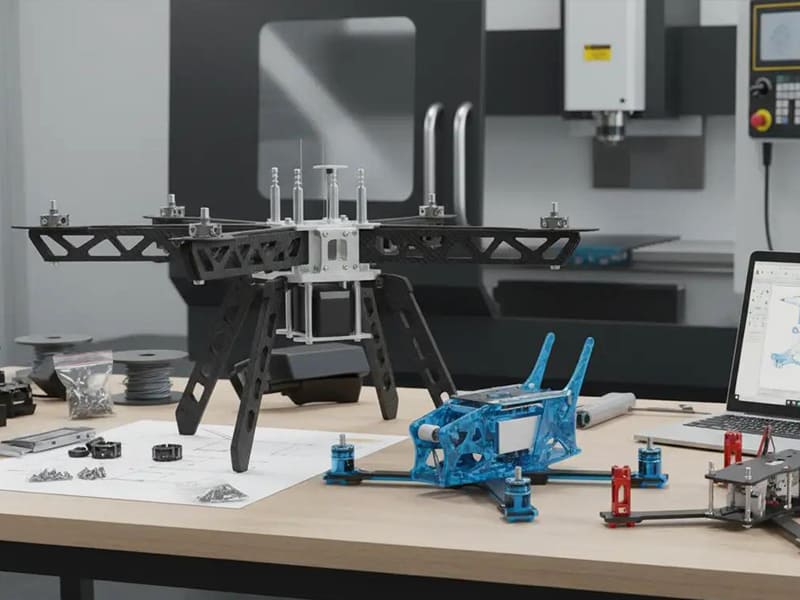
A survey drone manufacturer discovers persistent image blurring during mapping flights. Vibration analysis traces the problem to motor mount flatness — CNC-machined aluminum mounts with 0.06 mm flatness error transmit motor vibration directly into the gimbal frame. Re-machining the mounts to ≤0.01 mm flatness with controlled perpendicularity eliminates vibration transfer. Image quality improves dramatically — GPS-tagged photos achieve the positional accuracy the mapping application requires. The root cause wasn’t the camera, the gimbal, or the flight controller. It was a machining tolerance on a $12 aluminum part. We manufacture CNC-machined drone components for UAV programs across survey, industrial inspection, and defense applications. Drone manufacturing is system-level integration — structural components, propulsion, electronics, sensors, and software must work together under dynamic flight conditions. Manufacturing precision on individual parts directly determines flight stability, payload performance, and system reliability. A single poorly machined motor mount can cascade into vibration, sensor noise, and mission failure.
This guide covers the manufacturing process, key components, materials, manufacturing methods (CNC, 3D printing, injection molding, composites), CNC machining’s role, cost breakdown, prototype vs production strategy, applications by industry, common challenges, quality testing, and supplier selection guidance.
Manufacturing Process
| Step | Work | Goal |
|---|---|---|
| Concept design | Define payload, flight time, size | Match application requirements |
| CAD modeling | Design frame, mounts, housing | Optimize structure and weight |
| Prototyping | 3D printing / CNC samples | Validate fit and function |
| Material selection | Carbon fiber, aluminum, plastics | Balance weight, strength, cost |
| Part manufacturing | CNC, molding, composites | Precise, repeatable components |
| Electronics integration | Sensors, GPS, flight controller, battery | System functionality |
| Assembly | Motors, propellers, wiring | Mechanical reliability |
| Testing | Flight test, vibration, payload | Verify performance and safety |
| Production | Batch manufacturing + QC | Consistency and cost efficiency |
Design determines 70% of performance. Weight distribution, structural stiffness, and aerodynamics are locked during the design phase — manufacturing cannot compensate for poor design decisions. Prototyping with CNC machining and 3D printing enables rapid iteration before committing to production tooling. Based on our production data, UAV programs that complete 3–4 prototype iterations before production tooling achieve approximately 40% fewer assembly issues and 25% lower total development cost versus programs that rush to production after a single prototype.
Key Components
| Component | Function | Manufacturing Requirement |
|---|---|---|
| Frame / body | Main structure | Lightweight + high stiffness |
| Arms | Support motors | Strength + vibration resistance |
| Motor mounts | Align motors precisely | Tight tolerances (flatness, perpendicularity) |
| Propellers | Generate lift | Balance + aerodynamic accuracy |
| Landing gear | Absorb impact | Toughness + energy absorption |
| Gimbal bracket | Stabilize camera/payload | High precision + low vibration transmission |
| Sensor mounts | Position GPS, IMU, LiDAR | Dimensional accuracy + alignment stability |
Precision parts determine flight stability. Motor mounts and gimbal brackets are the most tolerance-critical components — even small misalignment creates vibration that affects sensor accuracy and image quality. One common pitfall we see: treating motor mounts as simple brackets and specifying general tolerance (±0.1 mm) — tightening flatness to ≤0.02 mm and positional tolerance to ±0.05 mm eliminates the vibration issues that most drone programs troubleshoot for weeks during flight testing.
Materials
| Material | Strength-to-Weight | Cost | Best For |
|---|---|---|---|
| Carbon fiber | Excellent | High | Frames, arms (high-performance) |
| Aluminum (6061/7075) | Good | Medium | Motor mounts, brackets, structural |
| Titanium | Excellent | Very high | Defense, critical fasteners |
| Engineering plastics (ABS/Nylon/PC) | Moderate | Low | Housings, covers, guards |
| Fiberglass | Good | Medium | Mid-range frames, panels |
| Kevlar | Good (impact) | High | Military/rugged drones |
Weight vs strength is the core trade-off. Lighter materials extend flight time. Stronger materials increase payload capacity. Carbon fiber provides the best balance for high-performance frames. Aluminum delivers the best precision-to-cost ratio for CNC-machined structural interfaces. Plastics enable cost-effective mass production of housings and covers. Most production drones use hybrid material strategies — carbon fiber frame, aluminum CNC mounts, plastic injection-molded covers — optimizing each material for its role. In our shop floor experience, hybrid material drones achieve approximately 15–20% better flight-time-to-payload ratio versus single-material designs at equivalent total cost.
Manufacturing Methods
| Process | Best For | Advantage | Limitation |
|---|---|---|---|
| CNC machining | Metal mounts, brackets | High precision, strength | Higher cost per part |
| 3D printing | Prototypes, custom parts | Fast iteration | Lower strength |
| Injection molding | Plastic housings (volume) | Low unit cost at scale | High mold cost |
| Composite fabrication | Carbon fiber frames | Best strength-to-weight | Labor-intensive |
| Sheet metal | Covers, shields | Cost-effective flat parts | Limited 3D shapes |
Selection logic: Precision load-bearing → CNC machining. Fast prototype → 3D printing. High-volume plastic → injection molding. Lightweight structure → composite fabrication.
CNC Machining in Drone Manufacturing
CNC machining produces the precision metal components where tight tolerances directly affect flight performance — motor mounts, gimbal brackets, sensor mounts, payload adapters, and heat sinks. These parts require dimensional accuracy (±0.01–0.05 mm), surface flatness, and positional control that other manufacturing methods cannot reliably achieve.
Why CNC matters for drones: Motor mount alignment accuracy determines thrust balance and vibration. Gimbal bracket precision determines image stability. Sensor mount accuracy determines data reliability. Landing gear joint strength determines impact survival. Based on our production data, CNC-machined motor mounts with verified flatness ≤0.02 mm reduce flight vibration amplitude by approximately 60% versus mounts at standard ±0.1 mm tolerance — the single most impactful manufacturing improvement for camera and survey drones.
Typical materials: Aluminum 6061/7075 for most structural CNC parts. Titanium for defense and extreme-performance applications.
Cost Breakdown
| Cost Element | Driver |
|---|---|
| Design / engineering | CAD, simulation, system architecture |
| Prototyping | Iterations, CNC samples, 3D prints, testing |
| Materials | Carbon fiber, aluminum, batteries, electronics |
| Manufacturing | CNC time, molds, composite layup, labor |
| Electronics | Sensors, GPS, flight controller, cameras |
| Software | Flight algorithms, firmware, integration |
| Testing | Flight validation, vibration, safety |
| Assembly | Labor, calibration, wiring, QC |
Electronics and software often dominate cost. Unlike simple mechanical products, advanced drones can have electronics + software exceeding 40–60% of total cost. Mechanical manufacturing (CNC, composites, molding) typically represents 20–35%. Prototyping is iterative and expensive — each design iteration adds CNC, printing, and testing cost.
Prototype vs Production
| Stage | Process | Cost Logic |
|---|---|---|
| Prototype | 3D printing + CNC | High unit cost, fast iteration |
| Pilot run | CNC + soft tooling | Validate assembly and quality |
| Mass production | Injection molding + composite tooling | Low unit cost, high consistency |
| Custom production | CNC + modular assembly | Flexible, higher unit cost |
Unit cost can drop 5–10× from prototype to production through tooling investment and process optimization.
Applications
| Industry | Drone Type | Manufacturing Focus |
|---|---|---|
| Agriculture | Spraying / mapping | Payload capacity, chemical resistance |
| Defense | Surveillance / tactical | Durability, secure systems, rugged design |
| Logistics | Delivery | Payload reliability, safety redundancy |
| Energy | Inspection (wind, oil & gas) | Sensor integration, wind resistance |
| Construction | Survey / mapping | Camera stability, positioning accuracy |
| Film / media | Camera drones | Vibration control, gimbal precision |
Common Challenges
| Challenge | Impact | Solution |
|---|---|---|
| Weight control | Reduced flight time | Lightweight design, topology optimization |
| Vibration | Sensor errors, image blur | Rigid structures, balanced propellers, damping |
| Heat management | Electronics degradation | Heat sinks, airflow design |
| Supply chain | Delays, cost fluctuations | Multi-sourcing, standardized components |
| Quality control | Flight instability, safety | Rigorous testing, inspection, calibration |
Choosing a Manufacturing Partner
Essential capabilities: CNC machining + 3D printing + composite or molding capability. DFM feedback before production. Precision tolerance achievement (±0.01–0.05 mm). Material expertise (aluminum, carbon fiber, titanium, plastics). Quality documentation (CMM reports, material certs). Prototype-to-production scalability. In projects we’ve delivered, drone manufacturers who engage manufacturing partners during the design phase rather than after finalization reduce total development cost by approximately 20–30% — early DFM feedback prevents costly redesign iterations.
Conclusion
Drone manufacturing is system-level integration — structural precision, electronics, software, and testing must work together for reliable flight performance. CNC-machined components (motor mounts, gimbal brackets, sensor mounts) provide the dimensional accuracy that determines vibration behavior, payload stability, and sensor reliability. Material selection (carbon fiber for frames, aluminum for precision interfaces, plastics for housings) optimizes weight-to-performance across the system. Manufacturing method selection (CNC for precision, 3D printing for prototypes, injection molding for volume) balances cost against capability at each production stage.
The highest-impact manufacturing decisions: specify tight tolerances on vibration-critical interfaces (motor mounts, gimbal brackets), use hybrid material strategies, prototype iteratively before production tooling, and engage manufacturing partners early for DFM optimization. Need help manufacturing precision drone components? [Contact our engineering team] for CNC machining, DFM review, and prototype-to-production support.
FAQ
What is drone manufacturing?
System-level process combining structural design, CNC machining, composite fabrication, electronics integration, software, assembly, and flight testing to produce complete UAV platforms. Performance depends on how well all subsystems work together.
What materials are used?
Carbon fiber (lightweight frames), aluminum (precision CNC mounts), engineering plastics (housings), titanium (defense/extreme), fiberglass/Kevlar (composites). Most drones use hybrid material strategies matching each material to its functional role.
Why is CNC machining important for drones?
Produces precision metal components (motor mounts, gimbal brackets, sensor mounts) where tight tolerances directly affect vibration, flight stability, and payload performance. Motor mount flatness ≤0.02 mm reduces vibration ~60% versus standard tolerance.
How much does drone manufacturing cost?
Driven by electronics + software (40–60% for advanced drones), materials, CNC machining, composite fabrication, testing, and certification. Prototypes cost highest per unit. Mass production reduces cost 5–10× through tooling and optimization.
How to choose a drone manufacturing partner?
Look for multi-process capability (CNC + 3D printing + molding), DFM support, precision tolerance achievement, material expertise, quality documentation, and prototype-to-production scalability. Engage during design phase for maximum cost reduction.


