
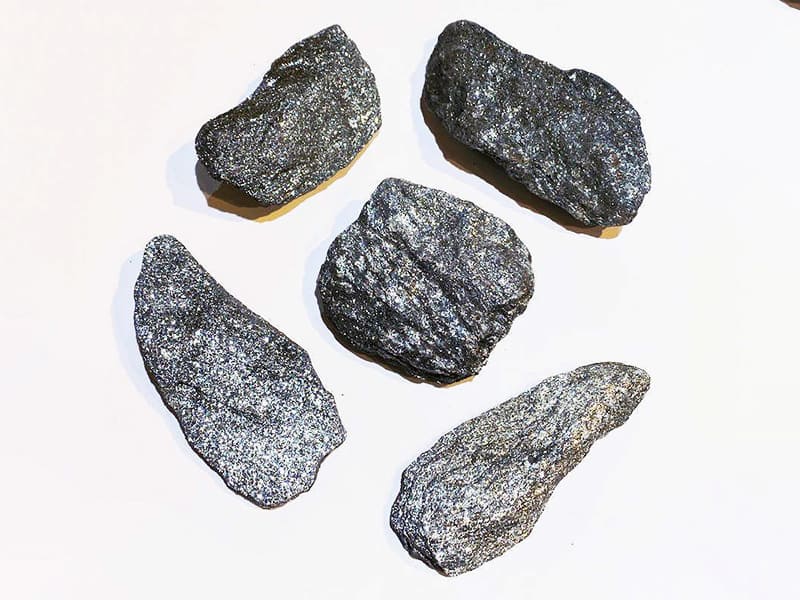
A mining operation processes a mixed iron ore containing both hematite and magnetite. The standard low-intensity magnetic drum separator captures magnetite efficiently — particles jump to the drum surface from several centimeters away. Hematite particles pass through the same separator and report to the tailings, lost as waste. Iron recovery drops to 45%. Installing a high-gradient magnetic separator (HGMS) operating at 1.5 Tesla with a steel wool matrix captures the hematite fraction — increasing total iron recovery to 82%. The equipment cost is 3× higher than the standard drum, but the recovered iron value exceeds the investment within 8 months. We evaluate magnetic properties of iron-bearing materials in our material sourcing and processing programs. The difference: magnetite is strongly magnetic (ferromagnetic), while hematite is weakly magnetic (antiferromagnetic) — requiring fundamentally different separation technology. Hematite (Fe₂O₃) contains iron but is not strongly magnetic. Its antiferromagnetic crystal structure causes internal magnetic moments to cancel, producing near-zero net magnetism. A standard magnet will barely attract hematite — often not at all. Despite this weak magnetism, hematite is one of the most industrially important iron ores, a key pigment source, and a significant material in geological research.
This guide covers what hematite is, why it’s not strongly magnetic (the antiferromagnetic mechanism), magnetic susceptibility data, comparison with magnetite, factors that affect its magnetism, industrial applications, magnetic separation technology, identification methods, and practical selection guidance.
What Is Hematite?
Hematite is an iron oxide mineral with the chemical formula Fe₂O₃ (iron(III) oxide). It’s one of the most abundant iron ores on Earth, with iron content up to approximately 70%.
| Property | Value |
|---|---|
| Formula | Fe₂O₃ |
| Crystal structure | Rhombohedral (hexagonal) |
| Appearance | Metallic gray (specular) or reddish-brown (earthy) |
| Primary use | Iron ore for steelmaking |
| Secondary uses | Red pigment, polishing compound, geological research |
The crystal structure is critical — iron atoms in hematite’s rhombohedral lattice arrange in a way that produces antiferromagnetic ordering, directly explaining its weak magnetic behavior.
Why Hematite Is Not Strongly Magnetic
Despite containing iron, hematite is not strongly magnetic. The explanation lies in atomic-scale magnetic structure, not elemental composition.
Antiferromagnetism
In ferromagnetic materials like iron or magnetite, magnetic moments (spins) of adjacent atoms align in the same direction — their effects add up, producing strong external magnetism. In hematite, adjacent iron ion (Fe³⁺) magnetic moments align in opposite directions (anti-parallel: ↑↓↑↓). These opposing moments cancel each other, resulting in near-zero net magnetization.
The key principle: Iron content alone doesn’t determine magnetism — the arrangement of magnetic moments within the crystal structure does. Hematite has iron, but its iron atoms are organized to cancel their individual magnetic contributions.
Weak Residual Magnetism
Hematite is not perfectly non-magnetic. Slight spin canting (tiny angular misalignment of the anti-parallel spins) produces very weak ferromagnetism — detectable with sensitive instruments but negligible in practical applications. Above the Morin transition temperature (~260 K / −13°C), this spin canting increases slightly, producing marginally enhanced weak magnetism. The effect remains too small for any practical magnetic function.
Magnetic Susceptibility
Hematite’s magnetic susceptibility falls in the range of approximately 10⁻⁵ to 10⁻³ (dimensionless SI) — orders of magnitude lower than magnetite or iron. It does not retain magnetization after removing an external field. Standard magnets produce negligible attraction. Only high-intensity magnetic fields (>0.8 Tesla) generate measurable response — which is why industrial hematite processing requires specialized equipment.
Hematite vs Magnetite
| Property | Hematite | Magnetite |
|---|---|---|
| Formula | Fe₂O₃ | Fe₃O₄ |
| Magnetism | Weak (antiferromagnetic) | Strong (ferromagnetic) |
| Magnet test | Little to no response | Strong attraction |
| Color | Red-gray to dark gray | Deep black |
| Streak | Reddish-brown | Black |
| Iron content | Up to ~70% | Up to ~72% |
| Separation method | High-intensity (HGMS) | Low-intensity drum |
Why the Difference?
Magnetite contains both Fe²⁺ and Fe³⁺ iron states — enabling electron exchange between them that produces strong ferromagnetic behavior. Hematite contains only Fe³⁺ — arranged anti-parallel with no electron exchange mechanism to generate net magnetism.
Practical identification: Hold a standard magnet near the sample. Strong attraction = magnetite. Little or no response = likely hematite. Confirm with streak test: reddish-brown streak = hematite, black streak = magnetite. Based on our production experience, this two-test combination (magnet + streak) provides reliable field identification without laboratory equipment.
Processing Implications
Magnetite separates easily using low-intensity drum separators (~0.1–0.3 Tesla). Hematite requires high-intensity or high-gradient magnetic separators (HGMS/WHIMS) operating at 0.8–2.0+ Tesla with matrix amplification. This equipment difference significantly impacts processing plant design, capital cost, and operating expense.
Factors Affecting Hematite Magnetism
| Factor | Effect | Practical Impact |
|---|---|---|
| Temperature | Phase transitions at Morin point (~260 K) | Lab vs field behavior differences |
| Impurities | Magnetite inclusions dramatically increase magnetism | Quality control critical |
| Particle size | Nanoparticles (<100 nm) → superparamagnetism | Enables biomedical applications |
| Crystal defects | Uncompensated spins → localized magnetism | Affects processing measurements |
Temperature: Below the Morin transition, hematite behaves as a more ideal antiferromagnet. Above it, slight spin canting produces weak ferromagnetism. Both states remain effectively non-magnetic for practical purposes.
Impurities: The most common source of “magnetic hematite” confusion. Magnetite inclusions within hematite ore can dominate overall magnetic response — in our experience, a sample testing as moderately magnetic often contains magnetite phases rather than being genuinely magnetic hematite. Material purity verification is essential for accurate ore characterization.
Particle size: At nanoscale (<100 nm), hematite nanoparticles can exhibit superparamagnetism — magnetic moments fluctuate freely under thermal energy. This enables applications in biomedical imaging, drug delivery, and magnetic fluids that bulk hematite cannot serve.
Crystal defects: Dislocations, vacancies, and grain boundaries disrupt perfect anti-parallel alignment, creating localized uncompensated spins. Processing (grinding, sintering) increases defect density and may slightly enhance measured magnetism.
Industrial Applications
Iron Ore Extraction (Primary Use)
Hematite is one of the most important sources of iron for steelmaking — high Fe content (up to ~70%) makes it a premium ore. Processed through blast furnaces, direct reduction, and sintering/pelletizing operations. Global steel production depends heavily on hematite ore supply.
Magnetic Separation
Although weakly magnetic, hematite can be separated using high-gradient magnetic separators (HGMS) with field strengths of 0.8–2.0+ Tesla. A steel wool or expanded metal matrix creates intense local field gradients that capture fine hematite particles while rejecting non-magnetic gangue (quartz, silica, clays). This technology upgraded hematite from a difficult-to-process ore into a commercially viable iron source.
Process considerations: Fine particles (<150 µm) benefit most from wet high-gradient separation. Grinding and desliming before separation improve liberation and capture efficiency. Energy and capital costs are higher than magnetite processing — requiring economic justification through ore value and recovery rates.
Pigments (Red Iron Oxide)
Hematite is the source of red iron oxide pigment — used in paints, coatings, construction materials (cement, bricks), and anti-corrosion applications. Color is stable against UV, chemicals, and weathering. Non-toxic and cost-effective compared to synthetic alternatives.
Geological and Scientific Research
Hematite records magnetic signatures over geological time — used in paleomagnetism studies to understand Earth’s historical magnetic field, plate tectonics, and planetary history. Its weak but measurable magnetic properties make it a valuable research medium.
How to Identify Hematite
Quick Field Identification
Magnet test (fastest): Standard magnet near sample. Strong attraction → magnetite. Little/no response → likely hematite.
Streak test (most reliable): Scratch mineral on unglazed ceramic plate. Reddish-brown streak → hematite. Black streak → magnetite. This combination provides reliable identification without laboratory equipment.
Laboratory Methods
For critical applications: XRD (X-ray diffraction) for crystal structure confirmation. Magnetic susceptibility measurement for quantitative characterization. Chemical analysis to distinguish Fe₂O₃ from Fe₃O₄ and identify impurities.
Selection Guide
| Need | Choose | Reason |
|---|---|---|
| Strong magnetic response | Magnetite | Ferromagnetic |
| Weak/no magnetic interaction | Hematite | Antiferromagnetic |
| High iron content for steel | Hematite | Up to ~70% Fe |
| Low-intensity magnetic separation | Magnetite | Easy separation |
| High-intensity magnetic separation | Hematite | Requires HGMS |
| Red pigment / coatings | Hematite | Stable red oxide |
| Biomedical (nanoparticles) | Hematite nanoparticles | Superparamagnetic |
Conclusion
Hematite (Fe₂O₃) is not strongly magnetic — its antiferromagnetic crystal structure causes internal magnetic moments to cancel, producing near-zero net magnetism despite containing iron. A standard magnet will not attract it. Only high-intensity magnetic fields generate measurable response.
This weak magnetism defines how hematite is processed industrially — requiring high-gradient magnetic separators (0.8–2.0+ Tesla) rather than simple drum magnets used for magnetite. Despite its magnetic weakness, hematite is one of the most important industrial minerals: a primary iron ore for steelmaking, a stable red pigment source, and a valuable medium for geological research. Its industrial value lies in chemistry and stability, not magnetism. Need help with iron ore material selection or processing equipment specification? [Contact our engineering team] for material evaluation and process guidance.
FAQ
Is hematite magnetic?
Weakly — technically yes, practically no. Its antiferromagnetic structure produces near-zero net magnetism. Standard magnets show negligible attraction. Only high-intensity fields (>0.8 Tesla) generate measurable response.
Why isn’t hematite magnetic despite containing iron?
Because its Fe³⁺ magnetic moments align anti-parallel (↑↓) in the crystal lattice — canceling each other. Magnetism depends on spin arrangement, not just iron content. Magnetite’s mixed Fe²⁺/Fe³⁺ structure enables electron exchange that produces strong magnetism.
Hematite vs magnetite — what’s the difference?
Hematite (Fe₂O₃): weakly magnetic, red-brown streak, requires HGMS for separation. Magnetite (Fe₃O₄): strongly magnetic, black streak, separates with standard drum magnets. Quick identification: magnet test + streak test.
Can hematite be used in magnetic separation?
Yes — but only with high-intensity/high-gradient equipment (0.8–2.0+ Tesla). Standard low-intensity drum separators are ineffective. Higher equipment cost but enables recovery of hematite ore that would otherwise be lost.
Does temperature affect hematite’s magnetism?
Yes — the Morin transition (~260 K) changes spin alignment slightly, producing marginally different weak magnetic behavior above and below this temperature. The effect is relevant for research but negligible for industrial applications.


