
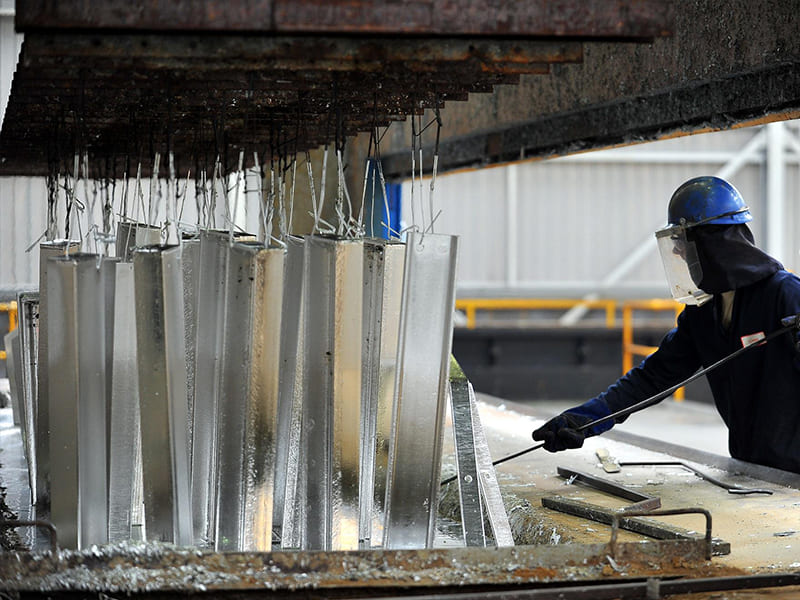
Galvanized metal is steel or iron protected by a zinc coating applied through a controlled galvanization process — and the key word is controlled. This isn’t a generic anti-rust spray or a surface paint. Galvanization creates a metallurgical bond between zinc and the steel substrate, producing intermetallic alloy layers that behave fundamentally differently from any purely surface-applied coating. The result is a material that protects against corrosion through two independent mechanisms simultaneously: physical barrier isolation and electrochemical sacrificial protection.
That dual mechanism is what makes galvanized metal worth understanding in engineering terms rather than just procurement terms. It determines how long a galvanized component survives in a specific environment, how it behaves when scratched or cut, what happens when it’s welded, and which applications it’s genuinely suited for versus where it falls short. This article covers all of that — from the electrochemistry of zinc protection through galvanizing method selection, coating standards, fabrication constraints, and material comparisons.
What Is Galvanized Metal, Exactly?
Mühendislik Tanımı
From a materials engineering perspective, galvanized metal is steel or iron with zinc bonded to its surface through a controlled process that creates true metallurgical bonding — not mechanical adhesion. Hot-dip galvanizing, the most common industrial process, forms distinct zinc-iron intermetallic layers (Gamma, Delta, Zeta) at the steel interface, topped by a pure zinc Eta layer on the outer surface.
This structure is why galvanized steel behaves differently from painted steel when damaged. The intermetallic layers are chemically stable and mechanically tough. The outer zinc corrodes predictably. And critically, the electrochemical relationship between zinc and steel continues to protect exposed steel areas even where the surface is breached.
In short: galvanized metal = steel/iron + zinc coating with metallurgical bonding, providing active corrosion protection rather than passive coverage.
What Metals Are Galvanized in Practice?
Steel and iron are the only metals routinely galvanized, and that’s not arbitrary. Zinc forms stable, well-bonded intermetallic layers specifically with iron. The galvanic series relationship between zinc and iron — zinc being more electrochemically active — drives the sacrificial protection mechanism that makes galvanizing effective.
Other metals follow different logic:
Alüminyum already forms a stable Al₂O₃ passive oxide layer at the surface. Anodizing enhances this layer; zinc coating over it provides no meaningful benefit and would interfere with the aluminum’s own protection mechanism.
Paslanmaz çelik relies on chromium content (~10.5%+ Cr) to form a thin, self-healing chromium oxide passive film. Galvanizing stainless would add a zinc layer with no metallurgical bonding to the substrate and would undermine the alloy’s design intent.
Bakır alaşımları are non-ferrous and corrode through completely different mechanisms — sulfidation, dezincification in the case of brass, and chloride-induced pitting for marine exposure. Zinc coating provides no useful protection for these materials.
When engineers specify galvanized metal, they mean zinc-coated steel — and that specificity matters for material selection, standards compliance, and performance prediction.
How Galvanization Works: The Material Science
Understanding the corrosion protection mechanism explains why galvanized steel outperforms painted steel in real service conditions — particularly after damage.
Sacrificial Anode (Cathodic) Protection
Zinc sits at approximately −0.76 V in the standard electrode potential series. Iron sits at −0.44 V. When both metals are in electrical contact in the presence of an electrolyte (rain, condensation, humidity), zinc is the anode and steel is the cathode. Zinc corrodes preferentially, supplying electrons that keep the iron in a reduced, protected state.
The critical engineering implication: zinc doesn’t just cover steel — it actively protects it. Small areas of exposed steel at scratches, cut edges, or drilled holes remain protected by the surrounding zinc through this electrochemical mechanism. The protection radius extends approximately 1–2 mm from intact zinc under typical atmospheric exposure conditions.
Painted steel has no equivalent. Once paint is breached, corrosion begins immediately at the exposed steel and typically spreads laterally under the paint film through under-film oxidation — a failure mode that galvanized steel doesn’t exhibit.
Zinc Patina Formation: Why Protection Improves Over Time
Fresh galvanized steel oxidizes rapidly in air, forming zinc oxide (ZnO) — a thin white-gray surface film. Over weeks to months of outdoor exposure, ZnO reacts with atmospheric CO₂ and moisture to form zinc carbonate (ZnCO₃), commonly called zinc patina.
Zinc carbonate is chemically stable, relatively insoluble in water, and adherent to the surface. It forms a secondary barrier layer that reduces the rate at which the underlying zinc is consumed. This is why galvanized steel’s corrosion resistance often stabilizes or improves after initial weathering — the patina acts as a self-forming protective system.
This behavior contrasts with steel rust (Fe₂O₃/Fe₃O₄), which is porous, non-adherent, and actively draws moisture into the interface to sustain further corrosion. Zinc patina does the opposite: it slows the process down.
Why Galvanized Steel Outperforms Painted Steel in Practice
Paint provides barrier protection only. When that barrier is intact, it works well. When it’s breached by impact, abrasion, cutting, fastener penetration, or UV degradation, the protection disappears entirely at that location. Corrosion then progresses under the film at rates that can be faster than on uncoated steel.
Galvanized steel provides redundant protection. The zinc layer is the barrier, but if the barrier is compromised, electrochemical protection continues. Patina formation provides a third layer of stabilization. This damage tolerance is the engineering reason galvanized steel is preferred for outdoor structural applications, fabricated assemblies, and components that will be handled, fastened, and exposed to variable field conditions.
Galvanizing Methods and Coating Types: Selecting the Right Process
Four primary galvanizing processes are in common industrial use. Each produces a zinc coating with different thickness, adhesion, surface quality, and cost profile. Selecting the correct process for the application is as important as specifying zinc coating at all.
Hot-Dip Galvanizing (HDG)
The standard process for structural steel. Steel is chemically cleaned (degreasing, pickling in HCl or H₂SO₄, fluxing with ZnCl₂·NH₄Cl), then immersed in molten zinc at approximately 450°C. During immersion — typically 3–10 minutes for fabricated sections — zinc reacts with iron at the surface to form the characteristic layered structure.
Coating thickness: typically 50–100 µm depending on steel chemistry and immersion time. High-silicon steels (the Sandelin range, 0.03–0.12% Si) can produce excessively thick, brittle coatings due to accelerated Gamma layer growth — a known issue in HDG that requires silicon content awareness in steel specification.
Surface appearance: rougher and more variable than electroplated coatings, with visible spangle patterns from zinc crystal growth during solidification. Spangle size reflects cooling rate and zinc bath chemistry; it does not correlate with corrosion resistance.
Best suited for: outdoor structural steel, fabricated frames, guardrails, transmission towers, agricultural equipment, heavy fasteners, and any application where coating life is the priority and cosmetic uniformity is secondary.
Electrogalvanizing
Zinc is electrochemically deposited onto steel at room temperature from a zinc salt bath. The process offers precise thickness control and produces a very smooth, uniform surface — but the coating has no metallurgical bonding layers. Adhesion relies on electrochemical deposition rather than intermetallic diffusion.
Coating thickness: 5–25 µm, with tolerances achievable to ±1–2 µm for precision applications. This makes electrogalvanizing appropriate for components with tight dimensional requirements where hot-dip coating thickness variation (potentially ±15–20 µm) would affect fit and assembly.
The thinner coating means shorter sacrificial life than HDG for equivalent environments — approximately 1/3 to 1/5 the corrosion resistance duration per ASTM B117 salt spray comparison. For indoor or lightly exposed applications, this is often acceptable.
Best suited for: automotive body panels, appliance housings, precision sheet metal, electronic enclosures, and components where surface quality and dimensional consistency are critical requirements.
Galvannealed Steel
Produced by heat-treating hot-dip galvanized steel immediately after the zinc bath, converting the outer pure zinc (Eta) layer into a zinc-iron alloy surface (approximately 8–12% Fe throughout). The result is a matte gray surface with no metallic spangle.
The zinc-iron surface improves paint adhesion significantly — galvannealed steel is the standard substrate for automotive painted body panels because the alloy surface provides better mechanical bonding for primer and topcoat than pure zinc. Weldability also improves since the alloy layer produces fewer zinc fume issues than pure zinc surfaces.
The trade-off: the iron-rich surface is somewhat more susceptible to red rust staining in early exposure compared to pure zinc HDG, because iron in the alloy layer can participate in rust formation before the sacrificial mechanism fully engages. This is cosmetically undesirable but structurally minor.
Best suited for: welded and painted assemblies, automotive closures and structural components, steel construction elements requiring painted finish.
Pre-Galvanized (Mill-Galvanized) Steel
Galvanized continuously at the steel mill before cutting to final dimensions. Produced through a continuous hot-dip line at very high speed, producing consistent thin-to-medium coatings across large volumes of sheet steel.
Cost is lower than post-fabrication HDG because the process is highly automated and the steel is handled in coil form before any fabrication costs are added. The limitation is cut edges: every cutting, punching, or shearing operation after delivery exposes bare steel at the edge. For many sheet metal applications, the surrounding zinc’s sacrificial protection covers these edges adequately. For aggressive environments or continuous immersion, edge protection becomes a design concern.
Best suited for: high-volume formed parts, roofing sheets, HVAC components, electrical enclosures, and any application where consistent coating at moderate thickness is needed on large surface areas.
| Yöntem | Tipik Kalınlık | Metallurgical Bond | Yüzey Kalitesi | Birincil Uygulama |
|---|---|---|---|---|
| Sıcak daldırma galvanizleme | 50–100 µm | Yes — multi-layer | Rougher, industrial | Outdoor structural, long-life |
| Electrogalvanizing | 5–25 µm | No — deposited | Smooth, precise | Automotive, precision sheet |
| Galvannealed | 40–70 µm | Yes — alloy surface | Matte, paint-ready | Welded/painted assemblies |
| Pre-galvanized | 10–40 µm | Evet | Consistent mill finish | High-volume formed parts |
Key Engineering Properties of Galvanized Metal
Corrosion Resistance: Predictable, Not Infinite
Galvanized steel’s corrosion resistance is quantifiable — which is one of its genuine engineering advantages over painted steel, where coating life varies widely with application quality and damage history. Zinc corrosion rates in different atmospheres are well-characterized:
- Rural atmosphere: ~0.5–1.5 µm/year
- Urban/industrial atmosphere: ~1.5–4.0 µm/year
- Marine atmosphere (coastal, >500 m from surf): ~2.0–5.0 µm/year
- Marine splash zone: potentially 5–15 µm/year
For a 75 µm hot-dip coating in an urban industrial atmosphere corroding at 3 µm/year, time-to-first-rust initiation is approximately 25 years — a rough but defensible engineering estimate. This predictability enables lifecycle cost calculations that painted steel can’t match.
Mechanical Properties After Galvanizing
Galvanization has negligible effect on bulk mechanical properties for most structural steel grades. Yield strength, tensile strength, and elongation remain within material specification after hot-dip treatment. This is consistent with the relatively low bath temperature (450°C) compared to typical steel heat treatment temperatures.
One exception: high-strength steels with yield strength above approximately 690 MPa are susceptible to hydrogen embrittlement from pickling acid exposure during the HDG pre-treatment process. The pickling step (HCl or H₂SO₄) can introduce hydrogen into the steel lattice. For high-strength bolts, springs, and structural members at this strength level, special pre-treatment procedures or alternative coating methods are warranted.
Surface Characteristics and Coating Adhesion
Spangle — the crystalline pattern visible on many galvanized steel surfaces — is often misinterpreted as a quality indicator. It reflects zinc crystallization behavior during cooling and has no direct relationship with coating thickness, adhesion quality, or corrosion resistance. Engineers should evaluate galvanized steel by coating weight measurement and adhesion testing per applicable standards, not by spangle size or appearance.
Coating adhesion in hot-dip galvanizing is mechanically robust because the metallurgical bond at the steel interface prevents delamination. Electrogalvanized coatings have lower adhesion and can peel under severe forming operations.
Service Life in Different Environments
Galvanized metal service life is environment-specific. Engineers who specify “galvanized” without considering exposure category are making a decision based on incomplete information.
| Çevre | Zinc Corrosion Rate | Estimated Service Life (75 µm HDG) | Notlar |
|---|---|---|---|
| İç mekan / kuru | <0.3 µm/year | 50+ years | Humidity control eliminates most risk |
| Outdoor, rural | 0.5–1.5 µm/year | 30–50 years | Patina formation slows rate over time |
| Outdoor, urban/industrial | 1.5–4.0 µm/year | 15–30 years | Sulfur compounds accelerate zinc loss |
| Marine atmosphere | 2.0–5.0 µm/year | 10–25 years | Distance from surf matters significantly |
| Marine splash zone | 5–15 µm/year | 5–12 years | Consider duplex systems |
These are engineering estimates based on zinc consumption rates — not guarantees. Actual service life is affected by drainage design (horizontal surfaces accumulate electrolyte longer than vertical), crevice geometry, coating continuity at edges and welds, and whether maintenance is performed.
The critical point for procurement and design teams: specify coating thickness based on the actual exposure category, not a generic “galvanized” requirement. An outdoor coastal structure specified with G60 sheet (approximately 9 µm per side) will fail in under 5 years. The same structure with 85 µm HDG per ASTM A123 will last decades.
Standards and Coating Specifications
Specifying galvanized steel correctly means referencing a standard and a coating designation — together. One without the other leaves performance undefined.
Key Standards
ASTM A123 governs hot-dip galvanized coatings on fabricated structural steel products. Minimum coating thickness requirements are specified by steel article thickness category, ranging from 45 µm for steel under 1.6 mm to 86 µm for steel over 6 mm. This is the standard for structural steel, fabricated frames, and heavy fabrications in North America.
ASTM A153 applies to hot-dip galvanized hardware: bolts, nuts, washers, fasteners, and small parts with complex geometry. Minimum coating weights differ from A123 to account for the geometric complexity of threaded parts.
ASTM A653 covers continuously galvanized sheet steel, defining the G-series coating designations (G30 through G210) based on total zinc coating weight on both surfaces combined in oz/ft².
ISO 1461 is the international counterpart to ASTM A123, broadly comparable in requirements with some differences in thickness minimums and acceptance criteria. Specified on European and global projects.
Reading Coating Designations
G60, G90, Z275 — these designations refer to total zinc coating weight on both sides combined, not single-side thickness. This is frequently misunderstood in procurement:
| Tanımlama | Standart | Total Coating Weight | Approximate Single-Side Thickness | Tipik Kullanım |
|---|---|---|---|---|
| G60 | ASTM A653 | 0.60 oz/ft² (180 g/m²) | ~9 µm | Indoor, light exposure |
| G90 | ASTM A653 | 0.90 oz/ft² (275 g/m²) | ~13 µm | Standard outdoor sheet |
| G210 | ASTM A653 | 2.10 oz/ft² (640 g/m²) | ~30 µm | Heavy outdoor exposure |
| Z275 | EN 10346 | 275 g/m² | ~19 µm | European structural standard |
A G90 specification on a coastal structure is technically compliant but likely inadequate for the exposure severity. Specifying ASTM A123 with minimum 75 µm coating for the relevant steel thickness category is the appropriate specification for long-life outdoor structural applications.
Applications in Manufacturing and Fabrication
İnşaat ve Altyapı
Structural steel for building frames, roofing purlins, cable trays, handrails, guardrails, utility poles, and transmission towers relies on hot-dip galvanizing as the baseline corrosion protection strategy. The material handles on-site cutting, drilling, bolting, and concrete embedment while maintaining adequate sacrificial protection at cut edges. For applications requiring 25–50 year service life with minimal maintenance, HDG galvanized structural steel is usually the most cost-effective specification.
Otomotiv ve Taşımacılık
Pre-galvanized and galvannealed steel account for a significant fraction of automotive body-in-white construction. Electrogalvanized steel is used for exposed outer panels where surface quality and paint adhesion are critical. Underbody components — floor pans, cross-members, bracket assemblies — use galvannealed steel optimized for resistance spot welding and e-coat primer adhesion. Modern automotive zinc coating specifications routinely call for 5–7 µm electrogalvanized on outer panels and 45–70 µm HDG on structural underbody components.
Agricultural and Industrial Equipment
Farm equipment, material handling systems, industrial platforms, and process equipment housings operate in environments that combine abrasion, moisture, chemical exposure, and long service intervals without regular maintenance. Hot-dip galvanized steel provides the damage tolerance and sacrificial protection these conditions require. Zinc’s ability to protect mechanically damaged surfaces is particularly valuable — a scratch on a hot-dip galvanized surface doesn’t initiate corrosion; a scratch on a painted surface does.
Custom Sheet Metal and CNC-Fabricated Parts
Galvanized sheet is widely used for enclosures, electrical cabinets, HVAC components, brackets, and covers in custom manufacturing. It machines well with standard carbide tooling, although zinc coating affects tool wear slightly. CNC laser cutting produces clean cut edges with minimal heat-affected zone — acceptable for most applications, though the exposed steel edge may show light rust in aggressive environments without additional protection.
Manufacturing Considerations and Limitations
Galvanized metal introduces specific fabrication constraints that must be addressed in process planning, not discovered on the shop floor.
Welding Galvanized Steel
Zinc vaporizes at approximately 907°C — well below typical arc welding temperatures of 1,500–3,500°C. During MIG, TIG, or flux-core welding of galvanized steel, the zinc coating in the heat-affected zone burns off completely, releasing zinc oxide fumes.
Safety: Zinc fume inhalation causes metal fume fever — a flu-like syndrome that’s unpleasant but typically not permanently harmful. Prevention requires local exhaust ventilation rated for metallic fumes, or respiratory protection (P100 filter with OV cartridge for Zn fumes). Welding galvanized steel without adequate ventilation is an OSHA-regulated hazard.
Weld quality: Burned zinc can introduce porosity in weld metal. Grinding back the zinc coating 50–75 mm from the weld line before welding improves weld quality significantly and reduces fume generation.
Post-weld restoration: The heat-affected zone after welding is bare steel. Corrosion protection must be restored using zinc-rich cold galvanizing compound (>92% zinc content by weight in dry film), thermal spray zinc, or stick-on zinc foil for small areas. None of these restores the full metallurgical bond of HDG, but they restore sacrificial protection adequately for most service environments.
Bending, Forming, and Cutting
Hot-dip galvanized coatings tolerate moderate bending but can crack on tight radii. A minimum bend radius of 3–4× material thickness is a practical guideline for pre-galvanized sheet to prevent coating cracking. For post-galvanized structural sections, forming after HDG is generally not recommended — the thick coating cracks at any significant deformation.
Laser cutting and plasma cutting create bare steel edges. For G90 sheet in a standard indoor or outdoor application, the surrounding zinc provides adequate sacrificial protection for cut edges up to approximately 1–2 mm wide. For more aggressive environments or cut edges wider than this, edge sealing or zinc-rich paint is appropriate.
Repairing Damaged Coatings
Cold galvanizing compounds (zinc-rich paints, >92% Zn in dry film) are the standard field repair method for areas where coating has been damaged by welding, cutting, drilling, or abrasion. Application by brush or spray is straightforward. The repair restores sacrificial protection but doesn’t replicate the hardness or abrasion resistance of the original HDG layer.
For critical structural applications where coating continuity is a safety or warranty requirement, thermal spray zinc (arc spray or flame spray) provides a repair layer closer in performance to HDG. This process requires specialized equipment and trained operators, making it more appropriate for shop repair than field use.
Galvanized Steel vs Stainless Steel vs Painted Carbon Steel
Material selection for corrosion-critical applications involves comparing not just initial performance but failure modes, maintenance requirements, and lifecycle cost.
Galvanized Steel vs Stainless Steel
| Aspect | Galvanizli Çelik | Stainless Steel (304/316L) |
|---|---|---|
| Protection mechanism | Zinc sacrificial + barrier | Cr₂O₃ passive film |
| Damage tolerance | High — zinc protects nearby steel | Moderate — scratches can initiate localized corrosion |
| Marine/chloride resistance | Limited — zinc depletes faster in chloride | 316L good; 304 susceptible to pitting |
| Initial material cost | Düşük–orta | High (3–5× galvanized) |
| Welding/fabrication | Standard with precautions | Grade-specific; 316L requires controlled heat input |
| Bakım | Minimal until zinc depletion | Minimal throughout service life |
Galvanized steel is the cost-effective choice for most outdoor structural applications. Stainless steel is justified when chloride exposure is severe, temperature exceeds zinc’s practical limits (~200°C sustained), hygiene requirements apply (food, pharma, medical), or cosmetic appearance must be maintained indefinitely.
Galvanized Steel vs Painted Carbon Steel
Paint provides barrier protection only. Once the barrier is breached — by a scratch, fastener, edge, or UV degradation — corrosion initiates immediately at the exposed steel and spreads laterally under the paint film. Maintaining painted carbon steel outdoors typically requires inspection and recoating every 5–15 years depending on environment and coating system quality.
Galvanized steel’s sacrificial mechanism prevents under-film corrosion propagation. Lifecycle cost comparisons consistently show galvanized steel as lower total cost over 20–30 year periods when repainting labor and materials are included. The crossover point depends on initial cost differential and environment severity, but galvanized steel typically wins on lifecycle cost for outdoor applications beyond 10 years.
Sonuç
Galvanized metal is one of the most thoroughly understood corrosion protection systems in structural engineering, and that understanding is what makes it reliable. The zinc-steel metallurgical bond, sacrificial anode protection, and self-stabilizing zinc carbonate patina together produce a predictable, damage-tolerant coating whose service life can be estimated from zinc thickness and environmental corrosion rate data.
For engineers and procurement teams, the practical application of that understanding is straightforward: specify the right galvanizing method for the application (HDG for structural durability, electrogalvanizing for precision and appearance, galvannealed for weld-and-paint assemblies), reference the correct standard with an explicit coating designation, account for fabrication constraints around welding and cutting, and match the coating thickness to the actual exposure environment — not a generic outdoor category. Done correctly, galvanized metal delivers decades of reliable corrosion protection at a cost that alternatives like stainless steel or multi-layer paint systems rarely match.
Sıkça Sorulan Sorular
Does galvanized metal rust?
Not in the same way as bare steel. The zinc coating corrodes preferentially through sacrificial action, protecting underlying steel even at small damage sites. Red rust on the steel only appears after the zinc layer is locally depleted — a gradual, predictable process rather than an abrupt failure. In outdoor atmospheric environments, well-specified hot-dip galvanized steel can take 20–50 years to reach this point.
Can galvanized metal be welded safely?
Yes, with proper precautions. Zinc vaporizes during welding, generating zinc oxide fumes that require local exhaust ventilation or appropriate respiratory protection. Grinding back the coating 50–75 mm from the weld line before welding improves weld quality and reduces fume generation. Post-weld coating restoration — using zinc-rich cold galvanizing compound or thermal spray zinc — is required to restore sacrificial protection at the heat-affected zone.
How thick is a typical zinc coating?
It depends on the galvanizing method. Hot-dip galvanizing per ASTM A123 produces 45–86 µm minimum depending on steel thickness. Electrogalvanizing produces 5–25 µm. G90 sheet per ASTM A653 has a total (both sides combined) coating weight of 0.90 oz/ft² — approximately 13 µm per side. Always specify the standard and coating designation together, not just “galvanized.”
Is galvanized metal suitable for CNC machining and fabrication?
Yes. Galvanized sheet is compatible with CNC laser cutting, punching, bending, and drilling. Standard carbide tooling handles the zinc coating without significant additional wear at typical sheet metal thicknesses. Cut edges expose bare steel — for most atmospheric applications, sacrificial protection from adjacent zinc is adequate. For aggressive environments or tight corrosion requirements, edge sealing or zinc-rich paint at cut edges is recommended.
How long does galvanized steel last outdoors?
It depends on environment and coating thickness. In rural or suburban atmospheres with standard hot-dip coatings (75 µm), 30–50 year service life before first rust initiation is achievable. Industrial or coastal environments with elevated sulfur or chloride concentrations reduce this to 10–25 years. The key advantage over alternatives is that zinc consumption is gradual and measurable, enabling realistic service-life prediction rather than guesswork.


