
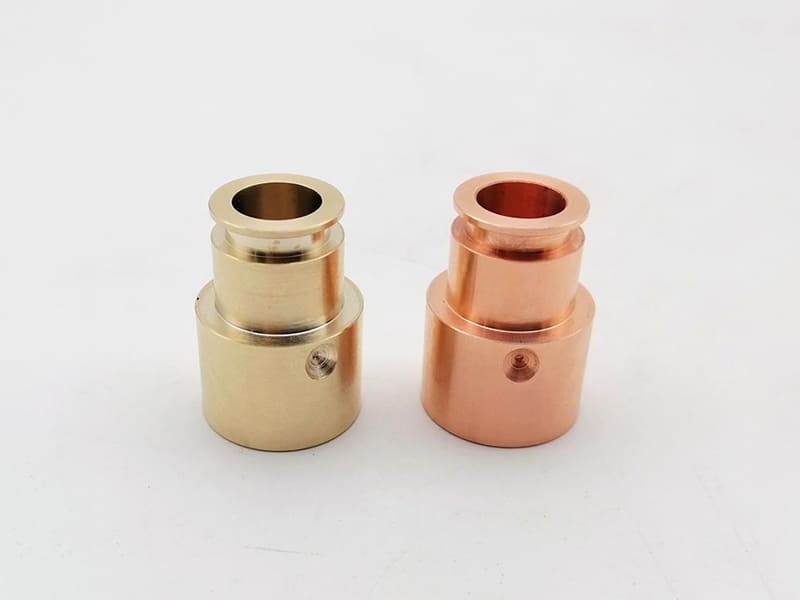
Herhangi bir CNC işleme operatörüne bir parti pirinç bağlantı parçası mı yoksa bakır bara bileşeni mi işlemeyi tercih edeceğini sorun; cevap neredeyse her zaman pirinç olur — bakır kötü bir malzeme olduğu için değil, kesici takım altında tamamen farklı davrandığı için. Pirinç ile bakır karşılaştırması bir malzeme bilimi sorusu olarak çerçevelenir, ancak üretim CNC ortamlarında bu aslında bir işleme davranışı sorusudur. Kimyasal özellikleri örtüşen iki malzeme, kökten farklı çevrim süreleri, takım aşınma desenleri, yüzey kalitesi sonuçları ve hurda oranları üretebilir.
Bu makalenin odaklandığı nokta bu üretim gerçeğidir. İletkenlik, korozyon direnci ve mekanik dayanımın hepsi önemlidir — ancak bir malzemenin ne kadar güvenilir talaş kaldırdığı, takımların ne kadar dayandığı ve sıkı toleranslı bir özelliğin 500 parçalık bir üretim boyunca tutulup tutulamayacağı da aynı derecede önemlidir. Pirinç ve bakırın CNC işleme bağlamında nereye ait olduğunu anlamak, mühendislerin maliyetli geç aşama malzeme değişikliklerinden kaçınmasına yardımcı olur ve satın alma ekiplerine maliyeti ve teslim süresini neyin yönlendirdiğine dair daha net bir tablo sunar.
İşleme Perspektifinden Bakır ve Pirinç
Çoğu malzeme karşılaştırması veri sayfalarıyla başlar. CNC işlemede, daha faydalı başlangıç noktası takım-talaş arayüzünde ne olduğudur — çünkü üretim sonuçları tam da orada ortaya çıkar.
Bakır: Yüksek İletkenlik Neden İşleme Ödünleşimleriyle Birlikte Gelir
Saf bakır (en yaygın işlenen kalite olan C11000 ETP), CNC operasyonlarında sorun yaratan iki özellik ile tanımlanır: son derece yüksek süneklik ve çok yüksek termal iletkenlik. Süneklik sorunu daha acil olanıdır. Kesici kenarın önünde temiz bir şekilde kesilmek yerine, bakır plastik olarak deforme olur. Malzeme takım ucunun etrafında akar, kırılmayan uzun sürekli talaşlar üretir, kesici kenarda birikir ve arkasında tutarsız yüzey koşulları bırakır.
Termal iletkenlik ikinci bir komplikasyon ekler. Kesme bölgesinde üretilen ısı, talaşla birlikte tahliye olmak yerine iş parçasına hızla yayılır. Bu, malzemeyi yerel olarak yumuşatır, bakır ile takım yüzeyi arasındaki yapışmayı artırır ve yığılma kenarı (BUE) oluşumunu hızlandırır. Sonuç, tutarlı bir şekilde işlemek için dikkatli parametre yönetimi gerektiren bir malzemedir — imkansız değil, ancak kesinlikle affedici değil.
Pirinç: Çinko İlavesinin Değiştirdiği Şeyler
Pirinç temelde çinko eklenmiş bakırdır — kaliteye bağlı olarak tipik olarak ağırlıkça –40%. Bu ilave, metalurjik davranışı CNC işleme için doğrudan elverişli şekillerde değiştirir. Çinko sünekliği azaltır, kesme sırasında kayma lokalizasyonunu teşvik eder ve bakırı işlemeyi zorlaştıran plastik akış davranışını kırar.
Pratik sonuç: pirinç kısa, iyi segmentli talaşlar üretir. Kesme kuvvetleri stabilize olur. Takım kenarları daha temiz kalır. Yüzey kalitesi parametreye duyarlı olmak yerine öngörülebilirdir. C36000 gibi serbest işleme kaliteleri, dahili talaş kırıcı olarak işlev gören küçük ilavelerle (tipik olarak kurşun veya bizmut) bunu daha ileri taşır ve pirinci yüksek hacimli CNC tornalama için varsayılan seçim yapan kontrollü, güvenilir talaş oluşumu üretir.
| Özellik (İşlemeyle İlgili) | Saf Bakır | Pirinç Alaşımı |
|---|---|---|
| Süneklik | Çok yüksek | Orta |
| İşlenebilirlik | Zayıf–orta | İyi–mükemmel |
| Talaş kontrolü | Sürekli, yapışkan | Kısa, iyi kırılmış |
| Yüzey kalitesi kararlılığı | Zor | Tutarlı |
| Takım aşınma eğilimi | Daha yüksek | Daha düşük |
Malzeme Özellikleri CNC Kesme Davranışına Nasıl Dönüşür
Bir veri sayfasındaki özellikler yalnızca kesim sırasında ne olduğunu etkilediği ölçüde önemlidir. Pirinç ve bakır için, malzeme özelliğinden işleme sonucuna geçiş doğrudan ve öngörülebilirdir — mekanizmayı anladığınızda.
Mekanik Özellikler: Süneklik-Sertlik İlişkisi
Yaygın bir yanılgı, daha yumuşak malzemelerin işlenmesinin daha kolay olduğudur. Bakır bunu güvenilir bir şekilde çürütür. Düşük sertlik ve aşırı süneklik kombinasyonu, malzemenin bir kayma düzlemi boyunca kırılmak yerine kesici kenarın önünde deforme olması anlamına gelir. Sonuç, kararsız kesme kuvvetleri, takım-talaş arayüzünde bulaşma ve tutarsız özellik geometrisidir — özellikle delik çaplarının ve diş formlarının bir üretim boyunca ±0,01–0,02 mm'yi tutması gereken sıkı toleranslı CNC tornalamada sorunludur.
Pirinç alaşımları sertliği artırır ve sünekliği, kontrollü kaymanın plastik deformasyonun yerini aldığı bir aralığa düşürür. Malzeme tanımlanmış bir kayma düzlemi boyunca kırılır, kesme kuvvetleri öngörülebilir hale gelir ve boyutsal tutarlılık önemli ölçüde iyileşir. H7 toleransında (20,000–20,021 mm) 20 mm deliğe sahip hassas bir bağlantı parçası için pirinç bu aralığı yüzlerce parça boyunca tutar; aynı toleransta bakır önemli ölçüde daha fazla proses dikkati gerektirir.
Termal İletkenlik: Kesme Bölgesi Sıcaklık Etkileri
Bakırın olağanüstü termal iletkenliği (~390 W/m·K) sezgiye aykırı bir sorun yaratır. Talaşla birlikte tahliye olması gereken ısı bunun yerine iş parçasına dağılır. Kesme bölgesi, talaşın kontrollü termal yumuşaması için gereken sıcaklığa asla ulaşmaz, ancak iş parçası yüzeyi malzemenin takım yüzeyine yapışmasını teşvik edecek kadar ısınır. BUE oluşur, aralıklı olarak kopar ve takım malzemesini beraberinde götürür.
Pirinç ısıyı daha az agresif iletir (C36000 için ~120 W/m·K). Daha fazla ısı talaşla birlikte tahliye olur, kesme bölgesi sıcaklığı stabilize olur ve takım aşınması, bakırda yaygın olan düzensiz yapışma kaynaklı arıza yerine öngörülebilir bir yan yüzey aşınma deseni izler. Takım değiştirme aralıklarının reaktif olmak yerine planlanması gereken üretim ortamlarında bu fark operasyonel olarak önemlidir.
Talaş Oluşumu: Farkın En Görünür Olduğu Yer
Talaş morfolojisi, işleme davranışının en net göstergesidir. Bakır, takımın, iş parçasının ve milin etrafına dolanan uzun, ipliksi, sürekli talaşlar üretir — makine durmaları, yüzey çizilmesi ve yüksek hızlı operasyonlarda tehlikeli talaş dolanması riskini artırır. 2.000+ RPM'de çalışan bir tornalama merkezinden bakır talaşlarını temizlemek gerçekten tehlikelidir.
Pirinç, soğutucu akışı veya basınçlı hava yoluyla temiz bir şekilde tahliye edilen kısa, kıvrılmış veya kırılmış talaşlar üretir. Talaş oluşumundaki bu tek fark, yüzey kalitesini, takım ömrünü, çevrim süresini ve operatör güvenliğini aynı anda etkiler.
| Malzeme Özelliği | Bakır | Pirinç | CNC İşleme Etkisi |
|---|---|---|---|
| Süneklik | Çok yüksek | Orta | Yüksek süneklik sıvanmaya, zayıf talaş kırılmasına neden olur |
| Sertlik (Brinell) | ~40–50 HB | ~80–120 HB | Daha yüksek sertlik, kesme stabilitesini artırır |
| Isı iletkenliği | ~390 W/m·K | ~100–130 W/m·K | İş parçasında aşırı ısı, kontrollü kesme bölgesine karşı |
| Talaş oluşumu | Sürekli, yapışkan | Kısa, kırılmış | Yüzey kalitesini ve takım ömrünü doğrudan etkiler |
Pirinç vs Bakır CNC Kesme: Hızlar, İlerlemeler ve Takım Aşınması
Pirinç ve bakır arasındaki performans farkı, üretim operasyonlarında gerçek kesme parametreleri ve takım aşınma davranışı karşılaştırıldığında en somut halini alır.
Kesme Hızı ve İlerleme Oranı: Pratik Değerler
Pirinç, bakıra kıyasla önemli ölçüde daha yüksek kesme hızlarına dayanabilir. CNC tornalamada C36000 serbest işleme pirinci için, F0.10–0.20 mm/dev'de karbür uç ile 150–250 m/dak yüzey hızları standart uygulamadır. Bu parametreler, ikincil operasyonlar olmadan kararlı talaşlar, öngörülebilir kuvvetler ve Ra 0.8–1.6 µm aralığında yüzey kaliteleri üretir.
Copper (C11000) typically requires surface speeds of 60–120 m/min — roughly half the speed of brass — to maintain dimensional control and acceptable surface finish. Feed rates must be managed carefully: too high promotes smearing and BUE; too low causes rubbing and heat buildup. The working window is narrow, and drifting outside it produces parts that require rework or inspection rejection. For a production run of 1,000 precision fittings, the cycle time difference between brass at 200 m/min and copper at 90 m/min translates directly into significant scheduling and cost variation.
Tool Wear Mechanisms: BUE in Copper vs Abrasive Wear in Brass
Tool failure modes differ between the two materials, and understanding the difference matters for tooling strategy.
In copper machining, the dominant failure mechanism is built-up edge. Copper’s chemical affinity for most tool materials causes it to weld intermittently to the cutting edge. BUE builds up, eventually fractures away, and takes fragments of the tool edge with it. The cutting edge geometry degrades non-linearly — tools don’t wear gradually, they fail suddenly. This makes tool change intervals difficult to predict and first-pass yield harder to maintain.
Brass wears tools primarily through controlled flank wear — a gradual, predictable process that allows shops to establish reliable tool change intervals. An insert that machines 300 brass parts before reaching its wear limit will consistently machine 280–310 parts. The same predictability in copper is rare without tight monitoring.
Tool selection also differs. Copper benefits from sharp-edged uncoated or PVD-coated carbide with polished flute geometry to minimize adhesion. Brass is compatible with a wide range of carbide grades; TiN and TiAlN coatings work well, and tool geometry is less critical because adhesion isn’t the primary failure concern.
Surface Finish and Dimensional Stability Under Cutting
Surface finish performance follows directly from cutting behavior. Copper parts machined without optimized parameters frequently show drag marks, micro-tearing, and inconsistent Ra values between parts — Ra 1.6 µm can become Ra 3.2 µm or worse if parameters drift slightly or a tool edge accumulates BUE. For applications requiring consistent cosmetic finish or tight Ra specifications, this variability creates inspection burden.
Brass consistently delivers Ra 0.8–1.6 µm in turning and Ra 1.6–3.2 µm in milling under standard production conditions. The surface finish is stable enough that first-article results hold across the production run, which is what makes brass the preferred material for precision fittings, connectors, and instrumentation components where appearance and dimensional accuracy both matter.
| Aspect | Bakır | Pirinç |
|---|---|---|
| Cutting speed (typical) | 60–120 m/min | 150–250 m/min |
| Feed rate tolerance | Narrow | Wide |
| Yığılma kenarı riski | Yüksek | Düşük |
| Tool wear predictability | Zayıf | İyi |
| Surface finish consistency | Zorlu | Kararlı |
Machinability: Why Brass Outperforms Copper in Production
Machinability ratings exist for a reason — and the difference between brass and copper isn’t subtle. C36000 free-machining brass is rated at approximately 100% machinability (the benchmark standard). C11000 ETP copper typically rates at 20–30%. That gap reflects real production experience, not theoretical predictions.
What the Machinability Gap Means on the Shop Floor
The physics behind the gap is the ductility-shear relationship described earlier, but the shop-floor manifestation is straightforward: brass is predictable and copper isn’t. Machinists who work with both materials regularly describe copper as “experience-dependent” — meaning results depend heavily on the operator’s ability to respond to parameter drift, BUE formation, and chip entanglement in real time. Brass, by contrast, runs consistently across shifts and operators, which is exactly what automated CNC turning cells and bar-fed lathes require.
For engineers specifying materials on custom CNC parts, this translates into concrete risks. A copper part with ±0.015 mm tolerance on a 15 mm bore is achievable — but it requires closer process monitoring, tighter tool change schedules, and likely more inspection touches than an equivalent brass part. That added process management has a cost, even when it doesn’t show up on the material line of the quote.
Cycle Time, Scrap Risk, and Automation Suitability
Production economics reinforce the brass preference. Shorter cycle times from higher allowable cutting speeds, combined with longer predictable tool life and lower scrap rates, reduce per-part cost even when brass carries a raw material premium over certain copper forms.
For automated CNC turning — particularly bar-fed operations running overnight or lights-out — brass is the rational default for components that don’t require copper’s conductivity. Process upsets from BUE formation or chip entanglement in copper can halt a cell for hours; brass runs continuously without that risk.
| Faktör | Bakır | Pirinç |
|---|---|---|
| İşlenebilirlik derecesi | ~20–30% | ~0 (C36000) |
| Çevrim süresi | Daha uzun | Shorter |
| Proses kararlılığı | Sensitive | Robust |
| Hurda riski | Daha yüksek | Daha düşük |
| Automation suitability | Sınırlı | Mükemmel |
Corrosion Behavior and Post-Machining Considerations
Cutting performance isn’t the only factor in material selection. Corrosion behavior and surface condition after machining influence long-term part reliability — and for both brass and copper, the machined surface state directly affects how the material performs in service.
Copper Oxidation and Surface Sensitivity
Freshly machined copper is chemically reactive. Surface oxide forms rapidly in air, and contamination from coolant residues or handling accelerates discoloration and early patina development. In decorative or architectural applications, this is expected and often desirable. In precision electrical contacts or optical-quality components, it’s a problem.
Surface defects from machining — torn edges, smeared material, residual BUE fragments — increase effective surface area and create sites for preferential oxidation. Parts that were dimensionally acceptable may still fail functional tests if surface condition is poor. This is why copper components often require polishing or protective coating immediately after machining, adding cost and lead time.
Dezincification Risk in Brass: What Actually Triggers It
Brass’s primary corrosion concern is dezincification — selective leaching of zinc from the alloy matrix, leaving a porous copper-rich structure with reduced mechanical strength. It’s worth being specific about when this actually occurs, because it’s commonly overstated as a general risk.
Dezincification requires specific conditions: prolonged exposure to chloride-rich water (notably in plumbing systems with soft, slightly acidic water), elevated temperatures above roughly 60°C, and stagnant or low-flow conditions. In standard industrial dry environments, indoor installations, or atmospheric exposure, dezincification is not a practical concern for most brass alloys.
CNC machining can influence this indirectly. Rough surface finish, micro-cracks from aggressive parameters, or residual tensile stress from high cutting forces can create initiation sites where corrosion progresses faster in susceptible environments. For plumbing fittings and fluid-handling components in known dezincification-risk environments, DZR brass grades (typically with 0.02–0.06% arsenic addition) are the correct specification.
Surface Treatment Options for Both Materials
Post-machining finishing choices differ by material and application. Copper components typically receive one of three treatments: protective clear lacquer for decorative parts, tin plating (3–10 µm) for electrical contact surfaces where oxide formation would increase contact resistance, or nickel plating for industrial components requiring both corrosion resistance and wear resistance. Brass parts may receive nickel plating, chromate passivation, or powder coating for outdoor or harsh-environment applications. For precision machined brass components used as-machined in indoor environments, no surface treatment is commonly required.
| Faktör | Bakır | Pirinç |
|---|---|---|
| Natural corrosion behavior | Oxidation, patina | Generally resistant |
| Primary risk | Surface-driven oxidation | Dezincification (specific environments) |
| CNC surface influence | Yüksek | Orta |
| Typical finishing needs | Tin/nickel plating, lacquer | Plating or as-machined |
Common Copper and Brass Grades in CNC Machining
Grade selection within each material family matters almost as much as the brass-vs-copper decision itself. Different alloys within the same family can behave significantly differently in production.
Copper Grades: C11000 and Its Machining Constraints
C11000 (Electrolytic Tough Pitch Copper, ETP) accounts for the majority of machined copper components. It offers electrical conductivity of ~100% IACS and thermal conductivity of ~390 W/m·K — properties unmatched by any brass alloy. Machining C11000, however, requires the parameter and tooling discipline described throughout this article. Expect lower cutting speeds, careful chip management, and likely secondary finishing for any surface finish specification below Ra 1.6 µm.
C10100 (Oxygen-Free Electronic Copper, OFE) offers slightly higher purity and conductivity but machines similarly to C11000. The machining challenge isn’t changed by the small compositional difference; the material selection between C11000 and C10100 is driven by the conductivity or contamination requirements of the application.
Brass Grades: C26000, C36000, and the Right Choice for Production
Brass grade selection involves a real trade-off between formability and machinability.
C26000 (Cartridge Brass, 70/30): 70% copper, 30% zinc. Good formability — suitable for parts requiring both machining and cold forming, such as stamped-and-machined components. Machinability is moderate; it machines significantly better than copper but doesn’t reach the productivity of C36000.
C36000 (Free-Machining Brass, 61.5/35.5/3): The addition of approximately 3% lead (or bismuth in lead-free variants) creates microscopic internal chip-breaking inclusions. C36000 is the benchmark for CNC machinability — high cutting speeds, clean chip formation, excellent surface finish, and long tool life. It is the default specification for precision turned parts, fittings, valves, and connectors produced on CNC lathes and bar-fed turning centers.
C26200 and C28000 (Muntz Metal): Higher zinc content (40%+) improves hot workability and reduces cost but introduces elevated dezincification risk. Generally avoided for fluid-contact applications without DZR treatment.
| Sınıf | Malzeme Türü | İşlenebilirlik | Typical CNC Applications |
|---|---|---|---|
| C11000 | Pure copper (ETP) | Low (~20–30%) | Electrical contacts, bus bars, heat sinks |
| C26000 | Brass 70/30 | Moderate (~60%) | Formed + machined components |
| C36000 | Free-machining brass | Excellent (~100%) | Precision fittings, valves, high-volume turned parts |
How to Choose Between Brass and Copper for CNC Parts
The decision framework is straightforward once conductivity requirements are established — because that single factor often determines whether copper is necessary or merely assumed.
Start with Conductivity: Is Copper Actually Required?
If the application requires maximum electrical conductivity — current-carrying contacts, bus bars, electrical terminals at high current density — copper is the correct choice regardless of machining difficulty. Brass electrical conductivity (~25–30% IACS for C36000) cannot substitute for C11000’s ~100% IACS in these applications, and no machining advantage compensates for that functional gap.
Similarly, for thermal management components — heat sinks, cooling plates, thermal interface structures — copper’s ~390 W/m·K thermal conductivity compared to brass’s ~120 W/m·K is often decisive. If the thermal performance requirement was calculated based on copper properties, substituting brass changes the thermal analysis and may invalidate the design.
When Conductivity Isn’t the Dominant Requirement
For most mechanical CNC parts — fittings, valves, manifolds, instrumentation components, decorative hardware, housings — conductivity is secondary or irrelevant. In these applications, the manufacturing argument for brass is compelling. Shorter cycle times (often 40–60% faster), lower tool consumption, predictable surface finish, and better automation compatibility reduce per-part cost even when brass carries a slight material price premium.
Tight-tolerance features are safer in brass. A 12 mm bore at ±0.010 mm tolerance on a 500-part run is a standard production operation in C36000. In copper, achieving the same tolerance consistently requires tighter process controls, more frequent tool monitoring, and acceptance of a higher reject rate — all of which add cost that doesn’t appear in the material price.
Decision Table: Application-Driven Material Selection
| Uygulama Senaryosu | Preferred Material | Engineering Rationale |
|---|---|---|
| Electrical contacts, bus bars | Copper (C11000) | Maximum conductivity required |
| Heat sinks, thermal paths | Copper (C11000) | Thermal performance dominates |
| Precision fittings, valves | Pirinç (C36000) | Stable machining, consistent finish |
| High-volume CNC turning | Pirinç (C36000) | Cycle time and automation compatibility |
| Tight-tolerance mechanical parts | Pirinç (C36000) | Lower scrap risk, predictable process |
| Cosmetic / decorative components | Pirinç | Consistent appearance, easy finishing |
Sonuç
Brass and copper serve different functions in CNC machining, and the choice between them deserves more engineering rigor than default material preferences usually allow. Copper earns its place in applications where conductivity or thermal performance is the primary design requirement — no brass alloy replaces it there. Outside those applications, however, the machining case for brass is strong: higher cutting speeds, better chip control, predictable tool wear, consistent surface finish, and lower scrap rates translate into real cost and schedule advantages at production volumes.
For engineers and procurement teams, the most reliable approach is to evaluate the brass vs copper decision against actual functional requirements first, then against manufacturing constraints. When conductivity isn’t critical, brass typically delivers better outcomes across every metric that matters in production — cycle time, tool cost, yield, and delivery reliability. When copper is genuinely required, the machining challenges are manageable — but they need to be planned for, not discovered during first-article inspection.
Sıkça Sorulan Sorular
Is brass easier to CNC machine than copper?
Yes, significantly. The reason isn’t hardness — it’s ductility and shear behavior. Brass forms short, controlled chips and produces stable cutting forces, allowing cutting speeds 1.5–2× higher than copper. Copper’s extreme ductility causes plastic deformation ahead of the tool, producing continuous chips, built-up edge, and surface inconsistency. In practical CNC operations, brass is predictable; copper requires active management.
Why does copper cause tool wear in CNC machining?
Copper causes wear primarily through adhesion rather than abrasion. Its chemical affinity for carbide and HSS tool materials promotes intermittent welding of copper to the cutting edge — built-up edge forms, fractures, and takes fragments of the edge coating or substrate with it. High thermal conductivity also softens the cutting zone, increasing material transfer to the tool face and accelerating this adhesion cycle.
Which material gives better surface finish in CNC machining?
Brass consistently delivers better and more repeatable surface finish under standard production conditions. Controlled chip formation and stable cutting forces keep Ra values in the 0.8–1.6 µm range in turning without secondary finishing. Copper can achieve fine finishes, but requires optimized tooling, conservative parameters, and often polishing steps — adding cost and process complexity.
Is brass suitable for electrical applications?
For moderate-conductivity applications — connectors, terminals, housings, and components where mechanical strength matters alongside conductivity — brass is suitable. C36000 provides ~25–30% IACS conductivity, adequate for many connector and housing applications. For current-carrying components where maximum conductivity is the design basis, copper remains the correct choice.
How does material selection affect CNC part cost?
Material selection affects cost well beyond the raw material line. Copper increases cycle time, tool consumption, inspection effort, and scrap risk — all of which add to total part cost. Brass supports faster machining, longer predictable tool life, and stable quality, reducing per-unit cost especially at medium-to-high volumes. For procurement teams quoting parts, these downstream effects often matter more than the material price difference itself.


