
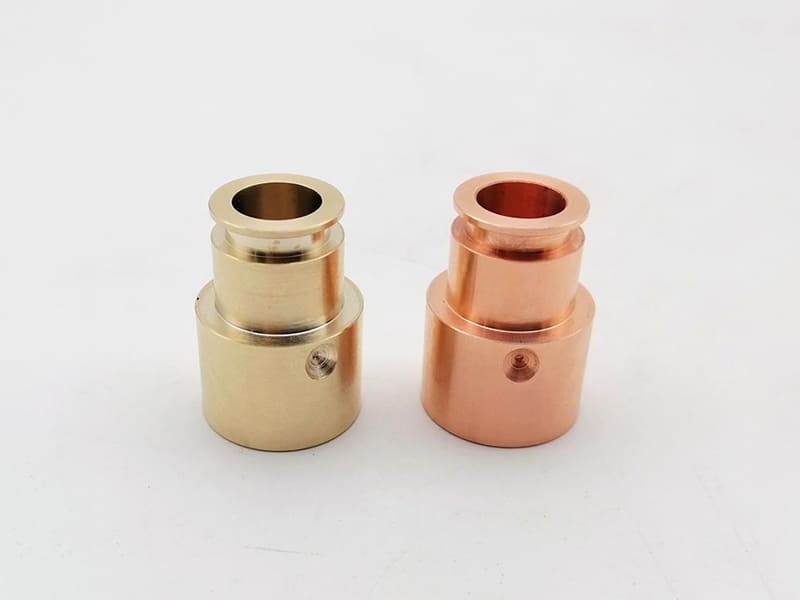
Ask any CNC machinist whether they’d rather run a batch of brass fittings or copper bus bar components, and the answer is almost always brass — not because copper is a bad material, but because it behaves completely differently under a cutting tool. The brass vs copper decision gets framed as a material science question, but in production CNC environments it’s really a machining behavior question. Two materials with overlapping chemistry can produce radically different cycle times, tool wear patterns, surface finish outcomes, and scrap rates.
That manufacturing reality is what this article focuses on. Conductivity, corrosion resistance, and mechanical strength all matter — but so does how reliably a material chips, how long tools last, and whether a tight-tolerance feature can be held across a 500-part run. Understanding where brass and copper each belong in a CNC machining context helps engineers avoid expensive late-stage material substitutions and gives procurement teams a clearer picture of what drives cost and lead time.
Copper and Brass from a Machining Perspective
Most material comparisons start with datasheets. In CNC machining, the more useful starting point is what happens at the tool-chip interface — because that’s where the production consequences actually show up.
Copper: Why High Conductivity Comes with Machining Trade-offs
Pure copper (C11000 ETP being the most common machined grade) is defined by two properties that create problems in CNC operations: extremely high ductility and very high thermal conductivity. The ductility issue is the more immediate one. Rather than shearing cleanly ahead of the cutting edge, copper deforms plastically. The material flows around the tool tip, producing long continuous chips that don’t break, build up on the cutting edge, and leave inconsistent surface conditions behind.
Thermal conductivity adds a second complication. Heat generated at the cutting zone spreads rapidly into the workpiece rather than evacuating with the chip. This softens the material locally, increases adhesion between copper and the tool face, and accelerates built-up edge (BUE) formation. The result is a material that requires careful parameter management to machine consistently — not impossible, but definitely not forgiving.
Brass: What the Addition of Zinc Changes
Brass is fundamentally copper with zinc added — typically 10–40% by weight depending on the grade. That addition changes the metallurgical behavior in ways that are directly favorable for CNC machining. Zinc reduces ductility, promotes shear localization during cutting, and breaks the plastic flow behavior that makes copper difficult to process.
The practical outcome: brass produces short, well-segmented chips. Cutting forces stabilize. Tool edges stay cleaner. Surface finish is predictable rather than parameter-sensitive. Free-machining grades like C36000 take this further with small additions (typically lead or bismuth) that act as internal chip breakers, producing the controlled, reliable chip formation that makes brass the default choice for high-volume CNC turning.
| Property (Machining-Relevant) | Pure Copper | Liga de latão |
|---|---|---|
| Ductilidade | Muito elevado | Moderado |
| Maquinabilidade | Ruim–razoável | Boa–excelente |
| Controlo de aparas | Continuous, gummy | Short, well-broken |
| Surface finish stability | Difícil | Consistent |
| Tool wear tendency | Mais alto | Mais baixo |
How Material Properties Translate into CNC Cutting Behavior
Properties on a datasheet only matter insofar as they affect what happens during the cut. For brass and copper, the translation from material property to machining outcome is direct and predictable — once you understand the mechanism.
Mechanical Properties: The Ductility-Hardness Relationship
A common misconception is that softer materials are easier to machine. Copper disproves this reliably. Its combination of low hardness and extreme ductility means the material deforms ahead of the cutting edge instead of fracturing along a shear plane. The result is unstable cutting forces, smearing at the tool-chip interface, and inconsistent feature geometry — particularly problematic in tight-tolerance CNC turning where bore diameters and thread forms must hold ±0.01–0.02 mm across a production run.
Brass alloys increase hardness and reduce ductility to a range where controlled shear takes over from plastic deformation. Material fractures along a defined shear plane, cutting forces become predictable, and dimensional consistency improves substantially. For a precision fitting with a 20 mm bore at H7 tolerance (20.000–20.021 mm), brass will hold that range across hundreds of parts; copper at the same tolerance requires significantly more process attention.
Thermal Conductivity: Cutting Zone Temperature Effects
Copper’s exceptional thermal conductivity (~390 W/m·K) creates a counterintuitive problem. Heat that should evacuate with the chip instead disperses into the workpiece. The cutting zone never reaches the temperature needed for controlled thermal softening of the chip, but the workpiece surface gets warm enough to promote material adhesion to the tool face. BUE forms, breaks off intermittently, and takes tool material with it.
Brass conducts heat less aggressively (~120 W/m·K for C36000). More heat evacuates with the chip, the cutting zone temperature stabilizes, and tool wear follows a predictable flank wear pattern rather than the erratic adhesion-driven failure common in copper. For production environments where tool change intervals need to be scheduled rather than reactive, this difference is operationally significant.
Chip Formation: Where the Difference Is Most Visible
Chip morphology is the clearest indicator of machining behavior. Copper produces long, stringy, continuous chips that wrap around the tool, workpiece, and spindle — increasing the risk of machine stoppages, surface scratching, and dangerous chip entanglement in high-speed operations. Clearing copper chips from a turning center running at 2,000+ RPM is genuinely hazardous.
Brass generates short, curled or broken chips that evacuate cleanly through coolant flow or compressed air. This single difference in chip formation affects surface finish quality, tool life, cycle time, and operator safety simultaneously.
| Material Property | Cobre | Latão | Impacto na Maquinagem CNC |
|---|---|---|---|
| Ductilidade | Muito elevado | Moderado | High ductility causes smearing, poor chip breakage |
| Dureza (Brinell) | ~40–50 HB | ~80–120 HB | Higher hardness improves cutting stability |
| Condutividade térmica | ~390 W/m·K | ~100–130 W/m·K | Excess heat in workpiece vs controlled cutting zone |
| Formação de cavacos | Continuous, gummy | Short, broken | Directly affects surface finish and tool life |
Brass vs Copper CNC Cutting: Speeds, Feeds, and Tool Wear
The performance gap between brass and copper becomes most concrete when comparing actual cutting parameters and tool wear behavior in production operations.
Cutting Speed and Feed Rate: Practical Numbers
Brass tolerates significantly higher cutting speeds than copper. For C36000 free-machining brass in CNC turning, surface speeds of 150–250 m/min with a carbide insert at F0.10–0.20 mm/rev are standard practice. These parameters produce stable chips, predictable forces, and surface finishes in the Ra 0.8–1.6 µm range without secondary operations.
Copper (C11000) typically requires surface speeds of 60–120 m/min — roughly half the speed of brass — to maintain dimensional control and acceptable surface finish. Feed rates must be managed carefully: too high promotes smearing and BUE; too low causes rubbing and heat buildup. The working window is narrow, and drifting outside it produces parts that require rework or inspection rejection. For a production run of 1,000 precision fittings, the cycle time difference between brass at 200 m/min and copper at 90 m/min translates directly into significant scheduling and cost variation.
Tool Wear Mechanisms: BUE in Copper vs Abrasive Wear in Brass
Tool failure modes differ between the two materials, and understanding the difference matters for tooling strategy.
In copper machining, the dominant failure mechanism is built-up edge. Copper’s chemical affinity for most tool materials causes it to weld intermittently to the cutting edge. BUE builds up, eventually fractures away, and takes fragments of the tool edge with it. The cutting edge geometry degrades non-linearly — tools don’t wear gradually, they fail suddenly. This makes tool change intervals difficult to predict and first-pass yield harder to maintain.
Brass wears tools primarily through controlled flank wear — a gradual, predictable process that allows shops to establish reliable tool change intervals. An insert that machines 300 brass parts before reaching its wear limit will consistently machine 280–310 parts. The same predictability in copper is rare without tight monitoring.
Tool selection also differs. Copper benefits from sharp-edged uncoated or PVD-coated carbide with polished flute geometry to minimize adhesion. Brass is compatible with a wide range of carbide grades; TiN and TiAlN coatings work well, and tool geometry is less critical because adhesion isn’t the primary failure concern.
Surface Finish and Dimensional Stability Under Cutting
Surface finish performance follows directly from cutting behavior. Copper parts machined without optimized parameters frequently show drag marks, micro-tearing, and inconsistent Ra values between parts — Ra 1.6 µm can become Ra 3.2 µm or worse if parameters drift slightly or a tool edge accumulates BUE. For applications requiring consistent cosmetic finish or tight Ra specifications, this variability creates inspection burden.
Brass consistently delivers Ra 0.8–1.6 µm in turning and Ra 1.6–3.2 µm in milling under standard production conditions. The surface finish is stable enough that first-article results hold across the production run, which is what makes brass the preferred material for precision fittings, connectors, and instrumentation components where appearance and dimensional accuracy both matter.
| Aspeto | Cobre | Latão |
|---|---|---|
| Cutting speed (typical) | 60–120 m/min | 150–250 m/min |
| Feed rate tolerance | Narrow | Wide |
| Risco de aresta postiça | Alto | Baixo |
| Tool wear predictability | Pobres | Bom |
| Surface finish consistency | Desafiador | Estável |
Machinability: Why Brass Outperforms Copper in Production
Machinability ratings exist for a reason — and the difference between brass and copper isn’t subtle. C36000 free-machining brass is rated at approximately 100% machinability (the benchmark standard). C11000 ETP copper typically rates at 20–30%. That gap reflects real production experience, not theoretical predictions.
What the Machinability Gap Means on the Shop Floor
The physics behind the gap is the ductility-shear relationship described earlier, but the shop-floor manifestation is straightforward: brass is predictable and copper isn’t. Machinists who work with both materials regularly describe copper as “experience-dependent” — meaning results depend heavily on the operator’s ability to respond to parameter drift, BUE formation, and chip entanglement in real time. Brass, by contrast, runs consistently across shifts and operators, which is exactly what automated CNC turning cells and bar-fed lathes require.
For engineers specifying materials on custom CNC parts, this translates into concrete risks. A copper part with ±0.015 mm tolerance on a 15 mm bore is achievable — but it requires closer process monitoring, tighter tool change schedules, and likely more inspection touches than an equivalent brass part. That added process management has a cost, even when it doesn’t show up on the material line of the quote.
Cycle Time, Scrap Risk, and Automation Suitability
Production economics reinforce the brass preference. Shorter cycle times from higher allowable cutting speeds, combined with longer predictable tool life and lower scrap rates, reduce per-part cost even when brass carries a raw material premium over certain copper forms.
For automated CNC turning — particularly bar-fed operations running overnight or lights-out — brass is the rational default for components that don’t require copper’s conductivity. Process upsets from BUE formation or chip entanglement in copper can halt a cell for hours; brass runs continuously without that risk.
| Fator | Cobre | Latão |
|---|---|---|
| Índice de usinabilidade | ~20–30% | ~100% (C36000) |
| Tempo de ciclo | Mais longa | Shorter |
| Estabilidade do processo | Sensitive | Robust |
| Risco de refugo | Mais alto | Mais baixo |
| Automation suitability | Limitado | Excelente |
Corrosion Behavior and Post-Machining Considerations
Cutting performance isn’t the only factor in material selection. Corrosion behavior and surface condition after machining influence long-term part reliability — and for both brass and copper, the machined surface state directly affects how the material performs in service.
Copper Oxidation and Surface Sensitivity
Freshly machined copper is chemically reactive. Surface oxide forms rapidly in air, and contamination from coolant residues or handling accelerates discoloration and early patina development. In decorative or architectural applications, this is expected and often desirable. In precision electrical contacts or optical-quality components, it’s a problem.
Surface defects from machining — torn edges, smeared material, residual BUE fragments — increase effective surface area and create sites for preferential oxidation. Parts that were dimensionally acceptable may still fail functional tests if surface condition is poor. This is why copper components often require polishing or protective coating immediately after machining, adding cost and lead time.
Dezincification Risk in Brass: What Actually Triggers It
Brass’s primary corrosion concern is dezincification — selective leaching of zinc from the alloy matrix, leaving a porous copper-rich structure with reduced mechanical strength. It’s worth being specific about when this actually occurs, because it’s commonly overstated as a general risk.
Dezincification requires specific conditions: prolonged exposure to chloride-rich water (notably in plumbing systems with soft, slightly acidic water), elevated temperatures above roughly 60°C, and stagnant or low-flow conditions. In standard industrial dry environments, indoor installations, or atmospheric exposure, dezincification is not a practical concern for most brass alloys.
CNC machining can influence this indirectly. Rough surface finish, micro-cracks from aggressive parameters, or residual tensile stress from high cutting forces can create initiation sites where corrosion progresses faster in susceptible environments. For plumbing fittings and fluid-handling components in known dezincification-risk environments, DZR brass grades (typically with 0.02–0.06% arsenic addition) are the correct specification.
Surface Treatment Options for Both Materials
Post-machining finishing choices differ by material and application. Copper components typically receive one of three treatments: protective clear lacquer for decorative parts, tin plating (3–10 µm) for electrical contact surfaces where oxide formation would increase contact resistance, or nickel plating for industrial components requiring both corrosion resistance and wear resistance. Brass parts may receive nickel plating, chromate passivation, or powder coating for outdoor or harsh-environment applications. For precision machined brass components used as-machined in indoor environments, no surface treatment is commonly required.
| Fator | Cobre | Latão |
|---|---|---|
| Natural corrosion behavior | Oxidation, patina | Generally resistant |
| Primary risk | Surface-driven oxidation | Dezincification (specific environments) |
| CNC surface influence | Alto | Moderado |
| Typical finishing needs | Tin/nickel plating, lacquer | Plating or as-machined |
Common Copper and Brass Grades in CNC Machining
Grade selection within each material family matters almost as much as the brass-vs-copper decision itself. Different alloys within the same family can behave significantly differently in production.
Copper Grades: C11000 and Its Machining Constraints
C11000 (Electrolytic Tough Pitch Copper, ETP) accounts for the majority of machined copper components. It offers electrical conductivity of ~100% IACS and thermal conductivity of ~390 W/m·K — properties unmatched by any brass alloy. Machining C11000, however, requires the parameter and tooling discipline described throughout this article. Expect lower cutting speeds, careful chip management, and likely secondary finishing for any surface finish specification below Ra 1.6 µm.
C10100 (Oxygen-Free Electronic Copper, OFE) offers slightly higher purity and conductivity but machines similarly to C11000. The machining challenge isn’t changed by the small compositional difference; the material selection between C11000 and C10100 is driven by the conductivity or contamination requirements of the application.
Brass Grades: C26000, C36000, and the Right Choice for Production
Brass grade selection involves a real trade-off between formability and machinability.
C26000 (Cartridge Brass, 70/30): 70% copper, 30% zinc. Good formability — suitable for parts requiring both machining and cold forming, such as stamped-and-machined components. Machinability is moderate; it machines significantly better than copper but doesn’t reach the productivity of C36000.
C36000 (Free-Machining Brass, 61.5/35.5/3): The addition of approximately 3% lead (or bismuth in lead-free variants) creates microscopic internal chip-breaking inclusions. C36000 is the benchmark for CNC machinability — high cutting speeds, clean chip formation, excellent surface finish, and long tool life. It is the default specification for precision turned parts, fittings, valves, and connectors produced on CNC lathes and bar-fed turning centers.
C26200 and C28000 (Muntz Metal): Higher zinc content (40%+) improves hot workability and reduces cost but introduces elevated dezincification risk. Generally avoided for fluid-contact applications without DZR treatment.
| Nota | Tipo de material | Maquinabilidade | Typical CNC Applications |
|---|---|---|---|
| C11000 | Pure copper (ETP) | Low (~20–30%) | Electrical contacts, bus bars, heat sinks |
| C26000 | Brass 70/30 | Moderate (~60%) | Formed + machined components |
| C36000 | Free-machining brass | Excellent (~100%) | Precision fittings, valves, high-volume turned parts |
How to Choose Between Brass and Copper for CNC Parts
The decision framework is straightforward once conductivity requirements are established — because that single factor often determines whether copper is necessary or merely assumed.
Start with Conductivity: Is Copper Actually Required?
If the application requires maximum electrical conductivity — current-carrying contacts, bus bars, electrical terminals at high current density — copper is the correct choice regardless of machining difficulty. Brass electrical conductivity (~25–30% IACS for C36000) cannot substitute for C11000’s ~100% IACS in these applications, and no machining advantage compensates for that functional gap.
Similarly, for thermal management components — heat sinks, cooling plates, thermal interface structures — copper’s ~390 W/m·K thermal conductivity compared to brass’s ~120 W/m·K is often decisive. If the thermal performance requirement was calculated based on copper properties, substituting brass changes the thermal analysis and may invalidate the design.
When Conductivity Isn’t the Dominant Requirement
For most mechanical CNC parts — fittings, valves, manifolds, instrumentation components, decorative hardware, housings — conductivity is secondary or irrelevant. In these applications, the manufacturing argument for brass is compelling. Shorter cycle times (often 40–60% faster), lower tool consumption, predictable surface finish, and better automation compatibility reduce per-part cost even when brass carries a slight material price premium.
Tight-tolerance features are safer in brass. A 12 mm bore at ±0.010 mm tolerance on a 500-part run is a standard production operation in C36000. In copper, achieving the same tolerance consistently requires tighter process controls, more frequent tool monitoring, and acceptance of a higher reject rate — all of which add cost that doesn’t appear in the material price.
Decision Table: Application-Driven Material Selection
| Cenário de aplicação | Preferred Material | Fundamentos de engenharia |
|---|---|---|
| Electrical contacts, bus bars | Cobre (C11000) | Maximum conductivity required |
| Heat sinks, thermal paths | Cobre (C11000) | Thermal performance dominates |
| Precision fittings, valves | Latão (C36000) | Stable machining, consistent finish |
| High-volume CNC turning | Latão (C36000) | Cycle time and automation compatibility |
| Tight-tolerance mechanical parts | Latão (C36000) | Lower scrap risk, predictable process |
| Cosmetic / decorative components | Latão | Consistent appearance, easy finishing |
Conclusão
Brass and copper serve different functions in CNC machining, and the choice between them deserves more engineering rigor than default material preferences usually allow. Copper earns its place in applications where conductivity or thermal performance is the primary design requirement — no brass alloy replaces it there. Outside those applications, however, the machining case for brass is strong: higher cutting speeds, better chip control, predictable tool wear, consistent surface finish, and lower scrap rates translate into real cost and schedule advantages at production volumes.
For engineers and procurement teams, the most reliable approach is to evaluate the brass vs copper decision against actual functional requirements first, then against manufacturing constraints. When conductivity isn’t critical, brass typically delivers better outcomes across every metric that matters in production — cycle time, tool cost, yield, and delivery reliability. When copper is genuinely required, the machining challenges are manageable — but they need to be planned for, not discovered during first-article inspection.
Perguntas frequentes
Is brass easier to CNC machine than copper?
Yes, significantly. The reason isn’t hardness — it’s ductility and shear behavior. Brass forms short, controlled chips and produces stable cutting forces, allowing cutting speeds 1.5–2× higher than copper. Copper’s extreme ductility causes plastic deformation ahead of the tool, producing continuous chips, built-up edge, and surface inconsistency. In practical CNC operations, brass is predictable; copper requires active management.
Why does copper cause tool wear in CNC machining?
Copper causes wear primarily through adhesion rather than abrasion. Its chemical affinity for carbide and HSS tool materials promotes intermittent welding of copper to the cutting edge — built-up edge forms, fractures, and takes fragments of the edge coating or substrate with it. High thermal conductivity also softens the cutting zone, increasing material transfer to the tool face and accelerating this adhesion cycle.
Which material gives better surface finish in CNC machining?
Brass consistently delivers better and more repeatable surface finish under standard production conditions. Controlled chip formation and stable cutting forces keep Ra values in the 0.8–1.6 µm range in turning without secondary finishing. Copper can achieve fine finishes, but requires optimized tooling, conservative parameters, and often polishing steps — adding cost and process complexity.
Is brass suitable for electrical applications?
For moderate-conductivity applications — connectors, terminals, housings, and components where mechanical strength matters alongside conductivity — brass is suitable. C36000 provides ~25–30% IACS conductivity, adequate for many connector and housing applications. For current-carrying components where maximum conductivity is the design basis, copper remains the correct choice.
How does material selection affect CNC part cost?
Material selection affects cost well beyond the raw material line. Copper increases cycle time, tool consumption, inspection effort, and scrap risk — all of which add to total part cost. Brass supports faster machining, longer predictable tool life, and stable quality, reducing per-unit cost especially at medium-to-high volumes. For procurement teams quoting parts, these downstream effects often matter more than the material price difference itself.


