
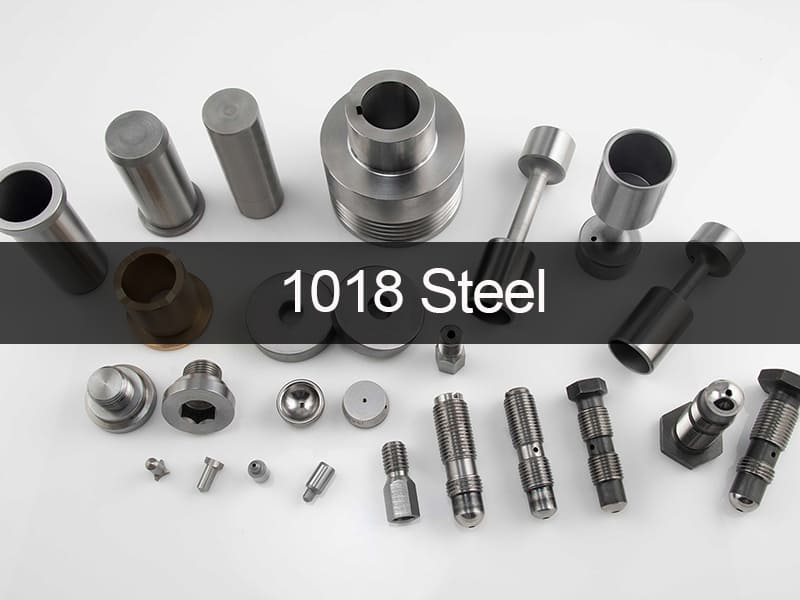
When engineers and manufacturers need a material that is predictable, cheap, and works with everything, they usually choose 1018 steel. 1018 is a low-carbon steel (often called mild steel). It is not chosen because it has one extreme property that makes it stand out, but because it has a good mix of machinability, weldability, and mechanical consistency that meets a wide range of industrial needs.
When it comes to manufacturing, 1018 carbon steel works well for CNC machining, drilling, turning, and milling. It has a low carbon content, which means that chips form in a stable way, tools wear out less quickly, and the surface finish is good without needing special tools or aggressive cutting settings. At the same time, it is easy to weld with common methods like MIG and TIG, so it can be used for assemblies, frames, and parts that need to be joined after machining.
It’s important to remember that 1018 is not a “generic” or careless choice of material. Engineers choose it on purpose when they don’t need high strength, extreme hardness, or advanced alloy performance. 1018 steel is better for shafts, brackets, plates, and structural parts where cost control, dimensional consistency, and manufacturing efficiency are more important than peak mechanical properties.
This guide looks at 1018 steel from three different angles: the basics of the material, how it behaves during manufacturing, and the logic behind choosing it for engineering projects. This will help designers, engineers, and procurement teams understand not only what it is, but also when and why it makes sense to use it.
What is 1018 Steel? — Standards and Definitions for Grades
The most common cold-rolled steel grade in the world is 1018 steel. The AISI/SAE carbon steel classification system has a definition for it.
-
“10”: This means that the steel is plain carbon steel and does not have any major alloying elements.
-
“18” means that the carbon content is about 0.18%.
1018 is definitely mild steel because it has such a low carbon level. “Mild steel” doesn’t mean low quality in the field of engineering. Instead, it refers to steels that are made to stay ductile, formable, and weldable, which is not the case with high-carbon grades, which are brittle.
Global Standards and Their Equivalents
1018 is similar to these standards for international sourcing:
-
UNS: G10180
-
ASTM: A108 (Standard for cold-finished steel bars, carbon and alloy)
-
EN / DIN: C15E / 1.1141
-
JIS: S15C or S20C
Perceção da engenharia: 1018 is different from structural steel grades like A36 because its yield strength is what defines it. This makes it easier to machine tight-tolerance parts because its behavior is more stable and predictable.
The chemical makeup of 1018 steel and what it means for engineering
To understand why 1018 acts the way it does, you need to know chemistry. It needs a “clean” chemistry with few impurities to make sure that processing is always the same.
Table 1: Common Chemical Composition (wt%)
| Elemento | Average Amount | Função de engenheiro |
| Carbono (C) | 0.15–0.20 | The main hardener. Maintained low to guarantee ductility and weldability. |
| Manganês (Mn) | 0.60–0.90 | Increases hardenability and tensile strength; helps with deoxidation. |
| Fósforo (P) | ≤ 0.040 | Impurity. Maintained at a low level to avoid brittleness. |
| Enxofre (S) | ≤ 0.050 | Impurity. Maintained low to keep weldability (but a little higher sulfur helps with machining). |
| Ferro (Fe) | Equilíbrio | Metal base. |
Why having a low carbon content is important
The 0.18% carbon content is the “Goldilocks” zone for most types of manufacturing:
-
Great for welding: Low carbon lowers the chance of making brittle martensite in the Heat Affected Zone (HAZ), so there is no need to pre-heat.
-
It is still ductile enough to be bent, rolled, or swaged without breaking.
-
Case Hardening Potential: It can’t be hardened all the way through (quench and temper), but it is a great candidate for carburizing, which makes a hard outer shell that resists wear while keeping a tough core.
What is Ferrite–Pearlite Microstructure?
The microstructure of 1018 steel is the best way to understand how it behaves as an engineer.
1018 is made up of the following at room temperature:
-
Ferrite: (The light grains) Iron that is pure. It is soft, flexible, and magnetic. This is most of the matrix.
-
Pearlite: (the dark grains) Layers of cementite (iron carbide) and ferrite. This gives it strength.
There isn’t much pearlite because the carbon is low. This structure, which is mostly made of ferrite, explains why 1018 is
-
Free-cutting: The soft ferrite makes it easy for chips to form.
-
Not brittle: Instead of spreading, cracks tend to dull in the soft ferrite.
Drawing in the cold vs. rolling in the hot
The processing method affects how the grain structure works:
-
Hot Rolled 1018: The grains are all the same size (random). Less stress, but more room for error in dimensions.
-
Cold Drawn 1018: The grains get longer in the direction of drawing. This strain-hardening makes the yield strength and surface hardness much higher and makes the dimensions more accurate (straightness and diameter). Cold drawn bars are what most people use for machining.
Physical Properties of 1018 Steel
Engineers don’t often choose 1018 for jobs that put a lot of stress on it. It is chosen because it is reliable in jobs with low to medium stress.
Common Values for Mechanical Properties (Cold Drawn)
Table 2: Properties of Mechanics
| Propriedade | Valor (típico) | Interpretação da engenharia |
| Resistência à tração | ~440–485 MPa (64–70 ksi) | Good enough for general structural use. |
| Resistência ao escoamento | ~370 MPa (54 ksi) | Cold work makes it much stronger than Hot Rolled (about 30 ksi). |
| Alongamento | 15–20% | Good ductility; it will bend before it breaks. |
| Dureza | about 126 HB (Brinell) | Soft enough for machining at very high speeds. |
| Maquinabilidade | about 70% (B1112 = 100%) | This is what people think of as the standard for “good” machinability in steel. |
Important Design Point: Cold drawing makes the yield strength almost 50% higher than hot rolling. Always specify Cold Finished (CF) 1018 if you are making a shaft that needs to be strong against bending.
Physical Characteristics
-
Densidade: 7,87 g/cm³
-
Modulus of elasticity: 200 GPa (29,000 ksi). Keep in mind that 1018 is just as stiff as high-strength alloy steels. Changing the shape of the steel will not reduce deflection; only using a stronger steel will.
How easy it is to machine and how it works with CNC
A lot of people think that 1018 is one of the easiest steels to work with. It is the steel that most people use to compare other steels to.
Why 1018 Is Simple to Machine
-
Stable Chip Formation: The ferrite-pearlite structure makes chips break fairly well, but they can be “gummy” compared to leaded steels like 12L14.
-
Not abrasive: so it doesn’t wear out tools quickly. Standard high-speed steel (HSS) or uncoated carbide tools last a long time.
-
Consistência: Unlike A36, this grade is chemically defined, so machinists don’t run into “hard spots” in the material.
Guidelines for CNC Machining
-
Virar: Works well at medium speeds. If the finish is tearing because it’s too sticky, raise the surface speed (SFM) and make sure the tool nose radius is sharp.
-
Drilling: It drills very easily. For deep holes, it is best to use peck drilling to get rid of the chips that keep coming back.
-
Líquido de refrigeração: A regular water-soluble coolant is enough to keep the heat down and get rid of chips.
Stability of Dimensions Note: Cold-drawn 1018 has residual stresses from the drawing process. If you cut a keyway into a long shaft, the shaft might bend as the stresses are released. Think about stress-relieved stock or turning between centers for shafts that need to be very precise.
Things to think about when welding and making
1018 is the “friend of the welder.” Some people say that it is the most weldable carbon steel on the market.
Why It Sticks Together So Well
The low carbon content (<0.20%) stops the weld zone from forming hard, brittle martensite as the metal cools.
-
Preheat: Not usually needed for parts that are less than 2 inches thick.
-
Not needed: Post-Weld Heat Treat (PWHT).
-
Processes: Works great for MIG (GMAW), TIG (GTAW), Stick (SMAW), and oxy-acetylene welding.
Tips for Making
-
Bending: It’s harder to bend cold drawn 1018 than hot rolled. Use hot rolled or annealed stock to keep the outer radius from cracking when you need tight radius bends.
-
Welding adds heat, which changes the shape. Heavy welding on one side of a plate can cause it to warp because 1018 is often used in forms that don’t relieve stress.
Different Ways to Heat Treat 1018 Steel
1018 can’t be “hardened” in the usual way (by quenching and tempering) to get a strong core, but it is the best material for Surface Hardening.
Carburizing (hardening the case)
1018 doesn’t have enough carbon to harden on its own, so carbon needs to be added to the surface.
-
Processo: Heat the part in an atmosphere that is rich in carbon. Carbon spreads out into the case’s outer layer.
-
Quench: Cool the part down quickly. The case, which has a lot of carbon in it, gets very hard (Rc 55-60), but the core, which has less carbon in it, stays tough and flexible.
Utilizar: Gears, pins, and wear plates where a hard surface resists wear and a tough core keeps the part from breaking when it hits something.
Normalizing vs. Annealing
-
Annealing: This makes the steel as soft as it can be for shaping.
-
Normalizing: Makes the grain structure more even by refining it. This is often done to 1018 forgings to make sure that the machining is always the same.
Common Uses of 1018 Steel in Manufacturing
1018 is the “utility player” of metals.
-
Shafts and pins are the most common uses for Cold Drawn 1018 bar. Shafts for pumps, motors, and locating pins.
-
Fixtures and jigs: These are used a lot in machine shops to make base plates, clamps, and setup blocks.
-
Low-strength bolts, studs, and tie rods are examples of fasteners.
-
Structural Brackets: Mounting brackets that are welded together for machines.
-
Carburized Parts: Cheap ratchets, gears, and sprockets.
Which one should you pick, 1018 steel or A36?
This is the most common mistake. A36 is the standard for structural shapes like I-beams and angles, while 1018 is the standard for bar stock.
Table 3: A36 vs. 1018 Comparison
| Recurso | 1018 Steel | A36 Steel | Choice Definition of Logic |
| Definição | Chemical Makeup | Yield is a mechanical property. | 1018 guarantees chemistry, and A36 guarantees strength. |
| Finish on the Surface | Cold Drawn: Smooth and Shiny | Rough and scaly (hot rolled) | Use 1018 for parts that need to be precise or seen. |
| Maquinabilidade | Consistent, good | inconsistent (“hard spots”) | Use 1018 for CNC parts. |
| Form Availability | Bar, rod, wire | plate, beam, and angle | A36 is the most common type of structural shape. |
| Preço | A Little Higher | Mais baixo | A36 is steel for bulk construction. |
The Rule for Making Decisions:
-
Are you machining a part that needs to be very precise, like a shaft or bolt? -> Pick 1018.
-
Are you welding a table or building frame? -> Pick A36.
When NOT to Use 1018 Steel: Design Limitations
1018 is flexible, but it has its limits.
-
High Strength Needed: If you need a high yield strength but don’t want a lot of bulk, switch to 1045 (medium carbon) or 4140 (alloy steel). 1018 will just bend.
-
Through-Hardening: 1018 can’t make the whole part hard, only the surface. Use tool steel or 4140.
-
Resistance to Corrosion: 1018 rusts right away in humid conditions. If you can’t paint or plate it, use 304 stainless steel or aluminum instead.
-
High Fatigue Loads: 1018 is not a good choice for cyclic parts that are under a lot of stress (like crankshafts) because it has less strength and more impurities.
Summary: What engineers should know about 1018 steel
1018 steel is the safe and cheap standard for engineering design.
-
Usinabilidade: It is the standard for CNC turning and milling that can be counted on.
-
Fabrication: It is easy to weld without any complicated steps.
-
Endurecimento da superfície: Carburizing makes parts that are very resistant to wear.
-
Price: It is one of the least expensive metals you can buy.
Melhores práticas: For shafts, pins, and other machined parts, use 1018 Cold Drawn bar. Use 1018 Hot Rolled only if the surface finish doesn’t matter or if you plan to do a lot of welding. If you need more strength, use 1045 or 4140.
Perguntas frequentes
Q: Can you weld 1018 steel?
A: Yes, very good. Because it has a low carbon content, it is one of the easiest steels to weld. For most uses, it doesn’t need to be heated before or after welding.
Q: Does 1018 steel get rusty?
A: Yes, very quickly. It doesn’t resist rust. To keep it from rusting, it needs to be painted, powder-coated, zinc-plated, or oiled.
Q: What’s the difference between 1018 and 1045?
A: The amount of carbon. There is about 0.18% carbon in 1018 and about 0.45% carbon in 1045. 1045 is stronger and can be hardened all the way through, but it is harder to weld and work with.
Q: Is it possible to harden 1018 steel?
A: You can’t through-harden it (quench and temper) because it doesn’t have enough carbon. You can only case harden (carburize) it to make the outside hard while keeping the inside soft.
Q: Is 1018 better than A36?
A: Yes, 1018 is cleaner and more consistent for machining. A36 is usually cheaper and good enough for structural welding, like making a rack.


