
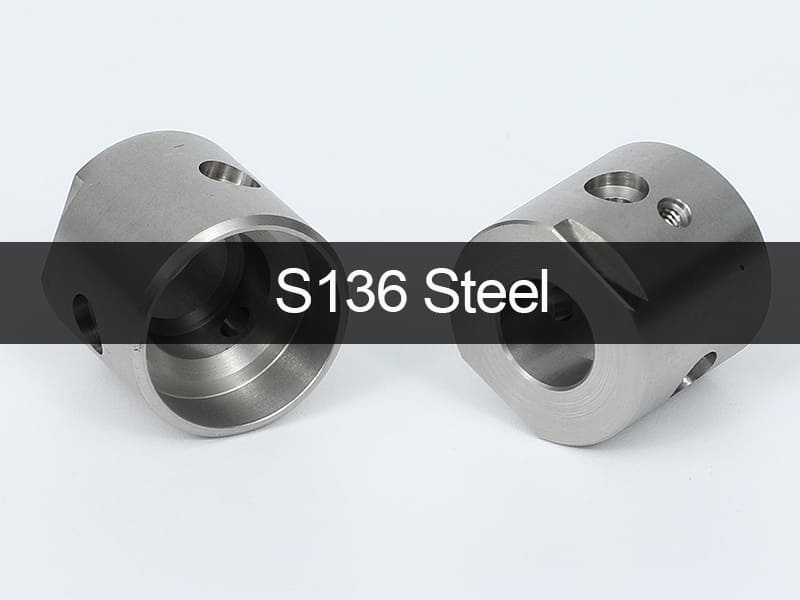
S136 is a martensitic stainless mold steel with a lot of chromium. It is very resistant to rust, has good hardness, and can be polished very well. It is often used for molds in the medical, food, optical, and high-gloss industries where stable surface performance and low maintenance are important.
What is steel S136? — Standards, Definitions, and Classifications
S136 steel is a type of martensitic stainless mold steel that was made just for tooling uses that need to be resistant to corrosion, easy to polish, and stable in size. From the point of view of materials engineering, S136 is at the crossroads of stainless steels and mold tool steels. It has the properties of both types of steel, and it can be heat treated to the hardness levels needed for injection molds and precision cavities.
Classification of Steel and Material Family
S136 is a type of high-chromium martensitic stainless tool steel. Because it has a lot of chromium (usually around 13%), it can form a passive oxide layer that protects against rust, pitting, and corrosion from water that are common in molding environments.
This makes S136 very different from:
-
Conventional carbon mold steels are easy to machine and cost-effective, but they corrode easily and lose surface quality in humid or aggressive conditions.
-
Pre-hardened mold steels are easier to work with, but they don’t have the corrosion resistance or high-polish ability needed for medical, food, or optical uses.
S136 can be hardened by heat treatment, which makes it possible to control the balance of hardness, strength, and corrosion resistance that is best for long-term mold service. This is not the case with austenitic stainless steels.
Standards and Steel Equivalents from Around the World
S136 is known by many names around the world, including:
-
DIN / EN 1.2083
-
AISI 420
-
JIS SUS420J2
-
DIN X42Cr13
People often think of these grades as the same, but they aren’t exactly the same. The polishability, corrosion resistance, and toughness of a material can change depending on the carbon range, cleanliness, inclusion control, and normal heat treatment practice.
Mühendislik notu: When surface quality, corrosion performance, or mold life are very important, the exact S136 steel specification and the quality of the supplier matter more than the nominal grade equivalence.
The chemical makeup of S136 steel and how it affects alloys
S136 steel works well as a stainless mold steel because it has a carefully balanced alloy system that makes it resistant to corrosion, easy to polish, and strong enough to be heat-treated. S136 doesn’t use carbon mold steels; instead, it relies on chromium-driven passivation and microstructural cleanliness to keep the surface quality stable over time in tough molding environments.
Typical Chemical Composition of S136 Steel (wt%)
| Element | Normal Aralık (%) | Main Role |
| Karbon (C) | 0.35–0.45 | Possible hardness, possible formation of martensite |
| Krom (Cr) | 12.5–13.5 | protects against corrosion and passivation |
| Silisyum (Si) | ≤ 1.0 | Deoxidation and stability of the matrix |
| Manganez (Mn) | ≤ 1.0 | Daha sert hale getirmeye yardımcı olur |
| Molibden (Mo) | ≤ 0.5 (optional) | Pitting resistance, temper stability |
| Nikel (Ni) | ≤ 0.6 (optional) | supports toughness and balances corrosion. |
Different producers and melting routes have different exact limits.
How adding other metals makes something resistant to corrosion and easy to polish
High Chromium Content — Corrosion Mechanism Chromium is the most important part of S136 steel. A stable chromium-oxide passive film forms on the surface at about 13% Cr. This protects the steel from rust, cooling water, and plastic additives that are corrosive (like halogens).
-
Microstructural effect: Chromium keeps martensite stable while allowing passivation.
-
The engineering result is less pitting and staining, less frequent maintenance, and a longer mold service life in wet or corrosive conditions.
Carbon Content—Hardness vs. Polishability Carbon determines how hard something can get after heat treatment, but it also affects how carbide forms.
-
Balance logic: S136 uses a moderate amount of carbon to get the mold hardness it needs without adding too much carbide, which would make polishing harder.
-
Engineering result: A smoother, more even surface finish than cold work steels with more carbon.
Mo and Ni — Secondary Performance Tuning Molybdenum makes things more resistant to localized corrosion and more stable when heated, while nickel can make things tougher without making them less resistant to corrosion. This is useful for larger mold inserts and cores.
ESR / VD Melting — Inclusion Control and Mirror Finish Premium S136 grades. Electroslag remelting (ESR) or vacuum degassing are two ways to make.
-
Microstructural effect: Fewer non-metallic inclusions and cleaner grain boundaries.
-
Engineering result: better mirror polishability, fewer polishing flaws, and better fatigue resistance at the surface.
The alloy design of S136 tool steel follows a clear element → microstructure → performance logic. This is why it is preferred when corrosion resistance and optical-grade surface quality are just as important as mechanical strength.
The microstructure and corrosion mechanism of S136 steel.
S136 steel’s ability to be both resistant to corrosion and hard enough for mold-making comes from its microstructure and cleanliness, not just its chromium content. Knowing how its microstructure changes after heat treatment helps explain why S136 keeps its surface performance stable over long production cycles.
Isıl İşlem Sonrası Mikroyapı
When S136 is properly austenitized, quenched, and tempered, it develops a microstructure that is mostly tempered martensite. This martensitic matrix gives mold cavities and cores the strength and hardness they need. Controlled tempering, on the other hand, relieves internal stresses and makes the dimensions more stable.
S136 has the following carbides:
-
Because of the moderate amount of carbon, they are relatively fine and evenly spread out.
-
Present in smaller amounts than high-carbon cold work steels
This distribution of carbides is very important. Too many or rough carbides break up the surface and make it less shiny. On the other hand, S136’s controlled carbide population helps both mirror finishing and structural integrity. In high-quality grades made by ESR or VD melting, non-metallic inclusions are kept to a minimum. This makes the surface more even and lowers the number of places where cracks can start.
Why S136 Stays Resistant to Corrosion After Hardening
S136 doesn’t lose its ability to resist corrosion when it hardens, unlike carbon mold steels. This is because its microstructure supports stable chromium passivation.
-
Passive film formation: S136 has about 13% chromium dissolved in the martensitic matrix, which makes a thin, self-healing layer of chromium oxide on the surface. This passive film keeps moisture, cooling water, and corrosive polymer byproducts from getting in.
-
Role of microstructural uniformity: A clean, uniform martensitic structure makes sure that chromium is evenly available at the surface. Large carbides or inclusions can remove chromium from certain areas and start corrosion; S136’s refined structure lowers this risk.
-
Effect of heat treatment: Correctly austenitizing and tempering stops chromium from separating and too much carbide from forming, keeping corrosion resistance without losing hardness.
Mühendislik çıkarımı: The fact that S136 tool steel doesn’t rust is not a coincidence. It has a martensitic microstructure that is uniformly hardened and has a high level of purity, which makes it durable for passivation. This makes S136 a good choice for molds that work in humid, corrosive, or hygiene-critical environments.
The physical and mechanical properties of S136 steel
The mechanical and physical properties of S136 steel are designed to make molds last a long time in corrosive and high-surface-quality situations. S136 is different from cold work steels that focus on wear. It focuses on corrosion resistance, polishability, and dimensional stability, while still being hard enough for injection molding service.
Mechanical Properties When Annealed and Hardened
| Durum | Normal Hardness | Mühendislik Anlamı |
| Tavlanmış | ~190–230 HB | Good for roughing out cavities and cores |
| Hardened and tempered | 48–54 HRC | a good balance of strength, resistance to rust, and polishability |
Interpretation in engineering:
-
S136 machines work reliably when they are annealed, which makes it possible to finish complex cavity shapes with very little residual stress.
-
The usual 48–54 HRC range is strong enough to resist plastic deformation under injection pressure after heat treatment, while still being tough and resistant to corrosion. Going beyond this range of hardness often doesn’t help and may make it harder to polish or more likely to crack.
S136 needs to be heat-treated, but it gives better surface quality and long-term stability in harsh environments than pre-hardened mold steels.
Ability to Maintain Dimensions and Finish Surfaces
| Mülkiyet | How it affects molds in real life |
| Air or controlled quench hardening | lowers the risk of distortion. |
| Tempered martensitic structure | with stable geometry over long runs |
| Low inclusion content (ESR/VD grades) | and better mirror polishing |
| Thermal expansion that is moderate | Size control that is easy to predict |
-
Boyutsal stabilite: After heat treatment, S136’s hardening response and controlled carbide precipitation help keep sizes very stable. This is especially important for cavities, cores, and shut-off areas that need to be very precise. Correct stress relief and tempering multiple times also help reduce movement after hardening.
-
Ability to finish surfaces: The steel’s clean microstructure and small number of carbides make it possible to get high-gloss and optical-grade finishes. This is very important for clear parts, cosmetic housings, and medical parts where surface flaws mean scrap or rework.
What This Means for the Life and Care of Mold
-
Longer service intervals: Resistance to corrosion means less downtime and less need to polish.
-
Stable part quality: Consistent dimensions keep the gate, vent, and shut-off working well over time.
-
Lower lifecycle cost: Higher costs for materials and heat treatment are made up for by fewer repairs and predictable maintenance schedules.
The properties of S136 steel are best for molds where corrosion resistance, surface quality, and dimensional stability are important. This makes it a good choice for high-gloss, precision, and hygiene-critical molding applications.
The Steps and Metallurgical Logic Behind Heat Treatment of S136 Steel
The heat treatment of S136 steel is a very important step that affects not only its hardness and strength, but also its ability to resist corrosion, be polished, and stay the same size. S136 is a martensitic stainless mold steel, so heat treatment has to find a balance between mechanical performance and surface integrity. This is a trade-off that is often oversimplified in general references but is very important in real mold service.
The Standard Heat Treatment Cycle
The following steps are part of a normal heat treatment process for S136:
-
Tavlama is done after forging or before a lot of machining.
-
The goal is to make the steel softer, make the structure more even, and lower the residual stress.
-
Engineering benefit: makes it easier to machine and reduces distortion during hardening.
-
-
Östenitleme is done at a high temperature to mix carbon and other metals into austenite.
-
Mantık: To make a strong martensitic matrix after quenching, you need to dissolve enough of the material, but not so much that it causes too much carbide precipitation, which would make it less polishable.
-
-
A common way to harden S136 after quenching is to use vacuum quenching with gas cooling or controlled air cooling.
-
Why use vacuum hardening? Stops oxidation and decarburization on the surface; Keeps the surface finish and corrosion resistance strong
-
Not: Gas quenching is better for precise cavities, while oil quenching is not often recommended because it can cause distortion.
-
-
Temperleme is done right after quenching, usually one or two times depending on how hard you want it to be.
Important Factors and Performance Control
Choosing the temperature for austenitizing
-
Too low → not hard enough and less resistant to wear
-
Too high means too much retained austenite, less toughness, and less polishability.
How to temper
Tempering takes away the stresses from quenching and makes the martensitic structure stable.
-
One tempering vs. two tempering:
-
For targets with moderate hardness, one tempering may be enough.
-
Double tempering makes molds more stable in size and harder, which is especially important for high-precision molds.
-
-
Hardness vs. corrosion and polishability balance. Pushing S136 to its highest hardness level doesn’t always make the mold work better, unlike with carbon tool steels. Too much hardness can:
-
Put more stress on the inside
-
Encourage the formation of microcracks while polishing
-
Chromium segregation lowers corrosion resistance.
-
Most mold applications can use the 48–54 HRC range, which is a good middle ground.
Risks of Common Heat Treatment
-
Distorsiyon: This happens when the heating is uneven, the shape is not symmetrical, or the quenching is too strong. Azaltma: Before hardening and vacuum/gas quenching, stress relief.
-
Cracking: Often caused by not controlling stress well enough or not quenching hard enough. Azaltma: controlled heating ramps and tempering right away.
-
Hardness and polishability are out of balance: S136 that is too hard or not tempered well enough may meet hardness goals but not get a mirror finish. Azaltma: Don’t just think about hardness when choosing a tempering strategy; think about the surface finish requirements as well.
The main point for engineers is that the goal of S136 steel heat treatment is not to make it as hard as possible, but to control the microstructure so that it is corrosion-resistant, stable in size, and has a good surface finish all at the same time. This is what determines the life and performance of the mold.
Things to think about when machining, grinding, and polishing S136 steel
To make S136 steel successfully, you need to be strict about how you machine, grind, and polish it. This is because the integrity of the surface directly affects how resistant it is to corrosion, how good it looks, and how long it lasts.
Machinability when Annealed
S136 is best machined a lot when it is annealed (about 190–230 HB), when cutting forces are easy to control and tool wear is easy to predict.
-
Parameters and tools for cutting:
-
Use coated carbide tools for milling and turning. Sharp edges and positive rake angles help keep the edge from getting too thick.
-
To avoid work hardening and tearing the surface, it’s best to cut at moderate speeds with stable feeds.
-
Flood coolant or MQL helps keep the temperature stable and the surface quality high.
-
-
Plan for the process:
-
Finish the roughing and semi-finishing before hardening, and leave the stock even for finishing after heat treatment.
-
Don’t have sharp corners inside; big radii lower residual stress and polishing flaws later on.
-
-
Cost control: Efficient annealed-state machining cuts down on the time needed for grinding after hardening, which is the main cost driver for high-finish molds.
Practices for Grinding and Mirror Polishing
Grinding and polishing determine final performance after hardening (usually 48–54 HRC).
-
Things to think about when grinding:
-
Localized overheating can cause S136 to become sensitive to grinding burn, which can lower its corrosion resistance and start microcracks.
-
Use wheels with fine grains, light passes, regular dressing, and plenty of coolant. It’s very important to control the temperature.
-
-
How well it can be polished to a mirror finish:
-
To get optical or high-gloss finishes, the microstructure must be clean and free of any particles. High-quality ESR/VD grades cut down on polishing time and the chance of defects by a lot.
-
Move forward with controlled polishing steps; don’t make sudden changes that could reveal defects below the surface.
-
-
Surface integrity: Any layer that has been affected by heat or any residual tensile stress can make corrosion resistance worse and shorten service intervals.
The engineering lesson is that S136 rewards a machining strategy that starts with annealing and careful thermal control during grinding, which leads to polishing methods that match the cleanliness of the steel. If done correctly, these steps will give you S136’s best features: the ability to make a mirror finish, resistance to rust, and long-term mold stability.
Common Uses of S136 Steel in Engineering
When corrosion resistance and surface integrity are just as important as mechanical strength, S136 steel is used in mold applications. When standard mold steels rust, stain, or lose their shine over time, it becomes clear how valuable it is as an engineering material.
Blow and injection molds for plastic
Many people use S136 to make plastic injection molds and blow molds that work with polymers that are sensitive to moisture or chemicals.
-
Corrosive plastics (PVC, flame-retardant materials): These materials give off chlorine or other corrosive byproducts when they are being worked on.
-
Why S136 is needed: A high chromium content creates a stable passive layer that stops pitting and surface attack that would quickly wear down carbon or pre-hardened mold steels.
-
-
In environments with a lot of humidity or cooling water, condensation and water leaks happen a lot in large molds and high-cycle production.
-
Why S136 is needed: True stainless behavior keeps rusting to a minimum, which means less time spent cleaning, polishing, or doing other maintenance.
-
Mühendislik çıkarımı: When you use non-stainless mold steels in these situations, you often have to repair the surface a lot and the parts don’t always work well. S136 changes the life of a mold from being limited by maintenance to being limited by the process.
Molds for medical, food, and optical use
For industries where hygiene and appearance are very important, S136 is the best material for molds.
-
Molds for food and medicine:
-
Why S136 is necessary: Corrosion resistance helps with cleaning, sterilization, and keeping the surface stable over time without getting dirty or stained.
-
-
Optical and high-gloss molds are used to make lenses, clear housings, and cosmetic parts.
-
Why S136 is necessary: A clean martensitic structure and low inclusion content make it possible to polish to a mirror finish with few subsurface flaws.
-
In these cases, surface degradation means scrap, regulatory risk, or cosmetic rejection. S136 gives surfaces that last for a long time and work the same way every time.
An engineering point of view
When S136 is chosen, it is because:
-
The risk of corrosion has a direct effect on the quality of parts and the life of molds.
-
Carbon mold steels can’t reliably meet the requirements for surface finish.
-
Long service intervals and consistent polishing performance make the higher material and processing costs worth it.
Mühendislik çıkarımı: S136 steel isn’t chosen for its hardness; it’s chosen when corrosion resistance and surface quality are must-haves for precision molding projects.
S136 Steel’s Failure Modes and Design Limits
S136 steel is not the best choice for everyone, even though it has a unique mix of corrosion resistance and polishability. To make realistic design choices and make sure that a mold will last a long time, you need to know how it can fail and what materials it can’t handle.
Stress Cracking and Corrosion Fatigue
S136 is resistant to general corrosion, but it can be prone to corrosion fatigue when tensile stress, cyclic loading, and corrosive media work together.
-
Temel nedenler: Microcracks can start when residual tensile stresses from heat treatment, grinding burn, or EDM recast layers mix with moisture or aggressive plastics.
-
Failure behavior: Cracks usually start on the surface and spread slowly, so they may not be noticed until the surface quality gets worse.
-
Tasarım etkisi: To keep corrosion resistance over time, it is important to control stress through proper tempering, gentle grinding, and polishing after EDM.
Wear vs. Toughness Trade-Off
Steel S136 doesn’t wear out easily.
-
Sınırlama: Its wear resistance is not as good as that of high-carbon cold work steels like SKD11/D2 at normal working hardness levels (≈48–54 HRC).
-
Trade-off logic: Making something harder to make it last longer can make it less tough and less able to be polished or resist corrosion.
-
Mühendislik etkisi: If molds have a lot of sliding wear, gate erosion, or glass-filled polymers, S136 may wear out faster than expected unless surface treatments or inserts are used.
When S136 Is NOT the Right Choice
When S136 should be thought about again:
-
Abrasive wear is the main cause of tool life (for example, plastics with a lot of glass fibers).
-
Impact or high clamping shock is important, so more toughness is needed.
-
People are very sensitive to price, and the requirements for corrosion and surface finish are moderate.
-
Simple pre-hardened steels can meet performance needs at a lower cost of processing.
In these situations, different mold steels or hybrid designs (S136 cavities with wear-resistant inserts) are often a better value for the money.
Mühendislik çıkarımı: S136 steel is the best choice when corrosion resistance and surface integrity are important. When wear, impact, or cost become the most important factors, its benefits become fewer, and making an informed choice about which material to use is often the best engineering choice.
S136 Steel vs Other Mold Steels—How to Choose
When you compare S136 to other mold steels that are often used, it becomes easier to choose because they have different delivery modes, corrosion resistance, and surface finish capabilities. The comparisons below are based on engineering trade-offs that change lead time, manufacturing cost, and mold life, not just grade names.
S136 vs S136H (Pre-Hardened): Lead Time vs. Best Performance
| Aspect | S136 (Hardened after machining) | S136H (Pre-Hardened) |
| Delivery state | Tavlanmış | pre-hardened |
| Typical hardness | 48–54 HRC (after HT) | 34–38 HRC |
| Talaşlı İmalat | Rough → HT → finish | Finish directly |
| Teslim süresi | Longer (needs HT) | shorter |
| Ceiling for surface finish | En yüksek | High (but lower ceiling) |
Logic in engineering:
-
S136H makes it easier to process and deliver medium-precision molds or quick programs.
-
S136 has a higher final hardness, better dimensional stability after the right HT, and a higher polishability ceiling for optical or cosmetic parts.
Sonuç olarak, pick S136H if speed and ease of use are most important. Pick S136 if you need the best surface quality and the longest service life.
S136 vs. P20/718: Which is better at resisting corrosion and saving money?
S136 and P20 / 718 are two different things.
-
High (stainless) corrosion resistance vs. low corrosion resistance
-
Typical hardness is between 48 and 54 HRC vs. between 28 and 34 HRC.
-
Parlatılabilirlik: Great vs. Average
-
Fiyat: Higher vs. Lower
-
Maintenance: Low maintenance (less rust) vs. Higher maintenance (rust, repolish)
Logic in engineering:
-
P20/718 is cheap and easy to machine, and it works well with plastics that don’t corrode and don’t need a lot of finishing.
-
In humid places or with corrosive plastics, S136 stops rust, stains, and polish loss.
Conclusion: If you need a low-cost program with a simple finish, go with P20/718. If you need a high-gloss finish or are worried about corrosion, go with S136.
Steel Cleanliness and Mold Life: S136 vs. Standard AISI 420
| Aspect | S136 (Premium) | Standard 420 |
| Quality of melting | ESR/VD options | Conventional |
| Control of inclusion | Yüksek | Değişken |
| Polishability | Daha iyi | not always |
| Corrosion stability | Yüksek | moderate-high |
| Service consistency | Reliable | based on the supplier |
Engineering logic: Both are martensitic stainless steels, but S136 is made with stricter cleanliness controls. This has a direct effect on how long it takes to polish a mirror, the risk of defects, and the fatigue life at the surface.
Final decision: Use S136 for precise cavities and optical finishes. Standard 420 might be enough for molds that aren’t as important and don’t need as much surface quality.
Summary of Engineering Choices
-
When surface quality and corrosion resistance are important, choose S136.
-
Choose S136H to cut down on lead time while still getting good performance.
-
Pick P20/718 when speed and cost are more important than polish and corrosion needs.
-
Choose S136 over generic 420 for a mold that lasts a long time and is easy to polish.
In the end, S136 is worth the extra money because it lasts longer and requires less maintenance, scrap, and downtime throughout the mold’s life.
In short
People like S136 steel because it doesn’t rust and stays stable on the surface for a long time, not because it’s very hard or resistant to wear. This martensitic stainless mold steel doesn’t rust, pit, or degrade on the surface when it’s humid, exposed to cooling water, or when it’s used to mold corrosive plastics. It has a clean microstructure that makes it easy to polish to a high-gloss and optical level. This makes it perfect for medical, food, and clear plastic applications where the quality of the surface directly affects how well the part works.
S136 is designed with a balanced hardness range of 48 to 54 HRC to keep its dimensions stable and its surface intact over long service cycles. To get these benefits, you need to do the right heat treatment and finishing. When mold life is based on corrosion resistance and surface finish, S136 is a great choice. However, it is not as good for materials that are very abrasive, tools that hit things hard, or applications where cost is more important than surface quality.
Sıkça Sorulan Sorular
What do people use S136 steel for?
S136 steel is mostly used for injection and blow molds that need to be resistant to corrosion and have a stable surface over time. Some common uses are making molds for medical devices, food-contact items, optical parts, clear parts, and cosmetic cases. It is also chosen for making molds that work with corrosive plastics like PVC and flame-retardant compounds, or for use in places with high humidity and cooling water where regular mold steels rust or stain.
Does S136 steel resist rust?
Yes. S136 is a type of martensitic stainless mold steel that has about 13% chromium in it. This makes a stable passive oxide layer. This is a good way to stop rusting, pitting, and corrosion from water that is common in molding shops. When heat treatment is done right, corrosion resistance stays the same after hardening. Premium ESR/VD grades make corrosion even more consistent by lowering the number of inclusions and chromium-depleted areas.
How hard is S136 steel?
S136 steel usually works in the 48–54 HRC range after heat treatment.
Lower end (48–50 HRC): More toughness and less chance of stress cracking; good for bigger molds and more complicated cavities.
Upper end (52–54 HRC): Better at resisting wear and plastic deformation, while still being able to be polished and resistant to corrosion. Pushing hardness past this point doesn’t usually make molds last longer and can make the surface finish or corrosion performance worse.
Is S136 the same as AISI 420?
AISI 420 and S136 are both chemically similar martensitic stainless steels, but S136 is often thought of as a higher-quality mold-grade version of AISI 420. But they don’t work the same way in real life. S136 is usually made with better composition control and cleaner melting routes (usually ESR/VD), which makes it easier to polish, more resistant to corrosion, and longer mold life. Standard AISI 420 may work for molds that aren’t very important, but the quality of the surface depends more on the supplier.
Which one should I choose, S136 or S136H?
The choice depends on how long it takes to get there, how it will be processed, and what kind of surface is needed:
If you need a shorter delivery time, easier machining, and a moderate surface finish, choose S136H (pre-hardened). It usually comes in the range of 34 to 38 HRC.
Choose S136 (annealed, then hardened) when you need a surface that can be polished to a high shine, is very hard, and stays stable over time. This is especially important for medical, optical, or high-gloss uses.


