
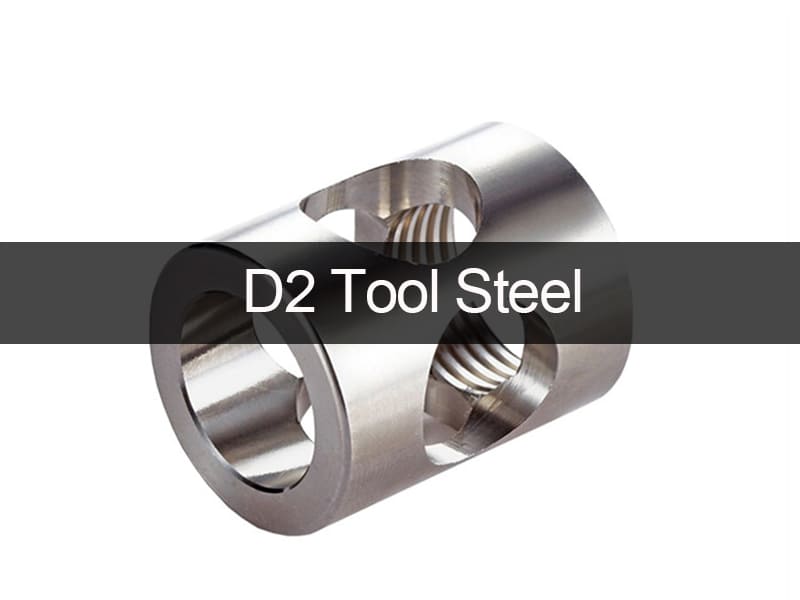
D2 — это холодноштамповая инструментальная сталь с высоким содержанием углерода и хрома, предназначенная для применений, где стойкость режущей кромки и износостойкость являются наиболее важными эксплуатационными требованиями. D2 содержит большое количество карбидов, что делает её очень устойчивой к абразивному износу и затуплению кромки. Это делает её давним стандартом для инструментов, критичных к износу, таких как штампы, пуансоны и режущие детали.
D2 — это воздушно-закаливаемая сталь, которая также довольно хорошо сохраняет форму при термической обработке. Но этот высокий уровень износостойкости достигается ценой меньшей ударной вязкости и большей хрупкости. D2 — это не инструментальная сталь общего назначения; это целенаправленный инженерный выбор, лучше всего подходящий для задач, где срок службы инструмента определяется износом, а не ударными или динамическими нагрузками.
Что такое инструментальная сталь D2?| Обозначение, стандарты и классификация
Инструментальная сталь D2 — это хорошо известная часть системы инструментальных сталей AISI. Она входит в "серию D" холодноштамповых инструментальных сталей. Её название сразу говорит о типе инженерного решения: высокоуглеродистая, высокохромистая, с преобладанием износостойких характеристик, а не ударной вязкости или коррозионной стойкости.
Место в системе инструментальных сталей AISI
В системе AISI:
-
"Серия D" состоит из холодноштамповых инструментальных сталей с высоким содержанием углерода и хрома.
-
D2 — наиболее популярная марка в этой серии, потому что она легкодоступна, существует давно и доказала свою долговечность.
Серия D была создана для инструментов, которые изнашиваются при интенсивном использовании и должны сохранять остроту кромок. Это включает вырубку, пробивку и резку. Поэтому D2 является эталонным материалом для применений, где важна износостойкость.
Почему D2 не является нержавеющей сталью: логика названия
Люди часто путаются в том, сколько хрома содержится в D2. D2 содержит около 12% хрома, что близко к количеству хрома, используемому в мартенситных нержавеющих сталях. Но:
-
D2 содержит много углерода (около 1,5%).
-
Большая часть хрома не находится в свободном твёрдом растворе; вместо этого он связан в карбидах хрома.
Из-за этого D2 не может образовать непрерывный слой пассивной оксидной плёнки хрома.
Инженерный вывод заключается в том, что D2 не является нержавеющей сталью, но она сопротивляется коррозии лучше, чем низколегированные инструментальные стали. Поэтому часто говорят, что она ведёт себя как "полунержавеющая": она выдерживает умеренную влажность, но не агрессивные среды.
Стандарты и глобальные эквивалентные марки
Инструментальная сталь D2 является стандартом во всём мире и может использоваться многими способами на уровне спецификаций:
| Регион / Стандарт | Класс |
| ASTM/AISI | D2 (ASTM A681) |
| DIN / EN | 2379 / X153CrMoV12 |
| JIS | SKD11 |
| GB (Китай) | Cr12MoV |
Эти марки имеют схожую философию проектирования и состав инструментальной стали D2, но способы их термической обработки и целевые свойства могут различаться для каждого стандарта.
Инженерный урок
Лучший способ думать о стали D2 — это холодноштамповая инструментальная сталь, которая изнашивается в первую очередь. То, как она классифицируется, называется и сравнивается с другими материалами по всему миру, передаёт одно и то же сообщение:
D2 создана для того, чтобы быть очень твёрдой, износостойкой и стабильной при закалке на воздухе. Она не создана для ударной вязкости против ударов или коррозии.
Химический состав и микроструктурные процессы
В этой части рассказывается, почему инструментальная сталь D2 ведёт себя именно так. Здесь не просто говорится, из чего она сделана; также объясняется, как её химия делает её очень износостойкой и одновременно ограничивает её ударную вязкость. Механизм, обусловленный карбидами, является основной причиной, по которой D2 остаётся стандартом для инструментов, требующих длительного срока службы.
Химический состав стали D2
| Элемент | Нормальный диапазон (вес.%) | Роль инженера |
| C | 1.40–1.60 | Высокий потенциал твёрдости; объём карбидов |
| Cr | 11.0–13.0 | карбиды хрома; сопротивление износу; способность закаливаться на воздухе |
| Mo | 0.70–1.20 | стабильность карбидов, вторичное твердение и сопротивление отпуску |
| V | 0,10–0,30 | Измельчение зерна и образование мелких карбидов |
| Mn | 0.20–0.60 | Помогает при закалке |
| Si | 0.20–0.60 | Удаляет кислород и упрочняет матрицу |
Высокое содержание C + высокое содержание Cr означает, что D2 уверенно относится к категории высокоуглеродистых, высокохромистых сталей, поскольку содержит около 1,5% углерода и 12% хрома. Эта химия обеспечивает большое количество карбидов, что и делает D2 настолько износостойкой. Но это также означает, что значительная часть хрома связана в карбидах, а не растворена в матрице. Именно поэтому она не ведёт себя как нержавеющая сталь и имеет меньшую ударную вязкость.
Процесс образования карбидов и то, как они сопротивляются износу
Износостойкость D2 определяется количеством и распределением карбидов, а не только твёрдостью основного объёма.
Первичные (эвтектические) карбиды: При затвердевании D2 образует грубые первичные карбиды хрома, в основном:
-
Cr7C3Cr_7C_3 -
Cr23C6Cr_C_6
Эти карбиды очень твёрдые и защищают от износа в малом масштабе. Они сопротивляются царапанию и удалению материала при контакте с чем-то абразивным, поэтому D2 так хорошо работает для вырубки, продольной резки и резки.
Вторичные карбиды (карбиды отпуска) образуются, когда мартенситная матрица нагревается и правильно отпускается:
-
Mo и V поддерживают её стабильность
-
Делают её твёрже и более устойчивой к отпуску при нагреве
-
Меньше разупрочнения во время эксплуатации
Почему D2 прочная, но не очень износостойкая
Та же микроструктура, которая делает D2 прочной, также делает её слабой:
-
Большое количество карбидов означает хорошую износостойкость.
-
The size and continuity of the carbide create stress concentration sites.
-
Less matrix continuity means less fracture toughness.
When something hits or is out of alignment, cracks usually start at the carbide-matrix interfaces. This causes chipping instead of plastic deformation.
What you can learn from engineering
Carbide is the main factor that affects D2's performance. It works great when abrasive wear and edge retention control tool life, but its toughness limit is set by the shape of the carbide. This is why D2 lasts longer than A2 and why A2 can take more impact than D2.
D2 Steel's Physical and Mechanical Properties
The performance of D2 tool steel is determined not by a singular strength value, but rather by the interplay of hardness, compressive strength, wear resistance, and dimensional stability. To choose the right materials, you need to understand these relationships.
Common Physical and Mechanical Properties
| Недвижимость | Типичный диапазон | Инженерное значение |
| Твердость (HRC) | 55–62 (after heat treatment). | High edge retention and wear resistance. |
| Compressive strength | Очень высокий | very resistant to surface deformation. |
| Ударная вязкость | Низкий до умеренного | can only handle a little shock and is at risk of chipping. |
| Размерная стабильность | Высокий | air hardening reduces distortion. |
| Плотность | ~7.7 g/cm³ | similar to other tool steels |
| Модуль упругости | ~210 GPa | very stiff and can hold a lot of weight. |
-
D2 is most commonly used at 58–61 HRC because its chromium carbide network makes it very resistant to wear and tear. Increasing hardness beyond this range leads to shorter wear life and a big drop in toughness.
-
D2 has very high compressive strength, which makes it perfect for uses where compressive and sliding contact stresses are the main types of stress, like blanking and forming. But its carbide-rich microstructure makes it less tough when it comes to impact. When D2 is shocked or misaligned, it tends to chip instead of bending, which is an important factor for tool designers to keep in mind.
-
As an air-hardening tool steel, D2 has an advantage when it comes to dimensional stability because it doesn't change as much in temperature during quenching as oil-hardened grades do. This leads to:
-
Less distortion
-
Better shape keeping
-
Less grinding to fix mistakes
-
-
Corrosion behavior of "semi-stainless" steel: D2 has about 12% chromium, but most of it is in carbides. This stops passive film formation, which makes D2 less resistant to corrosion than low-alloy tool steels but much less resistant than true stainless steels like 440C.
Вывод для инженеров
The properties of D2 steel show that it was designed to last. It has a lot of hardness, compressive strength, and dimensional stability, but it also has a clear limit on how tough it can be. D2 works best when wear and tear, not impact, controls how long the tool lasts.
Theory, parameters, and practical control of heat treatment of D2 tool steel
The performance of D2 tool steel really depends on how it is heat treated. D2 is an air-hardening steel with a lot of carbon and chromium. This means that even small changes in the process parameters can have a big effect on the distribution of carbides, hardness, toughness, and dimensional stability. This part tells you why each step is important, not just how to do it.
Standard Heat Treatment Cycle
-
Отжиг is usually done to soften the steel and make the microstructure more uniform. Annealing D2 at a high temperature and then cooling it very slowly in a furnace makes a spheroidized carbide structure that makes it easier to machine and lowers internal stress.
-
Preheating is very important because D2 has a lot of alloys and doesn't conduct heat well. Most of the time, one or two preheat stages are used to:
-
Minimize thermal shock
-
Minimize changes
-
Stop cracking while austenitizing
-
-
Choosing the right temperature for austenitizing is very important. If you heat it too low, the carbide won't dissolve as well and the hardness won't be as high. If you heat it too high, the grains will grow and too much austenite will stay in the metal. Good control keeps the grains stable while the carbides dissolve.
-
Air Quenching D2 is made for air quenching, which cools the metal enough to turn it into martensite while keeping thermal gradients to a minimum. This greatly improves control over dimensional distortion and lowers the risk of cracking in complicated tools when compared to oil quenching.
-
Закалка is required and is usually done two or three times. This keeps the martensitic structure stable, relieves stress, and controls the final hardness and toughness.
How the settings for heat treatment affect performance
Austenitizing temperature vs. carbide behavior: Higher austenitizing temperatures dissolve more chromium carbides into the matrix, which makes the material harder but also:
-
Increasing the amount of retained austenite
-
Lowering the stability of dimensions
-
Making things more brittle
Lower temperatures keep more primary carbides, which makes wear resistance more consistent but limits peak hardness.
Effects of tempering temperature
-
Low tempering temperatures lead to the hardest steel, but it is also the most brittle.
-
Temperatures that are not too high or too low give you a good balance of hardness and stability.
-
Higher tempering temperatures make the material tougher and a little less hard.
D2 also has a secondary hardening effect, which means that fine alloy carbides form during tempering and help keep the hardness up at high tempering temperatures.
Retained austenite High levels of retained austenite can cause:
-
Change in size after service
-
Less wear consistency
The main way to control is through multiple tempering cycles.
Риски распространённой термообработки
-
Коробление: Even though air hardening makes things more stable, uneven section thickness, bad fixturing, or wrong heating rates can still cause distortion.
-
Трещины happen most often when the object isn't heated enough before use or when there are too many temperature changes, especially in sharp corners.
What you should remember about engineering
Heat treatment of D2 tool steel is not something that is done every day; it is a precise process. When austenitizing, quenching, and tempering parameters are carefully controlled, its air-hardening nature gives it great dimensional control. D2's great wear resistance comes from proper heat treatment; poor control makes it more brittle.
Things to think about when machining, grinding, and welding
From a manufacturing point of view, D2 tool steel is known for being hard to work with, but it's not impossible if you have the right plan. The high amount of carbide in it makes it both very resistant to wear and hard to work with. Engineers should have realistic expectations when working with D2 and follow strict process control.
Characteristics of Machining
Condition of annealed vs. hardened
-
You can machine annealed D2, but it's not as easy to do as A2 or O1. Carbide particles make tools wear out quickly and make cutting forces high.
-
D2 that has been hardened to at least 55 HRC is not usually good for regular machining. It should only be used for grinding, EDM, or CBN hard turning to remove small amounts of stock.
Suggestions for tools
-
For annealed D2, carbide tools are the least you need.
-
After heat treatment, CBN tooling can be used for hard turning, but only with stiff setups.
-
To avoid edge chipping and thermal damage, use slow cutting speeds, controlled feeds, and don't stop cutting.
Cutting heat and tool failure risk High cutting temperatures speed up tool wear and cause micro-chipping. To stop tools from breaking suddenly, it's important to have good coolant delivery and stable fixturing.
Grinding and the integrity of the surface
Grinding is the main way to finish D2, but it poses a lot of risks to the surface integrity:
-
Прижог при шлифовании can make the surface softer or harder in certain areas.
-
At the interfaces between carbide and the matrix, microcracks may form, which can greatly shorten the life of the tool.
Some of the best ways to do things are:
-
Grinding wheels with sharp, open structures
-
Light passes with regular dressing
-
Coolant with a lot of volume and good direction
Damage to the surface is often hidden, but it has a direct effect on how resistant it is to chipping and fatigue.
Why Welding Is Hard
Welding D2 tool steel is not a good idea unless you are doing controlled repair work. Some of the biggest problems are:
-
High carbon content, which causes martensitic cracking in the area that was affected by heat
-
Localized heating causes high residual stresses.
-
Loss of even carbide distribution
When welding is necessary:
-
To avoid thermal shock, preheating is required.
-
To relieve stress and stabilize the microstructure, post-weld heat treatment is necessary.
Even when done right, repaired areas don't usually work as well as base material that has been heat-treated properly.
Вывод для инженеров
D2 steel is not easy to machine, grind, or weld. Engineers can make D2 into very reliable wear-critical tools, though, if they respect its carbide-dominated nature and use the right tools, follow strict grinding rules, and keep a close eye on the temperature.
Applications and design considerations for wear resistance
D2 tool steel works best when the main way it fails is through abrasive or adhesive wear, not impact or shock. Because it has a lot of carbide and responds well to air-hardening, it's a natural choice for wear-resistant tools, but only if the engineering side of the application is set up correctly.
Where D2 Works Best
-
Blanking and punching dies: D2 is the best material for blanking and punching dies because the life of the edge is controlled by abrasion against sheet material instead of impact energy. The hard chromium carbides keep the cutting edges sharp for a long time, which cuts down on the need to round off edges and regrind them.
-
Shear blades, slitting knives, and strip-cutting tools: D2 is great for shear blades, slitting knives, and strip-cutting tools because it doesn't wear down or micro-gall easily. It can handle constant contact stresses because it has a high compressive strength, as long as the alignment is good and the impact loads are low.
-
Forming and drawing dies: D2 works well in forming and drawing dies when the deformation is slow and the wear on the surface is the main problem. It works especially well for tools that need to keep their shape over a lot of cycles, like progressive dies and precision forming inserts.
-
Gauges and measuring tools: D2's dimensional stability and abrasion resistance are also good for high-wear gauges and measuring tools, especially when long-term surface integrity is more important than impact toughness.
Conditions That Are Good for D2
When the following conditions are met, D2 should be seen as the best option:
-
Chipping does not limit tool life; abrasion does.
-
Most loads are either compressive or sliding, not shock-driven.
-
Alignment and fixturing are stable and can be done again and again.
-
Long production runs make it worth it to pay more for materials and processing.
In these situations, D2 usually has the lowest total cost per part, even though the tooling cost up front is higher.
When D2 is too complicated
D2 might not be the best choice when:
-
Tools have a big effect on things, are out of alignment, or are loaded on the edge.
-
Small geometry features are under a lot of stress.
-
You should expect to make changes or repairs in the field often.
In these situations, D2's carbide-driven brittleness could cause the edge to chip or break suddenly. A tougher steel, like A2 or S7, would last longer, even with a little more wear.
Вывод для инженеров
D2 is not a general-purpose tool steel; it is a wear specialist. D2 is often the best choice when wear resistance is the most important factor in tool life. When toughness or impact are important, D2 can be too strong and not work as well. Choosing the right application is the key to getting the most out of it.
A Guide to Choosing Between D2 Steel and Other Steels
Choosing D2 tool steel only makes sense when its strengths match the most common service conditions. In this part, D2 is compared to A2, S7, and 440C, which are three steels that are most often used to make real engineering decisions.
D2 vs. A2 Tool Steel: Toughness vs. Wear Resistance
| Особенность | D2 | A2 |
| Износостойкость | Очень высокий | Умеренный до высокого |
| Прочность | Нижний | Выше |
| Термическая обработка | Air hardening | Air hardening |
| Стабильность размеров | Высокий | Высокий |
| Обрабатываемость | Hard to Moderate |
Choose D2 when the life of the tool is controlled by edge wear and abrasion, like when blanking or slitting for a long time. If chipping, misalignment, or moderate impact shorten the life of your tools, choose A2. In real life, A2 often lasts longer in mixed loading conditions, while D2 lasts longer in pure wear situations.
D2 and S7 Tool Steel: Wear vs. Impact Resistance
| Особенность | D2 | S7 |
| Износостойкость | Высокий | Низкий |
| Impact Toughness | Низкий | Очень высокий |
| Нормальная твердость | 58–61 HRC | 54–58 HRC |
| Режим отказа | Chipping | plastic deformation |
Engineering advice: S7 should be used for tools that will be exposed to high shock loads, like punches that are out of alignment or thick material. D2, on the other hand, works best when there isn't much impact and wear is the main factor. A common reason why tools fail too soon is because they are used in high-impact situations with D2.
440C vs D2 Steel: How well they resist rust and wear
| Особенность | D2 | 440C |
| Resistance to corrosion | Low (semi-stainless) | high (true stainless) |
| Износостойкость | very high | moderate-high |
| Типичное применение | Dies, punches, knives | Bearings, valves, and cutting tools |
| Stability of heat treatment | high | moderate |
When corrosion resistance is necessary, like in humid or slightly corrosive environments, choose 440C. Pick D2 when protecting against corrosion isn't as important as edge life and wear resistance.
Last Engineering Suggestion
-
D2 → Best for cold work tools that don't wear out quickly and don't hurt things
-
A2 is the best choice for tight tolerances and balanced wear and toughness.
-
S7 is the best for tools that are hit hard or loaded with shock.
-
440C is best for applications that are sensitive to corrosion and wear out slowly.
Important point: D2 is a type of steel that is used for specific purposes. When chosen correctly, it lasts a long time without wearing out. It gets brittle, hard to keep up with, and too expensive when used incorrectly.
Summary: What engineers should know about D2 tool steel
D2 tool steel is a material made for a specific purpose that is very resistant to wear because it has a lot of chromium carbide in it and hardens in the air. D2 has a long edge retention, high hardness, and reliable dimensional stability when abrasive or adhesive wear determines tool life.
But this performance comes at the cost of less toughness and impact resistance. D2 is not a general-purpose upgrade, and it can chip or crack when it is used in applications that put a lot of stress on it or that are not lined up correctly. The most important thing to remember about engineering is to choose the right material based on how it will fail. For example, use D2 when wear is the main concern, and choose tougher materials when impact or adaptability is more important.
Часто задаваемые вопросы
What do people use D2 steel for?
D2 steel is mostly used in cold work tools that wear out quickly because of sliding or abrasive wear. Common uses include blanking and punching dies, shear blades, slitting knives, forming dies, trimming tools, and gauges that wear out quickly. It is chosen when edge retention and a long service life are more important than impact toughness or how easy it is to fix.
Is D2 steel a good choice for knives or tools?
D2 is a great choice for industrial tools when wear resistance is the most important thing. D2 can hold an edge very well for knives, but it is not as tough as other blade steels when it comes to impact. D2 is better at resisting wear than shock, which is great for dies and cutting tools, but when used in knives, it needs to be carefully designed to avoid chipping.
How tough can D2 tool steel be?
D2 tool steel usually gets to 55–62 HRC after being properly air-hardened and tempered several times. Most industrial tools are used in the 58–61 HRC range because it gives them a good balance between being tough and being brittle. Pushing hardness to its highest point makes edges last longer, but it also makes them more likely to chip.
Is it possible to weld D2 steel?
It is hard to weld D2 steel, and most people don't recommend it unless they are doing controlled repair work. Because it has a lot of carbon, it is very prone to cracking in the heat-affected zone. When welding is necessary, it is essential to follow strict rules for preheating, controlling the heat input, and treating the weld afterwards. Even then, welded areas don't usually work as well as the original material that was properly heat-treated.
Should I choose D2 or A2?
Choose D2 when abrasive wear is clearly the main problem and impact loads are low. Pick A2 when tools get hit moderately, need to be aligned differently, or need to be tougher. A2 usually lasts longer in mixed loading conditions, while D2 does better in pure wear situations.
Is D2 made of stainless steel?
No. D2 has about 12% chromium, but most of it is in chromium carbides, which stops a protective passive layer from forming. D2 is better at resisting corrosion than low-alloy tool steels, but it is not stainless steel and should not be used in places where it will be exposed to corrosive chemicals.
These answers cover the most common questions about D2 tool steel in engineering, tooling, and selection. They help professionals choose it for the right reasons and avoid making mistakes that cost money.


