
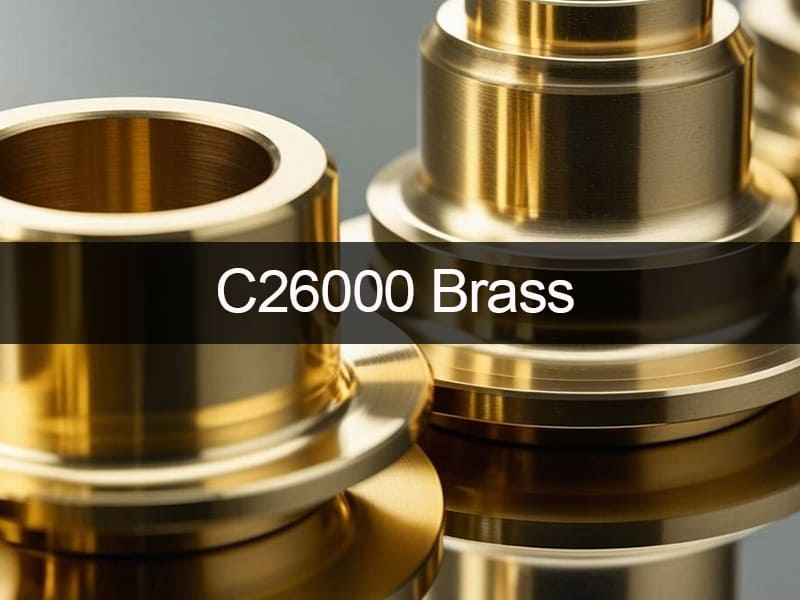
C26000 brass, also called cartridge brass, is a copper-zinc alloy that is known for being easy to shape when cold, having a good balance of strength, and being resistant to corrosion. C26000 is not chosen for high-speed machining like free-cutting brasses are. Instead, it is chosen for forming, bending, and deep-drawing operations.
This article talks about the physical properties, formability, and common engineering uses of C26000 brass. It helps engineers and designers figure out when it is the best choice compared to other brass alloys based on how they are made and how well they work.
What Is C26000 Brass? Definition, Classification, and Standards
Material Definition and Alloy Family
C26000 brass is a copper-zinc alloy that has about 70% copper and 30% zinc. It is a type of Alpha (α) Brass in terms of metallurgy. This means that its microstructure is made up of a single, ductile solid solution of zinc in copper.
This single-phase structure is what makes C26000 so easy to shape when it’s cold. C26000 can undergo significant plastic deformation, such as deep drawing and rolling, without needing to be annealed in between, unlike duplex (α+β) brasses.
The 70/30 Ratio Benefit:
-
More copper: Makes it more flexible and resistant to corrosion.
-
Zinc Content: Adds strength to the solid solution while keeping its shape.
-
The result is a material that is a Forming-Oriented Brass, not a machining grade.
Dünya Çapında Standartlar ve Tanımlamalar
C26000 is widely used, which makes sure that supply chains around the world are the same.
Table 1: Global Standards for C26000
| Region / System | Ad | Notlar |
| UNS (Unified) | C26000 | Is the main identifier for North America. |
| ASTM | B36 / B19 | Is the standard for rolled bar, sheet, plate, and strip. |
| CDA | Alloy 260 | Is also known as Cartridge Brass in the trade. |
| ISO / EN | CuZn30 / CW505L | Is the European equivalent. |
C26000 Brass Chemical Composition and Metallurgical Role
The clean, binary chemistry of C26000 determines how well it works. It doesn’t have lead (Pb), which is important for forming but bad for machining.
Table 2: Common Chemical Composition (wt.%)
| Element | Tipik Aralık | Mühendislik Rolü |
| Bakır (Cu) | 68.5 – 71.5% | Provides ductility, thermal conductivity, and resistance to corrosion. |
| Balance of zinc (Zn) | (about 30%) | The main alloying element that makes things stronger and harder. |
| Kurşun (Pb) | ≤ 0.07% | This level is kept low on purpose to make the material more flexible and stop it from cracking while it is being formed. |
| Demir (Fe) | ≤ 0.05% | A small amount of impurity that is kept in check to stop the grain boundaries from becoming brittle. |
Why Low Lead Content Is Important
The main difference between C26000 and C36000 is the amount of lead in the trace level (<0.07%).
-
Şekillendirilebilirlik: The alloy has a continuous ductile matrix that doesn’t break up the grain structure, so you can draw it deeply without tearing it.
-
Compliance: Because of its low-Pb chemistry, C26000 meets many RoHS and drinking water rules that say leaded brasses can’t be used.
-
Trade-off in machining: The lack of lead makes the chips long and stringy and the cutting forces higher, which makes it less ideal for CNC turning at high speeds.
Mechanical Properties of C26000 Brass (By Temper)
The strength of C26000 is mostly controlled by cold work (Temper), which is different from heat-treatable alloys like steel or aluminum. Engineers need to choose the right temper to find the right balance between strength and formability.
Yield Strength, Tensile Strength, and Elongation
The properties change a lot depending on how much cold rolling is done.
Table 3: Mechanical Properties by Temper (ASTM B36)
| Durum | Çekme Dayanımı (MPa) | Akma Mukavemeti (MPa) | Uzama (%) | En İyi Kullanım Örneği |
| O60 Soft Anneal | 300–330 | 75–100 | 45–55% | Deep drawing, spinning, and complex forming. |
| H01 1/4 Hard | ~340–380 | ~150–190 | 35–45% | Moderate bending with some structural rigidity. |
| H02 1/2 Hard | ~390–440 | ~250–310 | 20–30% | Stamped parts that need spring-like properties. |
| H04 Hard | ~480–540 | ~360–410 | 5–10% | Flat springs and electrical contacts (not much bending). |
Mühendislik İçgörüsü:
-
Strength vs. Ductility: As cold work increases (from O60 to H04), strength goes up but ductility goes down.
-
Rule for choosing: Use Annealed (O) stock for deep draw dies. Use H02 (Half Hard) for brackets or contacts that need to keep their shape.
Stiffness and Hardness
-
Rockwell F 55 (Annealed) to Rockwell B 77 (Hard) is the range of hardness.
-
Elasticity Modulus: ~110 GPa. (Softer than steel, but stiffer than aluminum).
Physical & Thermal Properties Engineers Should Care About
Besides its mechanical strength, C26000’s physical properties determine how well it works in electrical and thermal applications.
Table 4: Physical Characteristics
| Mülkiyet | Değer | Engineering Importance |
| Yoğunluk | 8.53 g/cm³ | Heavier than steel, which affects shipping weight and inertia. |
| Isıl İletkenlik | ~120 W/m·K | This is great for getting rid of heat in electrical enclosures. |
| Elektriksel İletkenlik | 28% IACS | Is good for connectors and terminals because it balances strength and conductivity. |
| Termal Genleşme Katsayısı | ~20 µm/m·°C | It expands more than steel, which is very important for bi-metallic assemblies. |
Formability and Cold Working Behavior
Cold forming is based on C26000. Its single-phase Alpha structure lets it bend without breaking, which would happen to other alloys.
Ability to Deep Draw
People know C26000 for its use in cartridge cases (hence the name) because it can be drawn into deep, thin-walled cylinders in one step or with little annealing.
-
Mechanism: The alloy hardens slowly enough to let material flow into the die without tearing or necking in one spot.
-
Süreç: Needs presses with a lot of weight and the right kind of lubrication.
Bending and Stamping
-
Bend Radius: C26000 can be bent 180° back on itself (zero radius) without breaking when it is in the annealed or 1/4 Hard state.
-
Geri Yaylanma: Predictable work hardening makes it possible for stamping dies to always spring back the same way.
Machinability: Where C26000 Performs Well — and Where It Does Not
C26000 is not a brass that cuts easily. It can only be machined 30% of the time (C36000 can be machined 100% of the time).
Why It Is Hard to Machine
-
Gummy Behavior: The metal drags and tears instead of shearing cleanly because it is very ductile.
-
Making Chips: It makes long, stringy chips that can wrap around the tool (bird-nesting), so you have to stop often to clear them.
-
Wear on Tools: Higher cutting forces cause more heat and faster wear on tools than leaded brass.
When to machine C26000
It is good for:
-
Secondary Operations: Drilling or tapping holes in a stamped part.
-
Low Volume: Prototype work where the cycle time doesn’t matter.
-
Tip: To deal with stringy chips, use chip breakers on carbide inserts and aggressive peck cycles when drilling.
Corrosion Resistance and Environmental Limitations
C26000 is very resistant to corrosion in normal air conditions, but it does have some weaknesses.
Overall Performance
It doesn’t rust easily in fresh water, dry air, or most organic chemicals. Over time, it makes a protective oxide patina that is brown or green.
Risks of Failure: SCC and Dezincification
-
Dezinkifikasyon: If the water is stagnant or acidic, the zinc can leach out of the alloy, leaving a copper sponge that can hold water.
-
Use inhibited brasses (like C46400) for saltwater service as a solution.
-
-
Stres Korozyon Çatlaması (SCC): C26000 is very likely to crack in the presence of ammonia and tensile stress.
-
To prevent this, stress relieve parts after they are formed (low-temperature anneal) to get rid of any leftover stresses.
-
Typical Products and Industrial Applications
When shape and surface quality are the most important factors, C26000 is the best choice.
-
Ammunition: Cartridge cases (the main use).
-
Plumbing: Drawn sink traps, aerators for faucets, and nuts for slip joints.
-
Electrical parts include lamp sockets, screw shells, terminals, and spring contacts.
-
Hardware includes hinges, door knobs, escutcheons, and kick plates.
-
Radiator cores and tanks in cars (because they can conduct heat and be shaped).
C26000 vs Other Brass Alloys (Selection Guidance)
To choose the right brass, you need to match the alloy to the way it is made.
Table 5: C26000 and other options
| Özellik | C26000 (Cartridge) | C36000 (Free-Cutting) | C26800 (Yellow Brass) |
| Main Process | Deep Drawing and Forming | CNC İşleme | General Stamping |
| İşlenebilirlik | Not good (30%) | Very good (100%) | Adil |
| Şekillendirilebilirlik | Very Good (Best) | Bad (Brittle) | Çok iyi |
| Kurşun İçerik | Çok Düşük | Düşük | Orta |
| Maliyet | Orta | Orta | Orta |
Seçim için Mantık:
-
Is the part stamped or drawn? -> Use C26000.
-
Is the part CNC turned? -> Use C36000.
-
Part is a simple bent sheet? -> Use C26800, which is often cheaper and easier to find in sheet form.
Summary — Key Engineering Takeaways
When it comes to cold forming, C26000 brass is the best. It’s not a general-purpose alloy; it’s a special material for parts that need to change shape a lot during the manufacturing process.
Önemli Noktalar:
-
Use C26000 for deep drawn shells, eyelets, and complicated stampings.
-
Choose the Temper: “Annealed” is for forming, and “Half Hard” is for stiffness.
-
Don’t use CNC turning for screw machine parts; the long chips will slow down production. Instead, use C36000.
-
Watch out for ammonia: Make sure that parts are stress-relieved if they might come into contact with cleaners that contain ammonia.
Engineers can get complex shapes with high reliability and great surface finishes by aligning C26000 with designs that require a lot of forming.
Sıkça Sorulan Sorular
Q: Is it easy to work with C26000 brass?
A: No. It gets a 30% machinability rating. It makes long, sticky chips that are hard to deal with. You can machine it, but you need C36000 for fast, efficient production.
Q: What is the strength of C26000 when pulled?
A: It depends on the mood. Soft (Annealed): ~300 MPa (44 ksi). Hard (H04): about 500 MPa (72 ksi). Always write down the temper on the drawing.
Q: Is it possible to weld C26000?
A: Yes, but mostly brazing and soldering. Oxy-acetylene welding is possible, but arc welding is hard because the zinc vaporizes too quickly (fumes). Soldering is great.
Q: Can C26000 be used in saltwater?
A: No, usually. In seawater, it tends to lose zinc. For marine hardware, use either Aluminum Bronze or Naval Brass (C46400).
Q: Does C26000 not have any lead in it?
A: Yes, but only in very small amounts (less than 0.07%). Unlike C36000, it often follows rules about not having lead. Check the specific mill certs to make sure they are all in order.


