
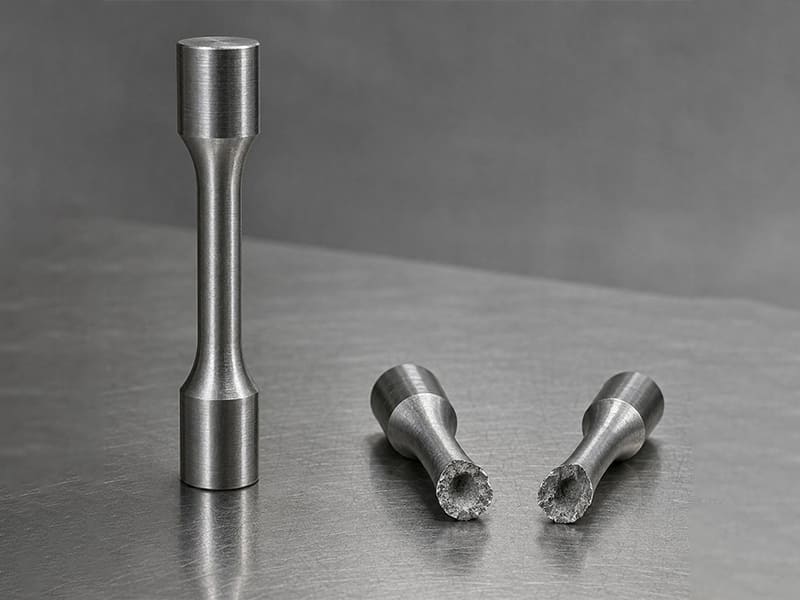
Tensile strength is one of the most fundamental mechanical properties used to describe how a material behaves under pulling or stretching forces. It defines the maximum stress a material can withstand before failure and plays a critical role in material selection, structural design, and safety evaluation across engineering applications.
This article explains what tensile strength is, how it is measured through standardized testing, and how it appears on a stress–strain curve. It also clarifies the engineering meaning of tensile strength and why it matters when designing components that must carry loads reliably without breaking.
What Is Tensile Strength?
Çekme mukavemeti is formally defined as the maximum engineering stress a material can withstand under uniaxial tensile loading before fracture. It is calculated by dividing the highest recorded tensile force by the specimen’s original cross-sectional area during a tensile test. This value is commonly referred to as the Ultimate Tensile Strength (UTS).
From an engineering perspective, UTS represents a failure threshold, not a usable operating limit. It marks the point at which a material can no longer sustain increasing load and begins to fracture, often after significant plastic deformation in ductile materials. For brittle materials, this maximum stress may occur with little warning and minimal elongation, making its interpretation even more critical.
A frequent misunderstanding is equating maximum stress ile safe stress. In real components, engineers design well below tensile strength by applying safety factors that account for variability in material properties, manufacturing defects, loading uncertainty, and service conditions. Using UTS directly for design would ignore these realities and significantly increase failure risk.
In practice, tensile strength serves as a comparative and screening property. It helps engineers differentiate material classes, assess heat treatment effects, and estimate resistance to catastrophic fracture. However, it must always be interpreted alongside yield strength, ductility, and loading mode to have real engineering value.
How Is Tensile Strength Measured and Calculated?
Tensile strength is obtained through a standard uniaxial tensile test, designed to load a material in controlled tension until failure. While the test setup appears simple, the way stress is defined and calculated carries important engineering implications.
The Tensile Test: What Actually Happens
A standardized specimen is gripped at both ends and pulled at a controlled rate using a universal testing machine. As the applied force increases, the machine continuously records load ve elongation. The test proceeds through elastic deformation, yielding (for ductile materials), plastic deformation, necking, and finally fracture. The maximum load reached before fracture is the key value used to determine tensile strength.
Stress = Force / Area: An Engineering Interpretation
Tensile strength is calculated using the engineering stress definition:
-
Stress = Applied force ÷ original cross-sectional area
From an engineering standpoint, this definition is intentional. Using the original area—rather than the continuously shrinking area during necking—provides a consistent basis for comparison between materials, heat treatments, and standards. It allows designers to compare tensile strength values across datasheets without needing full deformation data.
Original Area vs. Real-Time Area
During plastic deformation, especially near fracture, the specimen’s cross-section can reduce significantly. If stress were calculated using the instantaneous area, the resulting value would be much higher and is referred to as true stress, not engineering tensile strength. While true stress is valuable in advanced material modeling, UTS is always based on original area for standard reporting and design reference.
Units: MPa vs. psi
Tensile strength is typically reported in:
-
MPa (megapascals) in metric and ISO-based standards
-
psi (pounds per square inch) in imperial or U.S. standards
1 MPa equals 1 N/mm², making it directly compatible with common engineering drawings and finite element models. The choice of unit does not change material behavior, but clarity is essential when comparing specifications across regions.
Practical Example
If a specimen reaches a peak load of 50 kN and has an original cross-sectional area of 100 mm², the tensile strength is 500 MPa—regardless of how much necking occurs afterward.
Mühendislik çıkarımı: tensile strength calculation prioritizes comparability and standardization, not real-time local stress. Understanding this distinction prevents misinterpretation and misuse in design decisions.
What Happens During a Tensile Test? Understanding the Stress–Strain Curve
A tensile test is best understood by reading the stress–strain curve, which maps how a material responds to increasing tensile load. Each segment of the curve corresponds to a distinct deformation mechanism with clear engineering meaning.
Elastic Region: Reversible Deformation
At the beginning of the test, stress and strain increase proportionally. This elastic region is governed by Young’s modulus, and deformation is fully reversible. If the load is removed here, the material returns to its original dimensions. For engineers, this region defines stiffness, not strength, and is critical for deflection and vibration calculations.
Yielding: Onset of Permanent Change
At the yield point, the material transitions from elastic to plastic behavior. Beyond this point, deformation becomes permanent. Some materials exhibit a clear yield point; others show gradual yielding. In design, yield strength—not tensile strength—often defines the maximum allowable stress for load-bearing components.
Plastic Deformation: Load Carrying with Shape Change
After yielding, the material undergoes plastik deformasyon. Stress continues to increase as the material strain-hardens, allowing it to carry higher loads despite permanent elongation. This region reflects a material’s ductility and energy absorption capacity, which are essential for components subjected to overload or impact.
Necking: Localization of Deformation
At the peak of the curve, the material reaches its ultimate tensile strength. Beyond this point, deformation localizes into a narrow region known as necking. Although overall load capacity decreases, local true stress continues to rise. From an engineering standpoint, necking signals the onset of unstable deformation and imminent failure.
Fracture: Final Failure
The test concludes with fracture, which may be ductile (with noticeable necking and fibrous appearance) or brittle (with minimal plastic deformation). Fracture characteristics provide valuable insight into material quality, heat treatment, and suitability for specific loading conditions.
Mühendislik Perspektifi
The stress–strain curve shows that tensile strength is only one point on a much richer behavior map. Elastic limit, yield behavior, plastic deformation, and fracture mode together determine how a material performs in real components. Engineers who understand the full curve can select materials and safety factors that align with actual service conditions—rather than relying on a single headline number.
What Is the Difference Between Tensile Strength and Yield Strength?
Although tensile strength and yield strength are often listed together on material datasheets, they serve very different roles in engineering design. Confusing the two is a common source of overdesign, unexpected deformation, or premature failure.
Why Engineers Focus More on Yield Strength
Akma mukavemeti defines the stress level at which a material begins to deform plastically. Beyond this point, the material will not return to its original shape after unloading. For most structural and mechanical components, permanent deformation—not fracture—is the functional failure mode. Shafts that bend, brackets that deform, or housings that lose alignment are often unacceptable long before the part actually breaks.
As a result, allowable design stress is typically derived from yield strength divided by a safety factor, not from tensile strength.
Where Tensile Strength Still Matters
Tensile strength (UTS) represents the maximum stress a material can withstand before fracture. It remains important in:
-
Brittle materials, where yielding is minimal and fracture occurs near UTS
-
Failure analysis, to understand ultimate load capacity
-
Comparative material screening, especially across heat treatments or alloy families
-
Applications involving overload or crash scenarios, where fracture resistance matters
Ductile vs. Brittle Materials: Different Emphasis
Material behavior strongly influences which property dominates design decisions.
| Aspect | Akma Mukavemeti | Çekme Dayanımı |
| What it indicates | Onset of permanent deformation | Maximum stress before fracture |
| Design relevance | Primary limit for most components | Secondary or conditional limit |
| Ductile materials | Clearly defined, critical | Occurs well after yielding |
| Brittle materials | May be undefined or close to UTS | Often the controlling property |
İçinde ductile materials (e.g., most steels, aluminum alloys), yield strength is the controlling parameter. In brittle materials (e.g., cast iron, ceramics), tensile strength becomes more relevant because failure occurs with little plastic deformation.
Mühendislik Paket Servisi
Temel ayrım şudur:
-
Yield strength protects function and geometry
-
Tensile strength defines catastrophic failure
Good engineering practice recognizes that tensile strength alone does not ensure safe or reliable design. Understanding how yield and tensile strength interact—within the context of material ductility and service conditions—is essential for responsible material selection and structural integrity.
How Does Tensile Strength Differ from Other Mechanical Properties?
Tensile strength is only one dimension of a material’s mechanical behavior. In engineering practice, it must be interpreted alongside stiffness and strength under different loading modes. Many design errors stem from assuming these properties are interchangeable.
Key Mechanical Properties Compared (Engineering View)
| Mülkiyet | Ne Tanımlıyor | What It Controls in Design | Common Misunderstanding |
| Çekme Mukavemeti (UTS) | Maximum stress before fracture in tension | Ultimate failure limit | “Higher UTS means a stiffer or safer part” |
| Young’s Modulus | Slope of elastic stress–strain curve | Stiffness, deflection, vibration | Confused with strength |
| Compressive Strength | Resistance to crushing loads | Load capacity in compression | Assumed equal to tensile strength |
| Kesme Dayanımı | Resistance to sliding failure | Pins, bolts, joints | Approximated from tensile strength |
Tensile Strength vs. Young’s Modulus
Young’s modulus measures stiffness—how much a material stretches elastically under load—not how much load it can carry before failure. Two materials can have similar tensile strength but vastly different stiffness. Increasing tensile strength does değil reduce deflection; only modulus does.
Tensile vs. Compressive Strength
Many materials behave differently in tension and compression. Metals often have similar values, but brittle materials (cast iron, ceramics, concrete) are far stronger in compression than in tension. Designing compression-loaded parts using tensile strength alone can be dangerously misleading.
Tensile vs. Shear Strength
Kesme mukavemeti governs failure in joints, fasteners, and thin sections. While often estimated as a fraction of tensile strength, the actual value depends on microstructure, heat treatment, and loading direction. Direct shear data is preferred when joints are critical.
Mühendislik Paket Servisi
Tensile strength answers a narrow question: how much tensile stress causes fracture? It does değil describe stiffness, deflection, compressive behavior, or joint performance. Robust engineering decisions emerge only when tensile strength is evaluated in context, alongside modulus and strength in the relevant loading mode.
What Factors Affect the Tensile Strength of Materials?
Tensile strength is not an intrinsic constant of a material family. It emerges from composition, microstructure, processing history, and service conditions. Understanding neden tensile strength changes is essential for both material selection and manufacturing control.
Key Factors → Mechanisms → Strength Response
-
Material Composition and Alloying Alloying elements strengthen materials by solid-solution strengthening, precipitation, or phase transformation. For example, adding carbon to steel or zinc to aluminum alloys increases resistance to dislocation motion, raising tensile strength. However, higher alloy content can also reduce ductility and machinability—an important trade-off in manufacturing.
-
Grain Size and Microstructure Finer grains generally increase tensile strength through the Hall–Petch effect, which limits dislocation movement at grain boundaries. Microstructural phases (e.g., ferrite vs martensite in steel) strongly influence strength levels. Two materials with identical composition can show very different tensile strength due to microstructural differences alone.
-
Processing History: Cold Work and Heat Treatment
-
Cold working increases tensile strength by strain hardening but reduces ductility.
-
Isıl işlem can either increase strength (quenching and aging) or reduce it (annealing) by modifying phase structure and relieving internal stresses. Manufacturing history is therefore inseparable from tensile strength values on datasheets.
-
-
Temperature and Strain Rate Tensile strength generally decreases with increasing temperature due to enhanced atomic mobility. Conversely, higher strain rates often increase apparent strength, especially in metals and polymers. This explains why room-temperature test data may not represent high-temperature or impact loading conditions.
-
Defects, Porosity, and Impurities Voids, inclusions, and microcracks act as stress concentrators, reducing effective load-bearing area and lowering tensile strength. In cast or additively manufactured parts, defect population often dominates strength more than nominal alloy properties.
Mühendislik Paket Servisi
Tensile strength reflects a system of material + process + environment, not just chemistry. For engineers, this means strength values are only meaningful when linked to processing route and service conditions. For buyers, it explains why parts made from the “same material” can show different performance—and why supplier process control directly affects mechanical reliability.
How Does Tensile Strength Vary Across Different Materials?
Tensile strength varies widely across material classes because the mechanisms that resist tensile loading are fundamentally different. Comparing numbers without understanding these mechanisms often leads to poor material choices.
Tensile Strength Across Major Material Types
| Malzeme Türü | Typical Tensile Strength Range | Temel Özellikler | Mühendislik Çıkarımları |
| Metals (steel, aluminum, copper alloys) | ~100–2000 MPa | Ductile (most), isotropic, heat-treatable | Strength must be balanced with yield, fatigue, and machinability |
| Plastics / Engineering Polymers | ~20–150 MPa | Low modulus, viscoelastic, temperature-sensitive | High tensile strength does not imply stiffness or load capacity |
| Composites (e.g., CFRP, GFRP) | ~300–3000+ MPa (directional) | Anisotropic, fiber-dominated behavior | Strength depends on fiber direction and layup, not bulk material |
Metals: Strength with Predictable Behavior
İçinde metaller, tensile strength reflects resistance to dislocation motion within a crystalline lattice. Steels span the widest range—from low-carbon structural steels to ultra-high-strength alloy steels—while aluminum and copper alloys offer lower strength but better corrosion resistance or conductivity. Crucially, metals usually exhibit clear yield behavior, allowing engineers to design conservatively using yield strength rather than UTS.
Plastics: Tensile Strength Without Stiffness
Plastics and engineering polymers often show modest tensile strength compared to metals, but their more critical limitation is low stiffness (Young’s modulus). A polymer with 80 MPa tensile strength may still deform excessively under load. Additionally, tensile strength in plastics is highly sensitive to temperature, strain rate, and time (creep), making room-temperature datasheet values an incomplete basis for design.
Composites: Very High but Directional Strength
Fiber-reinforced composites can achieve extremely high tensile strength along the fiber direction, often exceeding metals on a strength-to-weight basis. However, this strength is anisotropic. Off-axis loading, poor fiber alignment, or weak interlaminar bonding can drastically reduce effective tensile performance. Here, “tensile strength” is inseparable from layup design.
Why Tensile Strength Alone Is Not Enough
Across all material classes, tensile strength answers only one question: how much tensile stress causes fracture under ideal test conditions? It does not describe stiffness, ductility, fatigue life, impact resistance, or behavior under real service environments.
Mühendislik çıkarımı: Tensile strength is useful for screening and comparison within a material class, but it cannot be used in isolation to select materials across metals, plastics, and composites. Robust material selection integrates tensile strength with modulus, yield behavior, environmental sensitivity, and manufacturing constraints.
Why Tensile Strength Matters in Engineering Design and Manufacturing
Mühendislik pratiğinde, tensile strength matters because it anchors design decisions to a measurable failure limit. While it is not always the controlling parameter, it frames how engineers think about safety, risk, and material capability throughout the product lifecycle.
Safety Factors and Structural Design
Tensile strength provides the upper bound against which safety factors are applied. Designers rarely allow stresses to approach UTS; instead, it informs how conservative a design must be relative to yield strength, fatigue limits, and service loads. Materials with higher tensile strength often allow thinner sections or lower mass, but only when stiffness, buckling, and fatigue are also satisfied.
Role in Failure Analysis
In failure investigations, tensile strength helps distinguish overload failures from those caused by fatigue, corrosion, or defects. If fracture stresses approach UTS, overload is likely; if failure occurs well below UTS, attention shifts to stress concentrations, surface quality, or microstructural issues. Here, tensile strength is a diagnostic reference, not the root cause.
Practical Impact on CNC Machined Parts
İçin CNC işleme, tensile strength influences material choice and process planning. Higher-strength alloys can improve load capacity but often increase tool wear, cutting forces, and cycle time. Conversely, selecting a material with “excess” tensile strength can raise cost without improving part performance. Effective material selection balances tensile strength with machinability, yield behavior, and tolerance requirements.
When Tensile Strength Is Not the Key Metric
There are many cases where tensile strength is secondary:
-
Deflection-limited designs → stiffness (Young’s modulus) dominates
-
Fatigue-loaded components → endurance limit or fatigue strength controls
-
Compression- or shear-dominated parts → compressive or shear strength matters more
-
Hassas montajlar → yield strength and dimensional stability are critical
Mühendislik Paket Servisi
Tensile strength matters most as a boundary condition—it defines what failure looks like, not how a part should normally operate. In sound engineering design and manufacturing, tensile strength is used in context: combined with safety factors, failure modes, and process realities to deliver reliable, cost-effective components rather than chasing the highest possible strength number.
What Are the Limitations of Tensile Strength as a Design Parameter?
Although tensile strength is widely used, it is a limited and sometimes misleading design parameter when taken in isolation. Many engineering failures occur well below a material’s ultimate tensile strength, highlighting the need for a broader performance view.
The Risk of a Single-Number Mindset
Tensile strength describes behavior under monotonic, uniaxial tension in a controlled test. Real components rarely experience such idealized loading. Stress concentrations, multiaxial loads, surface finish, and manufacturing defects can all trigger failure long before UTS is reached. Designing purely “to tensile strength” often leads to false confidence or unnecessary overdesign.
Disconnect from Fatigue, Impact, and Creep
-
Yorgunluk: Components under cyclic loading usually fail at stress levels far below tensile strength. Fatigue strength or endurance limit—not UTS—governs life expectancy.
-
Impact loading: Materials with high tensile strength can still perform poorly under sudden loads if impact toughness is low. Brittle fracture is a classic example.
-
Sürünme: At elevated temperatures, materials may deform gradually under constant load. Tensile strength measured at room temperature provides little insight into long-term creep behavior.
Implications for Engineering Design
Because tensile strength does not capture time-dependent or energy-based failure modes, it must be evaluated alongside other properties:
-
Yield strength for permanent deformation control
-
Fatigue strength for cyclic durability
-
Impact resistance for shock or crash scenarios
-
Creep resistance for high-temperature service
Mühendislik Paket Servisi
Tensile strength is best viewed as a boundary indicator, not a comprehensive measure of material performance. Robust engineering design relies on integrated property assessment, ensuring that strength, durability, and reliability align with real service conditions rather than a single headline value.
Özet
Tensile strength is a foundational mechanical property, but it is not a universal measure of material performance. It defines the maximum tensile stress a material can withstand before fracture, providing an important reference point for comparing materials and understanding ultimate failure limits.
Mühendislik pratiğinde, how tensile strength is interpreted matters more than how high the number is. Designing directly to tensile strength ignores permanent deformation, fatigue damage, impact behavior, and environmental effects that often govern real-world failures. Yield strength, ductility, and fatigue resistance usually play a more direct role in ensuring functional reliability and dimensional stability.
Robust engineering decisions treat tensile strength as part of a broader performance framework. When combined with yield behavior, fatigue life, loading conditions, and manufacturing constraints, tensile strength becomes a useful boundary indicator rather than a misleading target. Understanding this context allows engineers, designers, and buyers to select materials that deliver reliable performance—not just impressive datasheet values.
Sıkça Sorulan Sorular
Is higher tensile strength always better?
Not necessarily. Higher tensile strength increases the margin before fracture, but it often comes with trade-offs such as reduced ductility, tougher machining, and higher cost. Many components are yield-, fatigue-, or stiffness-limited, meaning they fail or deform permanently long before reaching tensile strength. Selecting a material solely for high UTS can lead to overdesign without improving real performance.
Why do some materials with high tensile strength fail easily?
Failure can occur far below UTS due to stress concentrations, fatigue loading, impact, corrosion, or manufacturing defects. Materials with high tensile strength but low toughness may fracture suddenly under shock or crack growth. In service, loading mode and environment usually dominate over the headline tensile number.
How does tensile strength affect CNC machined parts?
Tensile strength influences material selection and process planning. Higher-strength alloys typically require lower cutting speeds, more rigid setups, and wear-resistant tooling, which increases cycle time and cost. For many CNC parts, selecting a material with adequate (not maximum) tensile strength improves machinability, surface finish, and dimensional control while still meeting functional loads.
Can tensile strength be improved by heat treatment?
Yes, for many metals. Quenching and tempering, solution treating and aging, or work hardening can significantly increase tensile strength by altering microstructure. However, strengthening treatments often reduce ductility and can increase distortion or residual stress—factors that must be managed during machining and assembly.
What tensile strength values are typical for common metals?
Typical ranges (approximate, condition-dependent) include:
-
Low-carbon steel: ~350–550 MPa
-
Alloy/heat-treated steel: ~700–1500+ MPa
-
Aluminum alloys: ~150–600 MPa
-
Copper alloys (brass/bronze): ~200–600 MPa
-
Titanium alloys: ~800–1100 MPa


