
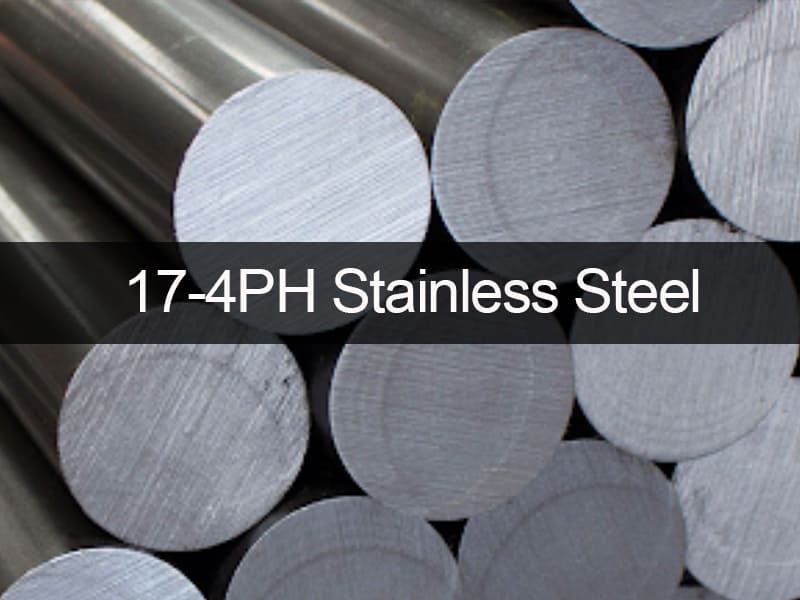
17-4 PH stainless steel (UNS S17400) is a unique and important material that sits between the corrosion resistance of regular austenitic grades (like 304) and the extreme strength of martensitic tool steels.
When engineers ask, “What is 17-4 PH?” they are usually trying to figure out how to get high strength without losing corrosion resistance. The most important thing about this alloy is that its strength doesn’t come from cold working or a lot of carbon. It is not, however, a Precipitation Hardening (PH) stainless steel. This means that its mechanical properties, like yield strength, hardness, and ductility, can be changed by a controlled heat treatment process called aging.
This tunability lets designers get yield strengths up to 1100 MPa (160 ksi), which is three times higher than 304 stainless steel, while still keeping good dimensional stability. It is very rare to find a material that has a good balance of high strength, moderate corrosion resistance, and predictable manufacturability.
This balance is why 17-4 PH is the standard for aerospace fittings, chemical pump shafts, and high-load mechanical assemblies. Engineers can machine parts in the softer Solution Annealed (Condition A) state, and then heat treat them to the final hardness with little distortion. But it can’t be used as a replacement for 316 all the time. Depending on the heat treat condition, its toughness and resistance to corrosion can be very different. This guide looks at the metallurgy, processing realities, and engineering trade-offs of 17-4 PH to help you figure out when it’s the best choice.
What is stainless steel 17-4 PH? Standards and Definitions for Grades
17-4 PH means that it has 17% chromium, 4% nickel, and is hardening by precipitation. From a metallurgical point of view, it is a martensitic precipitation-hardening stainless steel.
17-4 PH gets its strength from a two-step phase change, while 300-series steels get their strength from solid-solution strengthening.
-
Çözüm Tedavisi: Forms a martensitic matrix (Condition A).
-
Aging: Causes tiny copper-rich particles to form that stop dislocation movement, making the material very strong.
Dünya Çapında Standartlar ve Tanımlamalar
Standardization makes it easier to source goods from around the world. 17-4 PH is protected by:
-
AISI or Common Name: 17-4 PH or Type 630
-
UNS: S17400
-
ASTM: A564 (Bars/Shapes) and A693 (Plate/Sheet)
-
AMS: 5643 (Bars/Forgings) and 5604 (Sheet/Plate) are very important for aerospace.
-
EN / DIN: 1.4542 (X5CrNiCuNb16-4)
Chemical Composition and Logic for Alloy Design
The performance of 17-4 PH is not by chance; it is the result of a carefully designed chemistry that allows precipitation hardening while keeping the matrix stainless.
Tablo 1: Yaygın Kimyasal Bileşim (ağırlıkça%)
| Element | Tipik Aralık | Mühendislik Rolü |
| Krom (Cr) | 15.0–17.5 | This is what makes the passive oxide layer that protects against corrosion. |
| Nikel (Ni) | 3.0–5.0 | keeps the martensitic structure stable and balances the change in phase. |
| Bakır (Cu) | 3.0–5.0 | The Main Player. As it ages, it turns into copper-rich particles that give it strength. |
| Tantalum and Niobium | 0.15–0.45 | Stabilizes carbon (makes carbides) to stop corrosion at grain boundaries; makes the grain size smaller. |
| C (carbon) | ≤ 0.07 | Kept low to make sure it is tough and can be welded; stops it from breaking. |
| Manganez (Mn) | ≤ 1.0 | Deoksidizer. |
| Demir (Fe) | Denge | Temel matris. |
Why These Parts Are Important
-
This is the secret weapon: copper (Cu). Copper comes out of the solid solution when it is aged at low temperatures (480°C to 620°C). These tiny particles act like “roadblocks” in the crystal lattice, stopping layers of atoms from sliding over each other. This is called precipitation hardening.
-
Niobium (Nb): By binding with carbon, niobium stops the formation of dangerous chromium carbides, which keeps chromium available to fight corrosion. This makes the alloy stable and easy to weld.
The Precipitation Hardening Mechanism (How It Gets So Strong)
To understand why 17-4 PH is so versatile, you need to know how it hardens.
Step 1: Annealing the Solution (Condition A)
The alloy is heated to about 1040°C and then cooled quickly.
-
Sonuç: The copper and other metals are completely dissolved in the iron matrix. The structure changes into Martensite.
-
In Condition A, the material is fairly soft (about 30–35 HRC) and doesn’t bend easily. It can be machined, but it isn’t ready for service yet.
Step 2: Aging (Hardening)
The material is heated again, but not as hot (for example, H900 is heated to 480°C).
-
The result is that fine copper-rich precipitates form.
-
Güç goes through the roof. The hardness goes up. The final balance of properties depends on the exact temperature and time. Lower temperatures make things stronger, while higher temperatures make things tougher.
Conditions for Heat Treatment (H900–H1150)
Engineers must not only say “17-4 PH,” but they must also say what the Condition is. The “H” number tells you the temperature in Fahrenheit that the item will last.
Table 2: Typical Mechanical Properties by Condition
| Durum | Aging Temp | Akma Mukavemeti (MPa) | Çekme Dayanımı (MPa) | Sertlik (HRC) | Esneme hareketleri | Focus on the application |
| Condition A | Yok | ~760 | ~1030 | ~33 | 5–10% | Machining stock. Not for use (brittle). |
| H900 | 482°C (900°F) | 1170 (170 ksi) | 1310 (190 ksi) | 40–47 | 10% | Maximum strength. Parts that wear out quickly, like gears and shafts. |
| H1025 | 551°C (1025°F) | 1000 | 1070 | 35–38 | 12% | Balanced. Good strength and better toughness. |
| H1150 | 621°C (1150°F) | 725 (105 ksi) | 930 (135 ksi) | 28–33 | 16% | Toughness. Cryogenic parts and valve stems. |
Logic for Choosing Engineering:
-
Want Max Strength? Pick H900.
-
Are you worried about brittle failure or stress corrosion cracking (SCC)? Choose H1150.
-
General Purpose? H1025 or H1075 is a safe choice.
Tasarım için Önemli Fiziksel Özellikler
-
Yoğunluk: 7.75 g/cm³ (This is the standard for stainless steel).
-
Manyetizma: Yes, it is magnetic. Because of its martensitic structure, 17-4 PH is ferromagnetic in all situations, unlike 304/316.
-
Termal genleşme is 10.8 µm/m·°C. This means that 17-4 PH holds tighter tolerances when the temperature changes because it is lower than austenitic steels (304 is ~17.2).
17-4 PH vs. 304 and 316 for corrosion resistance
How does it hold up to the weather?
Genel Performans
In most mild environments (like the air and fresh water), 17-4 PH is as resistant to corrosion as 304 stainless steel. The 15-17% Chromium content makes sure that the passive film stays stable.
Restrictions
-
Chloride Attack: It doesn’t hold up as well in marine or chloride-rich environments as 316 stainless steel does. It doesn’t have the Molybdenum that keeps 316 from pitting.
-
Stres Korozyon Çatlaması (SCC): 17-4 PH is prone to SCC in corrosive environments when it is under tensile load in the high-strength H900 condition.
To lower the risk of SCC in harsh environments, set the conditions to H1150 or H1150-M. The “over-aging” process lowers internal stresses and makes the material stronger.
A good rule of thumb is
-
17-4 PH is fine for indoor, industrial, and mild outdoor use.
-
316 is safer for processing seawater and chemicals (or Duplex Stainless).
CNC Machining 17-4 PH Steel
From a manufacturing point of view, 17-4 PH is often better than 304/316 for making precise parts because it makes better chips and keeps tighter tolerances.
Condition A Machining
The Solution Annealed (Condition A) state is where most machining takes place.
-
Özellikler: Harder than 304 (about 30 HRC), but easier to cut. It doesn’t work-harden as hard as austenitic steels, and it makes chips that are easy to handle.
-
Boyutsal Kararlılık: The final heat treatment is done at a low temperature (for example, 480°C), so there isn’t much distortion during hardening. This makes it possible to machine to near-net shape before heat treatment.
Hardened States Machining (H900)
After hardening, it is possible to machine 17-4 PH, but the life of the tools will be greatly shortened. After heat treatment, it’s common to finish grind or hard turn critical dimensions.
En İyi Uygulamalar:
-
Use coated carbide tools (TiAlN) for tooling.
-
Flood coolant is necessary to keep tools cool and make them last longer.
-
Plan: Don’t “dwell.” Keep a steady flow to stop glazing.
Things to think about when welding and making things
Kaynaklanabilirlik
17-4 PH can be welded (better than 410, worse than 304).
-
TIG (GTAW) or MIG (GMAW) are the two methods.
-
Dolgu: To match the base alloy’s properties, use ER630 filler metal.
-
Preheat: Not usually needed for parts that are less than 100mm.
Heat Treatment After Welding
This is very important. When you weld, you make a Heat Affected Zone (HAZ) that has properties that are hard to predict.
After welding, the part should be solution-annealed (reset to Condition A) and then aged to the right temper (for example, H900). This makes sure that the weldment is strong all the way through.
Engineering Guide to Choosing Between 17-4 PH and Other Stainless Steels
You have to weigh Strength, Corrosion, and Cost against each other to make the right choice.
Table 3: Matrix for Choosing
| Özellik | 17-4 PH | 304 Paslanmaz | 316 Paslanmaz | 410 Stainless |
| Max Yield Strength | High (about 170 ksi) | Low (about 30 ksi) | Low (about 30 ksi) | Moderate (about 100 ksi) |
| Pas | İyi | İyi | Harika | Adil |
| Manyetik mi? | Evet | Hayır | Hayır | Evet |
| İşlenebilirlik | Good (Cond A) | Adil (Sakızlı) | Fair (Work Hardens) | İyi |
| Weldable Well | Adil | Mükemmel | Mükemmel | Zayıf |
| Maliyet | Yüksek | Düşük | Orta | Düşük |
Logic for Making Decisions:
-
Need strength and resistance to corrosion? -> 17-4 PH.
-
Need the most corrosion resistance possible (marine)? -> 316.
-
Need something cheap and easy to shape? -> 304.
-
Need knives and blades that won’t wear out? -> 440C or 420.
Common Uses of Engineering
The “Problem Solver” alloy is 17-4 PH.
-
Havacılık ve Uzay: Parts for landing gear, engine mounts, and structural fasteners (AMS 5643 spec).
-
Oil and gas: valve stems, pump shafts, and downhole tools that work in corrosive slurry with high torque.
-
Chemical Processing: The bodies and impellers of pumps.
-
Tıbbi: Surgical tools (like drills and reamers) that need to keep their edge and not be able to go through sterilization cycles.
-
Food Processing: In washdown areas, high-strength drive shafts are needed (H1150 condition is best).
Summary of Important Engineering Points
17-4 PH stainless steel is not a common material; it is a tool for precision engineering.
-
Tunable Strength: Its main benefit is that you can choose the yield strength between 100 ksi and 170 ksi by changing the temperature of the oven.
-
Manufacturing Friendly: It machines well in Condition A and heat treats with little distortion, making it perfect for complex parts with tight tolerances.
-
Çevresel Sınırlar: It is strong, but it can’t be used instead of 316 in seawater.
-
Design for Condition: Don’t just write “17-4 PH” on a print. Always say what the condition is, like 17-4 PH H900.
Engineers can use 17-4 PH to make mechanisms that are lighter, stronger, and last longer by knowing how heat treatment affects performance.
Sıkça Sorulan Sorular
Q: Does 17-4 PH have a magnetic field?
A: Yes. It is ferromagnetic no matter how it is heat treated. If you need something that isn’t magnetic, don’t use it (use 316 or Nitronic 60 instead).
Q: Does 17-4 PH rust?
A: It doesn’t rust easily in normal air and fresh water, just like 304. But it can pit and corrode in salt water or wet conditions that don’t move, especially in the H900 condition. It is best to passivate.
Q: What’s the difference between 15-5 PH and 17-4 PH?
A: 15-5 PH is a cleaner, better version of 17-4 PH. It was made to be tougher across the grain and easier to forge. 17-4 PH is good enough for most general machined parts and is easier to find. 15-5 PH is often the best choice for important aerospace forgings.
Q: After hardening, can I machine 17-4 PH?
A: Yes, but it’s hard. H900 (44 HRC) machining quickly wears out tools. It is common to machine in Condition A and then age, or to machine in H1150 (which is softer) if high strength isn’t needed.
Q: Is 17-4 PH safe to eat?
A: Yes, most of the time. It is used in food processing machines for parts that have to deal with a lot of stress. But the surface finish must be smooth (electropolished) to stop bacteria from growing, and H1150 condition is best to keep stress corrosion cracking from happening during hot cleaning cycles.


