
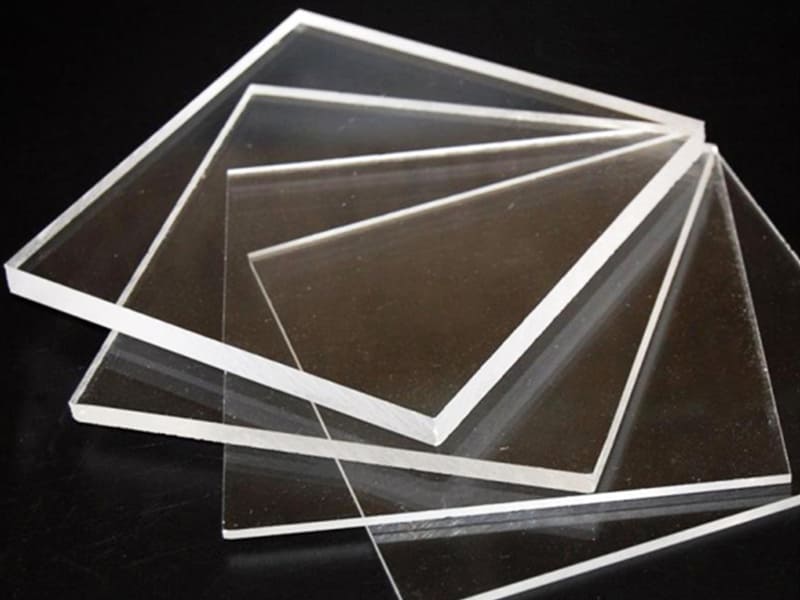
Когда инженеры спрашивают: “Что такое акрил?” Когда люди говорят “акрил”, они обычно имеют в виду акриловый пластик (ПММА, полиметилметакрилат), который представляет собой прозрачный термопласт, известный своей оптической прозрачностью, качеством поверхности и размерной стабильностью. С инженерной точки зрения акрил — это не просто замена стекла. Это материал с определённым профилем характеристик, который хорошо подходит для прозрачных конструкционных деталей, элементов дисплеев, промышленных защитных экранов и оптических элементов.
Акрил легче обрабатывать, чем стекло, и он пропускает много света (около 92%). Он также хорошо выдерживает плохие погодные условия. Именно поэтому ПММА так популярен: он прозрачный, хорошо выглядит и прочный, тогда как стекло было бы слишком тяжёлым, хрупким или трудным в обработке. Но акрил ведёт себя иначе, чем более прочные прозрачные пластики, такие как поликарбонат, особенно когда речь идёт о том, насколько хорошо он выдерживает удары, насколько легко трескается и как ведёт себя при длительных нагрузках. В этой статье подробно рассматриваются свойства материалов, небольшие различия в способах их производства и инженерные ограничения, которые необходимо учитывать для точного выбора материала.
Что такое акрил (ПММА)? Определение, химический состав и терминология
Полиметилметакрилат (ПММА) — это прозрачный термопластичный полимер, получаемый из мономеров метилметакрилата. Акрил — наиболее распространённое название для него в инженерии и бизнесе. В инженерии это слово означает твёрдый прозрачный твёрдый материал, а не покрытия или волокна.
С точки зрения материаловедения ПММА — это аморфный (некристаллический) инженерный термопласт. Причина, по которой акрил обладает превосходной оптической прозрачностью, стабильным светопропусканием и предсказуемым размерным поведением, заключается в его аморфной структуре. Но эта структура также устанавливает ограничения на его возможности. Акрил более хрупок при ударе, поскольку у него нет внутренней зернистой структуры, которая есть у полукристаллических пластиков и которая препятствует распространению трещин.
Акрил, ПММА и распространённые торговые названия (инженерное уточнение)
На практике многие термины используются взаимозаменяемо, что может затруднить составление спецификаций и закупки. Таблица ниже делает их значение более ясным в инженерном контексте:
| Слово | Значение в инженерии |
| Акрил | Общий термин для пластика ПММА в отрасли. |
| Полиметилметакрилат | Официальное химическое название ПММА. |
| Плексиглас® | Запатентованный бренд ПММА (Arkema). |
| Перспекс® | Запатентованный бренд ПММА (ранее ICI). |
| Акриловый лист | ПММА, нарезанный на листы, стержни или формы. |
Место акрила в ландшафте инженерных пластиков
Акрил — это уникальный тип инженерного пластика, который входит в более крупное семейство пластиков.
-
Оптически точный: прозрачнее почти всех других пластиков.
-
Жёсткий: Поверхность твёрдая и жёсткая.
-
Хрупкий: Не так хорошо выдерживает удары, как поликарбонат.
-
Погодостойкий: Прозрачные пластики, которые не стабилизированы, не так хорошо противостоят УФ-лучам.
Инженерные выводы: Акрил (ПММА) — это термопласт, который является хорошо определённым и аморфным. Его выбирают, когда жёсткость и визуальные характеристики очень важны, но его не следует использовать в ситуациях, где требуется высокая пластичность или поглощение ударов.
Молекулярная структура и материаловедение, лежащие в основе акрила
Молекулярная структура акрила (ПММА) напрямую влияет на его поведение как инженерного материала. Этот полимер аморфен, что означает, что его молекулярные цепи не arranged в кристаллоподобном порядке. Оптические и механические свойства акрила обусловлены тем, что в нём нет кристаллов.
Структура молекулярной цепи ПММА
ПММА имеет длинные цепи углерод-углеродных основных цепей и большие метилэфирные боковые группы. Эти боковые группы не позволяют полимерной цепи свободно вращаться, что делает структуру на молекулярном уровне довольно жёсткой. ПММА не образует упорядоченных кристаллических областей при охлаждении, в отличие от полукристаллических пластиков, таких как POM или PA.
Именно эта однородность делает акрил настолько прозрачным, что через него можно видеть насквозь. Свет может проходить через ПММА, не рассеиваясь кристаллическими границами. Это означает, что около 92% света может проходить через него, что больше, чем у большинства прозрачных пластиков и даже некоторых типов минерального стекла.
Взаимосвязи структуры и свойств (инженерный взгляд)
-
Высокая оптическая прозрачность: Аморфная структура и стабильный показатель преломления уменьшают внутреннее рассеяние света, что делает ПММА отличным для линз и оптических панелей.
-
Высокая жёсткость с относительной хрупкостью: Жёсткие боковые группы повышают модуль упругости и твёрдость поверхности. Но поскольку молекулы ПММА не перемещаются очень сильно, он не может эффективно рассеивать энергию удара, что приводит к лёгкому разрушению при внезапных нагрузках.
-
Отличная погодо- и УФ-стойкость: Полимерная основа не разрушается легко при воздействии УФ-света. Это сохраняет акрил прозрачным и цветостабильным при длительном нахождении на улице без пожелтения.
Инженерные выводы: Способ, которым arranged молекулы акрила, делает его отличным оптическим материалом и стабильным по размеру, но он не очень хорошо выдерживает удары.
Ключевые свойства акрилового пластика (ПММА)
Лучший способ понять акрил — это рассмотреть его сбалансированный профиль свойств для прозрачных, жёстких деталей. Он гибкий, но имеет строгие ограничения по тому, сколько тепла и ударов он может выдержать.
Оптические свойства (основное инженерное преимущество)
-
Светопропускание: Обычно 92% или более, что лучше, чем у стекла и поликарбоната.
-
Показатель преломления: ~1,49, что позволяет очень точно проектировать оптику.
-
Haze: Very low; the great surface finish helps clarity over large areas.
What it means for engineering: Acrylic is lighter and easier to work with than glass. Acrylic is clearer and less likely to scratch than polycarbonate (PC), but it is not as strong against impacts.
Mechanical Properties (Rigid but Brittle)
-
Прочность на разрыв: about 60–75 MPa.
-
Strength when bent: about 90–110 MPa.
-
Модуль упругости: about 3.0 to 3.3 GPa.
Meaning in Engineering: Acrylic keeps its shape well when there is no movement and doesn’t change shape on the surface. But it breaks instead of giving in. It shouldn’t be used as a structural impact material because stress concentrations make it much more likely to fail.
Thermal Properties (Moderate Heat Capability)
-
Tg, or Glass Transition Temperature: about 105 °C.
-
The Heat Deflection Temperature (HDT): usually between 85 and 95 °C.
-
Expansion: Has a higher coefficient of thermal expansion (CTE) than glass and metals.
Значение в инженерии: Acrylic works well in temperatures from room temperature to moderately high. Designers need to plan for thermal expansion so that assemblies don’t get too tight and cause stress cracking.
Environmental & Chemical Resistance
-
UV Resistance: Very good; stays clear even in the sun.
-
Химическая стойкость: Works well against weak acids and bases.
-
Sensitivity to Solvents: Very sensitive to alcohols, ketones, and aromatic solvents (risk of crazing).
Typical Engineering Property Table (PMMA)
| Недвижимость | Нормальное значение | Что это означает для проектирования |
| Плотность | ~1.18 g/cm³ | Light (about half as much as glass). |
| Light Transmission | At least 92% | Optical-grade clarity. |
| Прочность на разрыв | 60–75 МПа | It is stiff and does not bend. |
| Модуль упругости | About 3.2 GPa | Keeps its shape well. |
| Ударная вязкость | Низкий до умеренного | Not safe for impact; breaks easily. |
| Tg | ~105 °C | The upper limit for heat. |
| UV Resistance | Отлично | Long-lasting outdoors. |
Manufacturing Processes: Cast vs Extruded Acrylic
Casting or extrusion is the main way to make acrylic products. Both make clear materials, but the way they are processed affects the internal stress, how they are machined, and the cost.
Cast Acrylic
-
Метод: Putting liquid MMA monomer between molds (usually glass plates) and letting it harden.
-
Features: Low internal stress, great uniformity of thickness in thick sections, and better machining and polishing behavior.
-
Uses: thick panels, parts that need to be machined precisely, optical components, and parts that have been chemically exposed and need to have as little stress cracking as possible.
Extruded Acrylic
-
Метод: Pushing melted PMMA pellets through a die.
-
Features: more internal stress, tighter thickness tolerances for thin sheets, lower cost, but more likely to crack during machining or when exposed to solvents.
-
Uses: Making a lot of flat sheets, signs, guards, and parts where keeping costs down and tolerances for thickness are important.
Cast vs Extruded Acrylic — Engineering Comparison
| Аспект | Cast Acrylic | Extruded Acrylic |
| Internal Stress | Низкий | Выше |
| Quality of Machining | Великий | Moderate (can melt) |
| Quality of Surface | Очень высокий | Высокий |
| Стоимость | More | Less |
| Типичное применение | Precision, thick, machined parts | High-volume sheets, display panels |
Инженерный совет: Use Cast Acrylic for machining, bonding, or structural thickness. Use Extruded Acrylic for thin sheets that need to be cheap and made in large quantities.
Machining, Fabrication, and DFM Guidelines for Acrylic Parts
Acrylic is easy to machine, but its hard and brittle nature means that the processing strategy affects the quality of the part.
CNC Machining Considerations
-
When heat is controlled, PMMA machines cleanly.
-
Инструменты: Use carbide tools that are sharp, polished, and have positive rake angles.
-
Moderate speeds and a steady feed keep the surface from melting and turning white.
-
Heat Management: Use mist cooling or compressed air to get rid of chips.
-
Крепление: Make sure the part is evenly supported so that localized clamping pressure doesn’t cause stress cracks.
Laser Cutting vs CNC Cutting
-
Laser cutting: Makes edges that are clear and shiny, but it also adds heat and stress to the inside of the material. Best for thin sheets and parts that need to look good. If exposed to solvents, there is a chance of crazing near laser-cut edges.
-
CNC Cutting: Makes edges that are free of stress, but you need to polish them again to make them clear. Important for the strength of the structure and mechanical parts that need to fit tightly.
Thermal Forming and Bonding
-
Heat bending: Needs even heating; it is best to do it after annealing to relieve stress.
-
Solvent Bonding: Uses capillary action to join two surfaces. To avoid crazing, it needs flat, stress-free mating surfaces.
DFM Guidelines for Acrylic Parts
To lower the chance of failure:
-
Wall Thickness: For machined parts, keep it at least 3 mm.
-
Радиусы поворотов: Don’t have sharp internal corners; use radii that are at least 0.5 times the thickness of the material to spread out stress.
-
Placement of holes: Keep holes at least 1.5 times their diameter away from edges.
-
To relieve stress, don’t use press fits or constrained assemblies. For important parts, think about post-machining annealing.
Common Applications of Acrylic in Engineering and Industry
When impact toughness isn’t as important as transparency and surface quality, acrylic is the best choice.
Industrial Guards and Viewing Windows
-
Uses: Machine guards, safety covers, and inspection windows are some of the things that use them.
-
Engineering Condition: Good for controlled environments with low impact energy. Polycarbonate is needed for safety containment that can handle a lot of impact.
Display and Optical Components
-
Uses: HMI panels, lenses, and light diffusers.
-
Engineering Condition: PMMA is the standard for static optical parts because it lets a lot of light through (more than 92%) and doesn’t turn yellow when exposed to UV light.
Architectural and Structural Elements
-
Uses: Balustrades, partitions, and skylights.
-
Engineering Condition: It is important to carefully calculate structural loads. Acrylic creeps under constant load and should not be used as a main load-bearing structural element without a lot of support.
Medical and Laboratory Components
-
Uses: Observation rooms, desiccators, and covers for equipment.
-
Engineering Condition: Appreciated for its cleanliness and clarity. Must not be exposed to harsh solvents like alcohol or sterilized with an autoclave (heat).
Engineering Limitations and Failure Modes of Acrylic
Engineers need to know about PMMA’s limits to keep it from failing too soon.
Limited Impact Resistance
Acrylic is brittle, while polycarbonate is flexible. It breaks when it is suddenly put under a lot of stress. It shouldn’t be used for dynamic loading or ballistic containment that is critical to safety.
Stress Cracking and Crazing
When residual stress and chemical exposure come together, “crazing” (fine surface cracks) happens.
-
Triggers: cleaning products with alcohol, stress from machining, heat from laser cutting, and press-fit inserts.
-
Annealing, not using thread-lockers or solvents, and using the right CNC strategies are all ways to avoid problems.
Thermal Sensitivity
Acrylic starts to soften around its Tg (about 105 °C). In general, service temperatures should not go above 85 °C. Higher temperatures speed up creep and make things less stiff.
Long-Term Load Behavior
Acrylic can change shape over time. Over time, it doesn’t spread stress evenly, which makes it bad for parts that are always under high tension or clamping force.
Acrylic vs Glass vs Polycarbonate: Engineering Material Comparison
Most of the time, the choice is between Acrylic (PMMA), Glass, and Polycarbonate (PC).
Table of Engineering Comparisons
| Недвижимость | Acrylic (PMMA) | Стекло | Поликарбонат (PC) |
| Light Transmission | ~92% (Highest) | ~88–90% | ~88–90% |
| Ударопрочность | Low to moderate (brittle) | Very low (shatters) | Very high (tough) |
| Плотность | ~1.18 g/cm³ | ~2.5 g/cm³ | ~1.20 g/cm³ |
| Обрабатываемость | Великий | Плохое | Good (Heat sensitive) |
| Устойчивость к царапинам | Хорошо | Отлично | Poor (Soft) |
| UV Stability | Великий | Великий | Needs coatings |
One-View Engineering Decision Guide
-
Choose Acrylic (PMMA) when you need something that is clear, looks good, is UV stable, and is easy to work with, and when you can control impact loads.
-
Choose Glass when you need something that is completely rigid, won’t scratch, and won’t change temperature.
-
Pick Polycarbonate (PC) when safety, toughness, and resistance to impact are non-negotiable, even if it costs more and doesn’t look as good.
Standards, Grades, and Quality Considerations
Standards, not just general names, should define how well materials work.
Распространенные стандарты
-
ASTM D638: The ability to stretch and hold a load.
-
ASTM D790: Stiffness (flexural strength).
-
ASTM D256: Izod Impact (brittleness).
-
Thermal expansion (dimensional stability): according to ASTM D696.
Engineering-Grade vs. Display-Grade
-
Engineering-Grade: Made to keep machining stable, structures strong, and results consistent.
-
Display-Grade: Puts cost and visual finish first; usually has more internal stress and less chemical resistance.
Инженерный совет: To make sure that your drawings are mechanically sound, always include the material grade (Cast/Extruded) and the relevant ASTM standards.
Summary: When Acrylic Is the Right (and Wrong) Material Choice
When you need optical clarity, a smooth surface, and weather resistance but don’t want glass to be too heavy, acrylic (PMMA) is the best choice. It works very well in static, controlled settings like observation windows, optical parts, and outdoor panels. Cast acrylic is the best type for machined engineering parts.
But designers need to know what it can’t do. Acrylic can’t be used instead of polycarbonate for safety applications that need to withstand a lot of impact, and it can’t be used instead of high-performance plastics in environments that are very hot or have a lot of chemicals.
One-sentence engineering selection logic: If you need the most clarity and weather resistance at a reasonable price, use acrylic. If impact resistance or thermal stability is more important to the design, use polycarbonate or glass instead.
Часто задаваемые вопросы
What is the material that makes up acrylic?
Acrylic is a synthetic thermoplastic polymer made of polymethyl methacrylate (PMMA). Because it doesn’t have a set shape, it is very clear and strong, but it breaks more easily than semi-crystalline plastics.
Is acrylic stronger than glass?
Acrylic is half the weight of glass and can take more damage (it doesn’t break as easily). But glass is much stiffer (has a higher modulus) and harder (is less likely to get scratched). “Strength” depends on whether the application needs Acrylic to be able to handle impacts or Glass to be stiff.
Is it possible to CNC machine acrylic?
Yes, especially Cast Acrylic. With sharp tools and good cooling, it machines cleanly. Extruded acrylic is more likely to melt and make tools sticky. Annealing, or stress-relieving, after machining is a good idea for important parts to keep them from crazing.
Can you use acrylic outside?
Yes. PMMA is naturally UV-stable and keeps its clarity and physical properties even after years of being outside. Polycarbonate and ABS, on the other hand, break down or turn yellow without special stabilizers.
Which one should I choose: acrylic or polycarbonate?
Pick acrylic for its clear optics, scratch resistance, and good looks outside. Pick polycarbonate if you want something that is tough, safe from impacts, and won’t break.


