
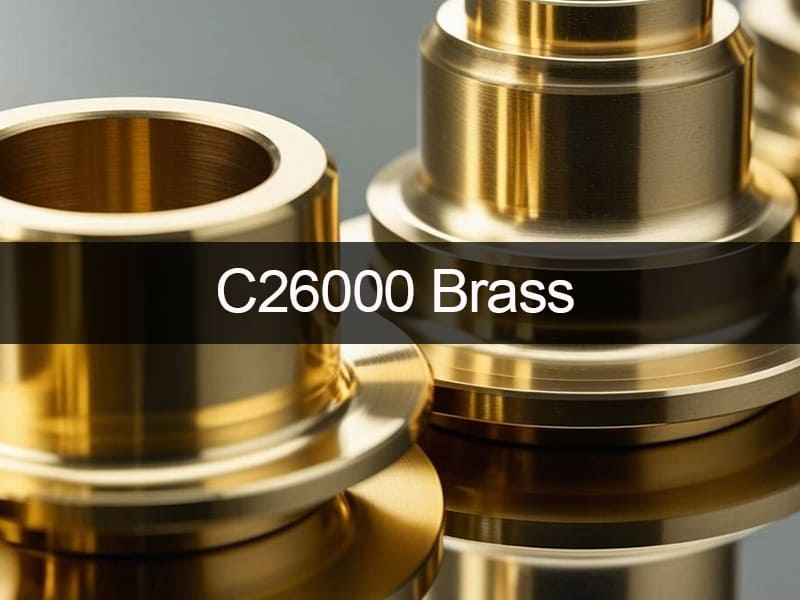
Латунь C26000, также называемая патронной латунью, представляет собой медно-цинковый сплав, известный своей легкостью формообразования в холодном состоянии, хорошим балансом прочности и коррозионной стойкостью. C26000 не выбирают для высокоскоростной обработки, в отличие от автоматных латуней. Вместо этого её выбирают для операций формообразования, гибки и глубокой вытяжки.
В этой статье рассматриваются физические свойства, технологичность формообразования и распространённые инженерные применения латуни C26000. Она помогает инженерам и проектировщикам определить, когда этот материал является наилучшим выбором по сравнению с другими латунными сплавами, исходя из способов их производства и эксплуатационных характеристик.
Что такое латунь C26000? Определение, классификация и стандарты
Определение материала и семейство сплавов
Латунь C26000 — это медно-цинковый сплав, содержащий около 70% меди и 30% цинка. С металлургической точки зрения это разновидность альфа (α) латуни. Это означает, что её микроструктура состоит из единого пластичного твёрдого раствора цинка в меди.
Именно эта однофазная структура делает C26000 настолько легко формуемой в холодном состоянии. C26000 способна выдерживать значительную пластическую деформацию, такую как глубокая вытяжка и прокатка, без необходимости промежуточного отжига, в отличие от двухфазных (α+β) латуней.
Преимущество соотношения 70/30:
-
Больше меди: Делает материал более гибким и коррозионностойким.
-
Содержание цинка: Придаёт прочность твёрдому раствору, сохраняя его форму.
-
Результат — материал, ориентированный на формообразование, а не на обработку резанием.
Стандарты и обозначения по всему миру
C26000 широко используется, что обеспечивает единообразие цепочек поставок по всему миру.
Таблица 1: Международные стандарты для C26000
| Регион / Система | Название | Примечания |
| UNS (Унифицированная) | C26000 | Является основным идентификатором для Северной Америки. |
| ASTM | B36 / B19 | Является стандартом для катаного прутка, листа, плиты и полосы. |
| CDA | Сплав 260 | Также известен в торговле как патронная латунь. |
| ISO / EN | CuZn30 / CW505L | Является европейским эквивалентом. |
Химический состав и металлургическая роль латуни C26000
Чистый бинарный химический состав C26000 определяет его эксплуатационные характеристики. В нём нет свинца (Pb), что важно для формообразования, но плохо для обработки резанием.
Таблица 2: Типичный химический состав (мас. %)
| Элемент | Типичный диапазон | Роль инженера |
| Медь (Cu) | 68.5 – 71.5% | Обеспечивает пластичность, теплопроводность и коррозионную стойкость. |
| Баланс цинка (Zn) | (около 30%) | Основной легирующий элемент, повышающий прочность и твёрдость. |
| Свинец (Pb) | ≤ 0,07% | Этот уровень намеренно поддерживается низким, чтобы сделать материал более гибким и предотвратить его растрескивание при формообразовании. |
| Железо (Fe) | ≤ 0,05% | Небольшое количество примеси, которое контролируется, чтобы предотвратить охрупчивание границ зёрен. |
Почему низкое содержание свинца важно
Основное различие между C26000 и C36000 заключается в количестве свинца на уровне следовых значений (<0,07%).
-
Технологичность формообразования: Сплав имеет непрерывную пластичную матрицу, которая не разрушает структуру зёрен, поэтому его можно глубоко вытягивать без разрывов.
-
Соответствие требованиям: Благодаря химическому составу с низким содержанием Pb, C26000 соответствует многим требованиям RoHS и нормативам по питьевой воде, которые запрещают использование свинцовых латуней.
-
Компромисс при обработке резанием: Отсутствие свинца делает стружку длинной и вьющейся, а силы резания — более высокими, что делает сплав менее идеальным для CNC точения на высоких скоростях.
Механические свойства латуни C26000 (по состоянию нагартовки)
Прочность C26000 в основном контролируется холодной деформацией (нагартовкой), что отличается от термически упрочняемых сплавов, таких как сталь или алюминий. Инженерам необходимо выбрать правильную нагартовку, чтобы найти оптимальный баланс между прочностью и технологичностью формообразования.
Предел текучести, предел прочности при растяжении и относительное удлинение
Свойства значительно изменяются в зависимости от степени холодной прокатки.
Таблица 3: Механические свойства по состоянию нагартовки (ASTM B36)
| Состояние | Прочность на разрыв (МПа) | Предел текучести (МПа) | Удлинение (%) | Лучший пример использования |
| O60 Soft Anneal | 300–330 | 75–100 | 45–55% | Deep drawing, spinning, and complex forming. |
| H01 1/4 Hard | ~340–380 | ~150–190 | 35–45% | Moderate bending with some structural rigidity. |
| H02 1/2 Hard | ~390–440 | ~250–310 | 20–30% | Stamped parts that need spring-like properties. |
| H04 Hard | ~480–540 | ~360–410 | 5–10% | Flat springs and electrical contacts (not much bending). |
Инженерный взгляд:
-
Strength vs. Ductility: As cold work increases (from O60 to H04), strength goes up but ductility goes down.
-
Rule for choosing: Use Annealed (O) stock for deep draw dies. Use H02 (Half Hard) for brackets or contacts that need to keep their shape.
Stiffness and Hardness
-
Rockwell F 55 (Annealed) to Rockwell B 77 (Hard) is the range of hardness.
-
Elasticity Modulus: ~110 GPa. (Softer than steel, but stiffer than aluminum).
Physical & Thermal Properties Engineers Should Care About
Besides its mechanical strength, C26000’s physical properties determine how well it works in electrical and thermal applications.
Table 4: Physical Characteristics
| Недвижимость | Значение | Engineering Importance |
| Плотность | 8.53 g/cm³ | Heavier than steel, which affects shipping weight and inertia. |
| Теплопроводность | ~120 W/m·K | This is great for getting rid of heat in electrical enclosures. |
| Электропроводность | 28% IACS | Is good for connectors and terminals because it balances strength and conductivity. |
| Coefficient of Thermal Expansion | ~20 µm/m·°C | It expands more than steel, which is very important for bi-metallic assemblies. |
Formability and Cold Working Behavior
Cold forming is based on C26000. Its single-phase Alpha structure lets it bend without breaking, which would happen to other alloys.
Ability to Deep Draw
People know C26000 for its use in cartridge cases (hence the name) because it can be drawn into deep, thin-walled cylinders in one step or with little annealing.
-
Mechanism: The alloy hardens slowly enough to let material flow into the die without tearing or necking in one spot.
-
Процесс: Needs presses with a lot of weight and the right kind of lubrication.
Bending and Stamping
-
Bend Radius: C26000 can be bent 180° back on itself (zero radius) without breaking when it is in the annealed or 1/4 Hard state.
-
Springback: Predictable work hardening makes it possible for stamping dies to always spring back the same way.
Machinability: Where C26000 Performs Well — and Where It Does Not
C26000 is not a brass that cuts easily. It can only be machined 30% of the time (C36000 can be machined 100% of the time).
Why It Is Hard to Machine
-
Gummy Behavior: The metal drags and tears instead of shearing cleanly because it is very ductile.
-
Making Chips: It makes long, stringy chips that can wrap around the tool (bird-nesting), so you have to stop often to clear them.
-
Wear on Tools: Higher cutting forces cause more heat and faster wear on tools than leaded brass.
When to machine C26000
It is good for:
-
Secondary Operations: Drilling or tapping holes in a stamped part.
-
Low Volume: Prototype work where the cycle time doesn’t matter.
-
Tip: To deal with stringy chips, use chip breakers on carbide inserts and aggressive peck cycles when drilling.
Corrosion Resistance and Environmental Limitations
C26000 is very resistant to corrosion in normal air conditions, but it does have some weaknesses.
Общая производительность
It doesn’t rust easily in fresh water, dry air, or most organic chemicals. Over time, it makes a protective oxide patina that is brown or green.
Risks of Failure: SCC and Dezincification
-
Обесцинкование: If the water is stagnant or acidic, the zinc can leach out of the alloy, leaving a copper sponge that can hold water.
-
Use inhibited brasses (like C46400) for saltwater service as a solution.
-
-
Коррозионное растрескивание под напряжением (SCC): C26000 is very likely to crack in the presence of ammonia and tensile stress.
-
To prevent this, stress relieve parts after they are formed (low-temperature anneal) to get rid of any leftover stresses.
-
Typical Products and Industrial Applications
When shape and surface quality are the most important factors, C26000 is the best choice.
-
Ammunition: Cartridge cases (the main use).
-
Plumbing: Drawn sink traps, aerators for faucets, and nuts for slip joints.
-
Electrical parts include lamp sockets, screw shells, terminals, and spring contacts.
-
Hardware includes hinges, door knobs, escutcheons, and kick plates.
-
Radiator cores and tanks in cars (because they can conduct heat and be shaped).
C26000 vs Other Brass Alloys (Selection Guidance)
To choose the right brass, you need to match the alloy to the way it is made.
Table 5: C26000 and other options
| Особенность | C26000 (Cartridge) | C36000 (Free-Cutting) | C26800 (Yellow Brass) |
| Main Process | Deep Drawing and Forming | Обработка на станках с ЧПУ | General Stamping |
| Обрабатываемость | Not good (30%) | Very good (100%) | Ярмарка |
| Формуемость | Very Good (Best) | Bad (Brittle) | Очень хорошо |
| Содержание свинца | Очень низкий | Низкий | Умеренный |
| Стоимость | Умеренный | Умеренный | Умеренный |
Критерии выбора:
-
Is the part stamped or drawn? -> Use C26000.
-
Is the part CNC turned? -> Use C36000.
-
Part is a simple bent sheet? -> Use C26800, which is often cheaper and easier to find in sheet form.
Summary — Key Engineering Takeaways
When it comes to cold forming, C26000 brass is the best. It’s not a general-purpose alloy; it’s a special material for parts that need to change shape a lot during the manufacturing process.
Важные моменты:
-
Use C26000 for deep drawn shells, eyelets, and complicated stampings.
-
Choose the Temper: “Annealed” is for forming, and “Half Hard” is for stiffness.
-
Don’t use CNC turning for screw machine parts; the long chips will slow down production. Instead, use C36000.
-
Watch out for ammonia: Make sure that parts are stress-relieved if they might come into contact with cleaners that contain ammonia.
Engineers can get complex shapes with high reliability and great surface finishes by aligning C26000 with designs that require a lot of forming.
Часто задаваемые вопросы
Q: Is it easy to work with C26000 brass?
A: No. It gets a 30% machinability rating. It makes long, sticky chips that are hard to deal with. You can machine it, but you need C36000 for fast, efficient production.
Q: What is the strength of C26000 when pulled?
A: It depends on the mood. Soft (Annealed): ~300 MPa (44 ksi). Hard (H04): about 500 MPa (72 ksi). Always write down the temper on the drawing.
Q: Is it possible to weld C26000?
A: Yes, but mostly brazing and soldering. Oxy-acetylene welding is possible, but arc welding is hard because the zinc vaporizes too quickly (fumes). Soldering is great.
Q: Can C26000 be used in saltwater?
A: No, usually. In seawater, it tends to lose zinc. For marine hardware, use either Aluminum Bronze or Naval Brass (C46400).
Q: Does C26000 not have any lead in it?
A: Yes, but only in very small amounts (less than 0.07%). Unlike C36000, it often follows rules about not having lead. Check the specific mill certs to make sure they are all in order.


