
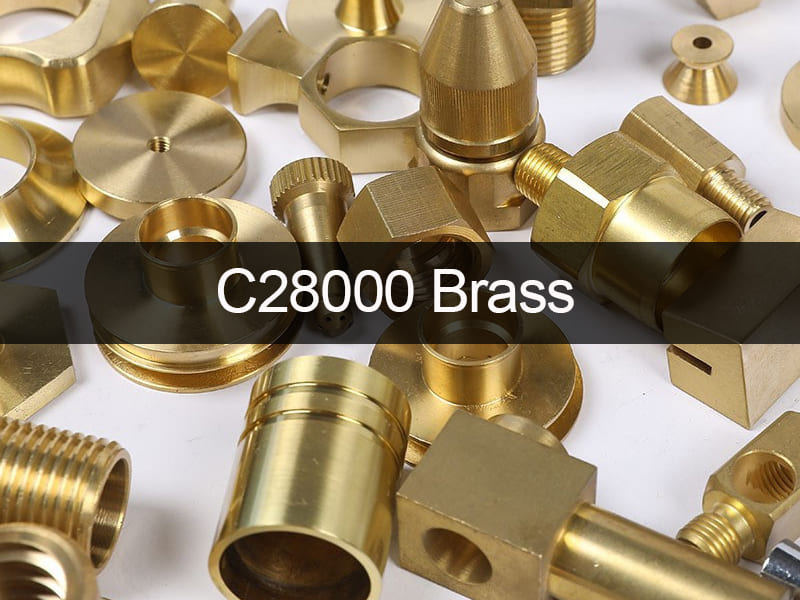
C28000 brass, often referred to as Muntz metal, is a copper–zinc alloy that offers a practical balance between strength, corrosion resistance, and cost. With a higher zinc content than cartridge brass, C28000 provides improved strength and wear resistance while maintaining reasonable formability, making it suitable for both forming and moderate machining applications.
This article explains the chemical composition, mechanical properties, and typical engineering uses of C28000 brass, helping engineers and procurement teams understand where it fits between more formable brasses and high-machinability copper alloys in real manufacturing scenarios.
What Is C28000 Brass? Material Definition and Classification
Basic Definition of C28000
C28000 is a copper–zinc (Cu–Zn) brass alloy with a nominal composition of approximately 60% copper and 40% zinc. In engineering practice, it is widely known as Muntz Metal or CuZn40. This composition places C28000 at the higher end of zinc content among common wrought brasses, giving it a distinct balance of strength, hot-work capability, and cost efficiency.
Historically, Muntz Metal was developed to provide a lower-cost alternative to high-copper brasses while maintaining adequate mechanical performance for structural and marine-related uses. Today, C28000 is still specified where moderate-to-high strength and good hot-forming behavior are required, and where extreme cold formability or free-machining performance is not the primary goal.
Where C28000 Fits in the Brass Family
From a metallurgical standpoint, C28000 belongs to the α+β brass category, which fundamentally distinguishes it from alloys such as C26000.
-
α brasses (e.g., C26000) are single-phase alloys characterized by excellent ductility and cold formability.
-
α+β brasses (e.g., C28000) contain a mixed microstructure that increases strength and hardness but reduces elongation and cold-working tolerance.
This phase structure means C28000 is strength-oriented, rather than optimized for deep drawing or high-speed machining. Compared with leaded free-cutting brasses like C36000, it lacks chip-breaking mechanisms and therefore offers lower machining efficiency. Compared with cartridge brass, it sacrifices some formability in exchange for higher load-bearing capability.
Engineering perspective: C28000 is best understood as a structural brass within the brass family—selected when designers need higher strength and reasonable corrosion resistance, and when manufacturing routes favor hot working, rolling, or moderate machining rather than aggressive forming or automated CNC production.
Chemical Composition and Alloy Design Logic
Typical Chemical Composition of C28000
C28000 brass is a binary copper–zinc alloy with a composition deliberately positioned near the upper limit of zinc content for wrought brasses:
| Elemento | Faixa Típica (% em peso) | Função de engenheiro |
| Cobre (Cu) | 59–63% | Base metal, corrosion resistance, ductility |
| Zinco (Zn) | Balance (~37–41%) | Strengthening, cost reduction |
| Chumbo (Pb) | ≤0.10% (trace) | Residual impurity, not for machinability |
| Ferro (Fe) | ≤0.05% (trace) | Grain refinement (controlled at low level) |
Unlike free-cutting brasses, C28000 does not rely on lead additions to modify cutting behavior. Its performance is driven almost entirely by the Cu–Zn ratio and the resulting phase structure.
Why High Zinc Content Matters
The defining feature of C28000 is its high zinc content, which fundamentally changes how the alloy behaves compared with lower-zinc brasses.
-
Strength increase mechanism Zinc in solid solution strengthens the copper matrix through lattice distortion. As Zn content approaches ~40%, tensile strength and hardness increase significantly compared with 70/30 brasses such as C26000.
-
Phase structure transition At this composition, C28000 develops a mixed α + β microstructure.
-
O α phase provides basic ductility and corrosion resistance.
-
O β phase is harder and stronger, improving load-bearing capacity but reducing cold-forming tolerance.
-
-
Manufacturing implications The presence of the β phase improves hot workability (hot rolling, extrusion) but makes cold forming more limited and machining less forgiving. This is the core reason C28000 is strength-oriented rather than formability- or machinability-driven.
Effect of Minor Elements
Although present only in trace amounts, minor elements play a disproportionate role in performance consistency:
-
Impurity control Excess iron or lead can promote microstructural heterogeneity, increasing the risk of hot cracking and inconsistent mechanical behavior during forming or rolling.
-
Corrosion and processing stability Tight control of residual elements improves resistance to localized corrosion and reduces sensitivity to thermal cracking during hot working.
A engenharia é um ponto de partida: C28000’s alloy design is intentional rather than accidental. Its chemistry prioritizes strength and hot-work capability, accepting trade-offs in cold formability and machining efficiency. Understanding this cause-and-effect relationship is essential for selecting C28000 appropriately, rather than expecting it to behave like more common cartridge or free-cutting brasses.
Microstructure and Phase Behavior
Alpha and Beta Phases in Brass
The mechanical and manufacturing behavior of brass alloys is governed primarily by their phase structure, which is controlled by zinc content. Two phases are most relevant in engineering brasses:
-
α (alpha) phase This is a copper-rich solid solution with a face-centered cubic (FCC) structure. The α phase is inherently dúctil, offering excellent cold formability, high elongation, and good resistance to cracking during bending or deep drawing.
-
β (beta) phase The β phase appears as zinc content increases and has a body-centered cubic (BCC) structure at elevated temperatures. It is harder and stronger than the α phase and exhibits better hot deformation characteristics, but it is significantly less ductile at room temperature.
Understanding how these two phases coexist is critical to understanding C28000 brass.
Microstructure of C28000 (α + β Brass)
C28000 is a classic α+β brass, meaning its microstructure contains a mixture of both phases. This is the fundamental difference between C28000 and alloys such as C26000, which remain fully α-phase at room temperature.
-
In C26000 (70/30 brass), the single α-phase structure supports extensive cold working and deep drawing.
-
In C28000 (60/40 brass), the emergence of the β phase increases strength and hardness but limits cold-forming capacity.
From a processing standpoint, the β phase becomes more ductile at elevated temperatures, which explains why C28000 performs better in hot working operations such as hot rolling and extrusion. This behavior historically made Muntz Metal suitable for plates, profiles, and structural sections formed at temperature rather than by cold deformation.
Microstructure–Property Relationship
The α+β microstructure directly explains the core trade-offs engineers must manage:
-
Strength vs. cold formability Increased β-phase content raises strength but reduces room-temperature ductility and tolerance for severe cold forming.
-
Manufacturing route implications C28000 favors hot working or moderate machining, not deep drawing or high-speed CNC operations.
A engenharia é um ponto de partida: C28000 should be selected based on its microstructural behavior, not just its nominal composition. Its α+β phase balance makes it a strength-oriented brass suited to hot-formed or structural applications, while simultaneously defining clear limits on cold forming and process flexibility.
Mechanical and Physical Properties
Mechanical Properties by Temper
The mechanical performance of C28000 brass varies significantly with temper, reflecting the balance between strength and ductility that engineers must manage during design and manufacturing.
| Temper (Typical) | Resistência à tração (MPa) | Resistência ao escoamento (MPa) | Alongamento (%) | Hardness Trend | Design Implication |
| Annealed (O) | ~350–380 | ~120–150 | 30–35 | Baixo | Maximum ductility, limited load capacity |
| Light Cold-Worked (H01) | ~420–460 | ~200–240 | 15-20 | Moderado | Balance of formability and strength |
| Half-Hard (H02) | ~480–520 | ~260–300 | 8–12 | Mais alto | Higher strength, reduced forming margin |
| Hard (H04) | ~550–600 | ~320–360 | 5–8 | Alto | Structural stiffness, minimal formability |
Engineering interpretation:
-
Strength is not a fixed value for C28000; it increases with cold work at the expense of elongation.
-
As β-phase content limits room-temperature ductility, heavily cold-worked tempers are more sensitive to cracking during secondary forming or bending.
-
Designers should specify temper explicitly based on whether the part prioritizes load-bearing capacity or manufacturing flexibility.
Physical and Thermal Properties
C28000’s physical properties are typical of high-zinc brasses but carry important implications for dimensional control and service behavior.
| Propriedade | Valor Típico | Engenharia Significado |
| Densidade | ~8.47–8.50 g/cm³ | Weight comparable to other structural brasses |
| Faixa de fusão | ~900–940 °C | Suitable for hot working, not for high-temperature service |
| Condutividade térmica | ~120 W/m·K | Good heat dissipation, beneficial in structural hardware |
| Condutividade elétrica | ~26–28% IACS | Lower than copper, acceptable for non-critical conductors |
| Coefficient of thermal expansion | ~20 × 10⁻⁶ /K | Requires allowance in tight-fit assemblies |
Conclusão de design: C28000 offers moderate-to-high strength for a brass alloy, but its thermal expansion and melting range mean it should not be treated as a high-temperature structural material. Proper allowance for thermal growth is essential in assemblies where dimensional stability matters.
Overall, the mechanical and physical property profile of C28000 reinforces its role as a strength-oriented brass, best applied where moderate structural capability is required and forming or service conditions remain within clearly defined limits.
Manufacturing and Processing Characteristics
Hot Working Performance
C28000 brass shows its strongest manufacturing advantages in hot working operations, which align well with its α+β phase structure. At elevated temperatures, the β phase becomes more ductile, allowing the alloy to deform plastically without the cracking risks seen at room temperature.
-
Hot forging, rolling, and bending are commonly used processes.
-
The material flows more uniformly under heat compared with single-phase α brasses, making it suitable for plates, bars, and structural profiles.
-
From an engineering standpoint, hot working is typically carried out in a high-temperature deformation window where strength is reduced, ductility is restored, and internal stresses are minimized.
Process logic: Hot working leverages the temperature-dependent ductility of the β phase, converting what is a limitation in cold forming into a manufacturing advantage.
Cold Working Limitations
In contrast, C28000 is not optimized for extensive cold deformation.
-
Rapid work hardening occurs due to the presence of the β phase, which quickly raises forming loads.
-
Elongation drops sharply with increasing cold reduction, narrowing the safe forming window.
-
Deep drawing, severe bending, or multi-step cold forming without intermediate annealing significantly increases the risk of edge cracking or tearing.
As a result, C28000 is generally limited to light cold work, such as minor bending or sizing operations. For parts requiring deep draws or complex cold-formed geometries, α brasses like C26000 are more appropriate.
Machinability Considerations
From a machining perspective, C28000 performs adequately but unremarkably.
-
Machinability is clearly inferior to leaded brasses such as C36000.
-
Chips tend to be continuous rather than breaking cleanly, increasing tool wear and limiting feed rates.
-
While conventional turning, drilling, and milling are feasible, C28000 is not well suited for high-speed automatic screw machining or Swiss-type production.
A engenharia é um ponto de partida: C28000 should be viewed as a structural, hot-work-friendly brass, not as a machining-efficient alloy. It fits best where manufacturing relies on hot forming or moderate machining, and where strength and cost balance matter more than cycle time or tool life.
Corrosion Resistance and Environmental Limits
General Corrosion Behavior
C28000 brass exhibits moderate corrosion resistance typical of high-zinc brasses. In normal atmospheric conditions and clean freshwater environments, it performs reliably, forming a stable surface oxide that slows uniform corrosion. This makes it suitable for general structural hardware, architectural components, and non-aggressive service environments where long-term exposure conditions are well controlled.
However, compared with higher-copper α brasses, C28000 shows reduced corrosion tolerance in chemically active media. Its corrosion performance should therefore be evaluated in the context of both environment and service stress, rather than assumed from brass classification alone.
Dezincification and Stress Corrosion Risks
The higher zinc content that gives C28000 its strength also introduces specific environmental risks:
-
Dezincification In stagnant or chloride-containing waters, selective leaching of zinc can occur. This process leaves behind a porous, copper-rich structure with significantly reduced mechanical integrity. Dezincification is a known risk for 60/40 brasses and must be considered in plumbing, marine-adjacent, or warm-water applications.
-
Stress corrosion cracking (SCC) C28000 is susceptible to SCC in ammonia-containing environments or where tensile stress and corrosive agents coexist. Cold-worked tempers are particularly vulnerable due to residual stresses.
Engineering guidance — environments to avoid:
-
Ammonia or ammonium-rich atmospheres
-
Stagnant or aggressive waters prone to dezincification
-
Applications combining sustained tensile stress and corrosion exposure
Principais conclusões: C28000 is acceptable for controlled, low-aggressiveness environments, but it should not be treated as a corrosion-resistant brass. Environmental compatibility must be verified early in the design phase to avoid premature failure.
Typical Engineering Uses of C28000 Brass
Industrial and Architectural Applications
C28000 brass (Muntz Metal) is typically selected for applications where higher strength than cartridge brass is required and where hot working or rolling is part of the manufacturing route. Common engineering uses include:
-
Heat exchanger plates and sheets Used where moderate strength and good thermal conductivity are needed, and where components are produced by rolling or hot forming rather than deep drawing.
-
Architectural and decorative components Panels, trims, and façade elements benefit from C28000’s strength and visual appearance, particularly in applications that require forming at elevated temperatures followed by finishing operations.
-
Marine-adjacent and structural hardware Historically used in marine fittings, fasteners, and structural sections where cost efficiency and mechanical strength were prioritized. Modern use requires careful environmental evaluation due to dezincification risk.
-
Tube sheets and pressure-related components Selected for tube plates and structural supports where stiffness and strength are more critical than extreme corrosion resistance or machinability.
Why Engineers Choose C28000
From a selection standpoint, C28000 occupies a practical middle ground within the brass family:
-
Strength–cost balance Higher zinc content increases strength while reducing copper usage, offering a favorable cost-performance ratio for large components.
-
Hot-work suitability The α+β microstructure supports hot rolling, forging, and bending more effectively than single-phase α brasses.
-
Structural intent C28000 is chosen when parts behave more like structural brass components rather than precision-formed or high-speed machined parts.
A engenharia é um ponto de partida: C28000 is best applied where strength and hot-forming capability outweigh the need for deep cold forming or high-efficiency machining. Its continued use reflects not tradition, but a clear alignment between alloy behavior, manufacturing method, and cost-sensitive engineering requirements.
C28000 Compared with Other Brass Alloys
Selecting C28000 makes sense only when its strength- and hot-work–oriented behavior is clearly understood relative to more commonly specified brasses. The comparison below highlights the practical engineering differences rather than just nominal composition.
Engineering Selection Comparison Matrix
| Aspeto | C28000 (Muntz Metal / CuZn40) | C26000 (Cartridge Brass / 70-30) | C36000 (latão de corte livre) | C46400 (Naval Brass) |
| Alloy type | α + β brass | α brass | Leaded brass (Cu-Zn-Pb) | α + β brass (Sn-bearing) |
| Typical Cu/Zn | ~60 / 40 | ~70 / 30 | ~61 / 35 (+ Pb) | ~60 / 39 (+ Sn) |
| Primary design intent | Strength + hot workability | Cold formability | Maquinabilidade | Resistência à corrosão |
| Cold formability | Limitado | Excelente | Pobres | Limitado |
| Hot working behavior | Muito bom | Moderado | Limitado | Bom |
| Maquinabilidade | Justo | Justo | Excellent (benchmark) | Poor–fair |
| Resistência à corrosão | Moderado | Moderada–boa | Moderado | Good (marine) |
| Aplicações típicas | Plates, structural sections | Deep-drawn parts | CNC-machined parts | Ferragens marítimas |
C28000 vs C26000
-
Diferença principal: phase structure C26000 is a single-phase α brass optimized for deep drawing and cold forming, while C28000’s α+β structure prioritizes strength.
-
Engineering choice: Escolher C26000 for deep-drawn or heavily cold-formed parts. Choose C28000 when higher strength is required and forming is done hot or with limited cold work.
C28000 vs C36000
-
Diferença principal: manufacturing route C36000 is engineered for machining efficiency; C28000 is not.
-
Engineering choice: Escolher C36000 for high-volume CNC or screw-machine parts. Choose C28000 only when machining is secondary and structural strength or hot working dominates.
C28000 vs C46400
-
Diferença principal: corrosion performance C46400 (naval brass) includes tin to improve resistance to dezincification and seawater corrosion.
-
Engineering choice: Escolher C46400 for marine or aggressive environments. Choose C28000 when corrosion exposure is controlled and cost or strength is the primary driver.
Conclusões da engenharia
C28000 should be viewed as a structural, hot-work-capable brass, not a general-purpose replacement for C26000 or C36000. Correct selection depends on process route (hot forming vs cold forming vs machining) and service environment, not just strength values or alloy name.
Summary — Key Engineering Takeaways
C28000 brass (Muntz metal) is a strength-oriented copper–zinc alloy with an α+β microstructure, fundamentally different from single-phase cartridge brasses and free-cutting brasses. Its higher zinc content provides increased strength and good hot workability, making it suitable for applications where mechanical capability and material cost must be balanced.
However, C28000 is not optimized for cold forming, deep drawing, or high-speed CNC machining, and it is not intended for highly corrosive environments. Successful use depends on matching its alloy behavior with hot-working processes and realistic service conditions, rather than relying on nominal property values alone.
Perguntas frequentes
What is C28000 brass used for?
C28000 brass, also known as Muntz Metal (CuZn40), is primarily used in structural and hot-worked applications rather than precision machined or deeply formed parts. Typical uses include rolled plates, structural sections, tube sheets, architectural metalwork, and selected marine-adjacent components. Engineers choose C28000 when higher strength than cartridge brass is required and when manufacturing relies on hot rolling, hot bending, or forging.
Is C28000 good for machining?
C28000 is machinable but not machining-optimized. Compared with free-cutting brasses such as C36000, it produces continuous chips, causes higher tool wear, and limits cutting speed. While conventional turning and drilling are feasible, C28000 is not suitable for high-speed CNC machining or automatic screw machine production. It is best viewed as a structural brass where machining is secondary.
What is the difference between C26000 and C28000?
The key difference lies in microstructure and manufacturing intent.
C26000 (70/30 brass) is a single-phase α brass optimized for cold forming and deep drawing.
C28000 (60/40 brass) is an α+β brass with higher strength but reduced cold-forming capability, making it more suitable for hot working and load-bearing parts. In short, C26000 favors formability, while C28000 favors strength.
Is C28000 suitable for marine applications?
C28000 has been historically used in marine hardware, but from a modern engineering standpoint, its use in seawater or stagnant water environments should be carefully limited. High zinc content increases susceptibility to dezincification. For demanding marine service, naval brass (C46400) or other dezincification-resistant alloys are generally preferred.
Does C28000 suffer from dezincification?
Yes. As a high-zinc brass, C28000 is susceptible to dezincification under certain conditions, particularly in warm, stagnant, or chloride-containing waters. Dezincification can significantly reduce mechanical integrity over time. Engineers should avoid using C28000 in environments where this corrosion mechanism is likely, or apply appropriate material substitutions and design safeguards.


