
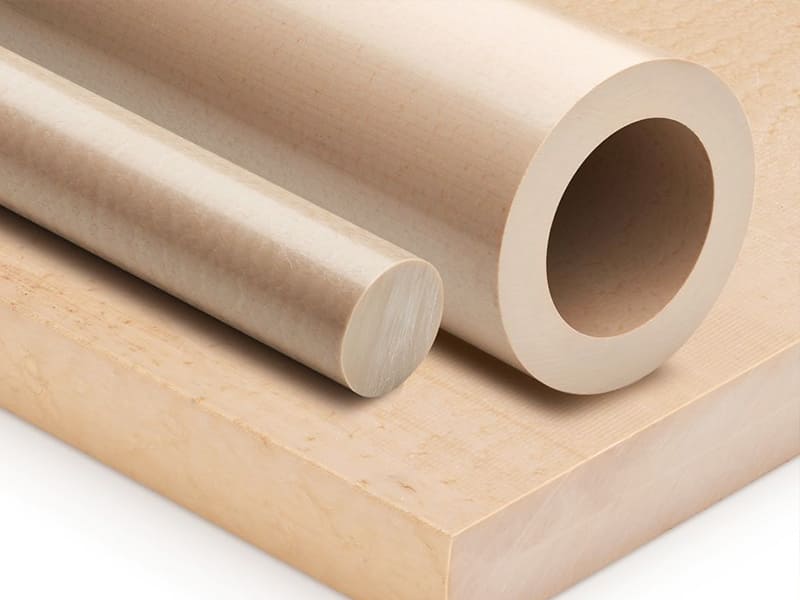
Polyetheretherketone (PEEK) plastic is well known as one of the best engineering thermoplastics on the market. It works well in extreme conditions, unlike regular plastics. It has high mechanical strength, great thermal stability, and a wide range of chemical resistance. This unique profile makes PEEK the best choice for tough jobs that need to replace metal, be lighter, or last longer in harsh conditions.
From an engineering point of view, PEEK has three main features: it can handle service temperatures up to about 250 °C, it is very stiff and resistant to fatigue, and it does not react with most industrial chemicals. This mix lets it take the place of metals in aerospace parts, medical implants, and high-performance machines. This article is a complete technical guide to PEEK plastic. It covers its material properties, how it behaves on a microstructural level, and the most important design and machining strategies for getting the most out of it.
What is PEEK plastic? Its definition and polymer structure
When engineers ask, “What is PEEK plastic?” the technical answer is that it is a thermoplastic that is semi-crystalline and belongs to the PAEK (Polyaryletherketone) family. It was made for places where regular plastics like ABS or Nylon would break down because of heat, weight, or chemicals.
The PAEK Family and Semi-Crystalline Structure
A rigid molecular backbone made up of repeating aromatic rings connected by ether (–O–) and ketone (–CO–) linkages makes PEEK what it is. Its semi-crystalline shape is what makes it work:
-
Crystalline Regions: Give the material strength, stiffness, resistance to wear, and stability at high temperatures.
-
Amorf Bölgeler: Add toughness, the ability to absorb impacts, and the ability to be processed.
This two-phase structure lets PEEK keep its shape even when it’s under a lot of stress and heat for a long time. It resists creep and fatigue much better than amorphous plastics.
PEEK compared to other common engineering plastics
| Mülkiyet | PEEK Plastic | ABS | Naylon (PA66) |
| Termal Kararlılık | Up to ~250 °C continuous | ~90–100 °C | ~80–120 °C |
| Mechanical Strength | Çok Yüksek | Orta | Orta–Yüksek |
| Boyutsal Kararlılık | Mükemmel | İyi | Moisture-sensitive |
| Kimyasal Direnç | Çok iyi | Not very good | Just okay |
| Yapı | Yarı kristalin | Amorf | Yarı kristalin |
Mühendislik Paket Servisi: The semi-crystalline, aromatic structure of PEEK is what makes it able to work well at high temperatures and resist chemicals at the same time. This is why it works better than standard engineering plastics in important applications.
Mechanical, thermal, chemical, and electrical properties of PEEK plastic
PEEK works better than almost all other thermoplastics. It is chosen when mechanical, thermal, and chemical needs must all be met at the same time.
Ranges of Core Property
Keep in mind that the values change depending on the grade and the type of reinforcement.
| Mülkiyet | Normal Aralık | Mühendislik Anlamı |
| Çekme Dayanımı | 90–100 MPa (unfilled) | Structural parts can hold a lot of weight. |
| Flexural Strength | 150–180 MPa | Very stiff when bent. |
| Elastik Modül | 3.6–4.1 GPa (unfilled) | Stiffness like bone; much higher with glass fiber. |
| Glass Transition (Tg) | ~143 °C | This is when the modulus starts to go down (softening). |
| Erime Noktası | ~343 °C | It can handle a lot of heat for a short time. |
| Continuous Service | 250 °C (UL 746B) | Keeps mechanical function in areas with high heat. |
| Kimyasal Direnç | Çok iyi | It doesn’t break down in acids, bases, hydrocarbons, or hydrolysis. |
| Electrical Resistivity | >10¹⁴ Ω·cm | A good insulator for parts that need a lot of voltage. |
1. How well it works mechanically
PEEK has a lot of strength and stiffness, and it stays that way even when it’s hot. It doesn’t soak up moisture like Nylon does (<0.5%), so its mechanical properties stay the same even when it’s humid.
2. How well it works in the heat
PEEK is one of the few plastics that can survive soldering processes and under-hood automotive environments without melting or degrading. It can handle temperatures of 250 °C for long periods of time and short bursts of over 300 °C.
3. Performance in terms of chemicals and electricity
Most organic and inorganic chemicals, including steam and hot water, don’t affect PEEK (hydrolysis resistance). It is also a great electrical insulator with a high dielectric strength, which makes it perfect for use in semiconductors and connectors.
Microstructure and How It Works
What makes PEEK work so well? Its rigid molecular chain and semi-crystalline structure are what make it work.
-
Crystallinity and Rigidity: The crystalline domains are like physical cross-links that keep polymer chains from sliding past each other when they are under stress. This makes it very resistant to creep.
-
Fatigue Endurance: PEEK can handle stress better than metals and other plastics because it has both crystalline and amorphous regions that work together to release stress energy.
-
Chain Stiffness: The aromatic rings in the backbone keep molecules from rotating, which helps the material stay stable at high temperatures and gives it a high modulus.
Mühendislik Paket Servisi: The way PEEK works is built into its microstructure. Knowing this helps engineers guess how it will act: it is stiff, stable, and tough, but it needs to be processed at high temperatures to shape properly.
Different Types of PEEK Plastic and Reinforced
Choosing the right grade of PEEK is very important for getting the best performance and price.
1. Unfilled (Virgin) PEEK
-
Özellikler: Best toughness and elongation; great resistance to chemicals.
-
En uygun kullanım alanı: Seals, medical implants, and parts that need to be pure and flexible.
2. PEEK with glass (30% GF)
-
Özellikler: More stiffness, strength, and dimensional stability; less thermal expansion.
-
Best For: Parts that need to hold up under high static loads, insulators, and structural components. Önemli: Glass fibers can scratch surfaces that are touching.
3. PEEK with 30% carbon fiber reinforcement
-
Özellikler: Maximum stiffness, compressive strength, and resistance to creep; weight is much lower than that of metal.
-
En uygun kullanım alanı: Brackets for aerospace, structural parts that have to hold a lot of weight, and wear rings.
4. PEEK Grade for Bearings
-
Özellikler: When mixed with PTFE, graphite, and carbon fiber, it reduces friction and wear.
-
En uygun kullanım alanı: Bushings, gears, and dynamic seals that don’t need outside lubrication to work.
CNC and Injection Molding Guidelines for PEEK Plastic Machining
PEEK is a high-performance material that needs to be processed very carefully. If you don’t handle it right, it could lose its semi-crystalline structure and dimensional stability.
Things to think about when CNC machining
PEEK works well with machines, but you need to use certain methods:
-
Aletler: Use diamond or carbide tools that are sharp. Dull tools make too much heat, which causes stress and changes the shape of things.
-
Soğutma: Air cooling or oil mist is the best way to cool things down. You can use water-based coolants, but you have to be careful with them so they don’t cause thermal shock.
-
Stres Giderici: Stock shapes often have stress left over. It is highly recommended to anneal before the final finish to avoid warping and make sure the tolerances are tight.
-
Reinforced Grades: Glass and carbon fibers are rough, so tools will wear out faster. Plan for this.
Injection Molding and Thermal Processing
-
High Temperatures: To melt PEEK, the temperature needs to be between 360 and 400 °C, and to mold it, the temperature needs to be between 160 and 200 °C.
-
Crystallization: For PEEK to fully crystallize, the mold must be very hot. A cold mold makes a “skin” that is amorphous, which means it is weaker and less resistant to chemicals.
-
Ekipman: Molding machines must be able to safely keep these high temperatures.
Design Rules for PEEK Parts (DFM)
When designing with PEEK, you need to think about how it expands when heated and how it behaves differently in different directions (in reinforced grades).
1. The thickness of the wall and the ribs
-
To make sure that cooling and crystallization happen evenly, keep the wall thickness the same (usually 2–4 mm).
-
To keep sink marks from forming, the ribs should be 50–60% of the wall thickness.
2. Tolerances and Thermal Expansion
-
PEEK’s coefficient of thermal expansion (CTE) is higher than that of metals but lower than that of most plastics. Design tolerances need to take into account that things will expand when they are hot (about 200 °C).
-
Check clearances to make sure that metal replacements don’t get stuck.
3. Threading and Inserts
-
Use metal inserts for high-torque fasteners to stop them from creeping over time.
-
If you need to take it apart often, don’t tap threads directly into PEEK; helicoils are better.
Different Industries Use PEEK Plastic
When the cost of failure is higher than the high material cost, PEEK is chosen.
Air travel
Used for brackets, cable clamps, and parts inside. Replacing aluminum and steel with it can save a lot of fuel because it has a high strength-to-weight ratio.
Tools for Health
PEEK is safe for living things and can’t be seen by X-rays. It is the standard for spinal cages, orthopedic implants, and surgical tools that can be used more than once and must be able to withstand repeated autoclaving.
Petrol ve Gaz
PEEK’s ability to resist high pressure (HPHT), sour gas, and hydrolysis is what makes it useful for downhole connectors, seals, and backup rings.
Yarı iletken
PEEK’s high purity (low outgassing) and resistance to chemicals make it perfect for parts that handle wafers and parts that are used in chemical etching processes.
PEEK Compared to Other Engineering Plastics
| Mülkiyet | PEEK | PEI (Ultem) | PPS | PTFE |
| Continuous Temp | ~250 °C | ~170 °C | ~200 °C | ~260 °C |
| Güç | Çok Yüksek | Yüksek | Yüksek | Düşük |
| Kimyasal Direnç | Mükemmel | İyi | Mükemmel | Olağanüstü |
| Resistant to wear | Mükemmel | Orta | İyi | Mükemmel |
Logic in Engineering:
-
If you want the best combination of strength, heat, and chemical resistance, choose PEEK.
-
If cost is a big problem and toughness isn’t as important, go with PPS.
-
Use PTFE only for chemical and friction applications where it doesn’t need to be strong enough to hold a load.
Summary: What engineers should learn about PEEK plastic
Polyetheretherketone (PEEK) plastic is the best engineering thermoplastic. It has metal-like performance but is lighter than metal.
-
Performans: It keeps its strength even at high temperatures (up to 250 °C) and is resistant to a wide range of chemicals.
-
İşleniyor: To get the most out of it, you need high-temperature equipment and strict process control (annealing, mold temp).
-
Tasarım: Engineers need to think about how reinforced grades expand and contract with heat and how they are not the same in all directions.
-
Selection: PEEK is a good choice for aerospace, medical, and critical industrial uses, but it is usually too strong for parts that don’t have a lot of load or are at room temperature.
Nihai Mühendislik Kararı: If high temperature, chemical resistance, and mechanical reliability are must-haves, pick PEEK plastic. Don’t use it for applications where standard engineering plastics like Nylon or Acetal are enough and the cost is important.
Sıkça Sorulan Sorular
What are some things that PEEK plastic can be used for?
PEEK is used in very harsh conditions where it needs to be able to stand up to high temperatures and chemicals. Aerospace brackets, spinal implants, semiconductor wafer carriers, and high-performance bushings and seals in the oil and gas industry are some of the most common uses.
Is plastic PEEK better than metal?
Yes, in some situations. PEEK is much lighter than steel (up to 70% lighter), resists corrosion better, and insulates electricity better. Metals are stiffer overall, but PEEK is often the better choice for strength-to-weight ratio and chemical resistance.
How hard is it to machine PEEK?
It is hard to machine PEEK, but it can be done. To keep tight tolerances, you need sharp tools, careful heat management, and stress-relief annealing. Reinforced grades (glass/carbon) are rough and will wear out tools faster.
What makes PEEK plastic so costly?
The complicated, high-purity monomer synthesis and difficult polymerization process needed to make PEEK make it expensive. Its high price is worth it because it can work in places where cheaper plastics would melt or break down chemically.
Is it possible for PEEK to take the place of aluminum or stainless steel?
Yes. In structural brackets, impellers, and wear parts, PEEK often takes the place of metals. It gets rid of corrosion problems, makes less noise (NVH), and has self-lubricating properties that metals don’t have.


