
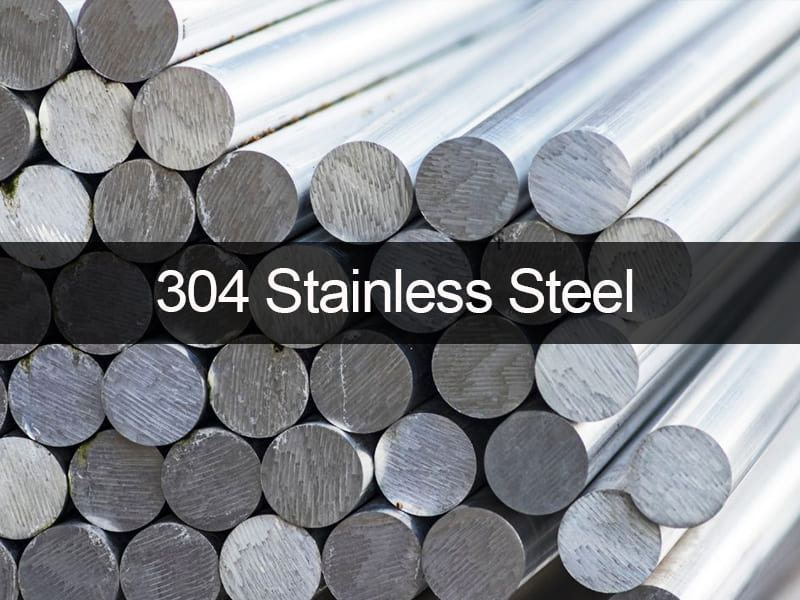
The standard 304 alloy is made with low carbon, which makes it less likely for welded parts to corrode between grains. The main metallurgical benefit is that it lowers the risk of sensitization in the heat-affected zone (HAZ). This means that welded structures can stay resistant to corrosion without needing to be annealed after welding.
Engineers use 304L stainless steel as the standard for making complicated things like pressure vessels, industrial piping, and pharmaceutical tanks. It has a little less mechanical strength than standard 304, but it is chosen for its reliability in the process. It makes sure that the structural integrity and corrosion resistance of an assembly aren’t affected by the heat cycles of welding, which makes it a good choice for long-lasting manufacturing.
What 304L stainless steel is made of
What Makes 304L Different from 304 in Low Carbon Design
The most important thing about 304L stainless steel is that it has a very low carbon content. According to ASTM and EN standards (UNS S30403 / EN 1.4307), 304L can only have 0.03 wt% carbon, while standard 304 can have up to 0.08 wt%. This may seem like a small chemical difference, but it affects how the material behaves when it is heated.
When austenitic stainless steels are heated to the sensitization range (about 450–850 °C), too much carbon reacts with chromium to form chromium carbides at the boundaries of the grains. This reaction lowers the amount of chromium in standard 304, which makes it easier for intergranular corrosion to happen. This is a failure mode that welding can often cause. 304L stops carbide precipitation by keeping carbon to 0.03%. This keeps heavy-gauge sections and multi-pass welds from rusting after they have been welded.
How Nickel and Chromium Affect the Stability of Austenitic Steel
304L not only controls carbon, but it also keeps the classic Chromium-Nickel balance that makes the 300-series austenitic family unique.
Common Composition Ranges:
| Element | Typical Content (wt%) | Mühendislik Rolü |
| Krom (Cr) | 18.0–20.0 | This makes the passive chromium oxide film that protects against corrosion. |
| Nikel (Ni) | 8.0–12.0 | Stabilizes the austenitic structure and makes it more flexible and tough. |
| Karbon (C) | ≤ 0.03 | Reduces sensitization and carbide precipitation while welding. |
| Manganez (Mn) | ≤ 2.0 | Stabilizes austenite and removes oxygen. |
| Silisyum (Si) | ≤ 1.0 | Improves resistance to oxidation during processing. |
| Demir (Fe) | Denge | The main structural matrix. |
Chromium gives the material its basic resistance to corrosion, and nickel makes sure it stays fully austenitic, which means it is ductile, tough at very low temperatures, and not magnetic when it is annealed. It is important to remember that heat treatment cannot harden 304L stainless steel; only cold working can do that.
Microstructure and how metals behave in different situations
Engineers who make sanitary equipment or pressure vessels need to know how stable the microstructure of 304L is. Its worth doesn’t come from being stronger; it comes from being able to resist metallurgical degradation during fabrication.
Austenitic Structure and Properties That Don’t Attract Magnets
The crystal structure of 304L stainless steel is face-centered cubic (FCC), which is typical of the austenitic family. This structure makes the material non-magnetic when it is solution-annealed, which is an important property for devices that need to be free of magnetic interference, like medical imaging devices and electronics.
But mechanical deformation (cold working), like bending, deep drawing, or heavy machining, can cause a phase change that turns some austenite into martensite. This makes the material a little magnetic. Engineers should know that this magnetic response is a physical effect of strain hardening, not a chemical flaw, and it doesn’t make corrosion resistance weaker by itself.
Why low carbon makes sensitization less likely
The engineering reason for using 304L is to stop sensitization. In standard 304, the creation of chromium carbides (Cr23C6) at grain boundaries makes areas that are low in chromium. These areas act like anodes compared to the grain interior, which makes intergranular attack happen quickly in corrosive environments.
304L’s low carbon chemistry stops this reaction from happening. There isn’t enough carbon to hold the chromium together, even when the metal is exposed to welding temperatures for a long time. So, the chromium stays in solid solution to keep the passive oxide layer. This behavior means that post-weld heat treatment (PWHT) is not needed, which is often not possible for large tanks or piping systems that are built in the field.
Mühendislik için ne anlama geliyor
-
Weld Reliability: Safe to use on thick welds where the cooling rates are slow.
-
Process Efficiency: Gets rid of the costs and risks of distortion that come with post-weld annealing.
-
Safety: Lowers the chance of catastrophic intergranular corrosion failure while in use.
Physical and Mechanical Properties of 304L Stainless Steel
304L stainless steel is not like high-strength alloys because it is very ductile and tough. Designers need to take into account its low yield strength and other physical properties, especially how it expands when heated.
Mechanical Properties (Condition of Annealing)
304L is moderately strong but very easy to shape when it is annealed.
| Mülkiyet | Normal Değer | Engineering Note |
| Yield Strength (0.2% Offset) | ~170–190 MPa | Lower than 304 on purpose to make forming easier. |
| Çekme Dayanımı | ~480–620 MPa | A high ultimate strength gives you a safety margin. |
| Uzama | ~40–55% | Very flexible for deep drawing and bending. |
| Sertlik | ~150–170 HB | It is moderately hard and becomes harder quickly when worked on. |
The yield strength is the most important thing to think about when designing a structure. 304L is not as strong as carbon steel, but its high ductility makes it less likely to break when it is hit or overloaded. This makes it safer in those situations.
Design Needs to Know About Physical Properties
-
Thermal Expansion (~17.2 µm/m·°C): 304L expands a lot more than carbon steel. To avoid thermal stress failures in mixed-metal assemblies like heat exchangers, this difference in expansion must be taken into account.
-
Low thermal conductivity (~16 W/m·K): means that heat stays in one place during welding and machining. This needs careful control of the heat input to keep distortion to a minimum.
Mühendislik Açıklaması: 304L is a material that is easy to shape and weld. For most containment and structural uses, its mechanical properties are good enough as long as the thickness of the sections is based on its yield strength.
Where 304L is good and where it isn’t (Corrosion Resistance)
304L stainless steel is the most common type of stainless steel used in the industry for general corrosion resistance, but it is not the best choice for every situation. To choose the right material, you need to know the exact chemical environment.
General resistance to corrosion in factories
304L works very well in places where it is exposed to oxygen, in freshwater systems, and in the air. It quickly regenerates its passive film, which gives long-term protection in:
-
Atmospheric environments: inside and outside (not on the coast).
-
Sanitary systems: processing food, drinks, and dairy.
-
Handling chemicals: weak alkalis and organic acids like acetic and citric acid.
Restrictions on Chloride and Marine Conditions
The main problem with 304L is that it is easily damaged by chlorides. When saltwater, brackish water, or cleaning products with a lot of chlorine are around, the passive film is damaged in some places. This causes:
-
Pitting Corrosion: Deep holes that are only in one place.
-
Crevice Corrosion: Attack that happens under gaskets or bolt heads.
-
Stres Korozyon Çatlaması (SCC): This can happen in chloride environments at temperatures above 60°C.
Useful Engineering Tips:
| Çevre | Uygunluk | Notlar |
| Indoor / General Outdoor | ✅ Recommended | Lasts a long time. |
| Food and Drink | ✅ Recommended | Make sure to use sanitizers that don’t contain chloride. |
| Freshwater Systems | ✅ Recommended | Safe for drinking water. |
| Marine / Coastal | ❌ Not Recommended | There is a high risk of tea-staining and pitting. |
| Chloride Processing | ❌ Not Recommended | Upgrade to 316L (with added molybdenum). |
How to Make and Weld 304L Stainless Steel
The fact that 304L stainless steel is easy to work with is a big reason why it is so popular. It is made to lower the metallurgical risks that come with welding.
Why 304L Is Better for Structures That Are Welded
Welding needs are almost always what makes engineers choose 304L over 304. The heat-affected zone (HAZ) in standard 304 is likely to become sensitive. The carbon cap on 304L (≤ 0.03%) almost completely removes this risk. This makes it possible to make complicated pressure vessels and piping spools that don’t rust when they are welded, which gets rid of the logistical and financial burden of heat treatment after welding.
Common Ways to Weld and Helpful Hints
-
Compatible with TIG (GTAW), MIG (GMAW), Stick (SMAW), and Laser welding.
-
The standard filler metals are ER308L or ER308LSi. The “L” in the filler keeps the low-carbon chemistry across the joint.
-
Controlling heat: 304L doesn’t get sensitized, but it does expand a lot when it gets hot, which can cause distortion. Intermittent welding, back-stepping, and proper clamping are very important.
Managing the Heat-Affected Zone (HAZ)
Cleaning after welding is necessary to keep corrosion resistance. The heat tint that forms during welding breaks down the surface chromium layer. Welds need to be chemically passivated or mechanically cleaned (pickled) to get rid of oxides and free iron in order to restore the passive film.
What CNC Machining Can Do with 304L Stainless Steel
304L is easy to weld, but it can be hard to work with in subtractive manufacturing. It is described as “gummy” and likely to harden when worked on.
How Work Hardening Works in Machining
304L doesn’t cut cleanly; it bends and breaks before the cutting tool. When the tool stays still or rubs, the work material hardens right away, and it can even get harder than the cutting edge itself. This causes tools to fail quickly and leaves a rough surface. 304L makes long, stringy chips that are harder to get rid of than 303 stainless steel, which has sulfur in it to break up chips.
Tooling, Feeds, and Speeds: Helpful Hints
-
Aletler: Use rigid, high-quality carbide tools with positive rake angles to cut the metal instead of plowing it.
-
Feed Rates: Keep the feed rate steady and high. “Babying” the cut makes the tool ride on the layer that has hardened from work.
-
Soğutma sıvısı: You need heavy flood coolant to keep things cool and help get rid of chips.
-
Strateji: Don’t make cuts that are broken up if you can help it. Make sure that drills go in quickly and come back out mostly to clear chips, not to stay there.
Engineering Impact: Compared to carbon steels or free-machining stainless grades, you should expect longer cycle times and higher tooling costs.
304L vs 304 vs 316L: How to Pick the Right Engineering Material
You should choose one of these austenitic grades based on how you plan to use it and how much exposure it will have to the environment.
304L vs. 304: Welding vs. General Use
The only difference is the amount of carbon and how well it can be welded.
| Faktör | 304 (Standard) | 304L (Low Carbon) |
| Karbon İçeriği | 0.08% or less | 0.03% or less |
| Welding Risk | High (Sensitization) | Low (Safe for Welding) |
| Güç | A Little Higher | A Little Lower |
| Best Use | Machined parts and non-welded items | Welded tanks, piping, and structures |
Seçim Mantığı: If the part is welded, choose 304L. 304 is fine for a machined bracket or bolt that won’t get hot (and it is often a little cheaper).
How bad is the environment for 304L vs 316L?
The difference is the amount of molybdenum.
| Faktör | 304L | 316L |
| Alloy Difference | Basic Cr-Ni | Adds 2–3% Molybdenum |
| Chloride Resistance | Sınırlı | Mükemmel |
| Maliyet | Daha az | Daha fazla |
| Best Use | General industrial, sanitary | Marine, chemical, and pharmaceutical |
Seçim Mantığı: Use 304L for most sanitary and industrial uses. Only switch to 316L if there are chlorides, saltwater, or strong chemicals.
What People Use 304L Stainless Steel For
304L stainless steel is the most important material for making things in factories because it is easy to weld and resists rust.
Welded tanks, vessels, and piping systems
This is the main use for 304L. Post-weld heat treatment is often not possible in big pressure vessels and process piping. 304L makes sure that the miles of weld seams in a chemical plant or water treatment facility stay as resistant to corrosion as the base metal.
Tools for Making Food and Drinks
For hygiene, surfaces need to be smooth and able to withstand frequent washdowns. 304L is the standard material for food conveyors, dairy piping, and brewing tanks. It can handle low-chloride sanitizing methods and doesn’t break down when exposed to organic acids found in food.
Chemicals and Drugs Equipment
304L is a cheap way to store skids, hoppers, and structural frameworks in places with moderate chemical exposure. It is used a lot in places where controlling contamination is very important, but the chemical aggressiveness doesn’t make 316L or Hastelloy worth the money.
Standards, Specifications, and Global Equivalents
Engineers should use well-known international standards to specify 304L so that the supply chain stays the same.
The Most Important Global Standards
| Region/Org | Standart | Grade Designation | Note |
| USA (ASTM) | ASTM A240/A276 | Type 304L | Standard for plate and bar. |
| Global (UNS) | — | S30403 | Number for the whole world. |
| Europe (EN) | EN 10088 | 1.4307 | Same as X2CrNi18-9. |
| Japan (JIS) | G4303 | SUS 304L | Used a lot in Asia. |
Engineering Best Practice: Always list the standard along with the grade, like “Material: ASTM A240 Type 304L.” This sets the limits for how the material can be used, how big it can be, and what tests it needs to pass to make sure it meets engineering standards.
A summary of engineering lessons
304L stainless steel is not stronger than other types of stainless steel; it is more reliable to make. Its low carbon chemistry (≤ 0.03%) is a specific engineering solution to the problem of carbide precipitation in welded structures.
-
If you need to weld something: like tanks, pressure vessels, or piping where post-weld annealing is not possible, choose 304L.
-
Manage the trade-offs: When machining, you have to accept a slightly lower yield strength and more work hardening.
-
Know the Limit: 304L will probably fail if it is exposed to chlorides or marine environments. Instead, use 316L.
Sıkça Sorulan Sorular
What is 304L stainless steel?
The standard austenitic 304 stainless steel has a low carbon content (≤0.03% C). It is designed to stop sensitization (carbide precipitation) during welding, which makes sure that the heat-affected zone is resistant to corrosion.
What makes 304 different from 304L?
The main difference is how much carbon is in it. 304 can have up to 0.08% carbon, but 304L can only have 0.03%. 304 is a little stronger, but 304L is a lot better at resisting intergranular corrosion after welding.
Is 304L better for welding than 304?
Yes. 304L is the standard for welded parts in the industry because it doesn’t need to be heat-treated after welding to keep its corrosion resistance.
Is 304L not as strong as 304?
A little bit. The lower carbon content means that the yield and tensile strength are only slightly lower than those of standard 304. But this difference doesn’t matter much for most structural and pressure applications when you think about the benefits of making things.
Is 304L safe to use for food and medicine?
Yes. 304L is used a lot in the food, drink, and pharmaceutical industries because it is easy to clean, doesn’t corrode when exposed to organic acids, and doesn’t react with other materials.
Can 304L replace 316L?
No, 304L doesn’t have Molybdenum and doesn’t resist chlorides and pitting corrosion as well as 316L does. Do not use it in water or with strong chemicals.
Is it simple to use 304L?
It can be welded, but machining it is hard. 304L work-hardens quickly, just like all other austenitic stainless steels. To keep tools from breaking, it needs rigid setups, sharp tools, and fast feed rates.


