
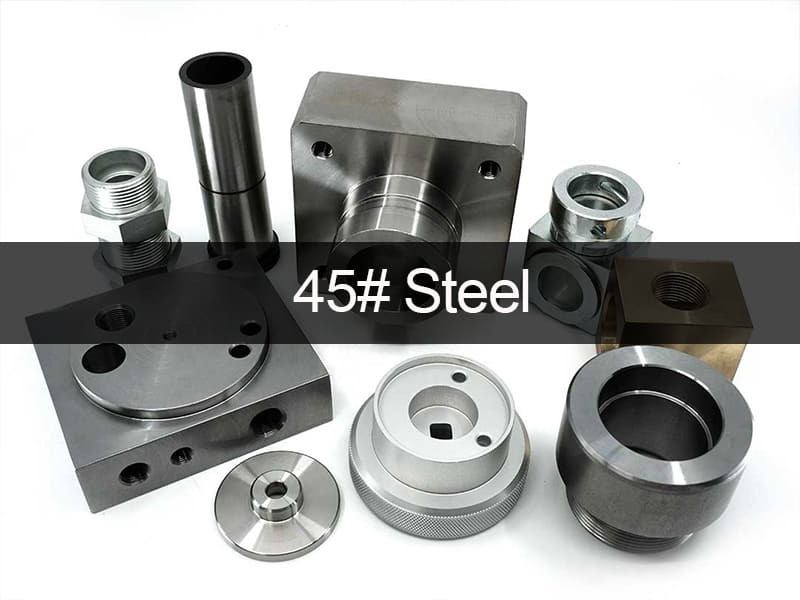
In mechanical engineering, 45# steel is the best medium carbon steel. It is also known as AISI 1045, C45, or S45C around the world. It has been popular for a long time because it has a well-defined engineering balance: it is stronger than low-carbon structural steels, can be made tougher through heat treatment, and is very cost-effective.
The name “45” comes from the fact that it has about 0.45% carbon by weight. This is the one thing that has the most effect on how it acts. When the carbon content is this high, the steel can be quenched and tempered to make it much stronger and harder than steels like Q235 or 1018. Low-carbon steels, on the other hand, get their strength mostly from the size of their sections.
For shafts, gears, connecting rods, spindles, and other mechanical parts, 45# steel is the most common choice. It is preferred when through-hardening or surface hardening is needed but alloy steels (like 4140) would be too much or too expensive.
This article looks at 45# steel as an engineering material. It connects things like chemical composition, how it responds to heat treatment, how easy it is to machine, and how to choose the best material for your project.
What is 45# steel? This article will explain the rules for naming it and how it compares to other types of steel around the world.
We need to look at the standards that make up 45# steel in order to understand it. The Chinese national standard GB/T 699, which covers high-quality carbon structural steels, defines it.
The Rule for Naming
The rule is simple:
-
“45”: This means that the average carbon content is 0.45%.
-
“#”: A common suffix in Chinese industrial jargon that means “Number” or “Grade.”
Grades that are the same in other countries
45# steel is a type of medium-carbon steel that is known all over the world. Even though they are chemically similar, the final properties depend on how they are heat treated.
Table 1: Equivalents around the world
| Регион / Стандарт | Назначение класса | Note |
| Китай (GB) | 45# | a type of high-quality carbon structural steel. |
| USA (ASTM/SAE) | AISI 1045 | The most common type of medium-carbon steel in North America. |
| Европа (EN) | C45 / 1.0503 | Used a lot in cars and machines. |
| Япония (JIS) | S45C | The most common grade for machine parts in Asia. |
Engineering Clarification: “Equivalent” does not mean the same thing. A C45 plate from Germany might have different manganese limits than a 45# bar from China. Always check the specific mill certifications (MTRs) for important uses.
The chemical makeup of 45# steel and what it means for metallurgy
The carbon-centered chemical design of 45# steel determines how well it works. It uses Carbon for strength and Manganese for hardening.
Таблица 2: Типичный химический состав (мас. %)
| Элемент | Диапазон | Metallurgical Importance |
| Углерод (C) | 0.42–0.50 | The main thing that makes things strong, hard, and able to harden. |
| Марганец (Mn) | 0.50–0.80 | Makes things stronger and harder; helps with uniform quenching. |
| Кремний (Si) | 0.17–0.37 | удаляет кислород и немного повышает прочность. |
| Фосфор (P) | ≤ 0.035 | an impurity. Too much of it makes it less tough (cold shortness). |
| Сера (S) | ≤ 0.035 | Impurity. It makes things easier to work with (good) and harder to break (bad). |
| Chromium/Nickel | ≤ 0.25 | Residuals. Not added on purpose (like alloy steels). |
The function of carbon (0.45%)
-
Прокаливаемость: This lets Martensite form when the steel is cooled, which makes it harder. The surface can get to 50+ HRC and the core can get to 20-30 HRC.
-
Компромисс: The more carbon there is, the harder it is to weld. There is a real chance that the Heat Affected Zone (HAZ) will crack.
Why 45# Is Not a Steel Alloy
It does not have enough Chromium, Molybdenum, or Vanadium. The Iron-Carbon phase change is what gives it its properties. This means that it can’t harden thick sections like 4140, which makes it less hardening.
Microstructure and Mechanisms of Strength
The microstructure of 45# steel directly affects how it behaves mechanically.
-
Normalized or Annealed (Ferrite-Pearlite)
-
The structure is made up of both soft Ferrite and hard Pearlite when it is rolled or normalized.
-
Результат: Easy to work with, medium strength, and good ductility. This is how bar stock is usually supplied.
-
-
Tempered and quenched (tempered martensite)
-
The structure changes into Tempered Martensite after being heated.
-
Результат: Strong, hard, and tough, but not too tough. This is the state that finished shafts and gears are in.
-
Physical and mechanical properties of 45# steel
Based on the heat treatment, properties can change a lot. Engineers need to write down the condition on the drawing.
Conditions Affect Mechanical Properties
Table 3: Common Mechanical Properties
| Состояние | Предел текучести (МПа) | Прочность на разрыв (МПа) | Твердость | Удлинение |
| Отожжённая | ~310 | ~570 | ~170 HB | 16% |
| Нормализованный | ~360 | ~600 | ~200 HB | 16% |
| Закалённая и отпущенная | 500–600+ | 700–850+ | 22–55 HRC | 12% |
Примечание: Induction Hardening can make the surface hard enough to reach 55 HRC, but the core is usually softer.
Физические характеристики
-
Плотность: 7,85 г/см³
-
Модуль упругости: 206 GPa (Stiffness stays the same no matter how hot it is).
-
Тепловое расширение: около 11,5 мкм/м·°C.
What happens when you heat treat 45# steel?
The main value lever for 45# steel is heat treatment.
-
Normalizing (Refining)
-
Процесс: Heat to about 840°C and then cool in the air.
-
Цель: Improve the size of the grains after forging. Gives machining a consistent starting point.
-
-
Quenching and tempering (making stronger)
-
Процесс: Heat to about 840°C, cool in water or oil, and then temper at 500°C to 600°C.
-
Цель: Make the bulk stronger. Water quenching is risky (it can crack), but it works for 45#. Oil is safer, but it doesn’t make the metal as hard.
-
-
Hardening by induction (wear on the surface)
-
Процесс: Heat the skin with high frequency, then spray it with water to cool it down.
-
Цель: Keep the core tough and ductile while making the case hard and resistant to wear (50–55 HRC). Great for gears and shafts that are straight.
-
Guidelines for CNC Processing and Machinability
machines made of 45# steel It’s strong, but not as strong as low-carbon steels like 1018.
Characteristics of machinability
-
Нормализованная: Good machinability (about 55% rating). The pearlite content makes chips break pretty well.
-
Закалка makes it much harder to work with. After hardening, it is usually necessary to do finish machining or grinding.
CNC Advice
-
Standard tooling is coated carbide (TiCN/AlTiN).
-
Feeds and speeds: Not too fast. Aggressive feeds help chips break.
-
Отделка поверхности: Can get great finishes (Ra 1.6 µm or better) because it isn’t “gummy” like low-carbon steel.
Controlling Weldability and the Heat-Affected Zone (HAZ)
Предупреждение: 45# steel can be welded, but it doesn’t give in easily.
The Risk of Welding
The 0.45% carbon content makes martensite brittle in the HAZ when it cools down quickly. This causes cracks in the cold.
Important Parts of a Welding Procedure Specification (WPS)
-
Предварительно разогрейте: Very important. Before welding, heat the part to between 150 and 250 degrees Celsius to slow down the cooling process.
-
Keep the part hot between passes.
-
Post-Weld Heat Treat (PWHT): To keep the weld from cracking while in use, it is highly recommended to relieve stress or temper it.
-
Наполнитель: You must use low-hydrogen electrodes.
Вывод для инженеров: If a structure is heavily welded, like a complex frame, you might want to use Q235 or Q345 (low alloy) instead of 45# to lower the risk of cracking.
A Guide to Choosing 45# Steel Over Other Common Steels
To pick the right steel, you need to find a balance between strength, cost, and how easy it is to work with.
Table 4: 45# vs. Other Brands
| Особенность | 45# (1045) | Q235 (Mild Steel) | 4140 (Alloy Steel) |
| Углерод | Medium (0.45%) | Low (<0.22%) | Medium (0.40%) |
| Сила | Moderate to High | Низкий | Очень высокий |
| Hardenability | Surface/Thin Section | Нет | Deep/Thick Section |
| Свариваемость | Fair (Preheat) | Хорошо | Сложно |
| Стоимость | Low/Medium | Самый низкий | Высокий |
| Типичное использование | Валы, шестерни | Brackets, frames | Heavy Duty Axles |
Как выбрать
-
Используйте 45# if you need something that is stronger or can withstand wear better (hardening). Use Q235 for welding and building things that don’t move.
-
If the part is thick (more than 50 mm) and needs to be hard all the way through, use 4140. 45# only gets harder near the surface.
Common Uses for 45# Steel in Engineering
The machinery industry relies on 45# the most.
-
Motion: Linear shafts, guide rods, and spindles.
-
Power transmission: Gears, sprockets, crankshafts, and connecting rods.
-
Крепежные элементы: Bolts with a high strength (Grade 8.8 equivalent base material).
-
Инструменты: fixtures, die sets, and mold bases.
-
Hydraulics: Cylinder rams that have been chrome plated and hardened by induction.
Summary—What Engineers Learned
45# steel is a cheap and useful material for engineering.
Важные моменты:
-
Tunable: It can be soft (annealed) or hard (quenched).
-
Поверхностная закалка: Great for induction hardening (about 55 HRC).
-
Machine-Friendly: The tool life and surface finish are both good.
-
Be careful when welding: You need to preheat and post-heat to keep from cracking.
Engineers can make strong, long-lasting mechanical parts for a lot less money than alloy steels if they know what heat treatment can and can’t do.
Часто задаваемые вопросы
Q: Is 1045 steel the same as 45#?
A: Yes. In terms of how they work, they are the same. The Chinese GB standard is 45#, and the American AISI/SAE standard is 1045. Both are steels with about 0.45% carbon.
Q: Does 45# steel get rusty?
A: Yes. It is a simple carbon steel with no chromium in it. It needs to be protected with oil, paint, plating, or black oxide.
Q: Is it possible to weld 45# steel?
A: Yes, but you have to heat it up first to keep it from cracking. It doesn’t weld as well as Q235 or 1018.
A: How hard can 45# steel get?
A: It can get to about 55 HRC on the surface by quenching. The core of thick parts, on the other hand, will stay softer because it doesn’t harden well.
Q: When should I use 4140 instead of 45#?
A: Use 4140 when you need a thick section to be very strong all the way through (through-hardening) or when the part will be under a lot of stress or impact. 4140 is stronger and tougher, but it costs more.


