
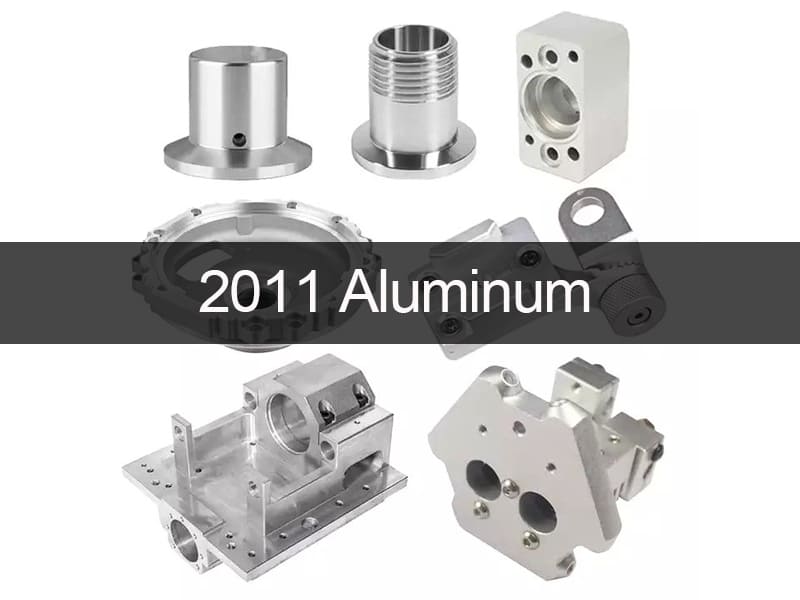
In the niche world of CNC machined parts and automatic screw machining, 2011 aluminum alloy has a unique and lasting place. This alloy was developed and standardized as the best free-machining aluminum long before multi-axis machining centers became common. It was specifically designed to improve cutting efficiency, chip control, and dimensional repeatability in high-speed production settings.
Even though general-purpose alloys like 6061 and high-strength alloys like 7075 are becoming more popular, 2011 aluminum is still the best choice when speed is more important than structural flexibility. But just because something is easy to machine doesn’t mean it can be used in every situation. It is great at making precise turned parts like connectors and fittings, but there are clear mechanical, corrosion, and regulatory limits on how it can be used. This guide looks at 2011 aluminum from an engineering point of view, helping designers and procurement teams figure out when it’s the best choice and when other alloys are better.
What is the 2011 aluminum alloy? Basic Definition and Classification of Alloys
What is 2011 aluminum ?
Al 2011, also known as free-machining aluminum, is a wrought alloy from the 2xxx series. Copper is the main alloying element in this alloy. It is usually sold in the T3 or T8 temper and is made specifically for automatic lathes and Swiss-type CNC machines, unlike regular aluminum.
From a metallurgical point of view, 2011 is different because Lead (Pb) and Bismuth (Bi) were added on purpose. These elements don’t really make structures stronger; instead, they work as tiny chip breakers.
“Free-Machining” Context: In this alloy, “free-machining” means that the chips break up in a predictable way, the cutting forces are low, and the tool stays engaged.
Primary Use Case: It is the standard for making precision parts with a lot of volume and small diameters, like connectors, fittings, and standoffs, on high-speed turning centers.
The key to choosing the right materials for modern CNC manufacturing workflows is to understand 2011 aluminum as a process-driven material instead of a universal structural solution.
The chemical makeup of 2011 aluminum and how it affects engineering
The chemical makeup of 2011 aluminum is purposely unbalanced so that it is easier to machine than to weld or resist corrosion. The 6xxx series has a magnesium-silicon blend, but 2011 uses a copper-lead-bismuth system.
Table 1: The usual chemical makeup of 2011 aluminum
| Artigo | Percentage (wt.%) | Main Engineering Role |
| Alumínio (Al) | Equilíbrio | Base Matrix |
| Cobre (Cu) | 5.0–6.0 | This is the main strengthener. It makes things harder but less resistant to corrosion. |
| Chumbo (Pb) | 0.2–0.6 | The Chip Breaker. Makes soft inclusions that help with clean shearing. |
| Bismuth (Bi) | 0.2–0.6 | Works with Lead to make the surface finish and lubricity better. |
| Ferro (Fe) | Max 0.7 | Impurity (controlled). |
| Silício (Si) | Max 0.4 | Impurity (controlled). |
| Zinco (Zn) | Max 0.3 | Impurity (controlled). |
How Lead and Bismuth Make Machinability Possible
Lead and Bismuth do not dissolve into the aluminum lattice when it comes to metallurgy. Instead, they make separate, soft, low-melting-point phases that are spread out throughout the material. These inclusions act as localized stress risers at the tool–chip interface during CNC machining.
This makes a chain of events that can be predicted:
-
Lubrificação: The inclusions get softer when they are cut, which helps the inside move smoothly.
-
Fratura: The chip breaks cleanly at these soft spots instead of stretching out.
-
Resultado: Short, granular chips that leave right away, stopping “bird’s nesting” on automated lathes.
The fact that this mechanism makes 2011 aluminum the easiest alloy to machine also means that it is less weldable and less resistant to corrosion, which sets clear limits on its use in engineering.
The physical and mechanical properties of 2011 aluminum
Engineers should look at how well 2011 aluminum works in manufacturing, not just how strong it is. It is fairly strong, but its elongation and thermal properties are designed to make cutting easier rather than make it more resistant to impacts.
Characteristics of Mechanics
The following numbers show the standard T3 temper, which is the most common state for machined parts.
Table 2: Typical Values for Mechanical Properties
| Propriedade | Valor (típico) | Compared to 6061-T6 and Important for Manufacturing |
| Ultimate Tensile Strength | ~380 MPa (55 ksi) | Higher (~310 MPa) Enough for threaded fasteners and fittings. |
| Resistência ao escoamento | ~295 MPa (43 ksi) | Similar (~276 MPa); Good at not bending when being put together. |
| Elongation at Break | 10–15% | Lower (Less ductile) Critical: Less ductility helps with chip breaking. |
| Dureza (Brinell) | ~95 HB | Similar (~95 HB); Hard enough to keep the thread from breaking. |
| Resistência ao cisalhamento | ~220 MPa | Higher than that of other pins. |
Perceção da engenharia: The fact that 2011 aluminum doesn’t stretch as much is a good thing for machining. Less ductility means that the material breaks easily when the cutting tool is used, which is what good machinability means.
Physical Properties That Are Important for Machining
Thermal conductivity is very important when running CNC machines at high speeds.
Table 3: Physical Characteristics
| Propriedade | Valor | Effect of CNC Machining |
| Densidade | 2,82 g/cm³ | A little heavier than the 6xxx series because it has more copper and lead. |
| Thermal Conductivity | ~150 W/m-K | Average. Good at getting rid of heat from the edge of the tool. |
| Melting Range | 535–645 °C | Low melting point phases (Pb/Bi) make it easier to break chips. |
Why 2011 Aluminum Is a Benchmark for Machinability
2011 aluminum machinability is the standard for the industry when it comes to wrought aluminum alloys. It is often rated as 100% machinable compared to other aluminum alloys, which makes it the standard by which others are judged.
Making and controlling chips
Chip control is very important when making a lot of things. Long, stringy chips are a big problem on a Swiss-type lathe. They wrap around the tool, damage the part surface, and stop production. 2011 aluminum makes fine, granular chips that leave the cutting area cleanly. This behavior is very important for “lights-out” (unattended) manufacturing, where the reliability of the process is more important than the strength of the raw materials.
Quality of the surface finish and consistency of the dimensions
Because the chips break cleanly and don’t smear, 2011 aluminum has a great as-machined surface finish.
-
Typical Roughness: Ra 0.4 – 0.8 µm is a common result that can be achieved directly from the tool without any extra grinding or polishing.
-
Estabilidade dimensional: Because the cutting forces are low, the tool doesn’t bend as much. This lets makers keep tight tolerances on long, thin parts like pins or shafts that would bend while being machined.
Life of Tools and Machining at High Speed
Lead and Bismuth’s internal lubrication cuts down on friction at the tool edge. This lets manufacturers run 2011 aluminum at much higher surface speeds (SFM) than 6061 or 7075 without the tools wearing out as quickly. For procurement teams, this means that the cost of using machines per hour goes down and the cost of tools per part goes down.
CNC Machining Rules for Aluminum in 2011
To get the most out of 2011 aluminum, machining strategies should be in line with the material’s properties. It is a material that works best when you cut it quickly and keep cutting it.
CNC Turning vs. CNC Milling
-
CNC Turning (Best): 2011 is the year for turning. It works best for continuous cutting tasks that are common in Swiss lathes and automatic screw machines. The chip-breaking parts can do their job well because they are always engaged.
-
CNC Milling (Good): It can be milled, but the benefits aren’t as clear as when it’s turned. Alloys like 6061 often give a better balance of toughness when cutting is stopped (milling). But 2011 is still faster for complicated drilled/tapped milled parts.
Recommended Machining Practices
Table 4: Guide to Machining Strategies
| Parâmetro | Recomendação | Raciocínio de Engenharia |
| Cutting Speed (Turning) | High (300–400 m/min) | Use the alloy’s ability to be easily machined to get the most throughput. |
| Taxa de alimentação | Aggressive (0.1–0.3 mm/rev) | This makes sure the chip shears instead of rubbing, which helps it break. |
| Coolant Strategy | Use oil (Swiss) or light flood | Heavy flood is not often needed; MQL (Minimum Quantity Lubrication) works well. |
| Geometria da Ferramenta | Standard/Polished Carbide | Sharp edges stop built-up edge (BUE). |
| Chip Breakers | Not as Important | The material breaks on its own; aggressive chip breaker geometry is not necessary. |
Common Uses of 2011 Aluminum in Machined Parts
The geometry and volume of 2011 aluminum, not the structural load, determine where it can be used. It is not often used for the main parts of an airframe, but it is very common in “screw machine parts.”
-
Precision Fasteners: Custom screws, nuts, bolts, and threaded rods where the cost of the part depends on how fast the threading is done.
-
Connectors and fittings: hydraulic, pneumatic, and electrical fittings that need complicated turning, boring, and threading.
-
Electronic Standoffs: Small pieces of hardware and spacers used to put together PCBs.
-
Automotive Parts: Millions of fuel system parts, brake pistons, and sensor housings are made.
-
Clock and watch parts: like gears, pinions, and casings, need to be made with very precise measurements and a smooth surface.
When the part is a high-volume turned component that won’t be exposed to corrosive environments and the rules allow lead content, choose 2011.
When not to use 2011 aluminum because of its engineering limits
2011 is a great place to make things, but it has some big problems when it comes to how it works. Not taking these limits into account when designing can often lead to redesign or qualification failure later on.
1. Bad Weldability
Don’t weld aluminum from 2011. This is a basic rule of metallurgy. When you heat up the Lead and Bismuth phases, they melt much faster than the aluminum matrix. When you weld, these phases melt, which leads to “hot cracking,” porosity, and weak fusion zones. Even with controlled TIG/MIG settings, the weld is not strong. It’s just as hard to braze as it is to solder.
If you need to weld, you can also use 6061 or 5052.
2. Not very resistant to corrosion
Compared to the 5xxx or 6xxx series, 2011 is a Copper-rich alloy (2xxx series) that doesn’t hold up well to atmospheric and galvanic corrosion.
-
The Risk: It can get pitting and intergranular corrosion in places that are humid, salty, or chemically aggressive.
-
The Fix: Most of the time, parts need to be covered with protective plating (Nickel, Zinc) or a chemical conversion coating (Alodine).
3. Regulatory Restrictions (RoHS / REACH)
This is the most important modern limit. Lead is present in 2011, so it might not meet strict environmental standards like REACH, RoHS (Restriction of Hazardous Substances), or certain medical and food safety standards.
-
The Effect: It is often not allowed in medical implants, machinery that comes into contact with food, and consumer electronics sold in the EU.
-
The Alternative: More and more people are using lead-free free-machining alloys like 6026 Aluminum or 6262 Aluminum, even though they don’t work as well when they are machined.
2011 vs. 6061 Aluminum: A Practical Way to Choose Materials
When it comes to CNC sourcing, one of the most common questions is which is better: 2011 or 6061 aluminum? It isn’t about which one is “better,” but which one works best for the process.
Table 5: A Comparison of Engineering in 2011 and 6061
| Recurso | 2011-T3 | 6061-T6 | Lógica de Seleção |
| Main Strength | Machinability (speed and finish) | Versatility (weld, corrode, and strength) | Use 2011 for speed and 6061 for general use. |
| Resistance to corrosion | Pobres | Excelente | Use 6061 for parts that are outside or exposed. |
| Soldabilidade | Very Poor | Excelente | Use 6061 for welded frames. |
| Anodizing Response | Poor/Unreliable | Excelente | Use 6061 for cosmetic parts. |
| Typical Product | Parts and fittings for screw machines | Structural frames, brackets, and plates | |
| Fator de custo | Less time spent on machining | lower cost of raw materials | 2011 saves money on complicated parts. |
Rule for Choosing:
-
For a lot of small, complicated turned parts where finish and tolerance are important, choose 2011.
-
Use 6061 for structural parts, welded assemblies, or any part that needs anodizing for looks.
Things to think about when finishing the surface of 2011 aluminum
When finishing the surface of 2011 aluminum, you need to be careful. The chemistry that makes cutting easier also makes some finishing processes harder.
Limitations of Anodizing
Anodizing 2011 aluminum is possible, but it is often difficult.
-
The Problem: The Lead and Bismuth inclusions don’t anodize, which means they leave tiny holes or dark spots in the oxide layer.
-
O resultado: The finish often looks dirty, yellowish, or uneven. Colors that have been dyed, like black or red, may look patchy or uneven.
-
Recomendação: Don’t use 2011 for cosmetic parts, also known as “Class A” surfaces. Use it only for functional hardcoat anodizing when looks aren’t as important.
Preferred Surface Treatments
To keep 2011 aluminum safe without drawing attention to its microstructural flaws, think about:
-
Electroless nickel plating: is great for protecting against corrosion, making things harder, and making things slippery. It does a good job of covering the lead inclusions.
-
Chemical Conversion (Alodine/Chromate): This method doesn’t change the size of the object and makes it better at conducting electricity and resisting mild corrosion.
-
Zinc plating: is a cheap way to protect against basic corrosion.
Summary: What Designers and Buyers Should Know About Engineering
2011 aluminum alloy is not a general-purpose material; it is a specialized tool for making things more efficiently. Its value proposition is simple: it gives up weldability and corrosion resistance to provide the fastest and most consistent machining performance of any aluminum alloy.
Pontos importantes:
-
Step One: Choose 2011 for high-volume CNC turning and Swiss machining. It is the key to making cycle times shorter on small, complicated parts.
-
Watch the Lead: Before you specify, make sure you follow the rules (RoHS/Medical). For global compliance, you may need to use lead-free options like 6026.
-
Be careful when you finish: Don’t say 2011 for cosmetic anodized parts. Instead, use plating or conversion coatings to avoid problems with how it looks.
-
No welding: Think of 2011 as a “machined-only” solution.
Manufacturers can use the unique properties of 2011 aluminum to make precision components at a lower cost and with better quality by choosing materials that are in line with these engineering realities.
Perguntas frequentes
Q: Is 6061 aluminum stronger than 2011?
A: In terms of tensile strength, 2011-T3 (~380 MPa) is actually stronger than 6061-T6 (~310 MPa). But 6061 is tougher (more ductile) and much less likely to rust, which makes it “stronger” in terms of how long it lasts in real life.
Q: What does “Free-Machining” mean?
A: Because it has Lead and Bismuth in it. These parts work as internal chip breakers, which means that chips break into small pieces instead of long ribbons. This keeps machines from getting stuck, lets them go faster, and makes tools last longer.
Q: Is it possible to weld 2011 aluminum?
A: No. When you weld, the low-melting-point lead inclusions melt, which causes “hot cracking” and weak joints. If you need to weld, use 6061 or 5052.
Q: Does 2011 aluminum meet RoHS standards?
A: It depends on the specific status of the exemption. Lead is in 2011, which is not allowed. Some copper/aluminum alloys can have up to 4% lead by weight, but many industries are moving toward lead-free alloys like 6026 or 6262 to make sure they stay compliant in the future.
Q: Does aluminum from 2011 rust?
A: Aluminum doesn’t rust like steel does, but 2011 does corrode easily. Because it has a lot of copper in it, it quickly turns white and powdery and pits in wet or salty places unless it is protected by plating or coating.


