
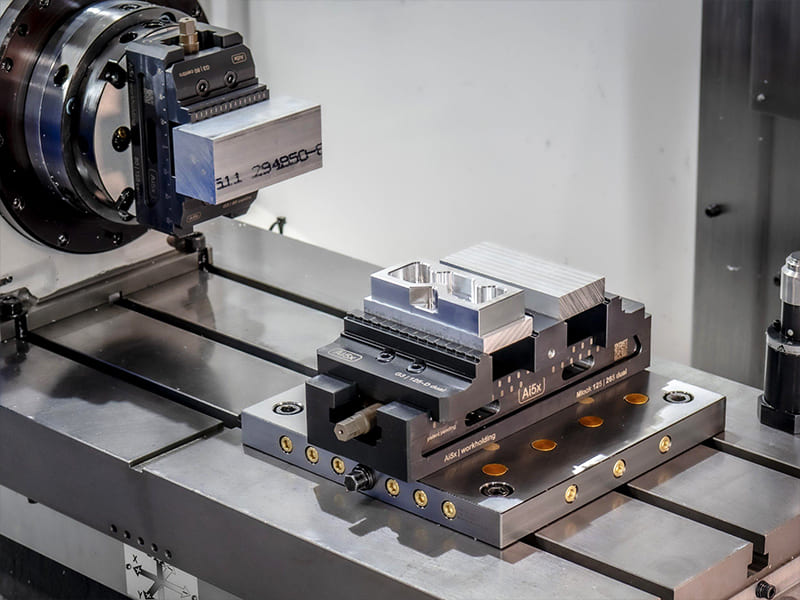
A CNC shop running a 200-piece aluminum bracket program uses a standard bench vise for milling — jaw parallelism is approximately 0.08 mm across the jaw face. Parts show 0.06 mm positional error on hole patterns, and 12% require rework for out-of-tolerance features. Switching to a precision machinist vise with ground jaws (parallelism ≤0.01 mm) and pull-down clamping eliminates jaw lift, reduces positional error to ≤0.015 mm, and drops the rework rate to under 1%. The vise costs 4× more than the bench vise but saves $3,200 in rework cost across the program — paying for itself in the first production run. We optimize workholding selection on CNC milling programs regularly. A machinist vise is a precision workholding device designed to clamp workpieces rigidly, squarely, and repeatably under machining forces. Unlike general-purpose bench vises, machinist vises feature precision-ground jaw surfaces (parallelism ≤0.01–0.02 mm), anti-lift clamping mechanisms, and heavy rigid construction that maintains dimensional accuracy throughout cutting operations.
This guide covers what a machinist vise is, its main components, how it works, types (machinist vs CNC vs bench vs toolmaker), fixed vs swivel base, selection criteria, setup and tramming procedure, workholding strategies for production, CNC-specific considerations, cost impact, maintenance, and a practical decision framework.
Main Components
| Part | Function | Engineering Impact |
|---|---|---|
| Fixed jaw | Reference datum surface | Controls squareness and repeatability |
| Movable jaw | Applies clamping force | Affects holding stability |
| Lead screw | Converts torque to linear force | Influences clamping consistency |
| Vise body | Structural frame | Controls rigidity and vibration resistance |
| Base (fixed/swivel) | Mounts to machine table | Impacts alignment accuracy |
| Jaw plates | Contact workpiece surface | Affects grip, protection, and customization |
Fixed jaw is the precision reference — ground flat and square to ≤0.01–0.02 mm. Any deviation transfers directly to part geometry. Pull-down (anti-lift) mechanism in quality machinist vises uses a wedge design that pulls the workpiece downward against parallels during tightening — preventing the upward jaw lift that causes parts to sit unevenly. Based on our production data, anti-lift vises reduce part seating errors by approximately 80% versus standard screw-type vises — the pull-down effect is the single most impactful feature for consistent part positioning.
How It Works
The handle rotates a lead screw that drives the movable jaw toward or away from the fixed jaw. The workpiece clamps between the two jaws — fixed jaw provides the datum reference, movable jaw applies force. Grip depends on jaw surface texture, contact area, and clamping force.
Critical balance: Sufficient force to resist cutting loads without deforming thin-walled parts. Too little → part slips during machining. Too much → dimensional distortion on delicate features. Align clamping direction to oppose the primary cutting force for maximum stability.
Types
| Type | Accuracy | Best For |
|---|---|---|
| Machinist vise | High (±0.01–0.02 mm) | General precision milling, small-batch CNC |
| CNC vise (production) | Very high | Multi-part setups, batch production |
| Bench vise | Low-Medium | Manual work, assembly, repair |
| Toolmaker vise | Very high | Small precision parts, grinding, inspection |
Machinist vise is the versatile standard — precision-ground jaws, good rigidity, suitable for both manual and CNC milling. Handles most workholding needs for low-to-medium volume production.
CNC vise is production-optimized — designed for repeatability with soft jaw compatibility, multi-part clamping, and modular fixturing integration. Faster loading/unloading. Consistent positioning across batches. One common pitfall we see: using a general bench vise for CNC milling to save cost — the lack of precision-ground surfaces and anti-lift mechanism produces inconsistent clamping that creates more scrap cost than the vise savings.
Bench vise mounts on a workbench for general holding during manual operations. Not precision-ground. Not suitable for CNC or tight-tolerance work.
Toolmaker vise is compact and extremely accurate — used for grinding, EDM, inspection, and small precision parts. Limited clamping capacity.
Fixed Base vs Swivel Base
| Base | Advantage | Limitation |
|---|---|---|
| Fixed | Higher rigidity, better accuracy, lower height | No angle adjustment |
| Swivel | Quick angular positioning (0–360°) | Reduced rigidity, requires re-indicating |
Fixed base provides maximum rigidity — direct mounting to machine table with fewer interfaces means less deflection and better parallelism. Standard for CNC machining and precision work. Swivel base allows quick rotation for angled features in manual milling — convenient but adds stack height (reducing stiffness) and requires dial indicator re-alignment after each rotation. In our shop floor experience, approximately 90% of our CNC vise setups use fixed bases — angles are achieved through toolpath programming or 4th/5th axis rather than mechanical vise rotation.
How to Choose
| Factor | Consideration |
|---|---|
| Jaw width | Match to typical part size (4″, 6″, 8″ common) |
| Jaw opening | Ensure clearance for part + parallels |
| Rigidity | Heavier/stiffer for steel cutting |
| Accuracy | ≤0.01–0.02 mm parallelism for precision |
| Base type | Fixed for CNC, swivel only if needed |
| Soft jaw compatibility | Essential for CNC batch production |
Size selection rule: 6″ vise covers most standard CNC milling work. 4″ for small precision parts. 8″ for heavy-duty or large components. Match vise size to machine table — oversized vises waste table space, undersized vises limit part capacity.
Setup and Tramming
Correct tramming ensures the fixed jaw is parallel to the machine X-axis — prerequisite for holding tolerances on square features.
Step 1: Clean all contact surfaces — table, T-slots, vise bottom. Even small debris introduces 0.01–0.05 mm error. Step 2: Position vise and lightly snug T-bolts (don’t fully tighten). Step 3: Mount dial indicator on spindle or mag base. Sweep along fixed jaw face left to right. Step 4: Tap vise gently with soft hammer to adjust until runout is within target (≤0.01 mm for precision, ≤0.02 mm for general). Step 5: Tighten bolts gradually, alternating sides. Re-sweep after each tightening stage — tightening can shift the vise. Step 6: Verify with test block — clamp and check for jaw lift or tilt.
Target tolerances: General machining ≤0.02 mm. Precision work ≤0.005–0.01 mm. Once trammed, avoid removing the vise unless necessary — each reinstallation requires re-tramming.
Workholding Strategies
Parallels: Keep parts elevated and level. Allow through-drilling and milling. Ensure consistent Z-height reference.
Soft jaws: Machinable aluminum or mild steel jaws shaped to match part contour. Increase contact area on irregular geometry. Reduce deformation on delicate parts. Essential for CNC batch production with consistent part loading.
Hard jaws: Hardened steel for durability and repetitive standard clamping. Default for general work.
Multi-vise setup: Mount 2–4 vises on one table for parallel machining. Reduces idle time and increases throughput per cycle. Based on our production data, dual-vise setups on CNC mills improve effective throughput by approximately 40–60% versus single-vise — the machine cuts one part while the operator loads the other.
Work stops: Fixed stop pins or blocks for repeatable part positioning. Faster loading without measurement. Critical for batch consistency.
Double-station vises: Clamp two parts in one vise — doubles parts per cycle.
CNC Considerations
Machinist vises work well in CNC for prototypes, small batches, and simple prismatic parts. For higher-volume production, CNC-specific vises with soft jaw systems, multi-station capability, and modular fixturing deliver better repeatability and throughput.
Key CNC factors: Repeatable positioning (use work stops and precision parallels). Consistent clamping force (manual tightening varies — develop consistent operator method). Tool clearance (verify no interference between toolpath and vise jaws). Multi-vise alignment (verify height and parallelism across all units when using multiple vises). In projects we’ve delivered, upgrading from general machinist vises to dedicated CNC vise systems with soft jaws and work stops reduces average setup time by approximately 35% and improves dimensional consistency by 40–50% on batch programs.
Cost Impact
Workholding directly affects machining cost through setup time, scrap rate, and process stability.
Low-quality vise risks: Vibration (chatter), part movement, dimensional drift → rework and scrap. A precision machinist vise costs more upfront but reduces variation, improving yield.
Setup time: Can account for 20–40% of total machining cost in small batches. Optimized workholding (stops, modular plates, soft jaws) significantly reduces loading time and alignment effort.
Soft jaw investment: Additional upfront cost for machining custom jaws. Returns faster loading, better clamping on complex parts, and reduced operator variability. Justified on any repeat-production program.
Maintenance
Clean after every use — remove chips, coolant, and debris that cause alignment errors. Lubricate lead screw and slideways regularly — reduces wear and ensures smooth clamping. Inspect jaw plates for dents, wear, and uneven surfaces — damaged jaws reduce grip and accuracy. Apply light oil after use to prevent rust — rust affects flatness and parallelism. Verify parallelism and squareness periodically (≤0.01–0.02 mm) — ensures consistent machining results. Replace worn components (lead screw, keys, jaw plates) before they degrade performance.
Decision Guide
| Condition | Recommendation |
|---|---|
| Flat prismatic parts | Machinist vise |
| Prototype / low volume | Machinist vise |
| CNC batch production | CNC vise + soft jaws + stops |
| Thin-wall / delicate | Soft jaws with support |
| Irregular geometry | Custom fixture |
| Multi-face machining | 4/5-axis workholding |
| Manual shop work | Bench vise |
| Small precision parts | Toolmaker vise |
Conclusion
A machinist vise is the foundational workholding tool for precision milling — providing the rigidity, accuracy (≤0.01–0.02 mm parallelism), and repeatability that cutting operations demand. Quality directly impacts scrap rate, setup efficiency, and dimensional consistency. Anti-lift (pull-down) design, precision-ground jaws, and rigid construction are the features that separate machining-grade vises from general-purpose bench vises.
For CNC production, soft jaws, work stops, multi-vise setups, and proper tramming transform a simple clamping device into a production-capable workholding system. The vise is not just a tool holder — it’s a precision instrument that directly determines part quality. Need help optimizing workholding for your CNC program? [Contact our engineering team] for fixture design, DFM review, and manufacturing support.
FAQ
What is a machinist vise?
A heavy-duty precision workholding device with ground jaws (parallelism ≤0.01–0.02 mm) and anti-lift clamping for secure, repeatable part holding during milling, drilling, tapping, and inspection. Not interchangeable with general bench vises.
Machinist vise vs CNC vise — what’s the difference?
Machinist vise is versatile for manual and CNC work. CNC vise is production-optimized with soft jaw compatibility, multi-part capability, and modular fixturing for faster, more repeatable batch production.
Do I need a swivel base?
Usually no for CNC — angles are achieved through programming or rotary axes. Swivel bases add convenience for manual milling but reduce rigidity. Fixed base is standard for precision CNC work (~90% of applications).
How do you tram a vise?
Mount dial indicator on spindle, sweep along fixed jaw face, tap vise to adjust until runout ≤0.01 mm (precision) or ≤0.02 mm (general). Tighten gradually, re-sweep after each stage. Clean all surfaces before starting.
How does workholding affect machining cost?
Setup time can account for 20–40% of total cost in small batches. Quality vises reduce scrap. Soft jaws and work stops reduce loading time. Multi-vise setups improve throughput 40–60%. Workholding is a major cost lever, not just a setup detail.


